Want to launch your own swim goggle line but are not sure what really happens inside the factory? Without a clear understanding of the production process, it is easy to run into problems such as lens fogging, water leakage, poor fit, delayed timelines, or inconsistent quality.
Swimming goggles are made through a multi-step manufacturing process that includes product design, prototyping, mold development, lens injection molding, silicone gasket and strap production, anti-fog and UV treatment, final assembly, leak testing, and packaging. Every step influences clarity, comfort, durability, and watertight performance.
For brands sourcing from a professional swimming goggle manufacturer, understanding this process makes it much easier to evaluate suppliers, compare quotations, and reduce development risk.
In this guide, I will walk you through how swimming goggles are made, what materials are commonly used, how OEM customization works, which quality checks matter most, and what buyers should confirm before mass production.
Quick Answer: How Are Swimming Goggles Made?
Swimming goggles are made by combining injection-molded lenses, soft sealing components, adjustable straps, and structural frame parts through a controlled design-to-production workflow. In most factories, the process starts with product design and prototyping, then moves to mold development, lens molding, coating, silicone part production, assembly, leak testing, and packaging.
If you are planning to develop custom swimming goggles, this workflow is the foundation behind both product performance and production consistency.
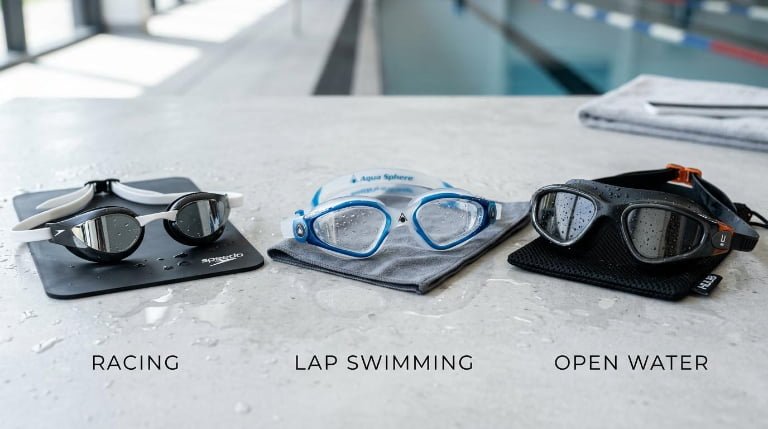
For OEM and private label projects, the exact production route may vary slightly depending on the structure, material grade, and level of customization. But in general, any capable factory must control four core areas well:
- optical clarity
- watertight sealing
- comfortable face fit
- consistent mass production quality
For buyers comparing OEM & ODM services or exploring a private label swim goggle program, these are the performance standards that matter most.
Five Key Facts Buyers Should Know
If you only have one minute, these are the most important points to understand before sourcing swimming goggles.
1. Most swim goggle lenses are made from polycarbonate
Polycarbonate, often called PC, is the standard lens material because it offers strong impact resistance, good optical clarity, and compatibility with anti-fog and UV treatments.
2. Seal material has a major impact on comfort
Medical-grade silicone usually performs better than TPE in softness, skin comfort, chlorine resistance, and long-term elasticity. TPE may lower cost, but silicone is often preferred for mid-range and premium products.
3. Anti-fog performance depends on both coating and user care
Standard anti-fog treatments often last 6 to 12 months under normal use. Higher-end systems can last longer, but rubbing the inside of the lens can shorten performance quickly.
4. Tooling is one of the biggest early investments
For a new custom swimming goggle model, tooling cost often ranges from USD 8,000 to USD 25,000 or more, depending on the number of molds, part complexity, and finish requirements.
5. Good-looking samples are not enough
A supplier should also prove:
- leak resistance
- lens quality consistency
- strap durability
- material stability
- repeatable batch production
That is why experienced buyers usually review not just the sample itself, but also the supplier’s sampling and prototyping process and overall quality assurance system.
What Materials Are Used in Swimming Goggles?
Material selection directly affects product performance. If the wrong material is chosen, swimmers may experience fogging, leakage, skin discomfort, lens distortion, or short product life.
Most swimming goggles use polycarbonate for lenses, silicone or TPE for gaskets and straps, and engineering plastics such as nylon, polypropylene, or TPU for frame components.
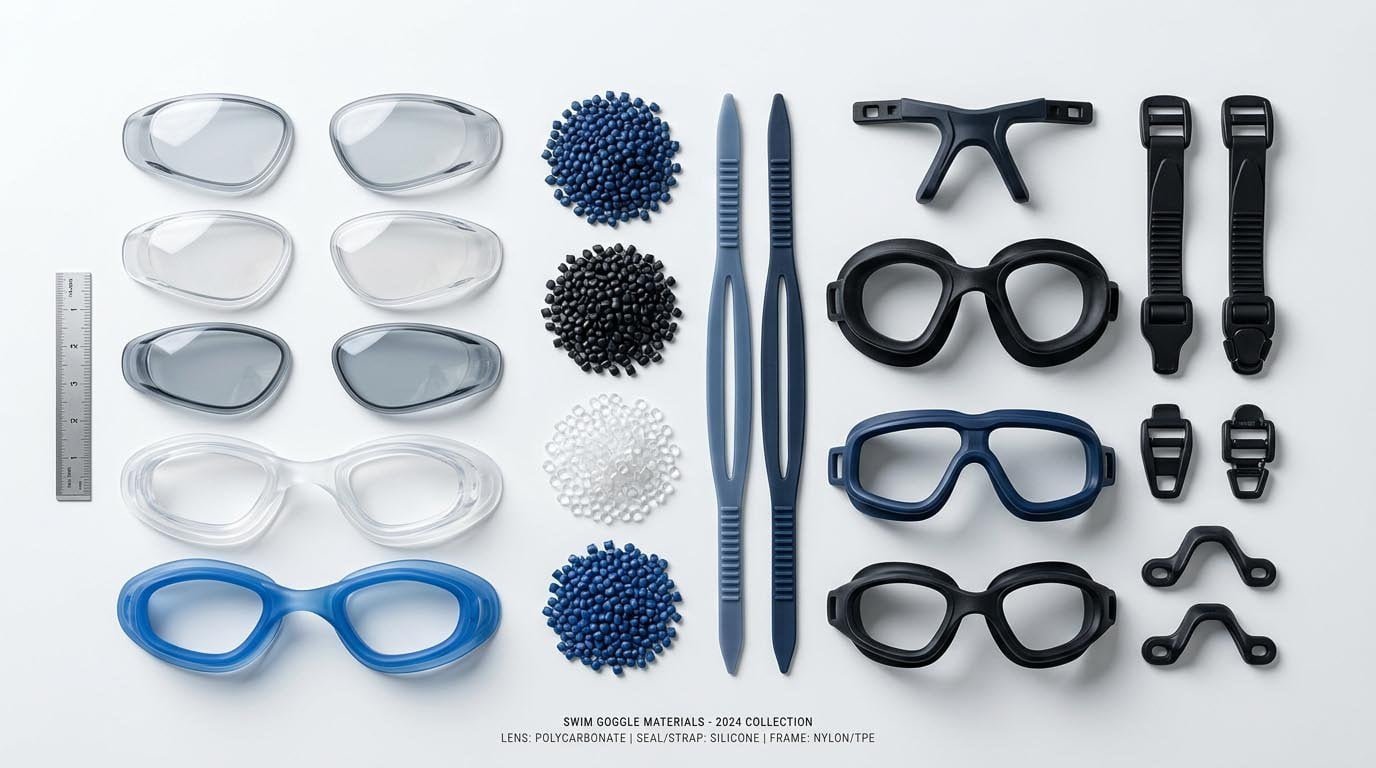
Common Materials by Component
| Component | Common Materials | Main Function |
|---|---|---|
| Lenses | Polycarbonate (PC) | Optical clarity, impact resistance, lightweight performance |
| Gaskets / Seals | Silicone, TPE | Skin comfort, water sealing, rebound |
| Straps | Silicone, latex-free elastomer | Stretch, fit adjustment, durability |
| Frames | Nylon, polypropylene, TPU | Structural support, flexibility, light weight |
| Nose Bridges | PC, TPE, silicone | Fit adjustment and stability |
| Buckles / Adjusters | PP, POM, PC | Strap locking and durability |
Why Polycarbonate Is the Standard Lens Material
Polycarbonate is widely used in swim goggles because it provides a strong balance of:
- impact resistance
- low weight
- high transparency
- moldability for curved lens shapes
- compatibility with UV and anti-fog treatment
In many factory programs, polycarbonate is the preferred lens material for recreational, training, racing, and open-water goggles.
Silicone vs. TPE Seals
For premium comfort and longer service life, silicone is usually the better material. It tends to feel softer, perform better over repeated use, and resist chlorine aging more effectively.
TPE can reduce cost, but it may not perform as well in:
- softness consistency
- rebound
- long-term elasticity
- chlorine resistance
- premium feel
For many entry-level products, TPE may still be acceptable. For higher-end OEM swim goggles, silicone is usually the safer choice.
Step 1: Product Design and Prototype Development
The manufacturing process starts long before production begins. Design decisions made early will affect fit, leakage risk, lens shape, mold complexity, and final cost.
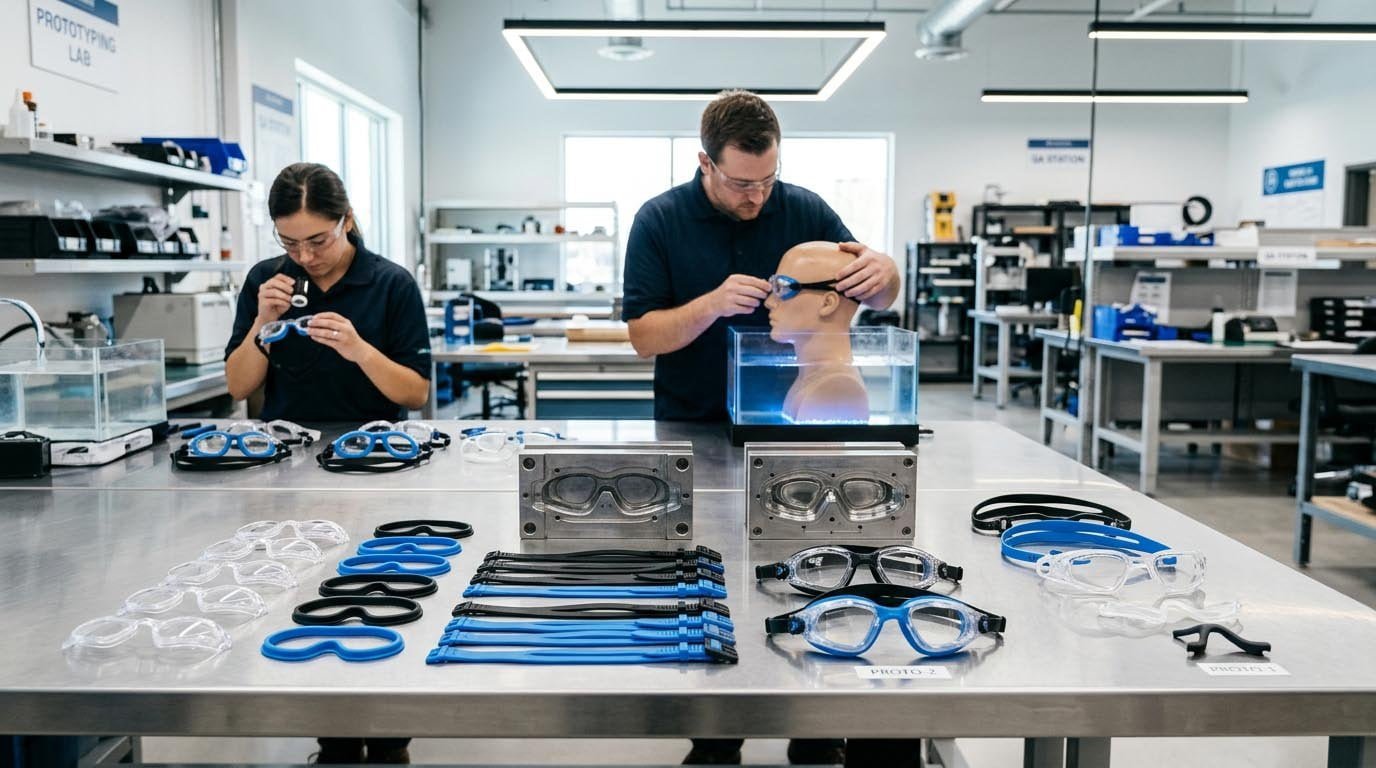
Swimming goggle design usually starts with concept planning, 3D CAD development, face-fit analysis, and physical prototype testing.
For brands developing a new model, reliable sampling and prototyping support is often the difference between a smooth launch and an expensive redesign later.
What Happens During the Design Stage
A typical development process includes:
-
Concept definition
The brand defines the target swimmer, such as racing, fitness, kids, or open-water users. -
Industrial design
Designers create the general product direction, including lens shape, frame style, strap appearance, and overall visual language. -
3D CAD modeling
Engineers create digital models for the lens, frame, gasket, nose bridge, strap, and buckle system. -
Face-fit consideration
Seal pressure distribution and facial compatibility are reviewed to reduce leakage and improve comfort across different face shapes. -
Prototype sampling
Samples are made for fitting, leak checks, appearance confirmation, and swimmer feedback. -
Design revision
The structure is refined before production tooling begins.
Design Elements That Affect Performance
| Design Element | Why It Matters |
|---|---|
| Lens curvature | Affects field of view and distortion control |
| Gasket profile | Determines comfort and sealing performance |
| Nose bridge angle | Influences compatibility across face shapes |
| Strap anchor position | Impacts pressure distribution and stability |
| Frame flexibility | Helps accommodate facial variation |
| Lens size and eye cup depth | Affects comfort and peripheral visibility |
Why Prototype Testing Matters
A CAD file can predict many things, but real swimmers reveal problems faster. In good factories, prototype samples are tested for:
- seal stability
- comfort over longer wear
- dive and turn performance
- pressure marks around the eyes
- strap adjustment behavior
- lens visual quality
For new OEM swim goggle projects, the design and prototype phase often takes 4 to 8 weeks, depending on complexity and revision count.
Step 2: Mold Development and Tooling
Once the design is approved, the factory develops tooling. This is one of the most important stages because mold quality directly affects dimensional consistency, assembly fit, lens quality, and defect rate.
Swimming goggle molds are developed for lenses, frames, silicone gaskets, straps, nose bridges, and other small structural parts.
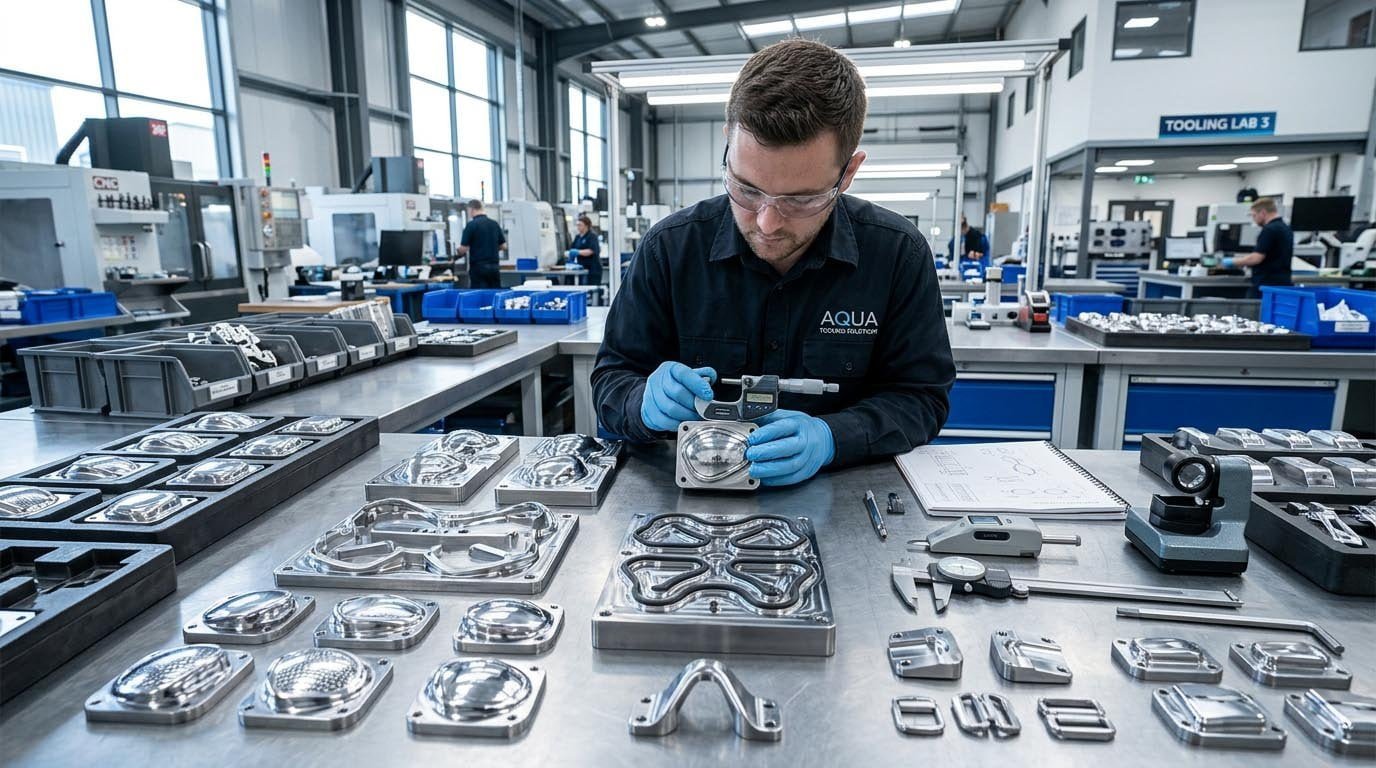
Why Tooling Matters
A good mold helps ensure:
- accurate lens geometry
- clean part edges
- stable gasket fit
- consistent assembly
- lower scrap rate
- repeatable mass production quality
Poor tooling often leads to:
- flashing
- warpage
- uneven sealing surfaces
- lens distortion
- assembly looseness
- unstable batch quality
Common Tool Types for Swim Goggles
| Part | Typical Tool Type |
|---|---|
| Lens | Precision injection mold |
| Frame | Plastic injection mold |
| Gasket | Liquid silicone injection mold |
| Strap | Silicone mold or extrusion die |
| Nose bridge | Small plastic or TPE mold |
| Buckle / Adjuster | Injection mold |
Typical Tooling Cost
For a new custom swim goggle model, tooling cost often depends on:
- number of components
- cavity quantity
- surface finish quality
- lens complexity
- mirrored or special coated lens requirements
- whether the design is fully custom or based on an existing platform
In many cases, total tooling cost falls in the range of USD 8,000 to USD 25,000+.
Before paying tooling charges, brands should confirm:
- who owns the mold
- whether modifications are included
- how many sample rounds are included
- expected mold maintenance responsibility
- whether the factory can use family molds to improve efficiency
Step 3: Lens Injection Molding
The lens is one of the most critical components of a swim goggle. Even if the fit is good, poor lens quality will ruin the product experience.
Swimming goggle lenses are usually made through polycarbonate injection molding. PC resin is dried, heated, injected into a precision mold, cooled, and then inspected before surface treatment.
How Lens Molding Works
The lens molding process usually includes:
-
Material drying
Polycarbonate is hygroscopic, which means it absorbs moisture from the air. If it is not dried properly before molding, moisture can create bubbles, haze, or optical defects. -
Heating and melting
The PC resin is heated to a process-specific range, often around 280–320°C, depending on the machine and material grade. -
Injection into the mold
Molten plastic fills the lens cavity under controlled pressure. -
Cooling and solidification
The part is cooled until it holds its shape and surface quality. -
Demolding and trimming
The molded lens is removed and checked for visual and dimensional defects.
Why Drying Polycarbonate Is So Important
This is a detail many buyers overlook. Good lens quality does not only depend on the mold. It also depends on material preparation.
If the PC pellets contain too much moisture, the final lens may show:
- haze
- bubbles
- flow marks
- internal stress
- reduced transparency
That is why serious manufacturers use controlled drying systems before injection molding.
Key Control Points During Lens Production
Factories usually monitor:
- mold temperature stability
- injection pressure
- shrinkage control
- surface polish quality
- warpage prevention
- optical distortion
- scratch prevention during handling
Common Lens Defects
If process control is weak, common lens defects include:
- black spots
- splay
- haze
- weld marks
- dimensional variation
- visible distortion
This is why lens molding is usually one of the most tightly controlled stages in swimming goggle manufacturing.
Step 4: Lens Tinting, UV Protection, and Anti-Fog Coating
After molding, the lens may receive additional treatments depending on the intended use and market positioning.
Swimming goggle lenses can be clear, tinted, mirrored, or polarized, and many also receive UV and anti-fog treatment.
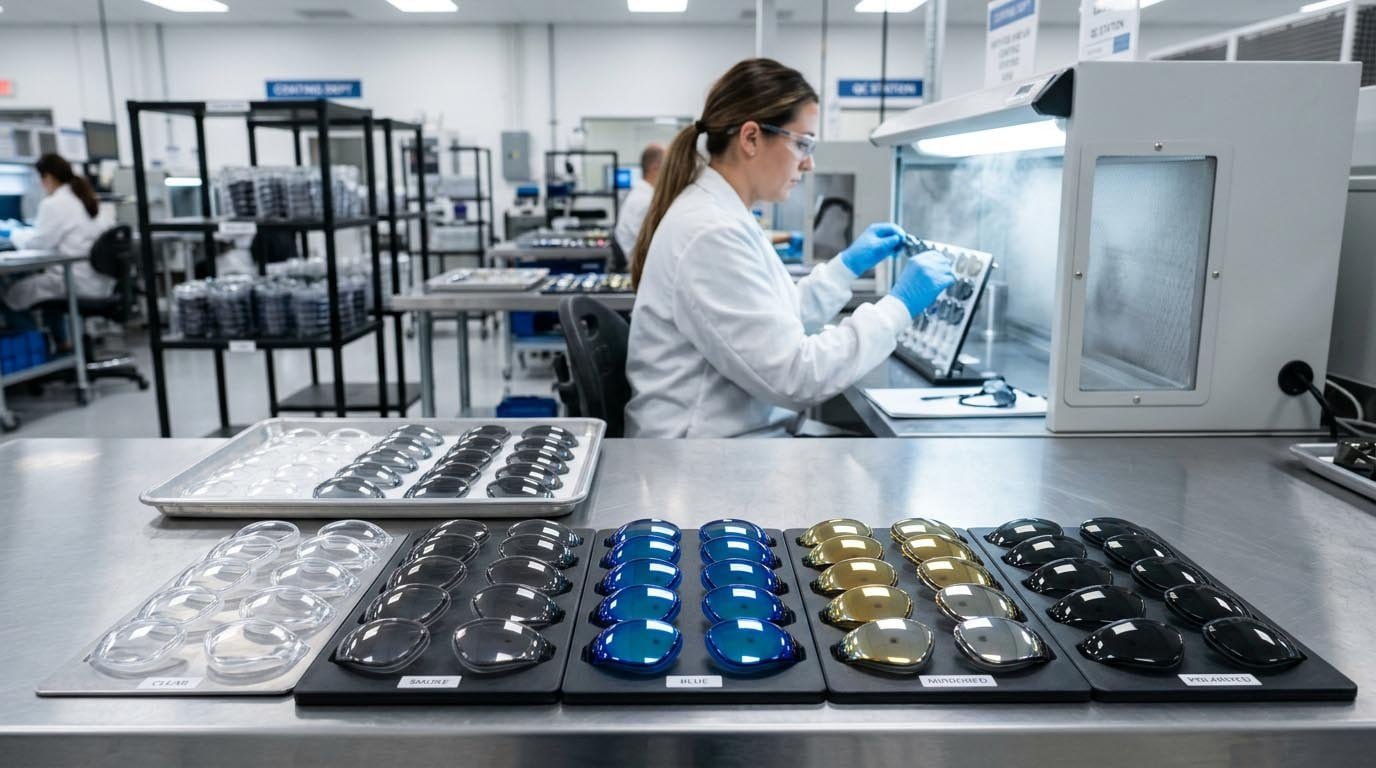
Common Lens Tint Options
| Lens Type | Typical Use |
|---|---|
| Clear | Indoor pools and low-light training |
| Smoke / Gray | Bright outdoor swimming |
| Blue | Outdoor use and glare reduction |
| Amber / Yellow | Low-light or cloudy conditions |
| Mirrored | Strong sunlight and open-water use |
| Polarized | Surface glare reduction outdoors |
UV Protection
For outdoor swimming, UV performance is an important selling point. Many swim goggle lenses are designed to help block harmful UV rays, especially for:
- open-water swimming
- triathlon
- recreational beach use
- outdoor training
Anti-Fog Coating Process
Anti-fog treatment is applied to reduce condensation on the inner lens surface. Depending on product level and factory process, anti-fog coating may be applied through:
- dip coating
- spray coating
- chemical surface treatment
- plasma-assisted treatment for higher-end applications
Some premium production lines also use staged processing such as:
- surface cleaning
- anti-fog application
- controlled oven curing
How Long Does Anti-Fog Last?
Anti-fog performance varies by:
- coating type
- curing quality
- storage conditions
- cleaning method
- chlorine exposure
- frequency of use
In general:
- standard anti-fog may last 6 to 12 months
- premium systems may perform longer with proper care
One simple rule matters a lot: swimmers should avoid rubbing the inside of the lens, because that can damage the anti-fog layer quickly.
Step 5: Silicone Gasket and Strap Production
The gasket creates the watertight seal around the eyes, while the strap keeps the goggle stable during movement. These soft parts play a major role in comfort and real-world performance.
Swimming goggle gaskets are commonly produced through liquid silicone injection molding or similar molding processes, while straps are made through silicone molding or extrusion depending on design.
Why Gasket Hardness Matters
Seal softness is often measured in Shore A durometer.
| Durometer Range | Feel | Typical Use |
|---|---|---|
| 20–30 Shore A | Very soft | Racing or close-fit competition styles |
| 35–45 Shore A | Medium-soft | Training and recreational goggles |
| 50–60 Shore A | Firmer | Some open-water or long-wear designs |
A very soft gasket may feel comfortable but may not always give enough structural support. A firmer gasket may seal better on some face shapes but can feel less comfortable during long sessions. The correct balance depends on product positioning.
Advantages of Silicone Gaskets
Silicone is often preferred because it offers:
- soft skin contact
- strong rebound
- stable elasticity
- good chlorine resistance
- latex-free comfort
- lower risk of skin irritation
Strap Production Options
Common strap types include:
- split strap for more secure positioning
- single wide strap for recreational use
- integrated buckle systems for premium designs
Overmolding vs. Separate Assembly
In some higher-end swim goggle designs, the soft gasket can be overmolded directly onto the lens or frame structure. This can provide:
- more stable bonding
- better dimensional control
- lower risk of gasket separation
- cleaner appearance
Other designs use separate parts assembled later, which may reduce cost and allow more flexibility in component replacement.
Typical Material Tests for Soft Components
Good factories may test gaskets and straps for:
- tensile strength
- elongation
- tear resistance
- buckle compatibility
- chlorine aging resistance
- skin sensitivity or restricted substance compliance
Step 6: Swimming Goggle Assembly
Once all components are ready, the factory assembles the finished product. This stage must be carefully controlled because dimensional mismatch, rough handling, or poor alignment can create leakage, comfort issues, or cosmetic defects.
Swimming goggle assembly combines the lenses, frame parts, gaskets, straps, buckles, and nose bridge into a complete product.
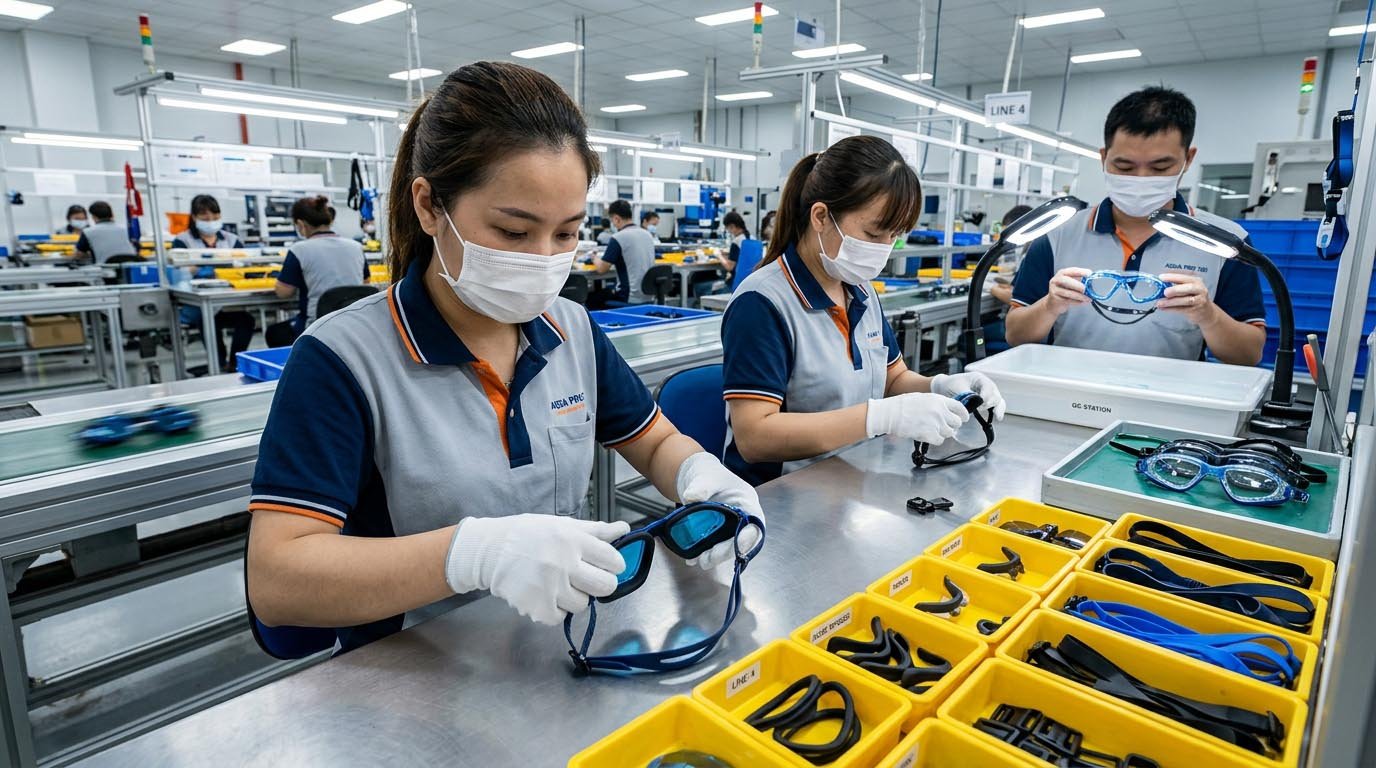
Typical Assembly Flow
- Lens fitting into frame
- Gasket attachment or alignment
- Nose bridge installation
- Strap threading and buckle attachment
- Visual and functional inspection
Depending on the structure, assembly may involve:
- manual fitting
- semi-automatic assembly
- adhesive bonding in some structures
- snap-fit locking systems
- integration of overmolded modules with straps and buckles
Common Assembly Risks
Factories usually monitor for:
- lens-frame looseness
- gasket misalignment
- flashing or burrs
- incorrect strap routing
- left-right mismatch
- scratching during handling
- buckle slippage
- nose bridge fit problems
In many swim goggle factories, final assembly still involves a large amount of manual work because tactile checks are important for soft-touch products.
Step 7: Leak Testing and Quality Control
This is the stage where a product must prove it performs, not just looks good.
Every reliable swimming goggle manufacturer should inspect finished goggles for leakage, appearance, fit consistency, and optical quality before shipment.
A well-documented quality assurance process is especially important for brands that need repeatable quality across multiple production runs.
Common Quality Control Checks
| Test Type | What It Checks |
|---|---|
| Leak test | Water sealing performance |
| Optical inspection | Lens clarity and distortion |
| Strap tension test | Stretch and buckle holding |
| Anti-fog check | Surface treatment effectiveness |
| Appearance inspection | Scratches, dirt, color mismatch, burrs |
| Drop or impact test | Basic structural durability |
Typical QC Focus Areas
Quality teams often check:
- whether lenses are seated correctly
- whether gasket edges are complete
- whether the strap adjusts smoothly
- whether the nose bridge fits securely
- whether the logo is positioned correctly
- whether packaging matches the approved artwork
Advanced Quality Control in Better Factories
More capable manufacturers may also offer:
- incoming raw material inspection
- in-line inspection records
- cavity-based dimensional sampling
- batch traceability
- accelerated chlorine or UV aging checks
- restricted substance testing support
- pre-shipment quality reports
Certifications Buyers Often Ask About
For export markets, common certifications or compliance support may include:
| Certification / Standard | Purpose |
|---|---|
| CE | EU market compliance |
| FDA | US market category support where applicable |
| ISO 9001 | Quality management system |
| REACH | EU chemical safety compliance |
| CPSIA | US consumer product safety requirements for applicable products |
| UKCA | UK market compliance where required |
For brands, batch consistency is often more important than sample quality. A good sample proves the factory can make one nice product. A good system proves they can make thousands of consistent units.
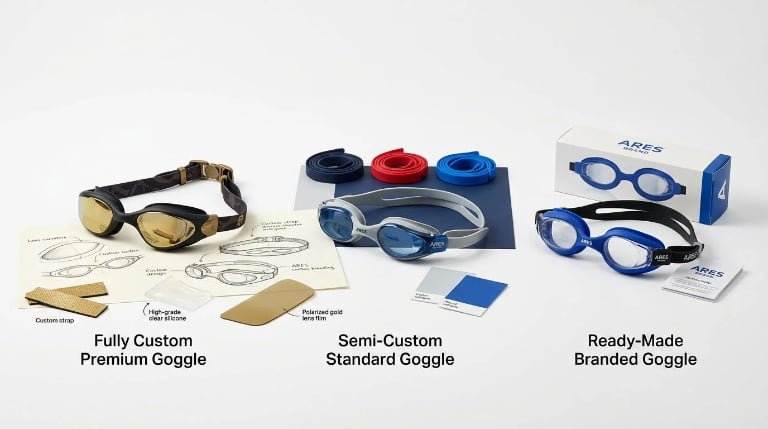
Customization Options for OEM and Private Label Swimming Goggles
For many brands, one of the biggest advantages of working directly with a manufacturer is the ability to customize the product.
Most swim goggle factories can customize lens color, frame structure, gasket material, strap design, logo application, and packaging based on your target market and price level.
If your project is based on OEM & ODM development or a private label program, these customization options should be defined clearly before mold work begins.
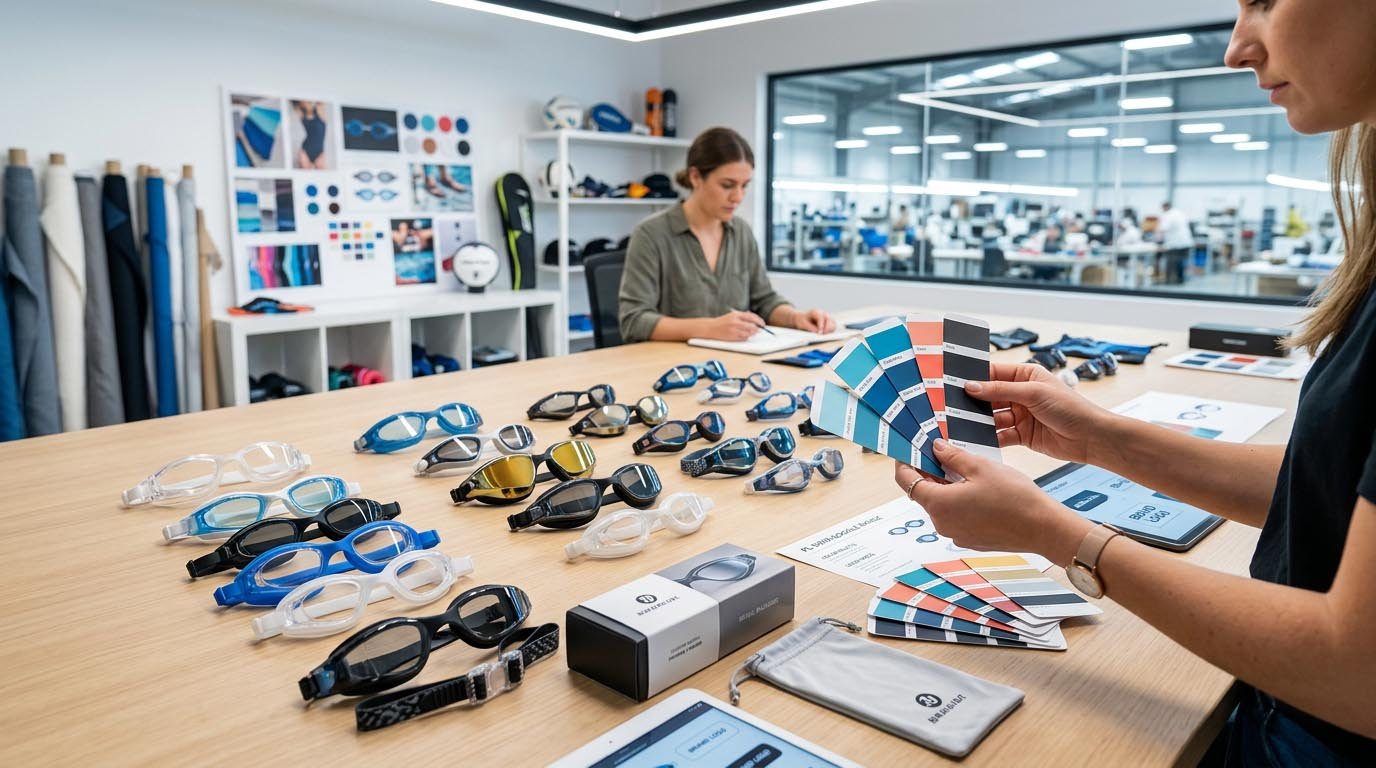
Common Customization Options
- lens shape
- lens tint color
- mirrored or polarized lens options
- frame color
- gasket color and material
- strap style and color
- interchangeable or fixed nose bridge
- printed or molded logo
- anti-fog level
- packaging design
- hard case, polybag, or retail box format
What Brands Should Confirm Early
If you are starting an OEM or private label project, it helps to confirm these points before sampling:
- target market
- target retail price range
- user group
- indoor, outdoor, or open-water usage
- expected order quantity
- compliance requirements
- logo and packaging needs
The earlier these details are clear, the easier it is for the manufacturer to recommend the right base model or custom development path.
MOQ, Lead Time, and Tooling Cost
Before starting a project, most buyers want to understand the commercial basics.
MOQ, lead time, and tooling cost vary by factory, design complexity, and customization level, but these are among the most important details to confirm before development begins.
MOQ
For swimming goggles, MOQ is often influenced by:
- model
- color
- lens option
- packaging type
- custom vs. existing mold structure
MOQ varies with customization depth. Selected existing models with private-label branding can start from around 300 pieces, while custom-color projects can start from around 600 pieces. Deeper OEM/ODM or new-mold developments are quoted by project.
Lead Time
Production lead time often depends on:
- mold readiness
- sample approval
- material availability
- lens coating schedule
- packaging confirmation
- order quantity
- inspection arrangements
Typical lead times may be:
- 4 to 8 weeks for design and development
- 45 to 60 days for mass production after sample approval, depending on project complexity
Once production is completed, clear shipping and delivery coordination also becomes important, especially for seasonal launches or retail deadlines.
Tooling Cost
As mentioned earlier, tooling cost often depends on:
- number of new molds
- part structure complexity
- cavity quantity
- finish quality
- coating or lens appearance requirements
A project using an existing platform usually has lower upfront cost than a fully custom design.
How to Choose a Reliable Swimming Goggle Manufacturer
Finding a supplier is easy. Finding one that can deliver stable quality over repeat orders is much harder.
A reliable swimming goggle manufacturer should offer strong sample quality, clear material transparency, controlled production processes, documented testing, and stable mass-production consistency.
It also helps to learn more about the supplier behind the product, including their company background and whether swimming goggles are a true area of specialization.
What to Evaluate Before Placing an Order
1. Sample Quality
Check for:
- lens clarity
- seal comfort
- actual leak performance
- strap adjustment smoothness
- cosmetic finishing
2. Material Transparency
Ask what materials are used for:
- lenses
- gaskets
- straps
- frames
- buckles
A reliable supplier should clearly explain the difference between silicone, TPE, polycarbonate, and other component materials.
3. Manufacturing Capability
Ask whether the factory handles:
- tooling
- injection molding
- silicone molding
- coating
- assembly
- in-house inspection
The more key processes are controlled in-house, the easier it is to manage consistency and solve problems quickly.
4. Process Knowledge
A serious manufacturer should be able to explain technical points such as:
- how polycarbonate is dried before molding
- how anti-fog coating is applied and cured
- whether the gasket is overmolded or separately assembled
- what leak test method is used
- how defects are controlled during mass production
5. Quality Documentation
Request:
- inspection photos
- test reports
- approved sample records
- packaging confirmation
- pre-shipment inspection results
6. Communication and Development Support
A strong supplier should communicate clearly during:
- prototype review
- color matching
- artwork confirmation
- packaging approval
- production issue resolution
If communication is vague during sampling, production will usually be worse.
FAQ: How Swimming Goggles Are Made
What are swimming goggle lenses made of?
Most swimming goggle lenses are made from polycarbonate, a durable plastic known for optical clarity, low weight, and impact resistance.
Are silicone gaskets better than TPE?
In many cases, yes. Silicone is generally preferred for better softness, skin comfort, chlorine resistance, and long-term elasticity, especially in mid-range and premium products.
How are swimming goggle lenses manufactured?
They are usually made by polycarbonate injection molding, followed by inspection and then surface treatments such as anti-fog, tinting, UV protection, or mirror coating.
How is anti-fog coating applied to swim goggles?
Anti-fog coating is typically applied after molding through dip coating, spray coating, chemical treatment, or plasma-assisted processes, depending on the product level and factory method.
How long does anti-fog coating last?
It depends on coating quality and how the goggles are used. Standard anti-fog may last 6 to 12 months, while premium systems may last longer if the inner lens surface is handled carefully.
Can swimming goggles be fully customized?
Yes. Many manufacturers offer customization of lens color, frame shape, gasket material, strap design, logo placement, and packaging. If you are comparing product options, you can start with a custom swimming goggles overview.
What is the MOQ for custom swimming goggles?
MOQ varies with customization depth. Selected existing models with private-label branding can start from around 300 pieces, while custom-color projects can start from around 600 pieces. Deeper OEM/ODM or new-mold developments are quoted by project.
How long does it take to manufacture swimming goggles?
After sample approval, mass production usually takes around 45 to 60 days. Fully custom development takes longer because design, tooling, and prototype testing come first.
What should I ask a swim goggle supplier before ordering?
You should ask about:
- material specifications
- mold ownership
- MOQ
- sample lead time
- anti-fog process
- quality control method
- certifications or compliance support
- packaging options
What tests should swimming goggles pass before shipment?
A reliable factory should at least inspect:
- leakage
- appearance
- lens clarity
- strap function
- assembly consistency
Higher-level suppliers may also support chlorine aging, UV stability, and compliance testing.
Conclusion
Swimming goggles are made through a detailed manufacturing process that includes product design, prototype validation, tooling, lens injection molding, silicone part production, anti-fog and UV treatment, assembly, and quality control. Every stage affects comfort, clarity, durability, and leak resistance.
For brands, understanding this process helps you:
- choose better materials
- reduce development mistakes
- evaluate suppliers more accurately
- improve product consistency
- launch OEM and private label swim goggles with fewer risks
If you are sourcing custom swimming goggles, the best results usually come from working with a manufacturer that can support not only sampling, but also stable mass production, documented quality control, and clear communication throughout the project.
Need Help with OEM Swimming Goggles?
If you are looking for a reliable supplier for OEM, ODM, or private label development, prepare these details before reaching out:
- target market
- estimated order quantity
- preferred lens type
- gasket and strap preference
- logo and packaging requirements
- required certifications
- target price range
That will help you get more accurate sampling, pricing, and production recommendations faster.
If you would like to discuss a project, you can contact us here.