Starting a swim goggle brand sounds straightforward at first. The product is small, relatively easy to ship, and familiar to most consumers. But once you begin budgeting seriously, the cost picture becomes more complicated. Tooling, sampling, packaging, testing, freight, and launch marketing all add up faster than many first-time founders expect.
For most small to mid-sized launches, the cost to start a swimming goggles brand in the USA usually falls between $15,000 and $50,000. A lean private label launch may come in near the low end, while a more customized OEM or full custom project can move well beyond that range.
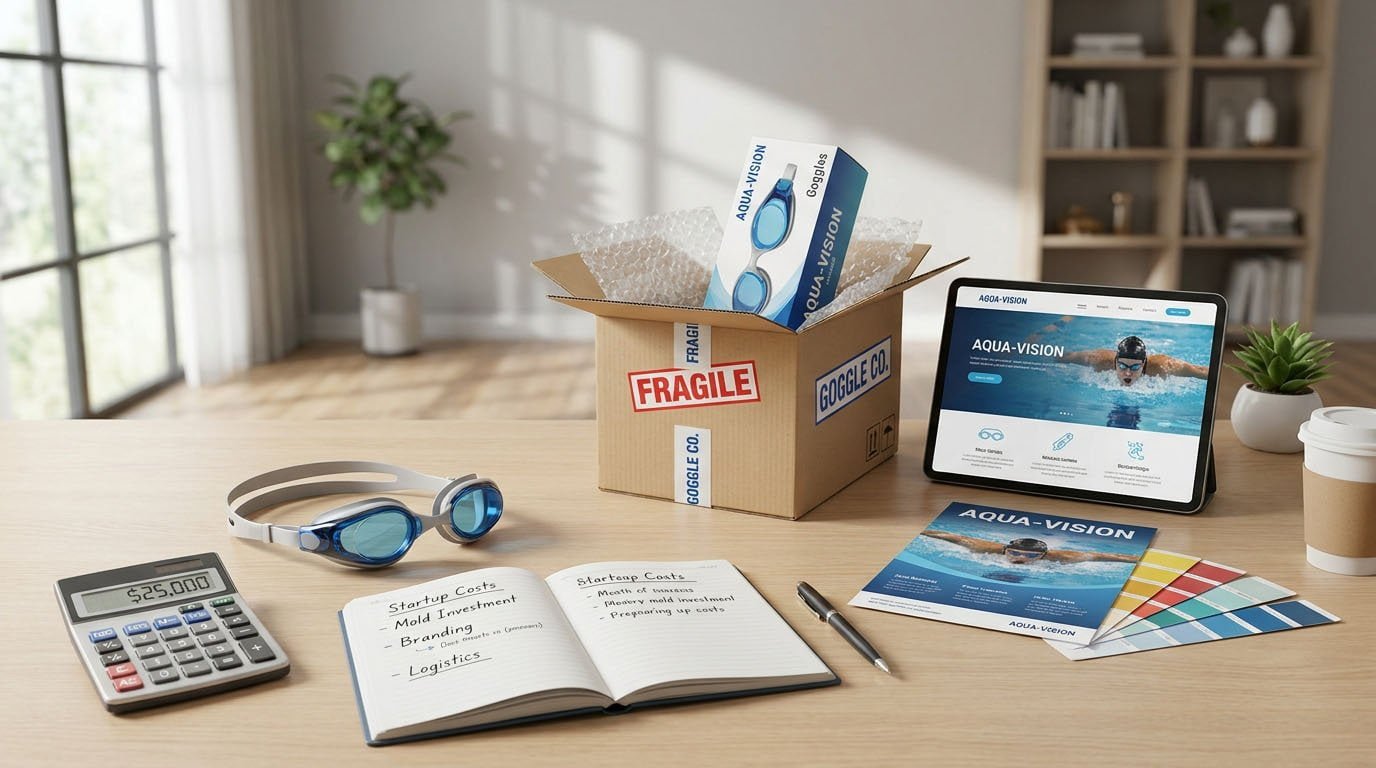
Over the years, I have seen new brand owners underestimate one thing in particular: the gap between factory cost and true launch cost. A product may look affordable when you only calculate the unit price, but once you add compliance review, packaging, shipping, inspection, and customer acquisition, the business looks very different.
This guide breaks the numbers down in a practical way so you can plan more realistically.
Quick Answer: What Budget Do You Actually Need?
If you want the short version, here it is:
- Bare-minimum private label launch: around $10,000-$15,000
- More realistic small brand launch: around $25,000-$35,000
- Premium or heavily customized launch: around $40,000-$50,000+
For most founders entering the U.S. market for the first time, a practical planning number is usually:
$25,000-$35,000 for a solid first launch with decent product quality, compliant packaging, initial inventory, and enough marketing to test demand.
That number will still vary depending on:
- how customized your product is
- how many SKUs you launch with
- your first order quantity
- your packaging complexity
- whether you sell DTC, Amazon, wholesale, or a mix
- whether your product is for adults or children
How Much Does It Typically Cost to Start a Swimming Goggles Brand?
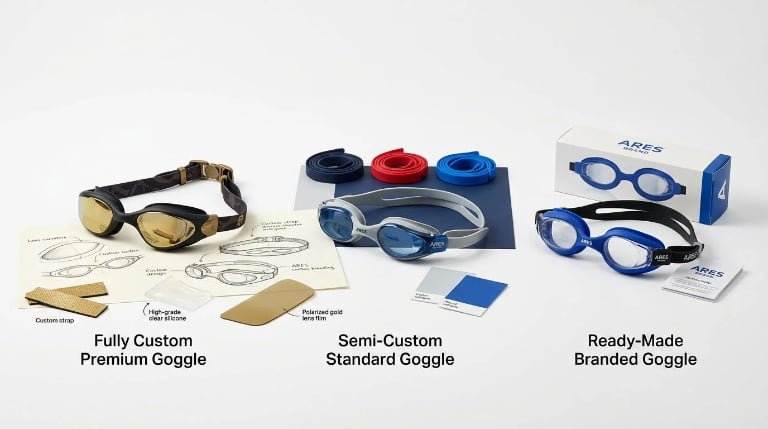
Most U.S.-focused swim goggle startups fall into one of three broad launch paths:
| Launch Type | Typical Cost Range | Customization Level | Typical First Order |
|---|---|---|---|
| Basic Private Label | $10,000-$20,000 | logo, simple packaging, existing design | 500-1,000 pcs |
| Semi-Custom OEM | $25,000-$35,000 | colors, branding, packaging, selected material changes | 1,000-2,000 pcs |
| Full Custom | $40,000-$50,000+ | new tooling, unique design, broader development work | 2,000+ pcs |
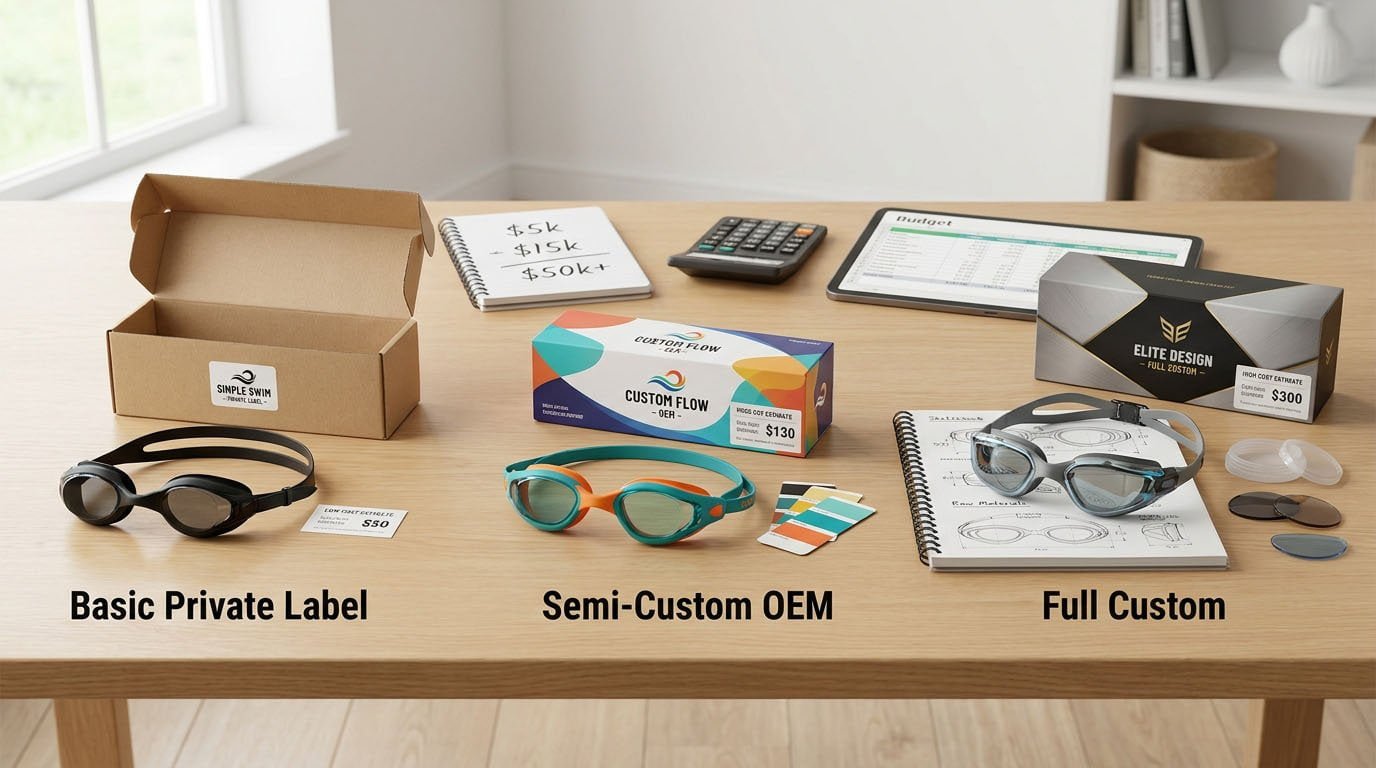
For most first-time founders, semi-custom is often the most balanced option. It gives you some differentiation without forcing you into full mold investment before the market has validated your concept.
One of the most common mistakes I see is this: a new founder assumes that spending more upfront will make the brand look more credible. In reality, early credibility usually comes more from:
- product quality
- fit consistency
- packaging clarity
- customer reviews
- smart positioning
Not from having the most expensive tooling on day one.
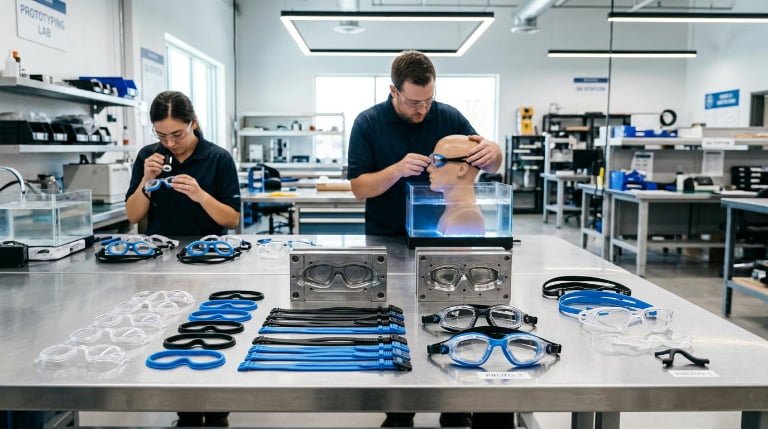
Cost Category 1: Product Design, Tooling, Samples, and Testing
This is where your product starts to become real, and where many founders get their first budget shock.
For small OEM or ODM swim goggle projects, product development and validation often cost somewhere between $5,000 and $12,000, depending on how customized the design is.
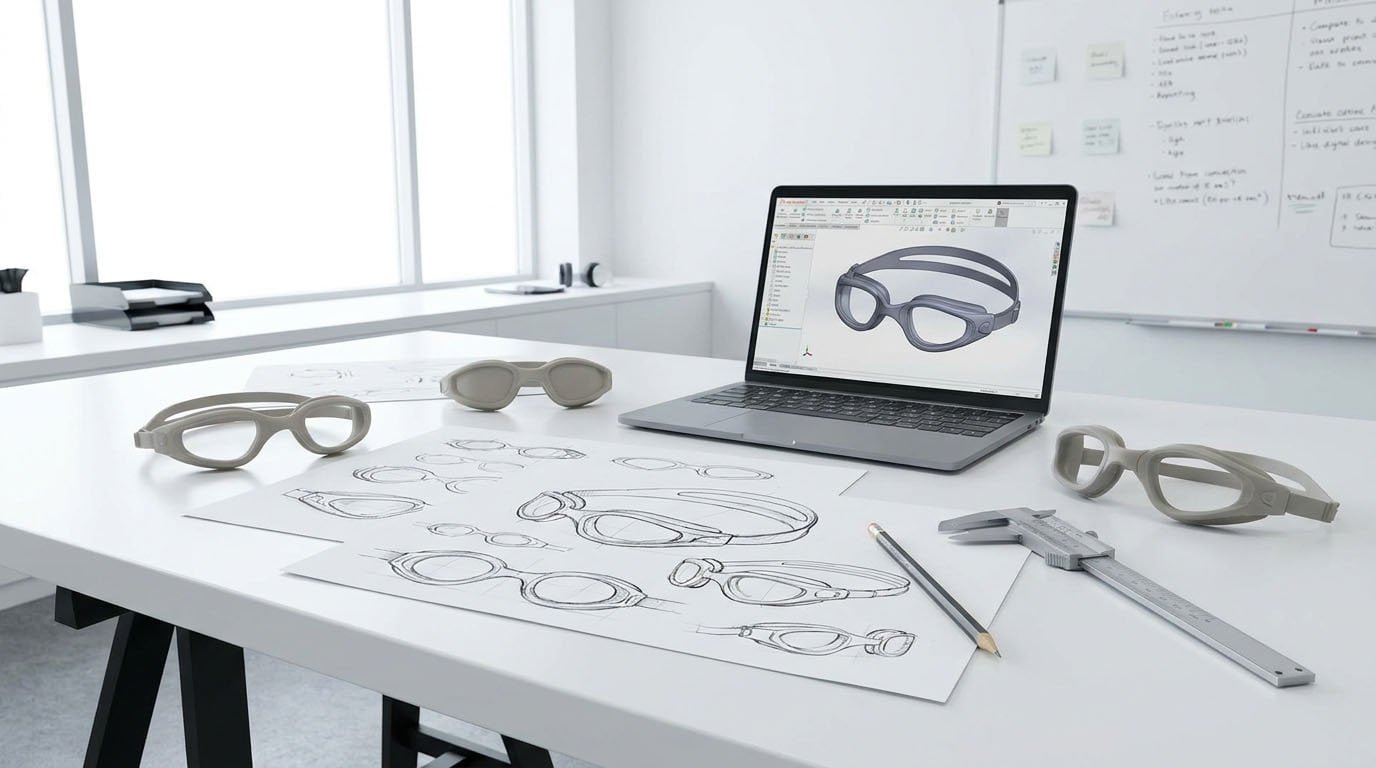
Design and Engineering
If you are starting from scratch, design work may include:
- concept sketches
- CAD development
- ergonomic review
- material selection
- component adjustments
- packaging fit review
A simple project using an existing platform may require very little paid design work. But a more original design can easily add $1,000-$3,000 or more in development-related costs.
In some factory-led OEM projects, basic design support is bundled into the order. In other cases, especially where the shape or fit system changes, it becomes a separate cost.
Tooling and Molds
Tooling is often the biggest upfront cost in a custom swim eyewear project.
Typical ranges may look like this:
- frame mold: around $3,000-$5,000
- lens mold: around $1,500-$2,500
- additional structural tooling or revisions: can add $1,000-$3,000+
If you need multiple sizes, a unique bridge structure, or more complex lens geometry, the number can climb quickly.
That is why many first launches begin with an existing factory platform instead of a fully original design. It reduces both cash risk and development time.
Sampling
Even a relatively simple project usually needs more than one sample round.
Typical sample-related costs may include:
- initial sample
- revised sample
- pre-production sample
- express shipping charges
A realistic budget for swim goggle samples is often around $300-$800, though it can be higher if multiple revisions are needed or if you are comparing several suppliers.
Testing and Validation
Testing costs vary widely depending on:
- your target customer
- whether the product is for adults or children
- retailer requirements
- lab scope
- product claims
- packaging materials
As a rough planning range, basic testing and validation may add $500-$2,000+.
That does not mean every product requires the same test package. It means you should not assume compliance and verification are free or automatic.
A common mistake is skipping practical validation just to save money. That often backfires later in the form of:
- returns
- negative reviews
- repackaging
- production delays
- resale channel rejection
If you are planning to sell in the U.S., especially through major platforms or retailers, it is worth confirming your testing and documentation needs before bulk production.
Cost Category 2: Manufacturing Cost per Unit
Manufacturing cost depends heavily on the level of customization.
As a general planning range, swim goggles may cost around $3-$6 per unit for basic private label, $5-$10 for semi-custom OEM, and $8-$15+ for more customized projects.
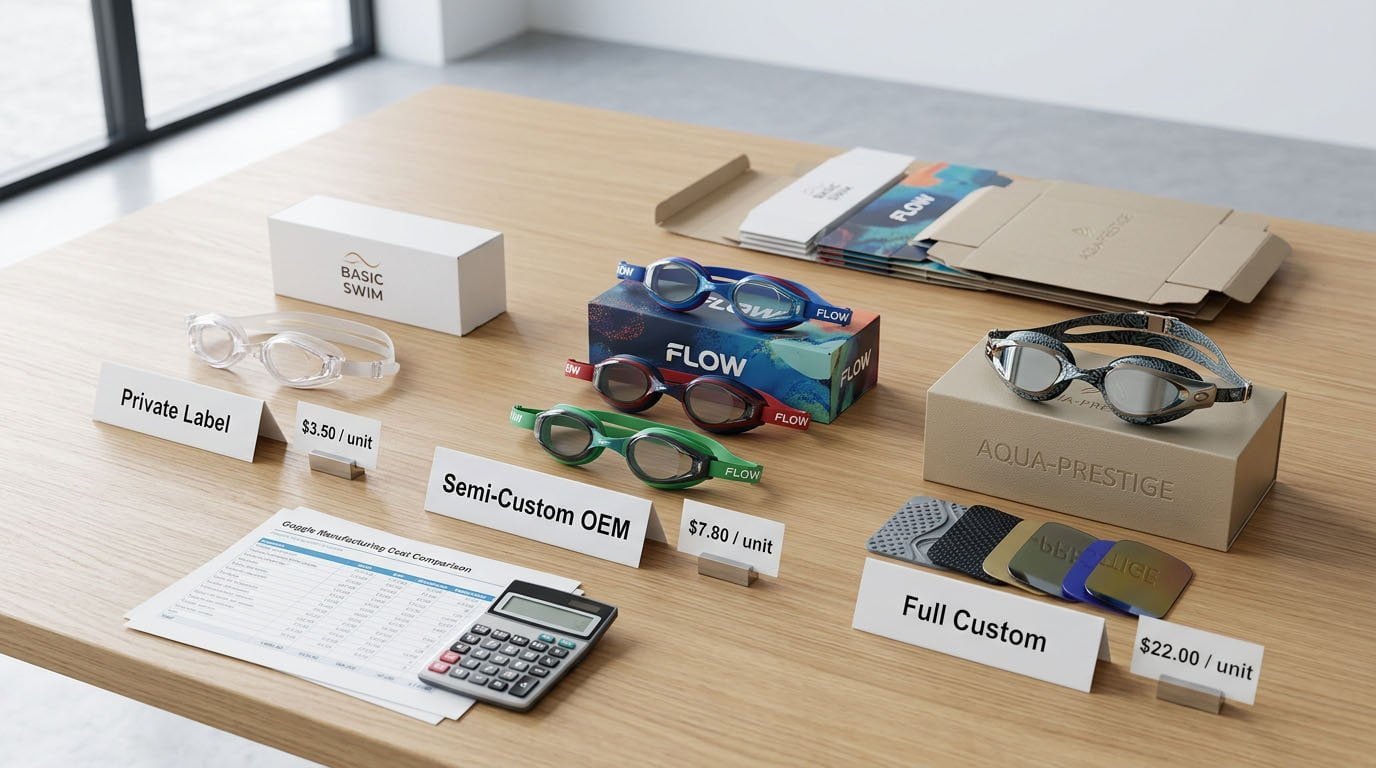
These are not fixed prices. They usually move based on:
- materials
- lens treatment
- anti-fog quality
- mirror or UV coating
- strap design
- gasket material
- packaging inclusion
- order volume
Private Label
With private label, you are usually selecting a supplier’s existing design and changing:
- logo
- packaging
- sometimes color combinations
This is the lowest-risk entry point for many new brands.
Typical range:
- $3-$6 per unit at workable order quantities
Semi-Custom OEM
Semi-custom usually means you are starting from an existing base model, then adjusting:
- strap color
- frame color
- lens tint
- branding details
- packaging
- some material or trim elements
This is often the best fit for brands that want some visual differentiation without paying for full new tooling.
Typical range:
- $5-$10 per unit
Full Custom
Full custom projects generally involve:
- new molds
- original geometry
- unique bridge or fit system
- more development time
- more approval cycles
Typical range:
- $8-$15+ per unit, plus tooling
For some advanced or niche designs, costs may go higher.
Example Cost Snapshot
Here is a simple example for a semi-custom order:
| Cost Component | Amount |
|---|---|
| Manufacturing: 1,000 units x $7 | $7,000 |
| Quality inspection | $300 |
| Sea freight allocation | $800 |
| Subtotal | $8,100 |
| Approx. landed product cost before marketing and overhead | $8.10/unit |
Now compare that with a first-order full custom project:
| Cost Component | Amount |
|---|---|
| Manufacturing: 1,000 units x $12 | $12,000 |
| Tooling | $6,500 |
| Quality inspection | $300 |
| Sea freight allocation | $800 |
| Subtotal | $19,600 |
| Approx. first-order cost | $19.60/unit |
This is why many founders start with semi-custom. Full custom can make sense, but usually only when the market opportunity or brand positioning clearly supports it.
Cost Category 3: Packaging, Compliance, Inventory, and Logistics
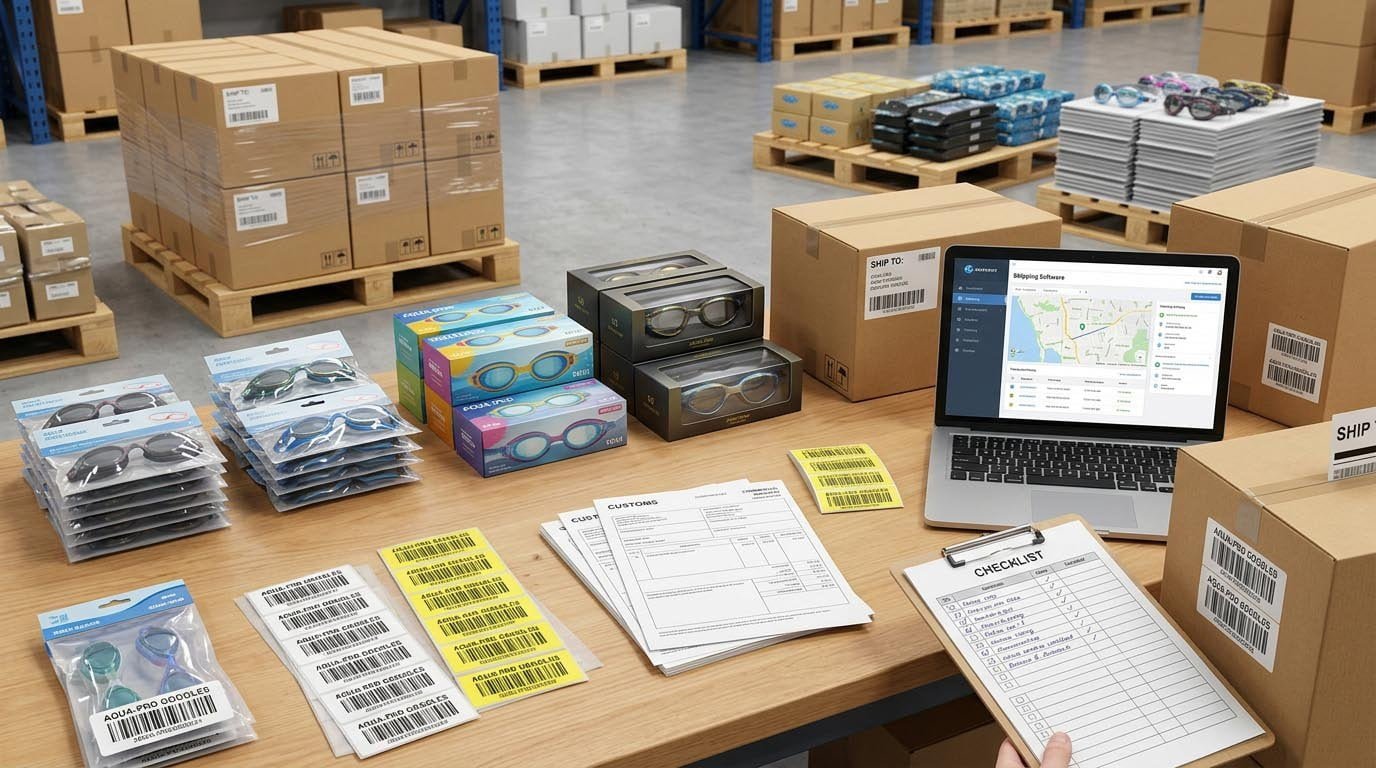
This is where many startup budgets begin to drift.
Founders often focus on unit price and forget the rest:
- packaging
- labels
- barcodes
- customs
- freight
- inspection
- warehousing
- prep and fulfillment
For a first imported order of roughly 1,000-1,500 units, these supporting costs can easily add $4,000-$8,000 or more.
Packaging
Packaging cost depends on your channel and positioning.
Basic options:
- polybag
- simple printed box
- insert card
- hang tag
Higher-end options:
- custom retail box
- hard case
- premium insert
- branded protective pouch
A rough packaging range may look like:
- $0.80-$1.50/unit for simpler packaging
- $1.50-$3.00+/unit for more premium presentation
A lot of founders overspend here too early. Packaging matters, but not more than:
- fit
- leak performance
- lens clarity
- anti-fog reliability
Compliance and Labeling
This part should be handled carefully.
There is no single universal cost that applies to every swim goggle sold in the U.S. Compliance needs may vary based on:
- age grading
- product materials
- packaging materials
- claims
- target sales channels
- retailer documentation requests
As a planning range, testing, labeling, and documentation support may cost around $800-$2,000+, but some projects may land below or above that depending on scope.
If you are selling children’s products, the compliance process may be more involved.
Shipping and Import Costs
For imported swim goggles, common freight choices are:
- sea freight: lower cost, slower transit
- air freight: faster, much more expensive
- express courier: mostly for samples or urgent small shipments
Approximate planning ranges:
- sea freight: around $600-$1,200
- air freight: around $2,500-$4,000+
- sample courier shipments: around $80-$150 each
Sea freight is usually the practical choice for first bulk orders unless your launch timing is unusually tight.
Duties and Customs
Import duties and customs-related fees depend on:
- declared value
- HS classification
- shipment structure
- current regulations
For planning purposes, many small importers set aside a few percentage points of product value plus customs handling costs.
Warehousing and Fulfillment
You also need to think through where the inventory goes after arrival.
Possible setups include:
- Amazon FBA
- third-party logistics provider
- self-fulfillment
- hybrid warehouse model
Startup costs here may include:
- carton prep
- labeling
- inbound shipping
- monthly storage
- pick-and-pack fees
A founder who budgets only for factory cost almost always underestimates the real cash required.
Cost Category 4: Website, Marketing, Amazon, and Launch Spend
A good product does not sell itself.
That is one of the hardest lessons for first-time brand owners. Even if the goggles are strong, you still need:
- traffic
- content
- reviews
- conversion assets
- customer trust
For the first 6-12 months, a modest but realistic launch marketing budget is often around $5,000-$15,000.
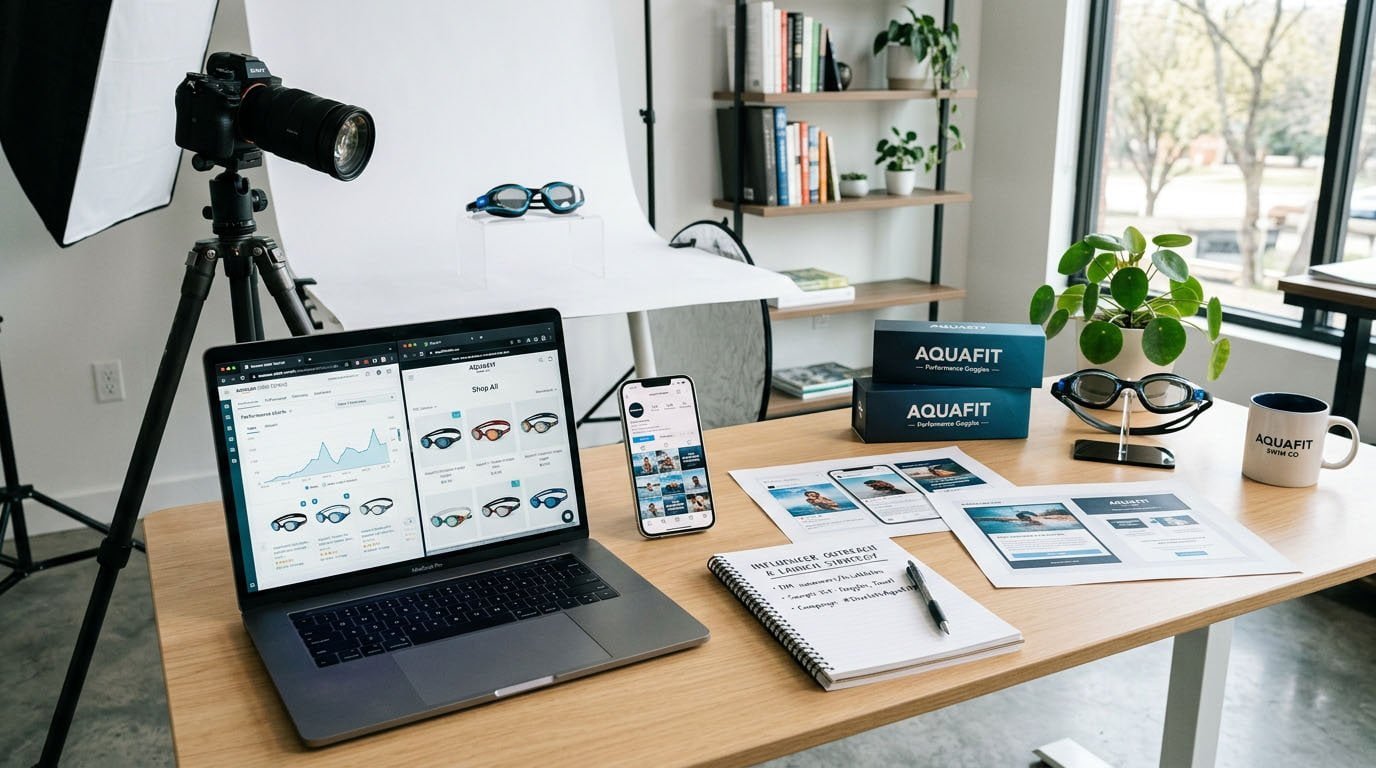
Website and E-Commerce Setup
Typical year-one costs may include:
- domain
- Shopify or WooCommerce setup
- theme customization
- product photography
- copywriting
- email capture tools
A common startup range is:
- $1,000-$3,000+, depending on how much you do yourself
Amazon Launch Costs
If Amazon is part of your launch strategy, budget for:
- seller account fees
- listing setup
- barcodes or product identification setup
- FBA prep
- PPC advertising
- coupon or promo spend
- early review generation strategy within platform rules
A practical early Amazon test may require:
- $2,000-$5,000+
Social Media and Influencer Outreach
For swim products, useful early channels often include:
- TikTok
- YouTube creators
- swim clubs
- triathlon communities
- local team partnerships
You do not need a huge budget at the start, but you do need content and consistency.
A working range for early content and outreach might be:
- $1,500-$4,000
Product Photography and Creative Assets
This is often underestimated. Swim products are visual, and bad imagery weakens both:
- conversion rate
- perceived product quality
Photography, short video, and listing creatives may cost:
- $500-$1,500+
Retail Launch Costs
If you plan to pursue retailers early, costs may rise through:
- line sheets
- sample kits
- trade shows
- travel
- rep commissions
- compliance documentation requests
This is one reason many new brands begin with DTC plus a controlled Amazon test before expanding into wholesale.
A Practical First-Year Startup Example
Here is a simplified example for a small semi-custom launch into the U.S. market:
| Category | Estimated Cost |
|---|---|
| samples and revisions | $500 |
| design/customization support | $1,500 |
| testing/compliance prep | $1,200 |
| first inventory order | $7,000 |
| packaging | $2,000 |
| freight, duties, import costs | $1,500 |
| inspection and quality control | $300 |
| website and product photos | $2,000 |
| Amazon launch and ads | $2,500 |
| social/media/influencer test budget | $1,500 |
| contingency | $2,000 |
| Estimated Total | $22,000 |
Now, if you increase:
- packaging complexity
- SKU count
- customization
- ad spend
- first inventory size
you can move from $22,000 to $30,000-$35,000 very quickly.
That is why I usually encourage founders to plan for more than the absolute minimum.
What Usually Drives Costs Up Fast?
The main budget accelerators are usually:
1. Too many SKUs at launch
Every colorway and model adds:
- MOQ pressure
- packaging complexity
- forecasting risk
- slower inventory turnover
2. Full custom tooling too early
Custom molds are not always the problem. Unvalidated custom molds are.
3. Premium packaging before product-market fit
A beautiful box does not fix leak complaints.
4. Underestimating freight and import cost
Even compact products become expensive if the packaging is bulky or the shipment is rushed.
5. Weak launch planning
A lot of founders budget for inventory but not enough for:
- photography
- listing content
- ads
- early sampling to creators
- returns
- replacement units
How to Start With Less Money
If your budget is limited, the smartest move is usually not to force a full custom launch. It is to simplify the model.
Ways to reduce startup cost:
- use an existing factory design
- launch with one hero SKU first
- avoid new molds
- keep packaging compact
- use sea freight instead of air
- test demand on your own site and Amazon before expanding
- delay wholesale outreach until the product is proven
A lean launch is not always glamorous, but it is often more survivable.
In practical terms, many brands are better off launching a well-positioned $15,000-$20,000 project than a poorly planned $45,000 project.
FAQ: Cost to Start a Swimming Goggles Brand in the USA
What is the absolute minimum budget to start?
If you strip the model down to private label, simple packaging, and a small first order, some founders may get started near $10,000-$12,000. But this usually leaves very little room for mistakes.
How long does it take before inventory is ready to sell?
A common timeline is 3-5 months, depending on:
- sample rounds
- packaging approval
- testing requirements
- production lead time
- freight method
Should I manufacture in the USA or overseas?
Most swim goggles are manufactured in Asia because the tooling ecosystem and component supply chain are already there. Domestic production is possible in some cases, but costs are often much higher.
What gross margin should I aim for?
For DTC, many brands try to build toward 50-65% gross margin. The exact number depends on:
- landed cost
- returns
- ad spend
- sales channel fees
- discounting strategy
What if I do not have $30,000 available?
Common alternatives include:
- bootstrapping with a smaller first order
- crowdfunding
- using an existing design first
- bringing on a partner
- testing one SKU before building a broader line
Final Thoughts
Starting a swimming goggles brand in the USA does not have to be prohibitively expensive, but it does require realistic planning.
For most founders, the real startup cost is not just the product. It is the combination of product development, inventory, packaging, compliance, freight, and customer acquisition.
If you are entering the market for the first time, the safest approach is usually:
- start with fewer SKUs
- keep your first order controlled
- avoid unnecessary tooling
- validate product quality before scaling
- budget around landed cost, not factory quote
- leave room for marketing and revisions
That approach may feel less ambitious at first, but in practice it is usually what gives a new brand the best chance to survive year one.