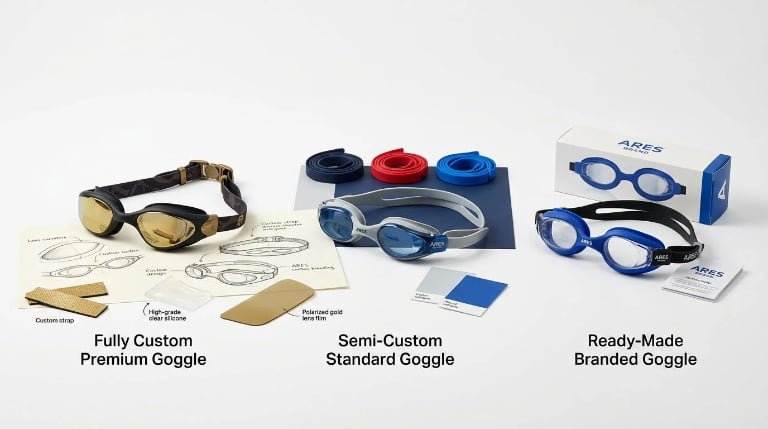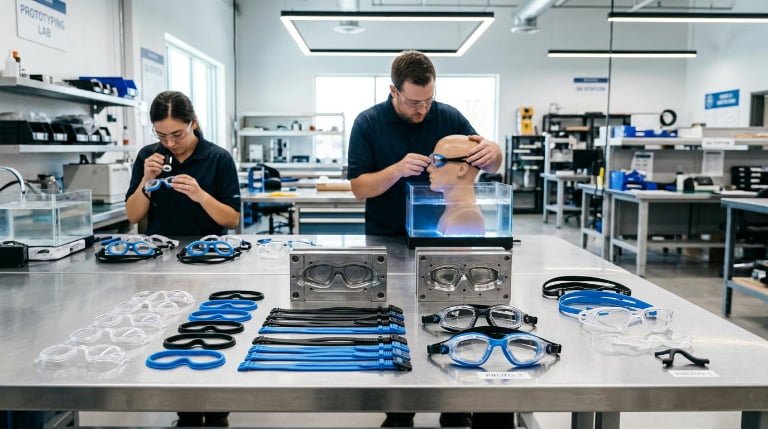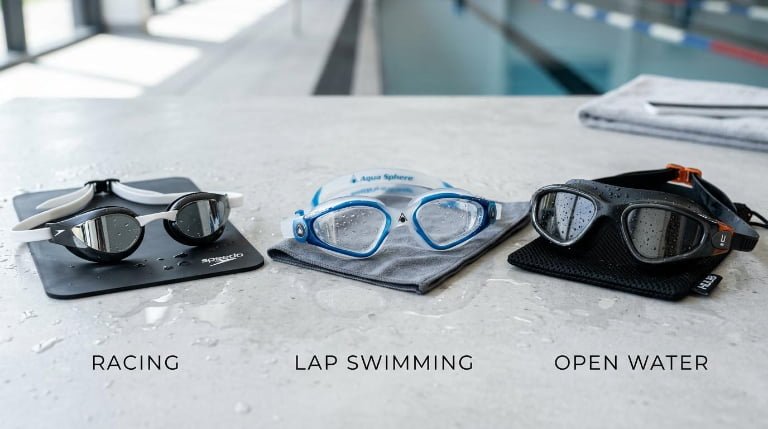
Swimming goggles may look simple, but making them consistently well requires much more than a clean sample. A pair of goggles can pass visual inspection and still fail later because of internal lens stress, weak gasket bonding, poor anti-fog adhesion, optical distortion, or unstable batch production control.
Swimming goggles are made through a multi-step manufacturing process that usually includes product design, material selection, lens and frame molding, gasket overmolding, anti-fog and mirror coating, assembly, and quality testing. The most important quality risks come from hidden process problems during mass production, especially in injection molding, coating adhesion, and durability control.
For importers, private label buyers, brands, and sourcing teams, understanding how swimming goggles are made helps reduce supplier risk, complaint rates, and product failures in bulk orders. This guide explains the full swimming goggles manufacturing process, the materials used, the most common defects, and the quality checks that matter most before shipment.
Quick Answer: How Are Swimming Goggles Made?
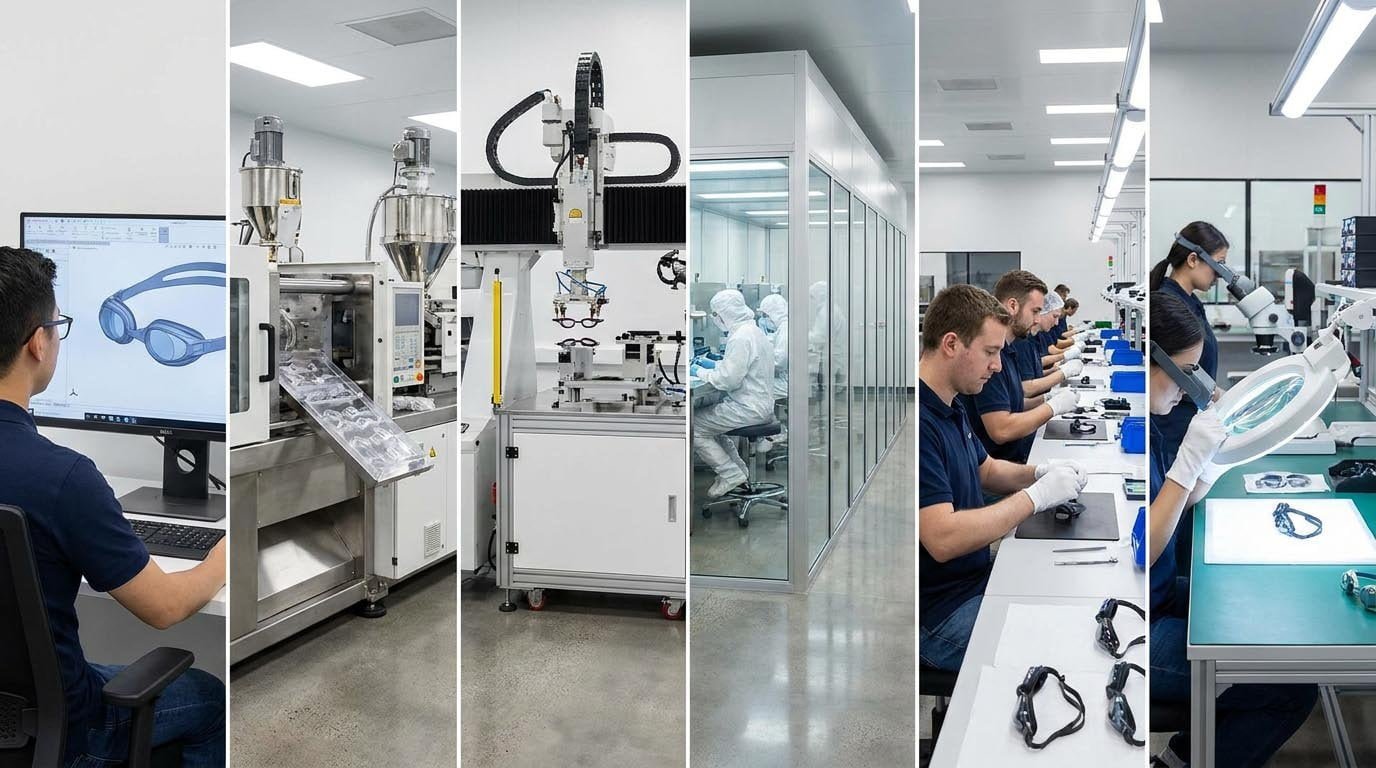
Swimming goggles are typically made in seven main stages:
- Product design and CAD development
- Material selection for lenses, gaskets, straps, and buckles
- Injection molding of lenses and hard plastic components
- Two-shot overmolding or gasket bonding
- Anti-fog, UV, mirror, or tint coating
- Assembly of straps, nose bridges, and buckles
- Quality control testing before shipment
The most common hidden defects in swimming goggles usually come from poor molding control, coating failure, material inconsistency, and incomplete durability testing rather than visible cosmetic flaws alone.
What Is the Swimming Goggles Manufacturing Process?
The swimming goggles manufacturing process usually follows a sequence that combines design, plastic molding, soft-part bonding, coating, assembly, and functional testing.
Swimming goggles manufacturing process at a glance
| Stage | Main Purpose | Main Risk | Key Control Point |
|---|---|---|---|
| Design and CAD | Define fit, lens shape, seal, and anchor structure | Poor geometry, leaks, stress concentration | CAD review and fit validation |
| Material Selection | Choose lens, gasket, strap, and buckle materials | Grade substitution, poor chemical resistance | Material certification and incoming inspection |
| Injection Molding | Form lenses and hard plastic parts | Internal stress, warpage, distortion | Temperature, pressure, and cooling control |
| Overmolding / Bonding | Attach soft gasket to frame or support structure | Weak bond, delamination | Bond verification and peel testing |
| Coating | Apply anti-fog, UV, mirror, or tint layers | Delamination, poor durability, uneven thickness | Surface preparation and curing control |
| Assembly | Connect straps, bridges, adjusters, and buckles | Misalignment, poor tension, loose parts | Functional assembly inspection |
| Quality Testing | Verify durability and real-use performance | Hidden defects missed by appearance check | Leak, optical, fatigue, and coating tests |
The exact flow varies by product type. Racing goggles, recreational goggles, children’s swim goggles, and mirrored competition goggles may all use slightly different tooling, coating, and assembly steps.
What Materials Are Used in Swimming Goggles?
The materials used in swimming goggles directly affect optical clarity, sealing comfort, durability, chlorine resistance, anti-fog performance, and structural strength.
Common materials used in swimming goggles
| Component | Common Material | Main Function | Main Risk if Material Is Poor |
|---|---|---|---|
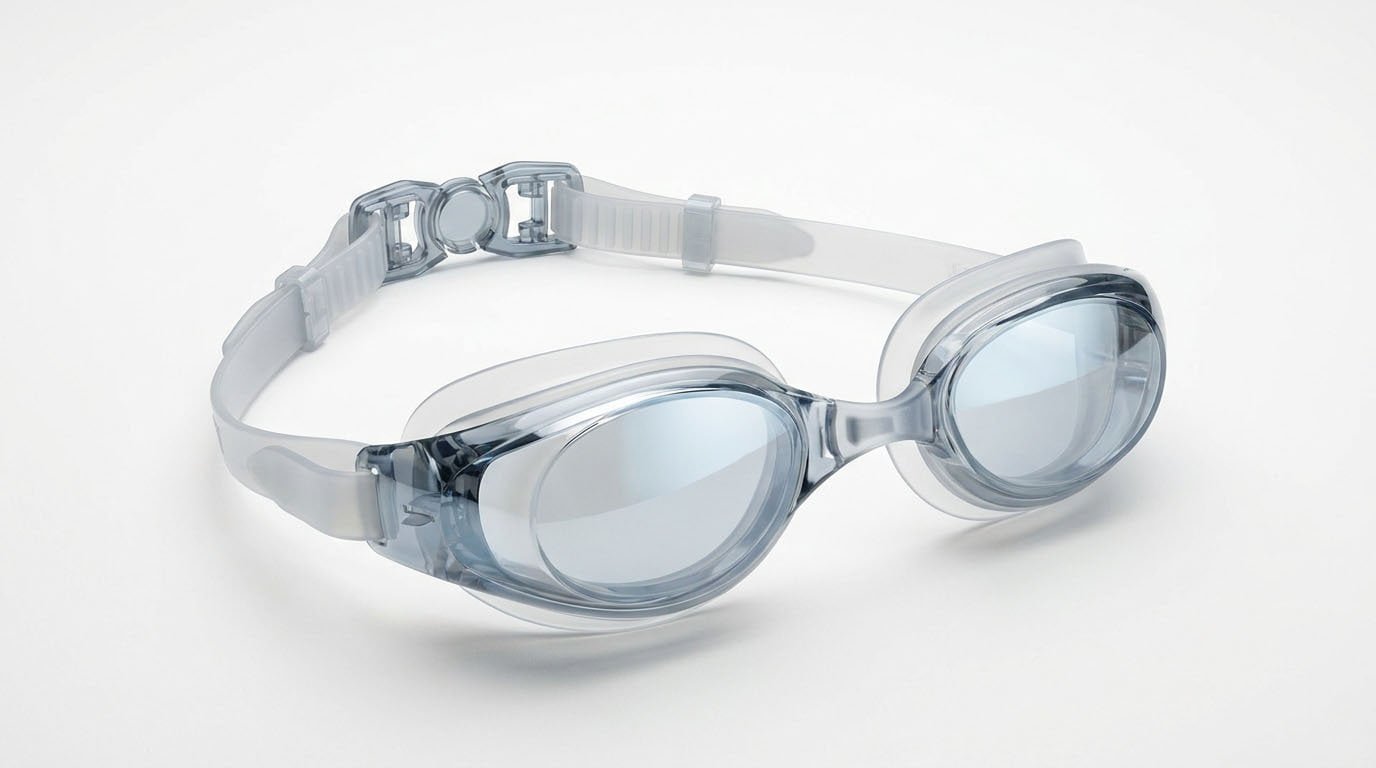
| Lens | Polycarbonate (PC) | Optical clarity and impact resistance | Distortion, cracking, yellowing |
| Gasket | Silicone or TPE | Soft seal around eye area | Leakage, discomfort, tearing |
| Strap | Silicone, TPE, or TPR | Stretch and fit retention | Loss of elasticity, breakage |
| Buckle / Adjuster | PC or POM | Strap adjustment and locking | Breakage, poor durability |
| Nose Bridge | Silicone, TPE, or rigid plastic | Fit and spacing between lenses | Poor comfort or unstable fit |
1. Polycarbonate lenses
Most swim goggle lenses are made from polycarbonate because it combines:
- high impact resistance
- good transparency
- stable molding performance
- compatibility with anti-fog and mirror coatings
Important things to verify:
- optical-grade resin
- low haze
- consistent UV performance
- proper drying before molding
- stable melt flow for lens geometry
If the lens resin is low grade or poorly dried, the final product may show haze, silver streaks, optical distortion, or a higher risk of cracking after use.
2. Silicone or TPE gaskets
The gasket is the soft component that seals against the face. Good gasket material must balance:
- comfort
- rebound
- sealing force
- chlorine resistance
- long-term dimensional stability
For many adult models, a medium-soft gasket performs best. If the gasket is too soft, it may collapse and leak. If it is too hard, it may leave pressure marks and feel uncomfortable.
3. Strap materials
Swim goggle straps are usually made from silicone, TPE, or TPR. The most important issue is not just initial elasticity, but recovery after repeated use.
A good strap should maintain:
- stretch under load
- fit after repeated adjustment
- chlorine resistance
- low permanent set after fatigue cycles
4. Buckles and adjusters
Buckle quality affects both usability and product lifespan. Common materials include:
- polycarbonate for higher impact resistance
- POM (acetal) for good dimensional stability and efficient production
Weak buckle material can lead to fracture during adjustment or after impact on poolside surfaces.
How Does Swimming Goggle Design Affect Product Quality?
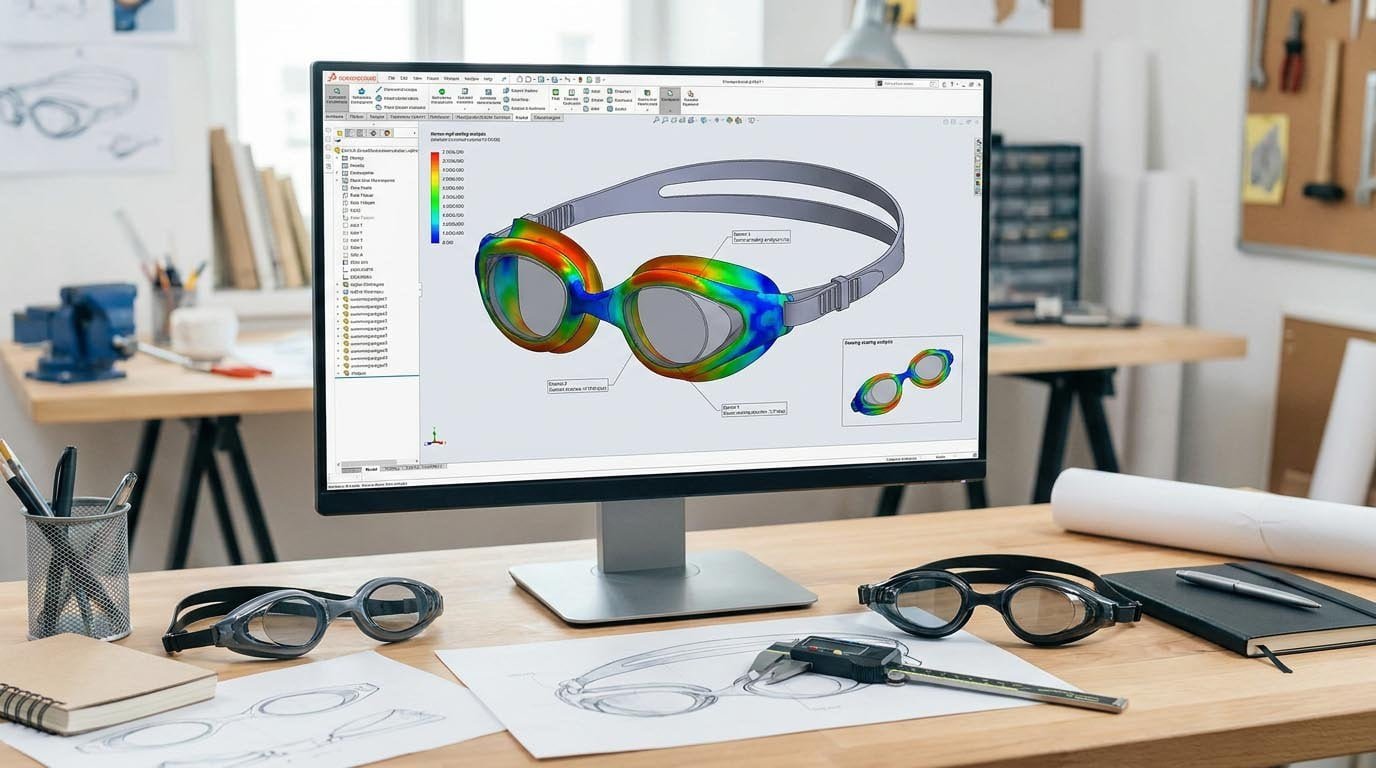
A large percentage of goggle defects begin in the design stage. Even with good materials, poor geometry can create manufacturing instability and real-use failure.
Gasket compression design
The seal area must create enough contact pressure to prevent leakage without causing discomfort or unstable molding.
Design teams should pay attention to:
- sealing perimeter geometry
- compression consistency
- facial contact area
- transition from gasket to rigid support part
Uneven gasket compression often causes one of the most common complaints in swimming goggles: one side seals while the other side leaks.
Lens curvature transitions
Lens curvature affects both optical quality and molding stress. Abrupt curvature changes can trap stress during cooling and later contribute to:
- delayed cracking
- edge distortion
- stress whitening
- coating instability on curved surfaces
Strap anchor load path
The strap anchor is a repeated load point. If the design does not distribute force well, cracks may form near the anchor root after repeated use.
What should be checked:
- wall thickness near anchor points
- fillet transitions
- rib support where needed
- tension path into frame structure
Why CAD review matters
Before tooling starts, a design review should assess:
- seal geometry
- mold release feasibility
- stress concentration areas
- thickness consistency
- assembly practicality
A good-looking 3D model is not enough. In swimming goggles production, manufacturability and repeatability are just as important as shape.
How Are Swimming Goggle Lenses Made?
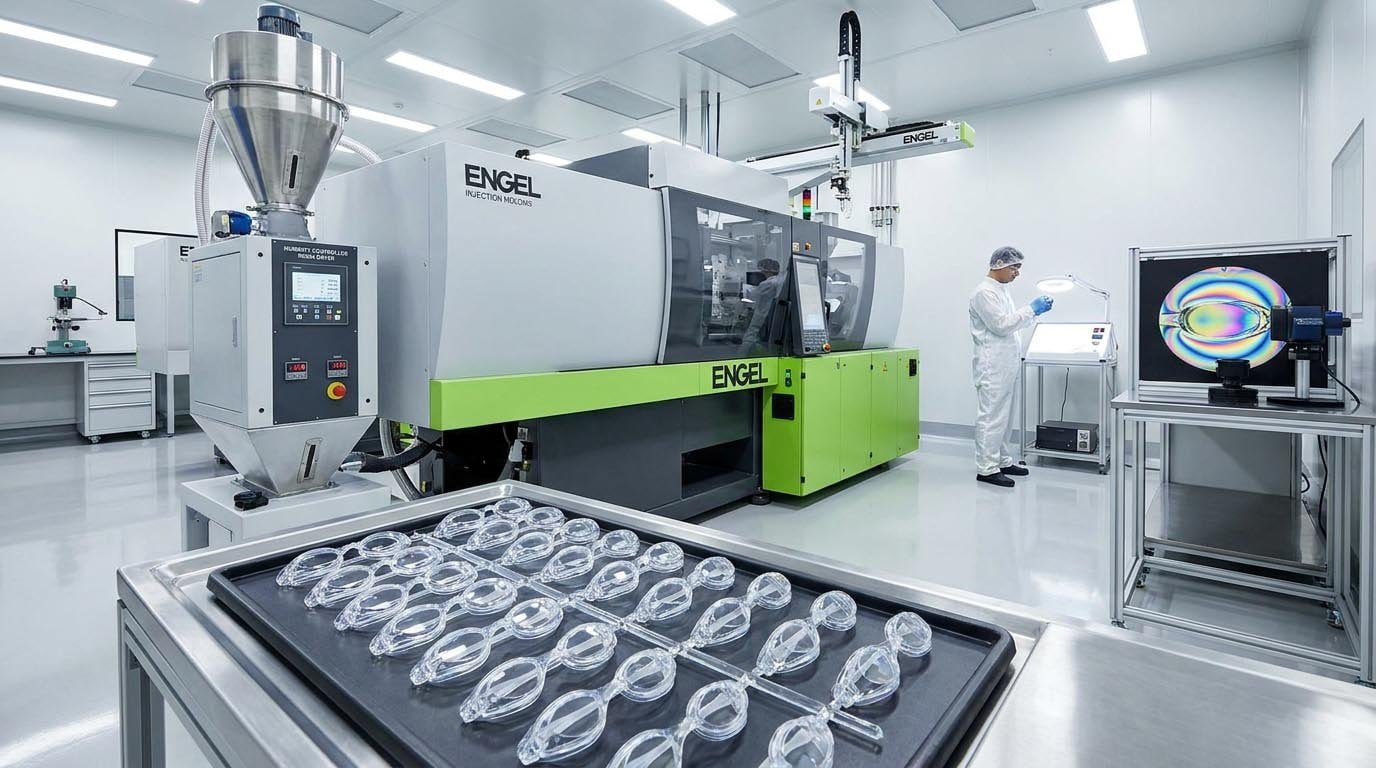
The lens is usually the most performance-critical component of the product. In most cases, swimming goggle lenses are made by injection molding polycarbonate resin into precision molds.
Step 1: Resin drying
Polycarbonate resin must be dried before molding. If moisture remains in the resin, the molded lens may develop:
- haze
- bubbles
- silver streaks
- reduced mechanical strength
Step 2: Injection molding
During lens molding, molten resin is injected into the lens cavity under controlled temperature and pressure. Important process variables include:
- barrel temperature
- mold temperature
- injection speed
- packing pressure
- cooling time
Step 3: Cooling and ejection
After the cavity is filled, the part must cool long enough to stabilize shape and reduce residual stress. If the lens is ejected too early, it may still look normal but fail later in use.
Why residual stress matters
Residual stress is one of the biggest hidden quality defects in swimming goggles. It may not be visible during first inspection, but it can later lead to:
- lens cracking after repeated use
- optical distortion
- poor coating adhesion
- lower impact resistance
What good factories control during lens molding
Reliable suppliers should control:
- machine parameter windows
- mold temperature consistency
- cooling cycle discipline
- material drying records
- stress inspection on molded lenses
Some factories also use polarized light inspection to identify stress patterns in clear polycarbonate lenses.
What Is Two-Shot Overmolding in Swimming Goggles?
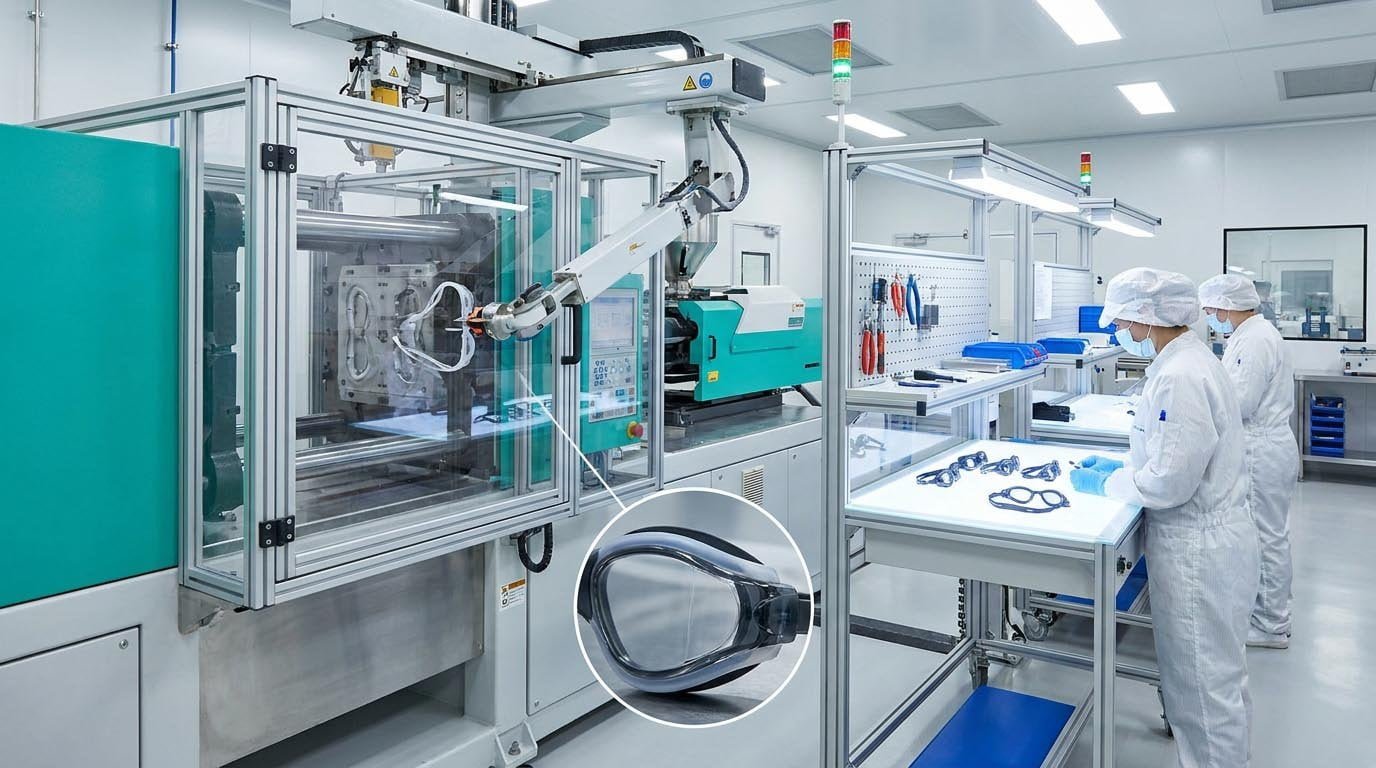
Many swimming goggles use a process called two-shot overmolding or soft-over-hard molding.
This process combines:
- a hard structural part such as a frame or lens support
- a soft material such as silicone or TPE for the gasket
How two-shot overmolding works
A typical sequence is:
- the rigid part is molded first
- the part is transferred or indexed into a second cavity
- the soft gasket material is molded onto the hard substrate
- the bonded part is cooled and inspected
Why overmolding quality matters
If the bond between hard and soft materials is weak, the gasket may:
- lift at the edge
- separate from the frame
- leak after repeated use
- fail after chlorine exposure or handling cycles
What buyers should verify
Ask suppliers about:
- surface preparation before second shot
- material compatibility
- substrate temperature control
- bond verification method
- peel test or bond strength data from production batches
A clean bond line is not enough. The real issue is whether the gasket remains bonded after use.
How Is Anti-Fog Coating Applied to Swimming Goggles?
Anti-fog coating is one of the most requested features in swim goggles, but it is also one of the most inconsistent if process control is weak.
Swimming goggle anti-fog coating typically depends on three factors:
- proper surface preparation
- stable coating application
- correct curing

Why anti-fog coating fails
Common anti-fog failures usually come from:
- mold-release contamination on the lens surface
- poor pre-treatment
- uneven coating thickness
- incomplete curing
- bad handling after coating
- weak compatibility with mirror layers
Surface preparation before coating
Before coating, the lens must be clean enough for the anti-fog layer to bond properly.
Typical preparation methods may include:
- plasma treatment
- controlled cleaning
- surface energy verification
- contamination control before coating
Suppliers that cannot clearly explain how lens surfaces are prepared often struggle to deliver consistent anti-fog durability.
Coating application methods
Common methods include:
- dip coating
- spray coating
- vacuum-based coating systems
Each method has different tradeoffs in:
- cost
- durability
- thickness consistency
- productivity
Curing and adhesion
After application, the coating must be cured under controlled conditions. If cure time is shortened to speed up output, the coating may appear acceptable at shipment but fail quickly during use.
What buyers should request:
- anti-fog process description
- cure standard and monitoring method
- adhesion test records
- wash-cycle durability results
- retained coated samples from production
How Are Mirror and Tinted Swimming Goggle Lenses Made?
Many premium swim goggles include mirror coating, UV treatment, smoke tint, or colored lens finishes.
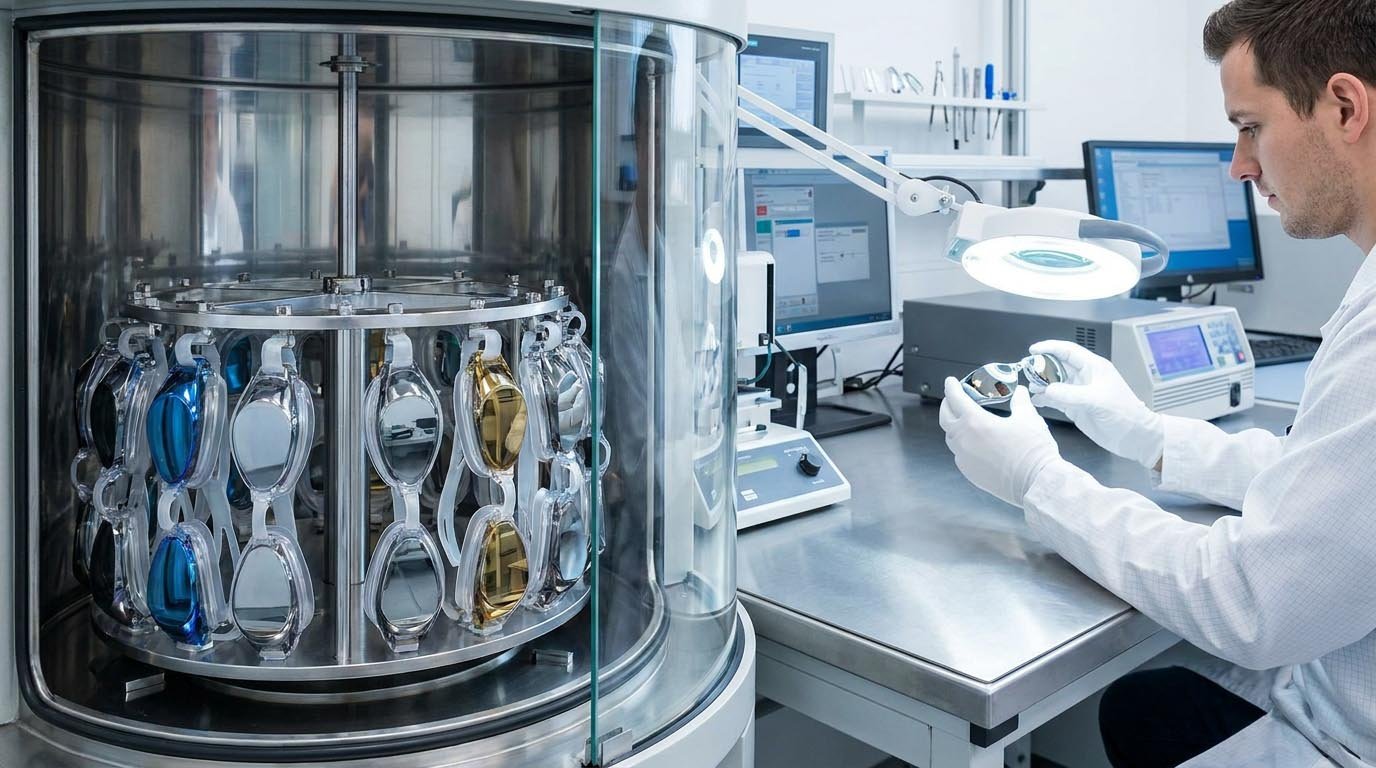
Typical mirror lens layer structure
A mirror lens may include:
- polycarbonate base lens
- thin reflective metal layer
- protective top layer
- anti-fog coating on the interior side
Why mirror-coated goggles need more control
Mirror-coated goggles are more complex than clear lenses because:
- more layers must adhere well
- curing sequence matters more
- aging stability becomes more critical
- failure can involve multiple layers at once
Common mirror coating risks
- peeling after repeated use
- poor adhesion between mirror and protective layers
- anti-fog failure linked to mirror layer instability
- appearance defects after humidity or heat exposure
What should be tested
For mirror-coated models, buyers should ask for:
- fresh adhesion testing
- aged adhesion testing
- humidity exposure results
- compatibility verification between mirror and anti-fog systems
How Are Swimming Goggles Assembled?
After molding and coating, the product moves into final assembly. This stage looks simple, but poor assembly can still create quality problems.
Typical assembly steps
- insert straps into side anchors or buckles
- install buckle or adjuster components
- fit nose bridge or interchangeable bridge system
- inspect left-right alignment
- verify strap movement and lock function
- clean and pack finished goggles
Common assembly problems
- twisted straps
- loose buckle engagement
- uneven tension left vs right
- nose bridge mismatch
- scratches during handling
- contamination after coating
Why assembly control matters
Even if the molded and coated parts are good, poor assembly may cause:
- user discomfort
- product returns
- false leakage complaints
- packaging damage or cosmetic rejects
Good factories use standard work instructions and final function checks before packing.
What Quality Tests Are Used for Swimming Goggles?
Appearance inspection is important, but it cannot detect many of the defects that cause complaints later. Reliable swimming goggles quality control should include both visual and functional testing.
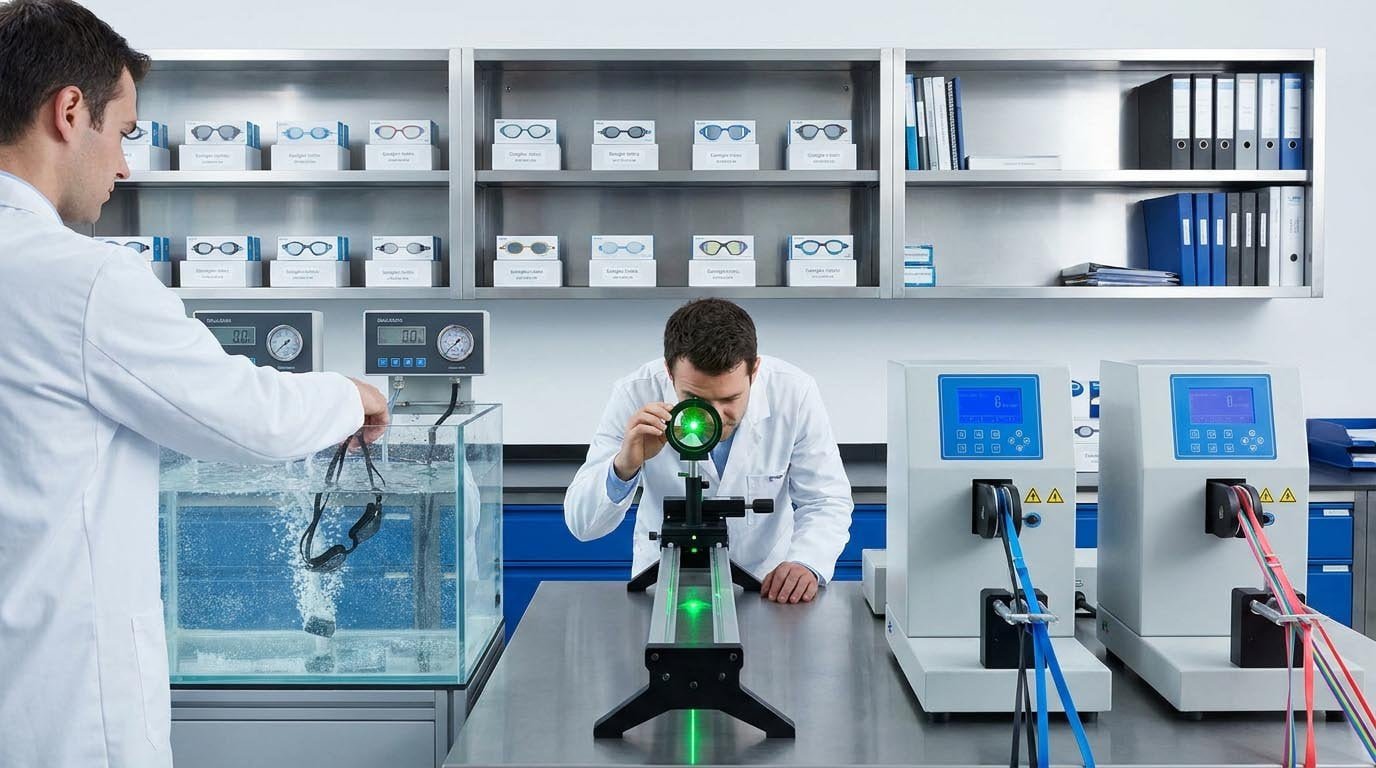
Swimming goggles testing checklist
| Test | What It Checks | Why It Matters |
|---|---|---|
| Leak Test | Seal integrity and frame-gasket stability | Prevents water leakage complaints |
| Optical Distortion Test | Clarity and visual accuracy | Protects user vision underwater |
| Impact Test | Lens and structural durability | Reduces fracture risk |
| Stress / Fatigue Test | Delayed cracking or repeated-use failure | Reveals hidden molding problems |
| Anti-Fog Wash Test | Coating durability over repeated cleaning | Validates anti-fog performance |
| Adhesion Test | Coating and bond stability | Detects peeling or delamination risk |
| Strap Tensile Test | Stretch, recovery, and break strength | Prevents fit failure |
| Chemical Resistance Test | Chlorine aging and material stability | Verifies pool-use durability |
1. Leak test
Leak testing verifies whether the gasket and frame maintain a stable seal under pressure conditions. This is more useful than simply checking appearance.
2. Optical distortion test
Lenses should provide clear visibility across the viewing zone, not only in the center. Distortion testing helps detect:
- lens warpage
- poor cooling balance
- stress effects
- geometry errors
3. Impact and fatigue testing
A good goggle should survive both:
- immediate impact
- repeated handling and flexing over time
Some defects appear only after repeated cycles, so fatigue testing is important.
4. Anti-fog wash cycle testing
This test evaluates how long anti-fog performance remains effective after repeated rinsing, wiping, or cleaning cycles.
5. Strap and buckle durability testing
These tests evaluate:
- tensile performance
- recovery after repeated stretch
- fatigue around anchor areas
- chlorine aging resistance
6. Documentation and traceability review
Testing only matters if it is linked to real production. Buyers should verify:
- batch-linked records
- retained samples
- model-specific reports
- valid compliance documents
- traceability to materials and machine settings
What Are the Most Common Swimming Goggle Manufacturing Defects?
Understanding common defects makes it easier to identify weak suppliers before problems reach the market.
1. Internal lens stress
Usually caused by unstable injection molding conditions, uneven cooling, or poor lens geometry.
2. Lens cracking after use
Often linked to hidden residual stress that was not detected during inspection.
3. Gasket delamination
Usually caused by weak overmolding bond, poor compatibility, or weak process control.
4. Anti-fog coating failure
Often caused by contamination, poor pre-treatment, uneven application, or incomplete curing.
5. Optical distortion
May result from warpage, mold alignment problems, uneven cooling, or stress concentration.
6. Strap fatigue
Caused by low recovery, poor material quality, chlorine degradation, or weak anchor design.
7. Buckle breakage
Commonly linked to poor resin choice, brittle design, or repeated impact.
How Can Buyers Audit a Swimming Goggles Supplier?
If you are sourcing swimming goggles, the biggest question is not whether the factory can make a good sample. It is whether the supplier can maintain stable quality in mass production.
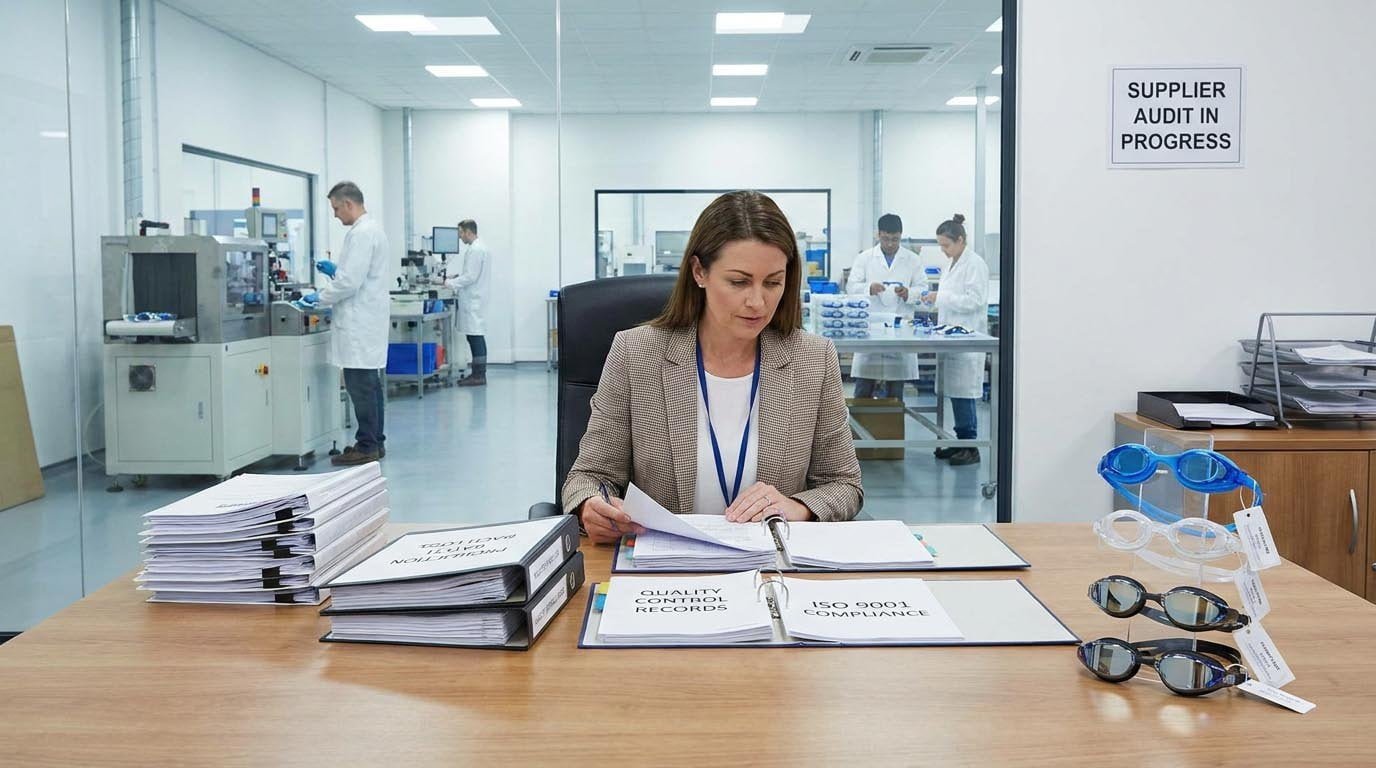
Swimming goggles supplier audit checklist
Before approving a supplier, buyers should review:
- CAD and tooling review workflow
- material approval and traceability system
- resin drying and incoming inspection records
- molding parameter monitoring and batch logs
- mold maintenance system
- gasket bonding verification
- anti-fog surface preparation method
- coating cure monitoring
- wash-cycle and adhesion testing
- optical and leak test records
- retention sample system
- corrective action process for failed batches
- model-specific compliance documents
What matters most during an audit
The most useful signs of a reliable supplier are:
- real production records
- batch-specific test reports
- stable process control discipline
- traceability from raw material to finished batch
- evidence that mass production follows the same standards as approved samples
A factory that shows only certificates and showroom samples may still have unstable quality control.
FAQ: How Swimming Goggles Are Made
How are swimming goggles made step by step?
Swimming goggles are usually made through design, material selection, injection molding, overmolding or gasket bonding, coating, assembly, and quality testing.
What plastic are swimming goggle lenses made from?
Most swimming goggle lenses are made from polycarbonate because it offers good clarity, impact resistance, and coating compatibility.
What material is used for swimming goggle gaskets?
Gaskets are commonly made from silicone or TPE, depending on the product positioning, comfort target, and cost level.
Why do swimming goggle lenses crack after repeated use?
The most common cause is internal stress from poor molding control, especially if cooling, pressure, or temperature is unstable during production.
Why does anti-fog coating wear off on swim goggles?
Anti-fog coating usually fails because of poor surface preparation, weak adhesion, uneven coating, or incomplete curing.
What is two-shot overmolding in swim goggles?
Two-shot overmolding is a process where a soft gasket material is molded directly onto a hard structural part, helping improve seal quality and assembly efficiency.
What quality tests should be done before shipping swimming goggles?
Key tests include leak testing, optical distortion testing, impact testing, fatigue testing, anti-fog wash testing, adhesion testing, and strap durability testing.
How can I evaluate a swimming goggles manufacturer?
Review material traceability, molding process logs, coating controls, batch testing records, retention samples, and model-specific compliance documents.
Conclusion
If you want to understand how swimming goggles are made, the most important thing to know is this: the process is not only about molding plastic parts and assembling them together. Reliable swim goggles depend on good design, stable materials, controlled injection molding, strong gasket bonding, durable coating, and real quality testing based on production batches.
For buyers, importers, and brands, the biggest risk is not a visible cosmetic defect. It is a hidden manufacturing problem that passes sample approval but fails later in the market.
That is why the best swimming goggle suppliers are not only those with clean samples, but those with:
- stable process control
- clear batch traceability
- verified coating and molding discipline
- durable materials
- real-use quality testing before shipment
If you are comparing suppliers, evaluate the process behind the product—not just the appearance of the sample.