You want to launch swim goggles under your brand. You contact factories and hear three terms: OEM, ODM, wholesale. Which one fits your budget and goals?
OEM, ODM and wholesale aren’t style preferences—they’re three separate paths defined by your budget threshold, minimum order quantity you can commit, and how much control you need over design and exclusivity. Each model has fixed cost structures and MOQ floors that determine whether your project moves forward or stalls.
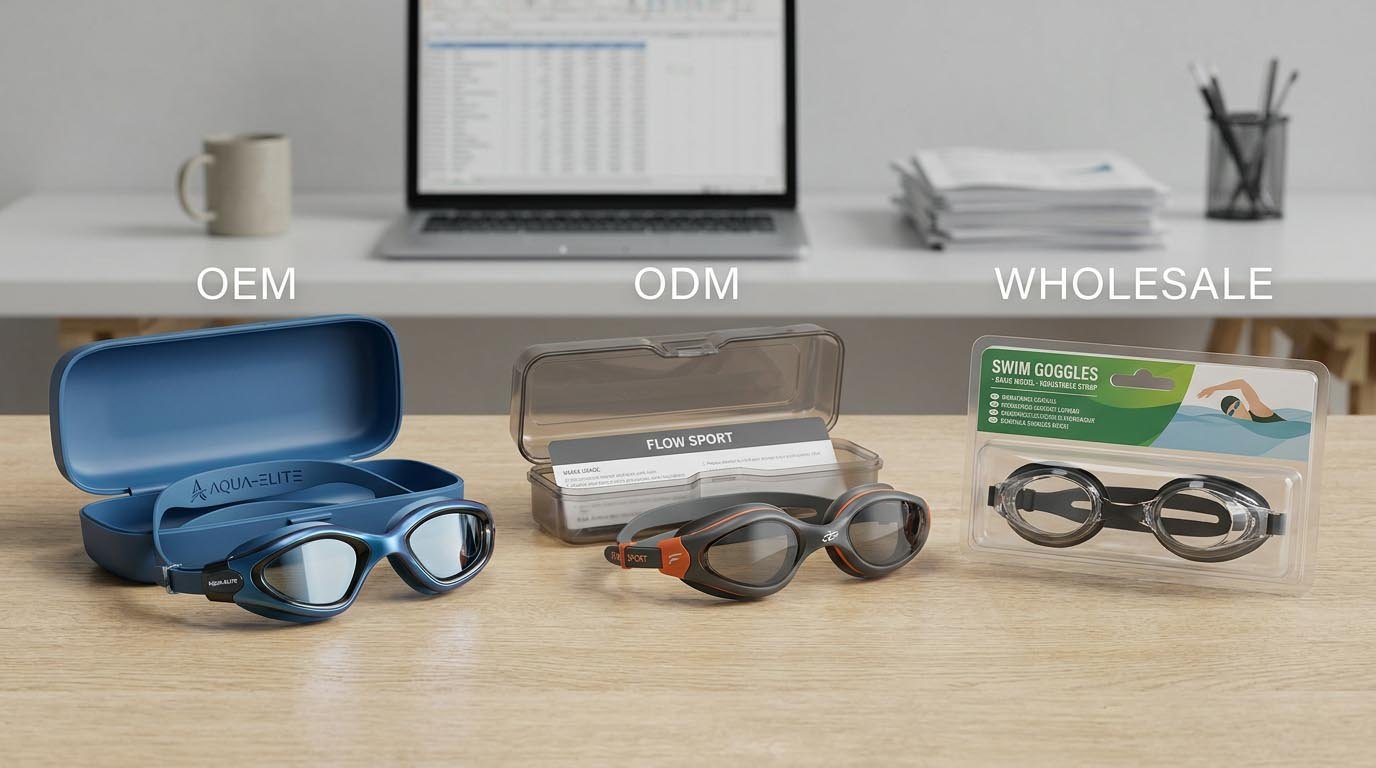
I work at Jerry as the order coordination lead. I talk with brand owners every week. Many arrive confused about these three models. They ask if they can "test 1,000 units first" in OEM. They wonder if ODM is just wholesale with a logo. These misunderstandings cause projects to fail before production even starts.
Quick Answers: OEM vs ODM vs Wholesale Swimming Goggles
What’s the core difference between OEM, ODM and wholesale swim goggles?
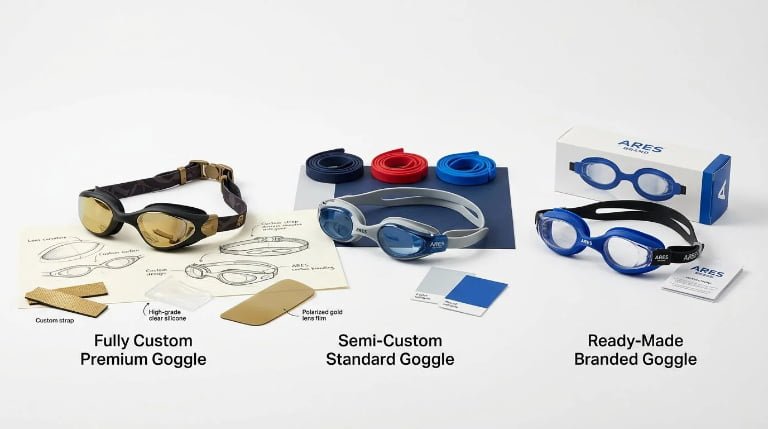
OEM means you design everything and we manufacture to your specs—requires tooling investment and high MOQs. ODM means you select from our existing designs and customize within safe limits. Wholesale means you buy our finished stock products with no customization beyond small logo additions.
Which model has the lowest MOQ and fastest delivery?
Wholesale has the lowest barrier: typically 500-1,000 pieces and ships within 2-4 weeks because products are already made. ODM usually requires 3,000-5,000 pieces and 8-12 weeks. OEM demands 10,000+ pieces and 16-20 weeks due to tooling and setup.
Can I own the design if I choose ODM?
No. ODM means you’re customizing our existing mold and design framework. We can sell similar products to other brands. Only OEM gives you full design ownership and exclusivity—because you’re paying for the tooling and development.
What happens if I want to change lens curvature in ODM?
You cross into OEM territory. ODM safe changes include colors, logo placement, strap adjustments and packaging. If you want to alter lens curvature, anti-fog coating formula or gasket shape, you’re requesting mold modifications—that requires new tooling and OEM-level investment.
How much does tooling cost for OEM swim goggles?
At Jerry, goggle mold tooling typically runs $8,000-$15,000 depending on complexity. Industry range is $6,000-$20,000. This cost must be amortized across your production run, which is why OEM MOQs start at 10,000 pieces—anything lower makes unit economics unsustainable.
Definitions: What OEM, ODM and Wholesale Mean in Swimming Goggles?
You hear these three terms everywhere. But what do they actually mean when you’re sourcing swim goggles? Each term describes a different relationship between you and the factory. They sound similar but lead to completely different outcomes.
OEM stands for Original Equipment Manufacturer. You design the product. You own the technical specs. You bring us drawings, material requirements and performance standards. We build the goggles exactly to your blueprint. ODM is Original Design Manufacturer—we already have designs and molds ready. You pick one and customize it within our existing framework. Wholesale means we manufacture standard products in advance. You buy from our inventory with minimal or no customization.
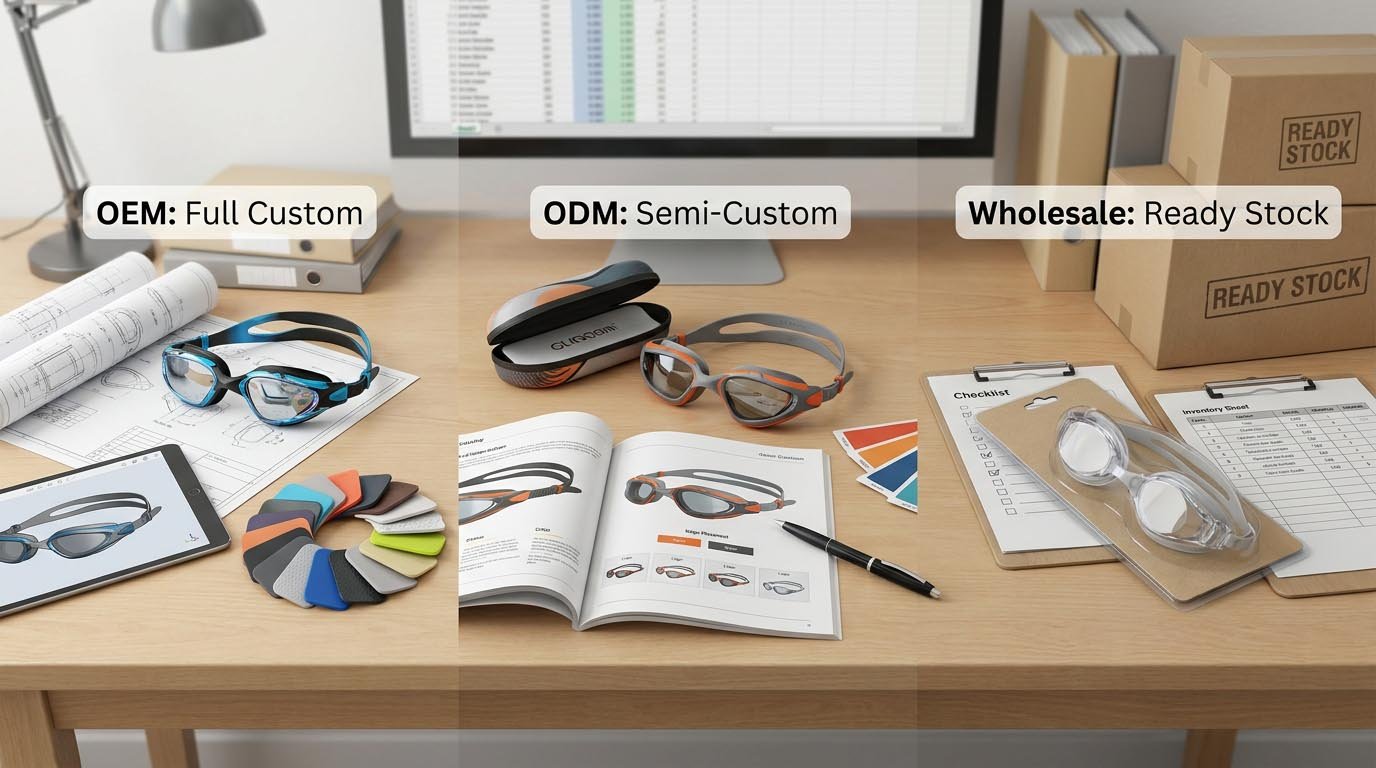
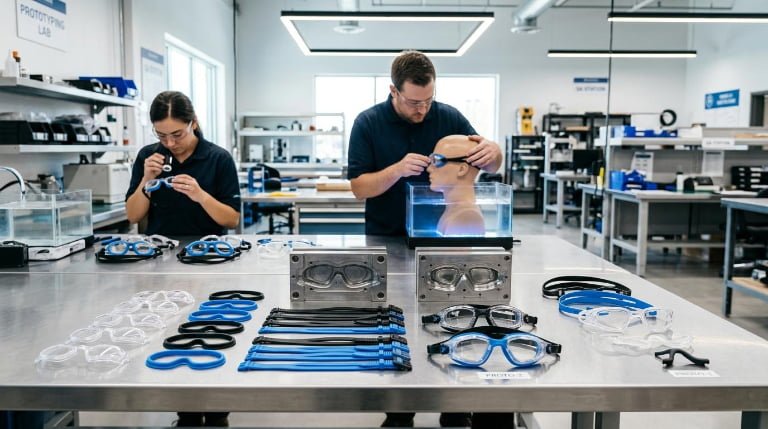
Let me break down what happens in each model at Jerry. When a brand approaches us for OEM, the conversation starts with their design files. Do they have CAD drawings? Have they selected lens materials and anti-fog coating specs? Do they know what silicone durometer they want for gaskets? If the answer is yes to all three, we can quote OEM. If they say "we have a sketch" or "something like this photo," they’re not ready for OEM—they need product development first, which adds $3,000-$8,000 and 8-12 weeks before tooling even begins.
ODM inquiries sound different. The client asks what goggle styles we currently produce. They want to see our catalog. They ask if they can change the lens color to match their brand palette, or swap our standard strap for a printed one. These are ODM signals. The client wants speed and lower risk. They’re willing to accept that other brands might buy similar base designs. I always ask: "Can you accept that competitors might use the same mold with different colors?" If they hesitate, ODM isn’t right for them.
Wholesale is the simplest path. The client needs goggles fast, often for an event, a retail test or a small online launch. They browse our stock SKUs. They ask about current inventory, lead time and the smallest order we’ll accept. Some ask if we can add their logo to the strap—we can, but only if it’s a simple pad print or heat transfer that doesn’t require mold changes. If they want to redesign the nose bridge or change the lens coating, they’ve outgrown wholesale.
Common Confusion I See
Here’s a typical inquiry I received last month. The client said "I want ODM." I asked if they had design files. They said no—they wanted us to design from scratch. That’s not ODM. That’s OEM with development work. Another client asked for "wholesale with customization." They wanted to change the lens shape and add anti-fog coating. That’s beyond wholesale scope—lens shape requires new tooling (OEM), and coating changes might need formula adjustments (OEM or advanced ODM).
The terms matter because they set expectations for:
- MOQ: Wholesale might start at 500-1,000 pieces. ODM typically requires 3,000-5,000. OEM demands 10,000+.
- Unit cost: Wholesale has the highest per-unit price. OEM has the lowest if you hit volume, but you pay tooling upfront.
- Control: OEM gives you full design ownership. ODM and wholesale don’t.
- Speed: Wholesale ships in weeks. ODM takes months. OEM takes quarters.
When you contact factories, you need to know which model matches your budget, timeline and control needs. Saying "I want custom goggles" doesn’t help us help you. We need to know: Do you have designs? What’s your target MOQ? Do you need exclusivity? Then we can recommend the right path.
Customization Levels: Design, Tooling, Materials, Coatings and Branding?
You want your swim goggles to stand out. You have brand colors. You want a specific logo placement. Maybe you want a unique lens tint or a softer gasket feel. The question is: how much can you customize in each model?
Wholesale offers cosmetic customization only—logo printing, basic packaging inserts and sometimes strap color selection from available stock. ODM allows design-layer changes within our existing mold architecture: you can adjust colors, coatings, strap styles and branding elements without altering the core structure. OEM gives you unlimited control—you define every material, every dimension and every feature, but you pay for tooling and development to make it real.
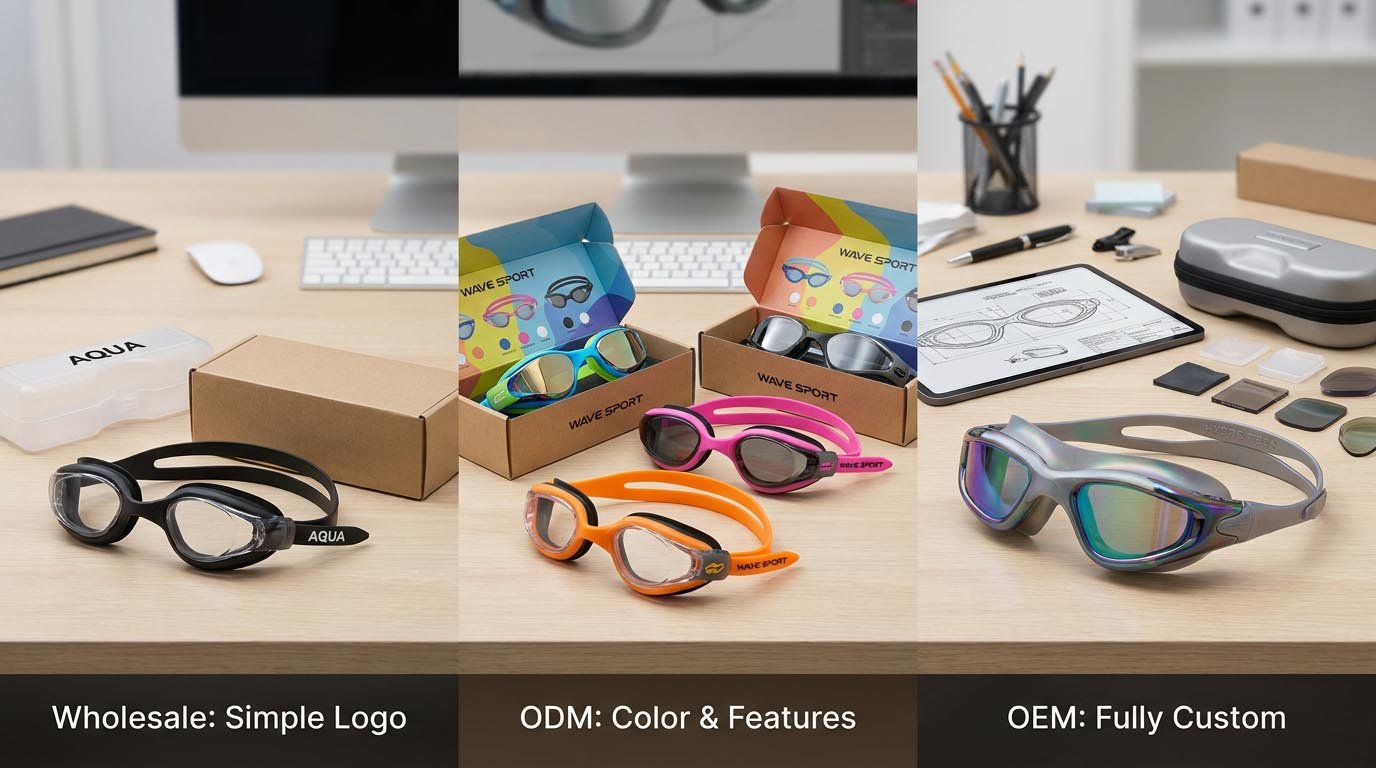
Let me show you the actual boundaries. At Jerry, wholesale customization is limited to what we can do without stopping production or changing molds. You can add your logo to the strap using pad printing or heat transfer—setup cost is around $200-$500 and adds 5-7 days to lead time. You can insert branded cards into packaging. You can sometimes choose from 2-3 available lens tints if we have inventory. That’s it. If you ask to change the nose bridge width or gasket softness, we have to decline—those require mold changes.
ODM customization has a safe zone and a danger zone. The safe zone includes:
- Color changes: Lens tint, frame color, strap color. We adjust pigment ratios in existing molds. Cost impact: $0.10-$0.30 per unit. MOQ: 3,000 pieces minimum because we need to run a dedicated batch.
- Logo and branding: Pad printing, laser etching, heat transfer on straps and cases. Setup: $300-$800. No mold changes needed.
- Strap style swaps: We have 4-5 strap designs in our system. You can pick one and match it to any goggle model. Small tooling fee if we need to adjust attachment points: $500-$1,200.
- Coating selection: We offer 3 anti-fog formulas and 2 UV protection levels. You pick from the menu. No extra cost if it’s a standard option.
- Packaging design: Fully custom boxes, inserts and hang tags. Costs vary: $0.50-$2.00 per unit depending on printing complexity.
The danger zone in ODM is when clients ask for changes that affect mold geometry or material formulas:
- Lens curvature or thickness: Requires new optical tooling. You’ve crossed into OEM.
- Gasket shape or silicone hardness: Needs mold modifications. OEM territory.
- Anti-fog formula adjustments: If our 3 standard options don’t work, custom formulation requires R&D and testing. That’s OEM-level development.
- Nose bridge width or angle: Mold change. OEM.
I’ve seen clients start with an ODM inquiry, then request 5-6 changes that all land in the danger zone. By the time we quote it, the cost approaches OEM because we’re essentially building custom tooling. That’s why I always ask upfront: "Which features are must-haves, and which are nice-to-haves?" If the must-haves require mold changes, we shift the conversation to OEM from the start.
OEM customization is total freedom—and total responsibility. You decide:
- Lens material and optical specs: Polycarbonate, PMMA or hybrid. UV400 rating, light transmission percentage, impact resistance standards.
- Gasket design: Shore A hardness (we typically use 30A-50A for swim goggles), multi-density molding, hypoallergenic additives.
- Frame geometry: Strap angle, nose bridge width, temple curvature. Every millimeter is yours to define.
- Coatings and treatments: Anti-fog chemistry, scratch resistance, mirror finishes. You can request custom formulas, but expect $2,000-$5,000 for development and testing.
- Component sourcing: You can specify branded buckles, premium silicone suppliers or proprietary strap materials.
The trade-off? You’re paying for all this freedom. Tooling for a goggle mold runs $8,000-$15,000 at Jerry. Industry range is $6,000-$20,000. If you want multi-cavity molds for faster production, add $3,000-$8,000. If your design requires complex undercuts or multi-material molding, costs rise further.
Here’s the decision filter I use: If you can describe your customization needs using our existing catalog as a starting point ("I want Model X but in navy blue with our logo"), that’s ODM. If you’re saying "I need the lens 2mm thicker and the gasket 3mm wider," that’s OEM. If you’re saying "just add our logo to whatever you have in stock," that’s wholesale.
Costs, MOQs and Lead Times: How Each Model Impacts Your Budget and Schedule?
You have a budget. You have a launch date. You need to know what each model will actually cost and how long it takes. This is where projects succeed or fail before production begins.
Wholesale has the highest unit cost but the lowest total investment and fastest delivery—expect $8-$14 per unit for stock goggles, 500-1,000 MOQ, and 2-4 weeks to ship. ODM lowers unit cost to $5-$10 but requires 3,000-5,000 MOQ, $500-$2,000 in setup fees, and 8-12 weeks lead time. OEM offers the best unit economics at $3-$7 per piece once you hit volume, but you pay $8,000-$15,000 upfront for tooling, commit to 10,000+ MOQ, and wait 16-20 weeks from design freeze to first shipment.
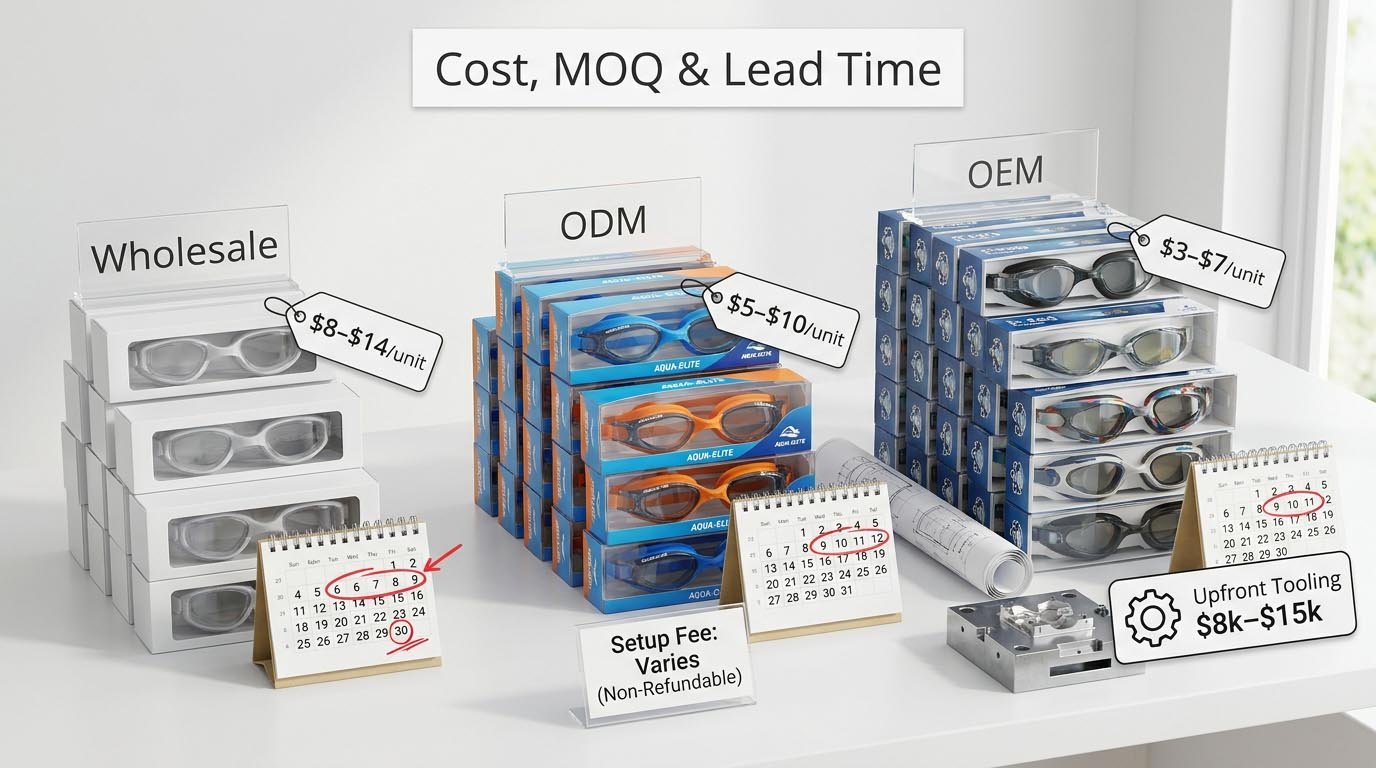
Let me walk through real numbers from Jerry’s pricing structure. These reflect our actual costs, not theoretical examples. For wholesale swim goggles from our stock catalog:
- Unit price: $8.50-$13.00 FOB, depending on features (mirrored lenses, premium anti-fog, silicone vs TPR gaskets)
- MOQ: 500 pieces per SKU (so if you want 3 colors, that’s 1,500 total)
- Setup cost: $200-$500 if you add logo printing
- Lead time: 2-4 weeks from order confirmation to port departure
- Payment terms: Usually 50% deposit, 50% before shipment
- Total investment for first order: $4,250-$6,500 for 500 units, all-in
This model makes sense if you’re testing a market, fulfilling a short-term contract or need goggles for an event. The cost per unit is high, but your total risk is under $7,000. You’re not stuck with 10,000 goggles if the product doesn’t sell.
ODM costs drop because we’re amortizing mold costs across multiple clients. Here’s our typical ODM structure:
- Unit price: $5.20-$9.80 FOB, depending on customization depth
- MOQ: 3,000-5,000 pieces (we prefer 5,000 for fully custom colors and coatings)
- Setup fees: $500-$2,000 covering color matching, logo tooling, packaging plates and first-article samples
- Lead time: 8-12 weeks (2-3 weeks for sampling, 1 week for approval, 4-6 weeks for production, 1 week for QC and packing)
- Tooling cost: $0 if you’re using our standard molds; $1,200-$3,000 if we need to create custom strap attachments or minor mold adjustments
- Total investment for first order: $17,600-$51,000 for 3,000-5,000 units, plus setup fees
Clients often underestimate ODM’s true floor. They think "3,000 MOQ" sounds manageable. Then they realize that’s $17,000-$30,000 committed before seeing market response. If you have $20,000 in working capital and you’re spending $18,000 on inventory, you have no cushion for marketing, shipping or iteration.
OEM economics look scary upfront but make sense at scale. Here’s a real OEM breakdown:
- Unit price: $3.50-$7.20 FOB at 10,000-piece volume (drops to $2.80-$5.50 at 50,000+)
- MOQ: 10,000 pieces minimum for first order (sometimes negotiable to 8,000 if mold setup is simple)
- Tooling cost: $8,000-$15,000 for goggle molds (includes design validation, mold fabrication, sampling and first-article testing)
- Development cost: $3,000-$8,000 if you need us to finalize designs from sketches or refine specs (optional if you have production-ready CAD files)
- Setup and sampling: $1,500-$3,000 for color standards, coating tests and pre-production samples
- Lead time: 16-20 weeks (2-4 weeks design finalization, 6-8 weeks tooling, 1-2 weeks sampling, 4-6 weeks production, 1 week QC)
- Total investment for first 10,000 units: $58,000-$87,000 all-in
The math works if you have distribution lined up or strong pre-orders. If you’re selling at $25-$40 retail and your landed cost is $6-$8 per unit, your margin supports marketing and growth. But if you launch with OEM and sales stall at 2,000 units in year one, you’re carrying 8,000 goggles in inventory and your tooling cost hasn’t been recovered.
Why 1,000-Unit Test Orders Don’t Work in OEM
This is the most common misconception I encounter. A client says: "I want to test the market with 1,000 units first. If it works, I’ll order 10,000 next time." This sounds logical. It’s not feasible in OEM. Here’s why:
- Tooling is a fixed cost. Whether you produce 1,000 or 10,000 units, the mold costs $10,000. That’s $10 per unit tooling cost at 1,000 pieces vs $1 per unit at 10,000.
- Production setup has a floor cost. We need to reserve injection machines, set up quality checkpoints, calibrate coating lines. These setup costs are $2,000-$4,000 regardless of batch size.
- MOQ is driven by efficiency. Our machines are designed for runs of 5,000-10,000 pieces. A 1,000-piece run means we’re starting and stopping frequently, wasting time and material.
If you absolutely need a small test batch in OEM, the unit cost becomes prohibitive. I’ve quoted 1,000-piece OEM orders before: the unit price jumps to $12-$18 because we’re amortizing tooling and setup over a tiny run. At that price, you might as well do ODM or wholesale.
Lead Time Reality Check
Clients often ask: "Can you do it faster?" The answer depends on where the time actually goes. In wholesale, 2-4 weeks is realistic because goggles are finished. We just need to print your logo and pack. In ODM, 8-12 weeks breaks down as:
- Weeks 1-2: Color and coating samples sent to you
- Week 3: You approve samples (or request adjustments, which adds 1-2 weeks)
- Weeks 4-9: Production (4-6 weeks depending on volume and our current queue)
- Week 10: QC inspection and packing
- Weeks 11-12: Shipping to port and customs clearance
We can shorten this to 6-8 weeks if you approve samples instantly and we have capacity, but it’s rare. In OEM, 16-20 weeks is non-negotiable for first orders. Tooling alone takes 6-8 weeks. If you’re on a tight deadline, OEM won’t work for your launch.
Quality, Compliance and IP: Standards, Testing and Ownership?
You need your goggles to meet safety standards. You want to protect your brand. You’re worried about competitors copying your designs. Each model offers different levels of quality assurance, compliance support and intellectual property protection.
Wholesale goggles come with factory-default certifications—you get what we already test for, typically CE, FDA and ISO standards, but you can’t request custom testing or exclusive quality protocols. ODM allows you to add specific tests (like ASTM impact or EN166 compliance) and request detailed inspection reports, but the core design remains our IP. OEM gives you full ownership of design IP, custom quality specs and the ability to enforce exclusivity, but you’re also responsible for ensuring compliance in your target markets.
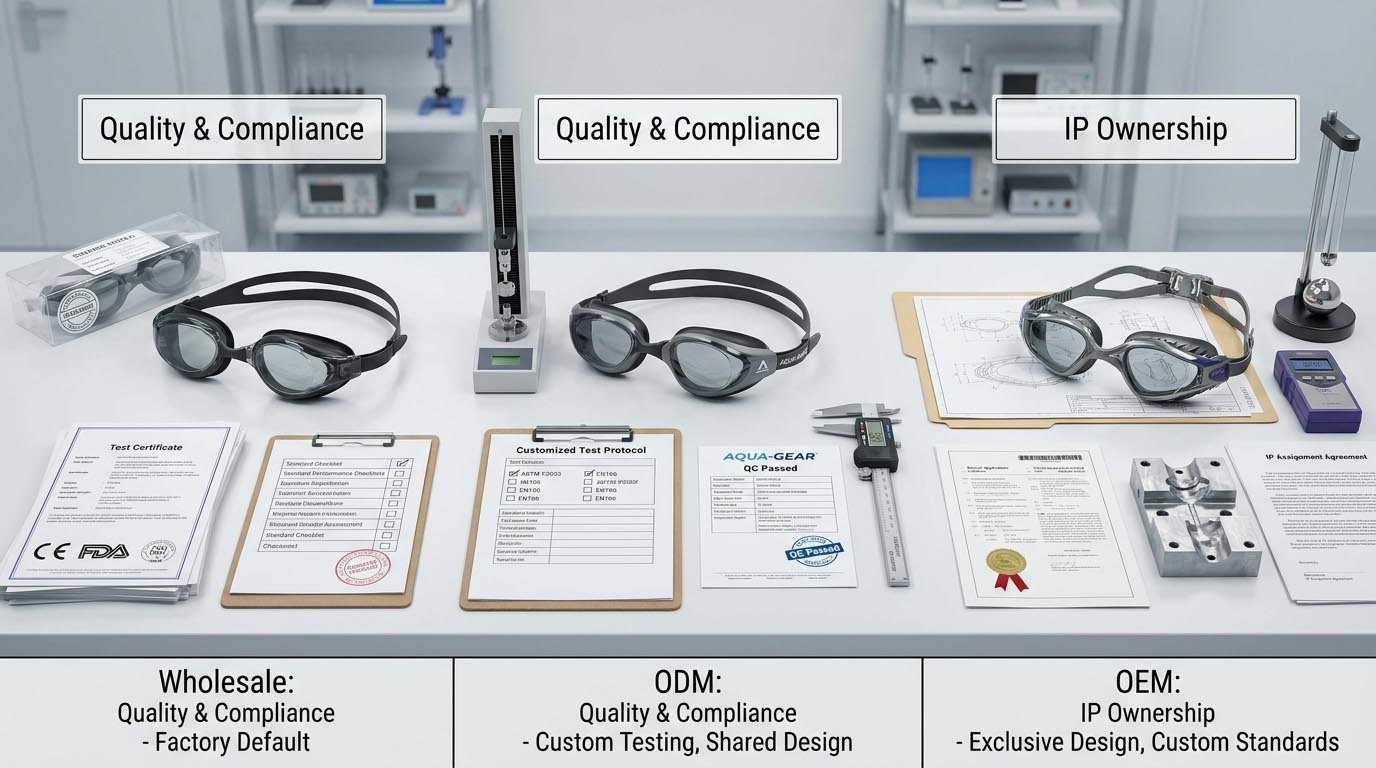
Let me explain how quality and compliance work at Jerry, then show you the IP differences. For wholesale, we test our stock goggles against standard swim goggle requirements:
- Impact resistance: ASTM F1827 or EN166 (if clients need it)
- UV protection: We use UV400 polycarbonate lenses and can provide test reports showing >99% UVA/UVB blocking
- Material safety: REACH compliance for EU markets, FDA food-grade silicone for gaskets, phthalate-free straps
- Anti-fog durability: Internal testing for 20+ swim sessions (we don’t claim specific standards here because anti-fog performance varies by water chemistry and user care)
You get copies of these test reports when you order. But you can’t request a custom drop test at -20°C or a prolonged UV exposure test for desert climates. The testing is fixed to what we’ve already done. If your market requires a specific standard we don’t cover (for example, Australia’s AS/NZS 1067 for sun protection), you’d need to arrange third-party testing yourself—and wholesale goggles might not pass if the design wasn’t built for that standard.
In ODM, you have more flexibility. You can request:
- Additional testing: If you need ASTM impact certification for US school teams, we can send samples to an accredited lab. Cost: $800-$2,000 per test protocol.
- Custom QC checklists: You want to inspect strap tensile strength, buckle break force or gasket shore hardness? We’ll add those checks. Setup: $300-$600 for calibration and documentation.
- Third-party inspection: You hire SGS, Bureau Veritas or Intertek to inspect before shipment. We coordinate the process. Cost: $300-$500 per inspection day.
- Compliance documentation: We provide material declarations, test reports and technical files to support your CE or FDA filings.
The limitation? You’re still using our base design. If the lens curvature doesn’t meet a specific optical standard in your market, you can’t change it without entering OEM territory. And if we discover a defect in our mold—say, a small sink mark that appears after 10,000 cycles—we’ll fix it, but that affects all clients using that mold, not just you.
OEM quality control is entirely in your hands. You define:
- Material specifications: You can require Japanese silicone suppliers, Zeiss polycarbonate or specific anti-fog chemistry from a named vendor.
- Performance standards: You set the pass/fail criteria. Strap break force must exceed X newtons. Lenses must pass Y cycles of abrasion. Gaskets must maintain seal at Z pressure.
- Testing protocols: You can request pilot production runs, accelerated aging tests, extreme temperature tests. We execute them and provide data. Cost: $1,000-$5,000 depending on complexity.
- Inspection levels: AQL 1.5, 2.5 or 4.0? Critical, major and minor defect definitions? You decide. We follow it.
The trade-off is responsibility. If you specify a silicone that’s too soft and gaskets deform in shipping, that’s your design decision. If your anti-fog coating formula performs poorly in chlorinated pools, you own that outcome. We’ll warn you if we see problems during development, but final accountability is yours.
IP Ownership: Who Owns the Design?
This is where brands get blindsided. In wholesale, we own everything. You’re buying finished goods. You can’t prevent us from selling the same goggles to other brands—including your competitors. Last year, I worked with two brands in the same country who unknowingly bought the same wholesale model from us. One sold on Amazon, the other in retail stores. When they discovered it, the retail brand was frustrated—they felt their "unique" product was now generic.
In ODM, we still own the mold and core design. You own:
- Your brand name and logo (obviously)
- Custom colors and finishes you specified (but we can sell the same base goggle in different colors to others)
- Packaging design and graphics (if you created them)
You don’t own:
- The mold or tooling (we paid for it, we maintain it)
- The base goggle design, lens shape or structural features
- The right to exclusivity (unless you negotiate a contract clause, which typically requires volume commitments of 50,000+ pieces per year)
I’ve seen brands spend $20,000 customizing ODM goggles—unique colors, premium coatings, custom packaging—then discover a competitor launched a similar product using the same mold with minor tweaks. Legally, we’re within our rights. Ethically, it feels bad for the client. But that’s ODM economics: shared tooling means shared access.
OEM is the only model where you own the design. If you pay for tooling, it’s legally yours (ensure this is explicit in your contract). You can:
- Demand exclusivity: We won’t sell that design to anyone else.
- Control the mold: If you switch factories, you can request mold transfer (usually $1,000-$3,000 for shipping and re-commissioning).
- Patent or design-protect the product: You own the IP needed to file design patents or trademarks on unique features.
At Jerry, our OEM contracts state: "Tooling ownership transfers to the client upon full payment. We will not produce or sell the design to third parties without written consent." This is industry-standard for reputable factories. If a factory refuses to give you tooling ownership after you’ve paid for it, walk away.
Which to Choose: Brand Scenarios, Trade‑offs and a Quick Decision Checklist?
You’ve read the definitions, costs and trade-offs. Now you need to decide. Which model actually fits your situation? Let me show you how I guide clients through this decision at Jerry.
Choose wholesale if you’re testing demand, launching fast or lack capital to commit to large MOQs—it’s the lowest-risk entry point but caps your margins and leaves you vulnerable to competitors. Choose ODM if you have $20,000-$50,000 budget, want brand identity without design risk, and can accept that others might use similar base products. Choose OEM if you have $60,000+ budget, need design exclusivity, plan to sell 20,000+ units per year and want the lowest long-term unit cost.
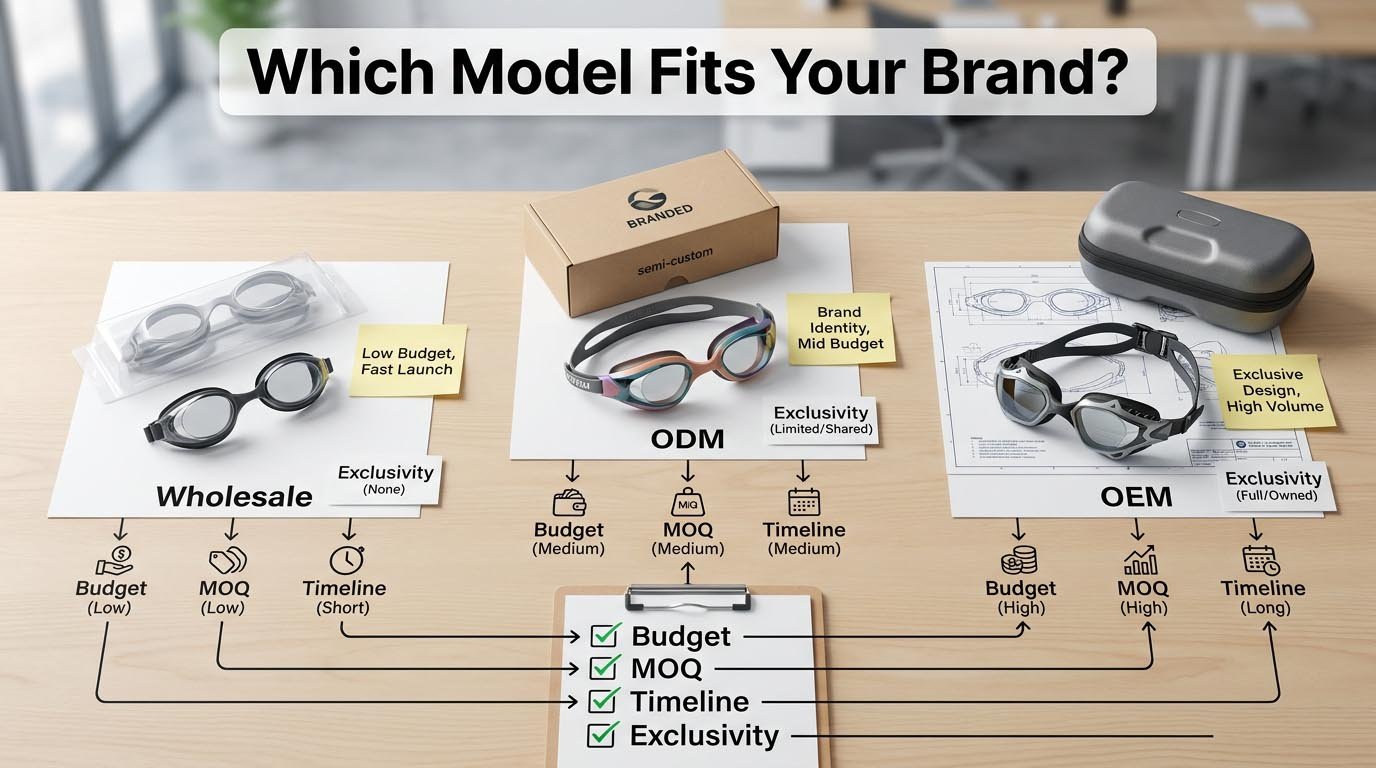
Let me walk through real scenarios I’ve handled. Scenario 1: You’re launching a swim club retail brand. You have $10,000 in startup capital. You secured a partnership with 5 local swim schools who’ll stock your goggles. Estimated year-one sales: 2,000-3,000 units. You need goggles in 8 weeks for the season start.
My recommendation: Wholesale or light ODM. Here’s why:
- Your budget can’t cover OEM tooling ($8,000-$15,000) and still leave money for marketing and inventory.
- Your sales projection of 2,000-3,000 units can’t amortize tooling costs effectively.
- Your timeline of 8 weeks rules out OEM (16-20 weeks minimum).
I’d suggest: Order 1,000 pieces from our wholesale catalog in 2-3 colors. Add your logo via pad printing ($300 setup). Total cost: $9,000-$13,000 all-in. If the schools respond well, scale to ODM with 3,000-piece orders in year two when you have sales data.
Scenario 2: You’re an established online brand expanding into swim. You currently sell running and cycling gear. Your email list has 15,000 subscribers. You project 8,000-12,000 goggle sales in year one across 4 SKUs. Budget: $50,000 for swim category launch.
My recommendation: ODM. Here’s the logic:
- You have budget for $17,000-$25,000 in inventory per SKU without overextending.
- You have existing distribution (your website, email marketing) so you’re not starting from zero.
- You want brand differentiation but don’t need radical design innovation.
I’d recommend: Choose 2 of our ODM base models. Customize colors to match your brand palette. Add anti-fog coating upgrade. Custom packaging with your brand story. Order 5,000 pieces per model (10,000 total). Unit cost: $5.80-$7.20. Total: $58,000-$72,000 including setup fees. You’d be slightly over budget, but the per-unit economics make sense if your retail price is $28-$40.
Scenario 3: You’re a European distributor with retail contracts. You have confirmed purchase orders for 25,000 goggles from sports retailers. They want unique designs they can’t get from other suppliers. You have $120,000 allocated for this product line.
My recommendation: OEM. You have the volume, budget and need for exclusivity:
- Your PO volume of 25,000 units amortizes tooling to $0.40-$0.60 per unit.
- Your budget of $120,000 covers tooling ($12,000), development ($5,000) and 25,000 units at $4.00-$4.50 FOB.
- Your retail partners want exclusive products—OEM is the only model that guarantees no competitor gets the same design.
I’d propose: Develop 2-3 unique goggle designs based on your market research. Full OEM process. Tooling: $10,000-$14,000 per design. Production: $4.20 per unit at 25,000 volume. Timeline: 18-20 weeks. Total investment: $115,000-$130,000 (slightly over, but you negotiate payment terms to spread cash flow).
Decision Checklist I Use
When brands contact Jerry, I ask these questions in order:
-
Do you have production-ready design files (CAD, technical drawings)?
- Yes → OEM is possible
- No → ODM or wholesale (OEM requires design development first, adding $3,000-$8,000 and 8-12 weeks)
-
What’s your realistic first-order budget (all-in, including tooling and setup)?
- Under $15,000 → Wholesale only
- $15,000-$50,000 → ODM
- Over $50,000 → OEM becomes viable
-
What’s your target MOQ for the first order?
- Under 2,000 units → Wholesale
- 2,000-7,000 units → ODM
- 7,000+ units → OEM (though 10,000 is safer for first-time OEM)
-
Do you need design exclusivity (no competitors can buy similar products)?
- Yes, critical → OEM only
- Nice to have but flexible → ODM with volume-based semi-exclusivity
- Not important → Wholesale
-
What’s your timeline to first shipment?
- Under 6 weeks → Wholesale only
- 6-12 weeks → ODM
- 12+ weeks → OEM
-
What’s your year-one sales projection?
- Under 5,000 units → Wholesale or ODM
- 5,000-15,000 units → ODM
- 15,000+ units → OEM makes economic sense
If your answers align with one model, the decision is clear. If you’re borderline (for example, $45,000 budget and 6,000-unit target), I usually recommend ODM for the first order, then transition to OEM in year two when you have market validation and can commit to 15,000+ units.
Common Trade-offs Clients Miss
"We’ll start with ODM, then switch to OEM later." This works, but you can’t directly transfer ODM designs to OEM—you’d need new tooling anyway. ODM is a stepping stone for market testing and brand building, not a prototype for future OEM production.
"We’ll do wholesale to test, then scale to OEM." Smart risk management. But recognize that wholesale unit cost is 2-3x higher than OEM. Your retail pricing and margins in the test phase won’t reflect your long-term economics. Don’t over-optimize pricing during wholesale testing—you’ll confuse customers when you later lower prices after switching to OEM.
"Can we split the order across models?" I sometimes get asked: "Can we do 500 wholesale, 2,000 ODM and lock in OEM tooling for later?" This fragments your budget and doesn’t save money. Pick one path per product category. If you’re launching 3 different goggle styles (kids, adults, performance), you could do wholesale for one, ODM for another and OEM for the third—but each should have its own budget and sales plan.
FAQ: OEM vs ODM vs Wholesale Swimming Goggles
Can I switch from ODM to OEM later without paying for new tooling?
No. ODM uses our existing molds. If you want OEM, you’re creating new tooling from scratch—even if the design looks similar to the ODM version you started with. You can use ODM products as market validation before committing to OEM, but there’s no cost transfer. The only exception: if we offer a "tooling buyout" option where you pay to own an existing ODM mold exclusively, but this typically costs $12,000-$20,000 and we rarely offer it unless you’re committing to very high volumes.
How do I protect my brand if I choose wholesale or ODM?
Focus on what you can control: your brand story, marketing, customer service and distribution channels. Wholesale and ODM don’t give you design exclusivity, so your differentiation must come from brand positioning. I’ve seen brands succeed with wholesale goggles by building strong communities, offering superior packaging or bundling goggles with training content. If design exclusivity is truly critical, you need OEM—there’s no workaround.
What happens if I order ODM and want to make changes after the first production run?
It depends on the change. If you want different colors or strap styles for the second order, that’s easy—we just adjust settings. If you want to change lens curvature or gasket shape, you’re requesting mold modifications, which means OEM-level investment. Always discuss changes during the sampling phase, not after production. Making changes mid-run can delay delivery by 2-4 weeks and add $500-$2,000 in adjustment costs.
Do I need separate certifications for each model (OEM, ODM, wholesale)?
Certifications follow the product, not the business model. If you buy wholesale goggles that are already CE and FDA certified, you can use those certs (we provide documentation). If you do ODM or OEM, the goggles need their own testing if the design changes significantly. For example, if ODM uses our certified base model but you add a different coating, you may need to retest the coating’s skin-contact safety (REACH, FDA). If you’re doing OEM with a fully new design, expect to budget $2,000-$5,000 for comprehensive testing (impact, UV, material safety). Always check target market requirements—EU, US, Australia and Japan have different standards.
Can I order samples before committing to MOQ?
Wholesale: Yes, we sell samples at retail price ($12-$20 per unit plus shipping). No customization on samples.
ODM: Yes, we provide 2-5 pre-production samples showing your custom colors and branding. Cost: $50-$150 per sample (covers setup). Sampling adds 2-3 weeks to lead time.
OEM: Yes, but sampling happens after tooling is complete. We produce 5-10 first-article samples from the new mold. You approve or request adjustments (which may require mold tweaks, adding 2-4 weeks). Sampling is included in tooling cost, but if you want extensive revisions, expect $1,000-$3,000 per iteration.
What if my ODM order doesn’t sell and I’m stuck with inventory?
This is the core risk in ODM and OEM. Factories don’t offer returns or buybacks (unlike retail suppliers). Your options:
- Liquidate: Sell remaining inventory to discount retailers or online liquidators at 30-50% of your cost.
- Rebrand: If you have another brand or channel, repackage and sell under a different label.
- Donate: Write off the loss and donate to swim clubs or schools (you get a tax deduction, they get free goggles).
The best protection is conservative forecasting. If you project 5,000 sales in year one, order 3,000 for the first batch. You can always reorder ODM (8-12 weeks lead time). Running out of stock is better than sitting on 2,000 unsold units.
How do payment terms differ across models?
Wholesale: We usually require 50% deposit, 50% before shipment since order values are low ($5,000-$15,000) and risk is manageable.
ODM: 30% deposit, 70% before shipment is standard. For larger orders ($40,000+), we sometimes offer 30% deposit, 40% mid-production, 30% before shipment.
OEM: Tooling is paid separately, usually 50% at tooling start, 50% at tooling approval. Production follows standard terms (30/70 or 30/40/30). For first-time OEM clients with large orders, we may request 40% deposit, 60% before shipment until we establish trust.
Always negotiate payment terms before signing. If cash flow is tight, ask if we can split payments or extend the balance window by 15-30 days. Reputable factories will work with you if you’re transparent about your financial situation.
Conclusion
OEM, ODM and wholesale are not equal choices. They are distinct paths shaped by your budget, MOQ capacity and control needs. Choose the model that matches your reality, not your ideal vision.