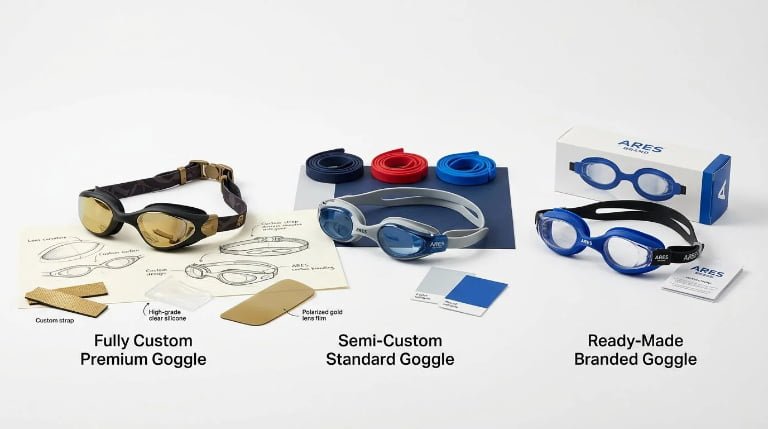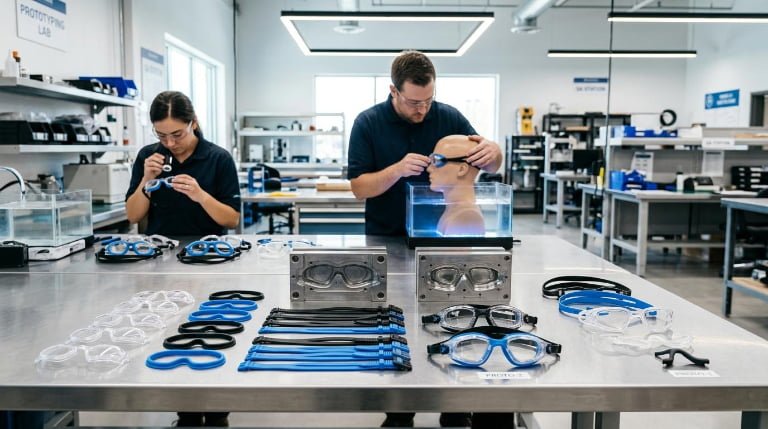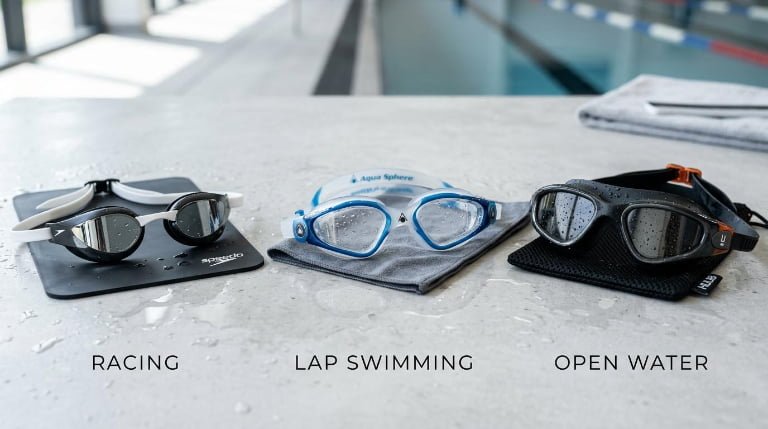
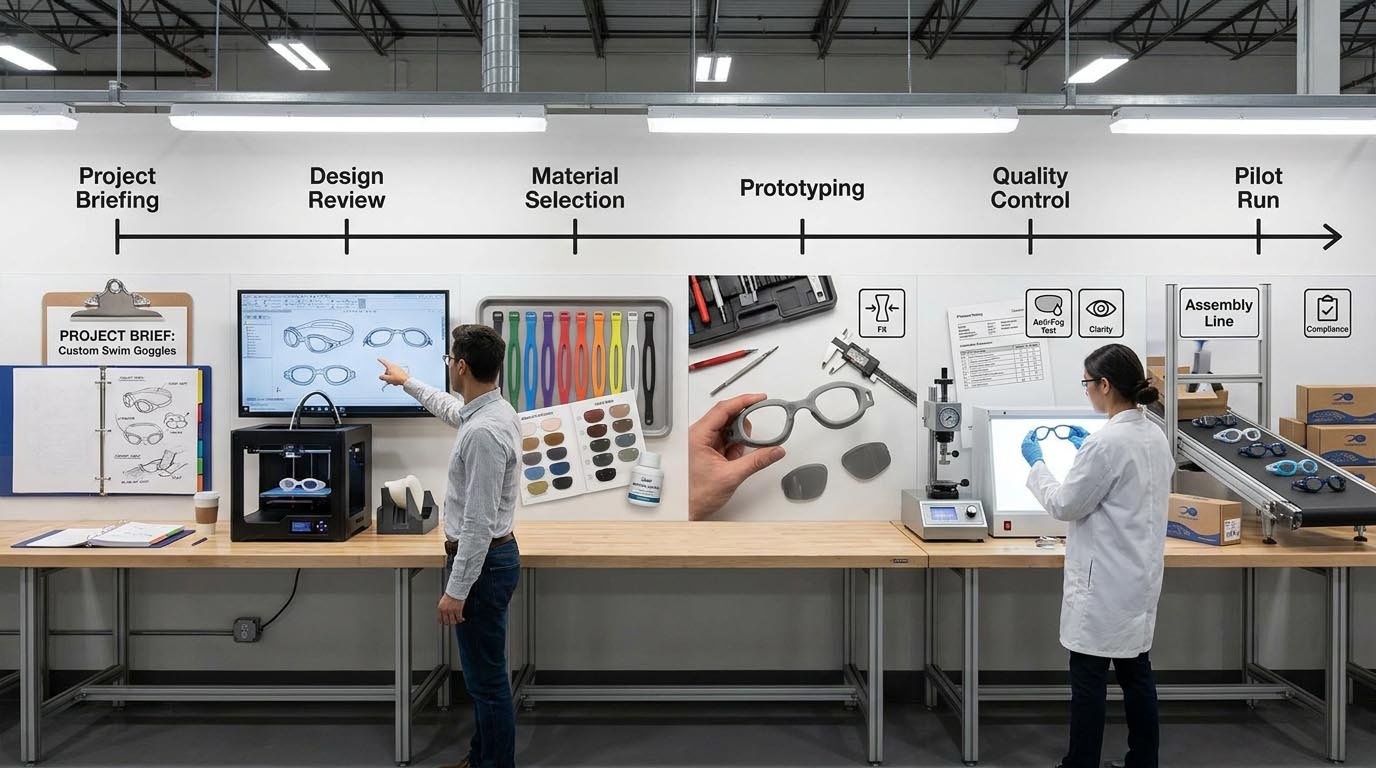
If you want to develop private label or custom swimming goggles, the OEM process usually includes six stages: project brief and quotation, design and engineering review, material and coating selection, prototyping and validation, compliance and quality control, and pilot run before mass production.
For most projects, the full swimming goggles OEM process takes around 90 to 120 days, depending on product complexity, mold requirements, testing scope, and order quantity. The main goal is not just to make a sample. It is to ensure the goggles can be produced consistently with the right fit, anti-fog performance, lens clarity, durability, and compliance documentation.
This guide explains how OEM swimming goggles are made, what happens at each stage, typical timeline and tooling requirements, and how buyers can avoid common development mistakes.
Quick Answers: Swimming Goggles OEM Process
Here are the questions most buyers ask first.
What is the OEM process for swimming goggles?
The OEM process for swimming goggles usually covers product brief, design review, mold development, prototype testing, compliance checks, pilot production, and mass production.
How long does swimming goggles OEM production take?
A full OEM project usually takes 90-120 days from concept to mass production, although simple private label projects based on existing molds may be faster.
What is the MOQ for OEM swimming goggles?
MOQ depends on customization depth. Selected private-label projects based on existing models can start from around 300 pieces, while custom-color projects can start from around 600 pieces. Deeper OEM projects involving structural modifications, special components, or new tooling are quoted individually.
Do custom swimming goggles require new molds?
If the project changes the product structure, lens geometry, gasket shape, buckle system, or other physical features, new molds or tooling changes are usually required.
What materials are commonly used in swimming goggles?
Most quality swim goggles use polycarbonate (PC) lenses, plus silicone or TPR gaskets and straps, depending on comfort, price point, and target market.
What tests are done before mass production?
Common checks include fit testing, leak testing, anti-fog evaluation, optical clarity review, material safety checks, and production quality inspections.
Swimming Goggles OEM Process at a Glance
The table below shows the standard development path from idea to finished product.
| Stage | What Happens | Typical Time | Main Output |
|---|---|---|---|
| 1. Project Brief & RFQ | Define product goals, specs, MOQ, price target | 1-2 weeks | Confirmed project brief |
| 2. Design & Engineering | Review lens shape, gasket structure, DFM, mold feasibility | 2-3 weeks | Engineering drawings |
| 3. Material & Coating Selection | Select lens material, gasket type, anti-fog and UV options | 1-2 weeks | Approved material plan |
| 4. Prototype & Validation | Create samples, test fit, seal, optics and performance | 2-4 weeks | Approved prototype |
| 5. Compliance & QA Planning | Confirm test standards, QC checkpoints, packaging requirements | 2-3 weeks | QA and compliance plan |
| 6. Pilot Run & Mass Production | Trial run, inspection, production approval, bulk manufacturing | 2-4 weeks | Shipment-ready goods |
For fully custom swimming goggles, some stages may overlap, but delays in design approval or sample feedback can extend the full timeline.
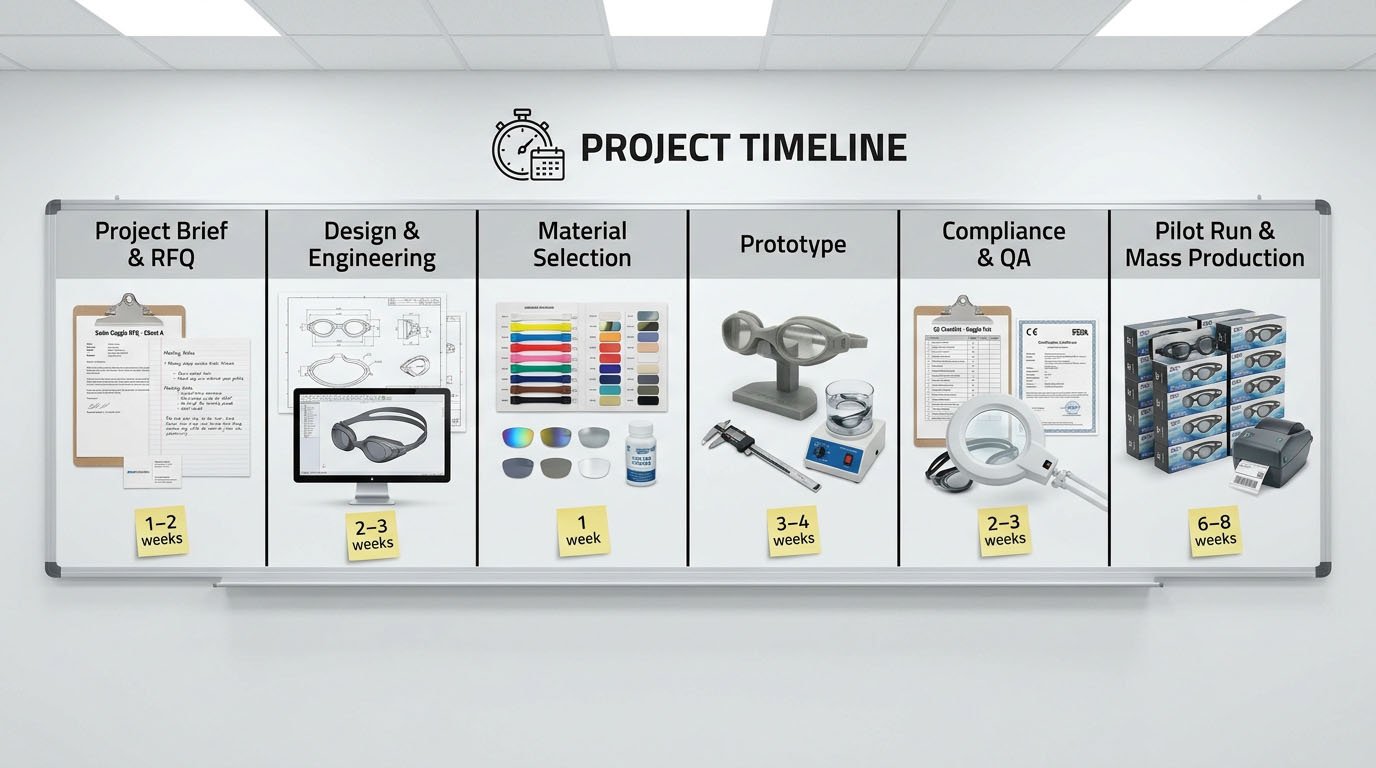
Stage 1: Project Brief, RFQ and Timeline Planning
Every successful OEM project starts with a clear product brief.
Before a factory can quote accurately, it usually needs to know:
- Target market
- Product positioning
- Intended use, such as training, racing, kids, or open-water swimming
- Target retail price
- Estimated order quantity
- Required certifications
- Packaging expectations
- Whether the project is based on an existing design or a new concept
What should be included in a swimming goggles RFQ?
A useful RFQ for OEM swimming goggles should include:
- Reference photos or sketches
- Preferred lens type
- Gasket material preference
- Strap style
- Color requirements
- Branding details
- Packaging format
- Target launch date
- Sales market, such as EU, USA, Amazon, retail, or club distribution
The clearer the RFQ, the easier it is to estimate cost, tooling needs, and realistic lead time.
Typical OEM timeline planning
Many delays happen because buyers focus only on the target ship date and not on the approval steps in between.
A practical OEM timeline usually includes:
- Product brief confirmation
- Design and DFM review
- Mold fabrication or mold modification
- Sample production
- Fit and leak testing
- Packaging approval
- Compliance or lab testing
- Pilot run
- Final production approval
For a simple private label project using existing molds, the cycle may be shorter. For fully custom swimming goggles with new tooling, the timeline is usually much longer.
Stage 2: Design and Engineering Review
The next step is translating a product idea into something that can be manufactured consistently.
Design is not only about appearance. It affects comfort, seal performance, lens clarity, production yield, and mold cost.
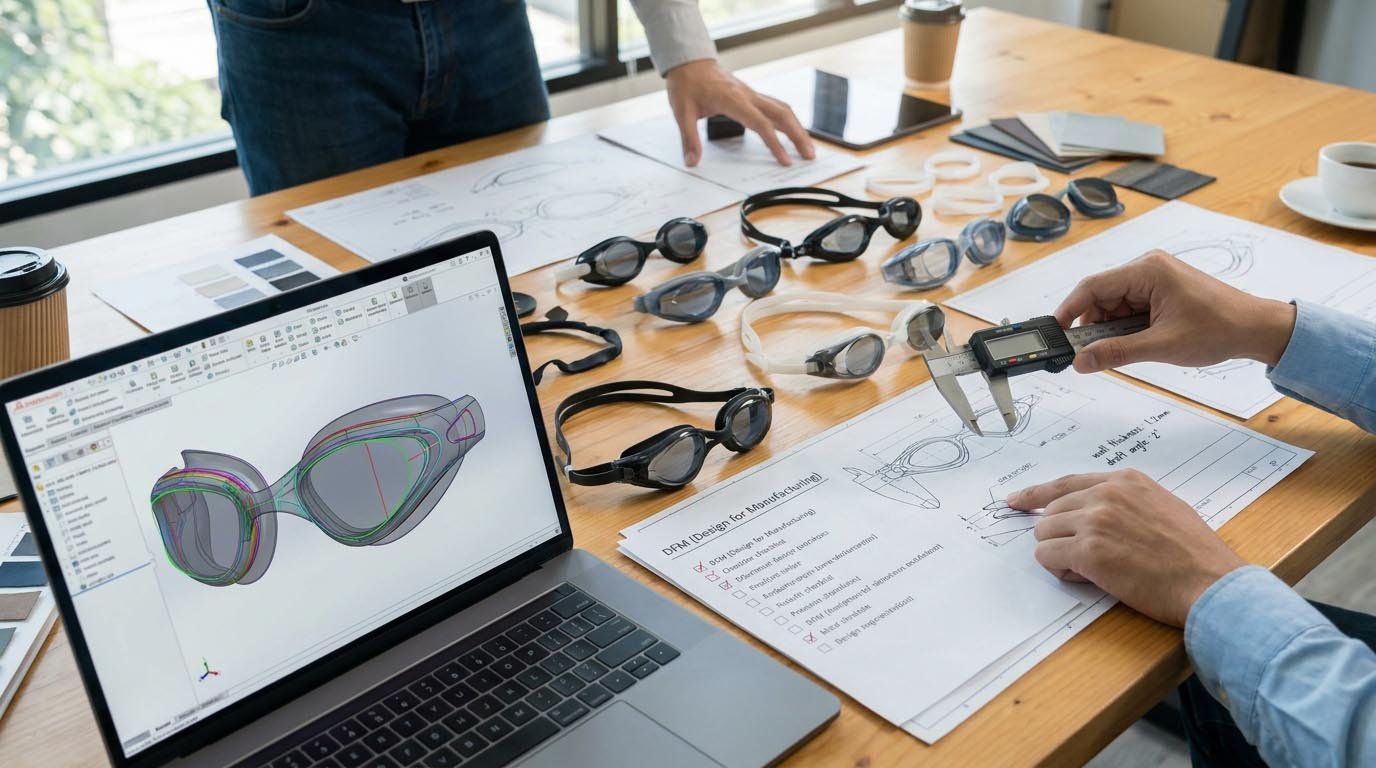
What engineering decisions matter most?
For swimming goggles, the most important design factors usually include:
- Lens geometry
- Lens thickness
- Frame profile
- Gasket shape and softness
- Nose bridge structure
- Strap attachment system
- Buckle or size adjustment mechanism
A design that looks attractive on paper may still fail during prototyping if it creates:
- Uneven pressure around the eyes
- Poor seal on different face shapes
- Optical distortion
- Difficult mold release
- Visible sink marks, weld lines, or flow marks
Why DFM matters in swim goggle production
DFM means Design for Manufacturing. It is the engineering review that checks whether the product can be made efficiently and consistently.
Typical DFM checks include:
- Wall thickness consistency
- Draft angles for mold release
- Gate location
- Undercut risks
- Parting line placement
- Assembly tolerance
- Surface finish feasibility
For example, a highly curved lens may improve field of view, but it may also increase tooling complexity and make optical consistency harder to control. A gasket that is too soft may feel comfortable, but it may not hold shape during long-term use or assembly.
This is why good OEM development is not just sketch approval. It is an engineering process.
Stage 3: Material and Coating Selection
Material choice has a direct effect on safety, performance, user comfort, and product claims.
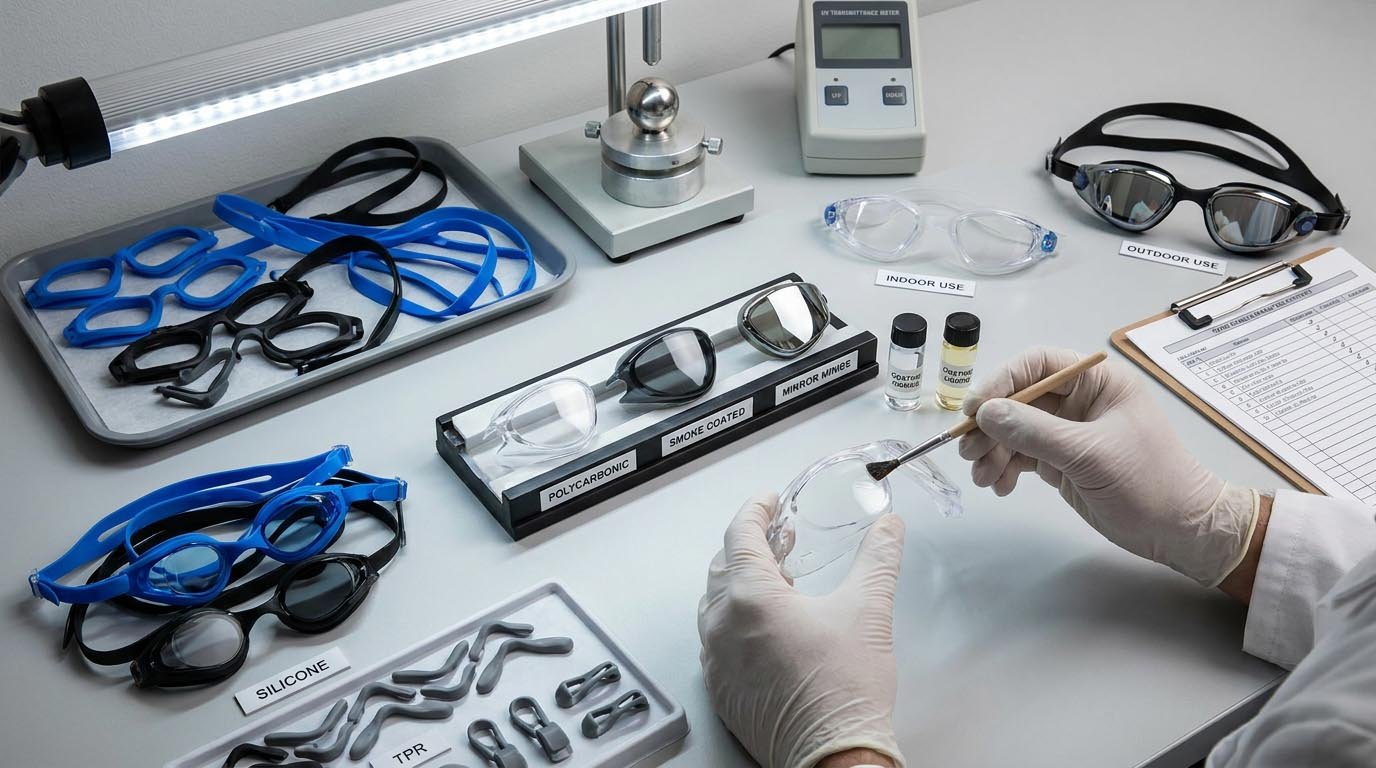
What materials are used in OEM swimming goggles?
Most OEM swimming goggles use these core materials:
Polycarbonate lenses
Polycarbonate, or PC, is commonly used because it offers:
- Good impact resistance
- High optical clarity
- Compatibility with anti-fog treatments
- Suitability for UV-resistant formulations
Silicone gaskets and straps
Silicone is often used for:
- Better softness and comfort
- More flexible sealing
- Premium product positioning
TPR gaskets and straps
TPR may be used when buyers want:
- Lower cost
- Faster scaling for entry-level products
- Acceptable comfort for mass-market styles
Material selection often depends on the target customer, price point, and regulatory market.
How anti-fog treatments are selected
Anti-fog performance is one of the most important product expectations in swim goggles.
Common anti-fog approaches include:
- Surface dip coating
- Surface activation plus coating
- More durable treatment systems depending on factory capability and lens specification
Actual durability depends on:
- Lens material grade
- Lens shape and curvature
- Coating method
- Curing process
- How the end user handles and cleans the goggles
What about UV protection?
For outdoor or open-water use, buyers often request UV protection. This is usually achieved through lens material formulation or specification rather than a simple cosmetic add-on.
When discussing material options with a factory, buyers should clarify whether they need:
- Clear lenses
- Tinted lenses
- Mirror coating
- Smoke lenses
- Indoor training lenses
- Outdoor lenses with UV protection
Stage 4: Prototype Development and Validation
Prototype development is where the project moves from concept to physical testing.
This stage is critical because small fit or sealing problems are much cheaper to fix before mass production than after tooling and bulk assembly are locked.
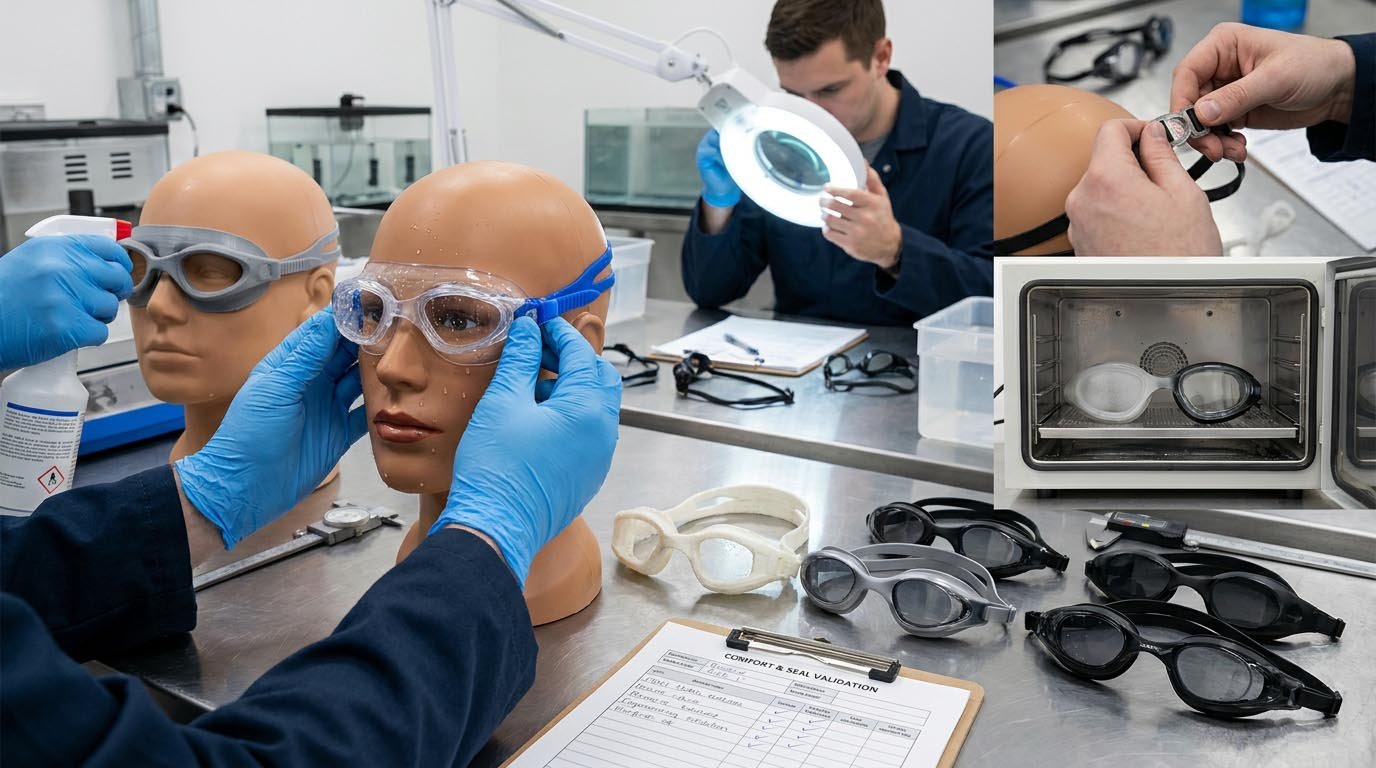
What types of prototypes are used?
Depending on the project, prototype stages may include:
- 3D-printed visual models
- Appearance samples
- Soft-tool injection samples
- Pre-production engineering samples
A simple appearance sample can help confirm shape and branding. However, it does not fully replace molded functional samples for testing seal performance, optics, and assembly accuracy.
What is tested during validation?
Typical validation checks include:
Fit testing
The goggles are tested on different face shapes to evaluate:
- Comfort
- Eye socket pressure
- Stability during movement
- Gasket contact consistency
Leak testing
The seal is checked to see whether the goggles maintain proper contact without water intrusion.
Optical review
The lens is checked for:
- Clarity
- Distortion
- Coating consistency
- Visual defects
Strap and buckle durability
The adjustment system should hold tension and survive repeated use.
Anti-fog performance review
The coating or treatment is evaluated under real-use or simulated conditions.
Skipping this stage can create expensive problems later, especially if the mold must be modified after bulk tooling is complete.
Stage 5: Compliance Testing and Quality Assurance Planning
Before mass production starts, buyers should confirm what standards and documentation are required for the target market.
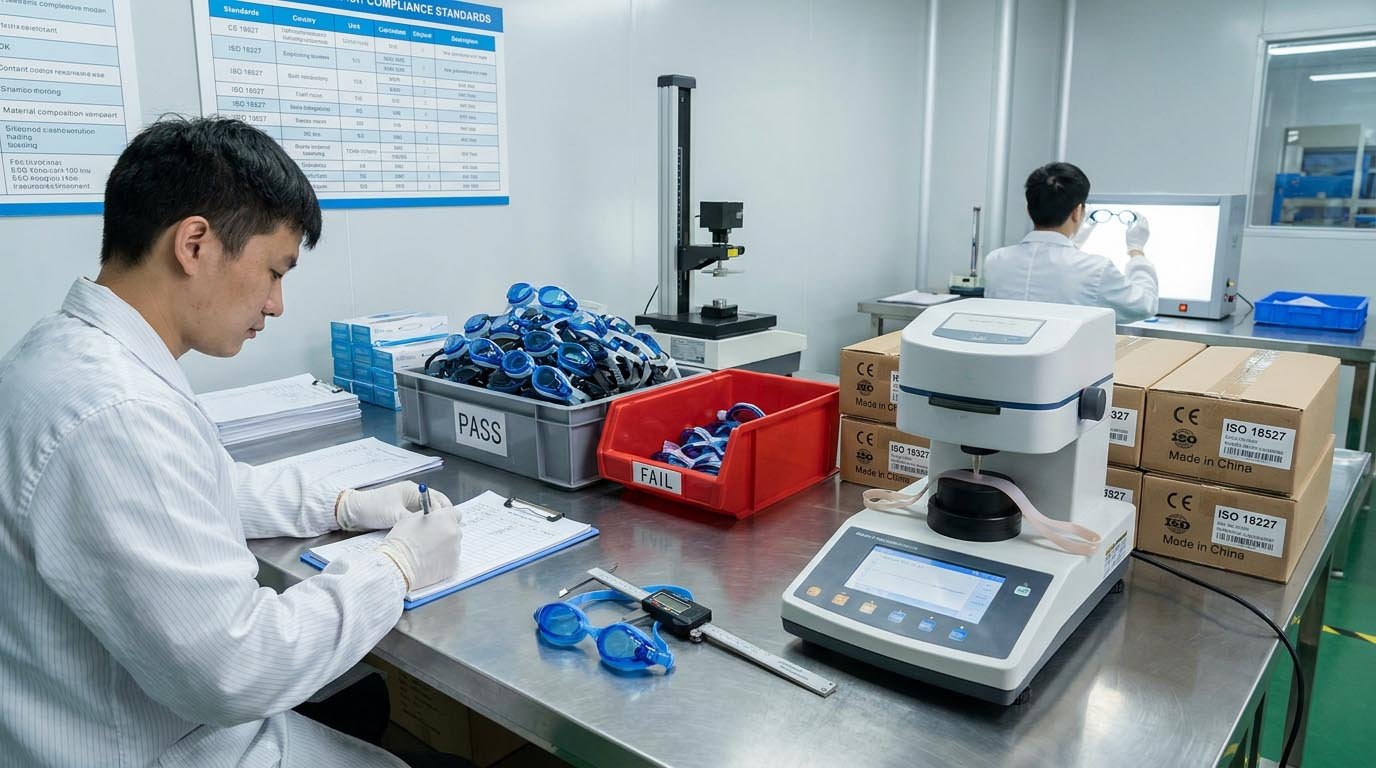
What certifications or compliance checks may apply?
Requirements vary by market, but common areas may include:
- Material safety compliance
- REACH checks for EU markets
- CPSIA-related checks for children’s products in the US
- Packaging labeling requirements
- Marketplace documentation requirements
- Product performance verification where required
Buyers selling through Amazon, retail chains, or distributors should always verify documentation expectations before production begins.
How QA should be planned before production
Quality assurance should not start only after goods are finished.
A good OEM project typically defines QC checkpoints at several stages:
- Incoming raw material check
- In-process molding inspection
- Coating inspection
- Assembly inspection
- Packaging verification
- Final random inspection
It is also useful to define:
- Critical defects
- Major defects
- Minor defects
- Acceptable AQL level
- Approved reference sample
- Tolerance for dimensions and appearance
This reduces disputes later and helps both buyer and factory work from the same quality standard.
Stage 6: Pilot Run and Mass Production
Before full-scale production begins, many factories run a small pilot batch.
The purpose of the pilot run is to verify that the approved sample can be reproduced consistently under actual production conditions.
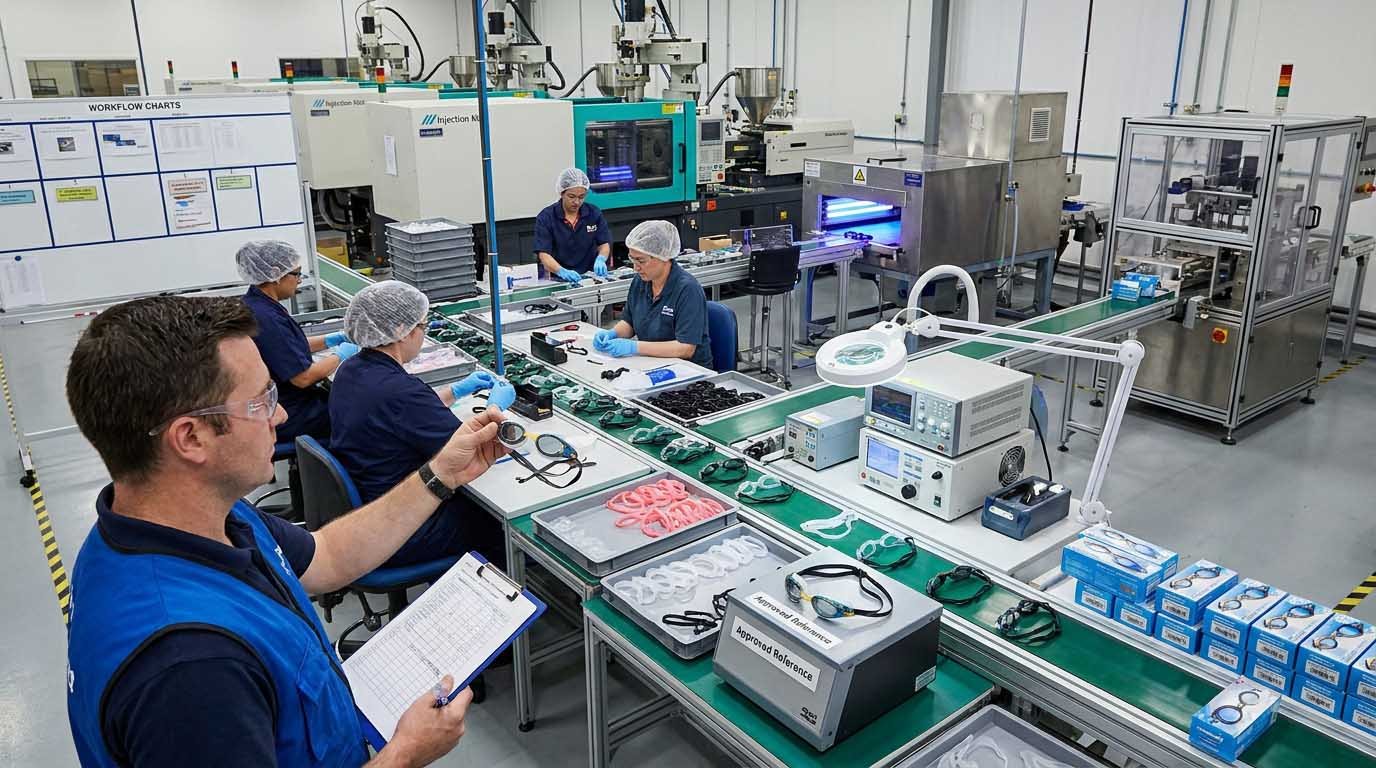
What happens in a pilot run?
A pilot run may be used to verify:
- Mold stability
- Lens consistency
- Gasket fit
- Assembly process
- Coating performance
- Packaging workflow
- Defect rate under real production speed
This step is especially important for:
- New molds
- New material combinations
- New assembly structures
- New coating processes
- Higher-risk product launches
When does mass production start?
Mass production usually starts after:
- Sample approval is complete
- Compliance requirements are confirmed
- Packaging is approved
- Pilot run quality is accepted
- Purchase order and production plan are finalized
At this point, the factory can schedule bulk manufacturing, final inspection, and shipment.
Typical OEM Timeline for Swimming Goggles
Below is a general timing reference for a custom project.
| Phase | Typical Time |
|---|---|
| RFQ and project brief | 1-2 weeks |
| Design and engineering review | 2-3 weeks |
| Mold development or modification | 3-5 weeks |
| Prototype sampling and validation | 2-4 weeks |
| Testing and compliance | 2-3 weeks |
| Pilot run and mass production setup | 2-4 weeks |
Estimated total: around 90-120 days
For private label projects using existing molds, production may move faster because development risk is lower.
Common Mistakes in Swimming Goggles OEM Projects
Many sourcing delays and product problems come from avoidable mistakes.
1. Starting without a clear product brief
If the factory does not know the intended market, quality level, and feature priorities, quotations and samples are more likely to miss the target.
2. Underestimating tooling and development time
New molds, curved lenses, special coatings, and custom buckle systems all add time.
3. Treating appearance samples as final validation
A visual sample is not enough to confirm fit, seal, optics, or long-term performance.
4. Ignoring compliance until the end
If testing and labeling are handled too late, the launch may be delayed by documentation issues.
5. Using all the budget on the first order
OEM development often includes hidden costs beyond unit price, such as packaging setup, testing, inspection, and sample revisions.
6. Skipping pilot production
Without a pilot run, buyers may only discover production instability after the full order is already underway.
OEM vs Private Label Swimming Goggles: What Is the Difference?
These terms are related but not always identical.
Private label swimming goggles
Private label usually means:
- Existing product structure
- Your logo
- Your packaging
- Limited cosmetic customization
OEM swimming goggles
OEM may include private label, but it can also involve:
- Material upgrades
- Structure adjustments
- Different component combinations
- More engineering involvement than simple branding
When buyers say they want “custom swim goggles,” it is important to clarify whether they mean:
- Branding only
- Packaging only
- Color changes
- Product structure changes
This affects MOQ, tooling, lead time, and quotation accuracy.
How to Prepare for a Swimming Goggles OEM Project
Before contacting a manufacturer, prepare the following:
- Product references or sketches
- Target market and price point
- Estimated MOQ
- Branding requirements
- Packaging ideas
- Lens and gasket preferences
- Required compliance documents
- Launch timeline
- Sales channels
The clearer your brief, the faster the factory can evaluate whether the project should follow a private label, OEM, or custom development path.
FAQ: Swimming Goggles OEM Manufacturing
How are swimming goggles manufactured?
Swimming goggles are typically manufactured through a process that includes design review, mold development, lens and gasket material selection, sample validation, assembly, quality inspection, and bulk production.
How long does it take to make custom swimming goggles?
For fully custom OEM swimming goggles, the process often takes about 90-120 days. Simpler private label projects may be faster.
What is the MOQ for custom or OEM swimming goggles?
MOQ depends on customization depth. Selected private-label projects based on existing models can start from around 300 pieces, while custom-color projects can start from around 600 pieces. Deeper OEM projects involving structural modifications, special components, or new tooling are quoted individually.
Do I need a new mold for private label swimming goggles?
Not always. If you are using an existing design and only changing logo or packaging, new mold development may not be necessary.
What is the difference between OEM and ODM swimming goggles?
OEM usually uses an existing manufacturing base with your branding or selected modifications. ODM generally involves deeper product design changes and often new tooling.
Why is prototyping important in swim goggle manufacturing?
Prototyping helps confirm fit, seal, optics, and assembly quality before mass production, reducing the risk of expensive mold rework or customer complaints later.
What materials are best for swim goggles?
Polycarbonate is commonly used for lenses, while silicone and TPR are often used for gaskets and straps depending on quality level and target price.
What tests should be done before mass production?
Common checks include fit testing, leak testing, lens review, anti-fog evaluation, assembly inspection, and compliance-related testing where required.
Final Thoughts
The swimming goggles OEM process is much more than sending a sketch and waiting for a sample. A successful project depends on clear planning, practical engineering, suitable material selection, thorough prototype validation, and controlled production approval before bulk manufacturing begins.
For buyers sourcing private label swimming goggles, custom swim goggles, or OEM swimming goggles, the most important questions are not only about unit price. They are also about:
- Whether the design can be manufactured reliably
- Whether the product will fit and seal properly
- Whether the materials and coatings support your product claims
- Whether quality and compliance are confirmed before shipment
Understanding the process early helps reduce delays, avoid expensive tooling changes, and improve the odds of launching a product that performs well in the market.
Need Help Evaluating a Swimming Goggles OEM Project?
When comparing suppliers, ask for:
- Similar project experience
- Material options
- Mold development capability
- Sample process
- Quality checkpoints
- Compliance support
- Typical MOQ and lead time
- Packaging and branding options
A strong OEM partner should be able to explain the process clearly from concept to mass production, not just quote a unit price.