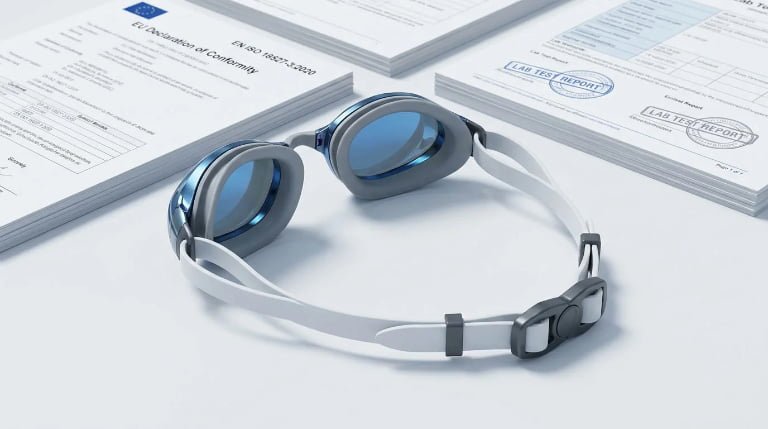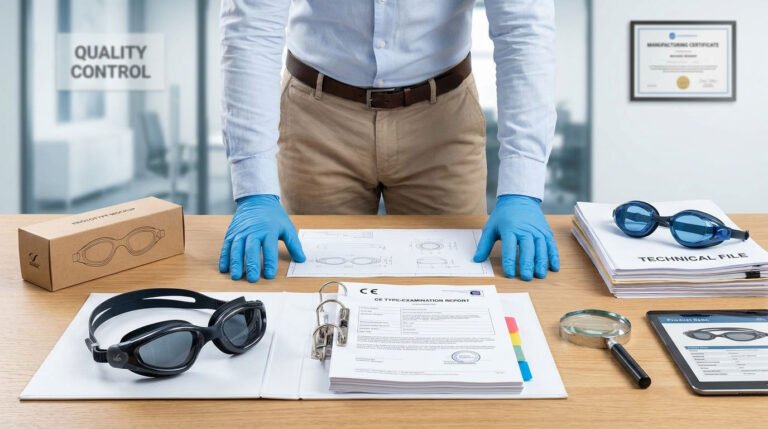
If you import or sell swimming goggles in California, Proposition 65 should not be treated as a simple certificate that a factory hands over before shipment.
The better question is:
Does the compliance evidence match the exact materials, colors, coatings, printed parts, packaging, and configuration of the swimming goggles you are buying?
For swimming goggle importers, California Prop 65 is best managed as a component-level exposure and documentation review. Start with the bill of materials, identify relevant chemical risks, match supplier declarations and test reports to the actual order, and review the evidence again when materials or suppliers change.
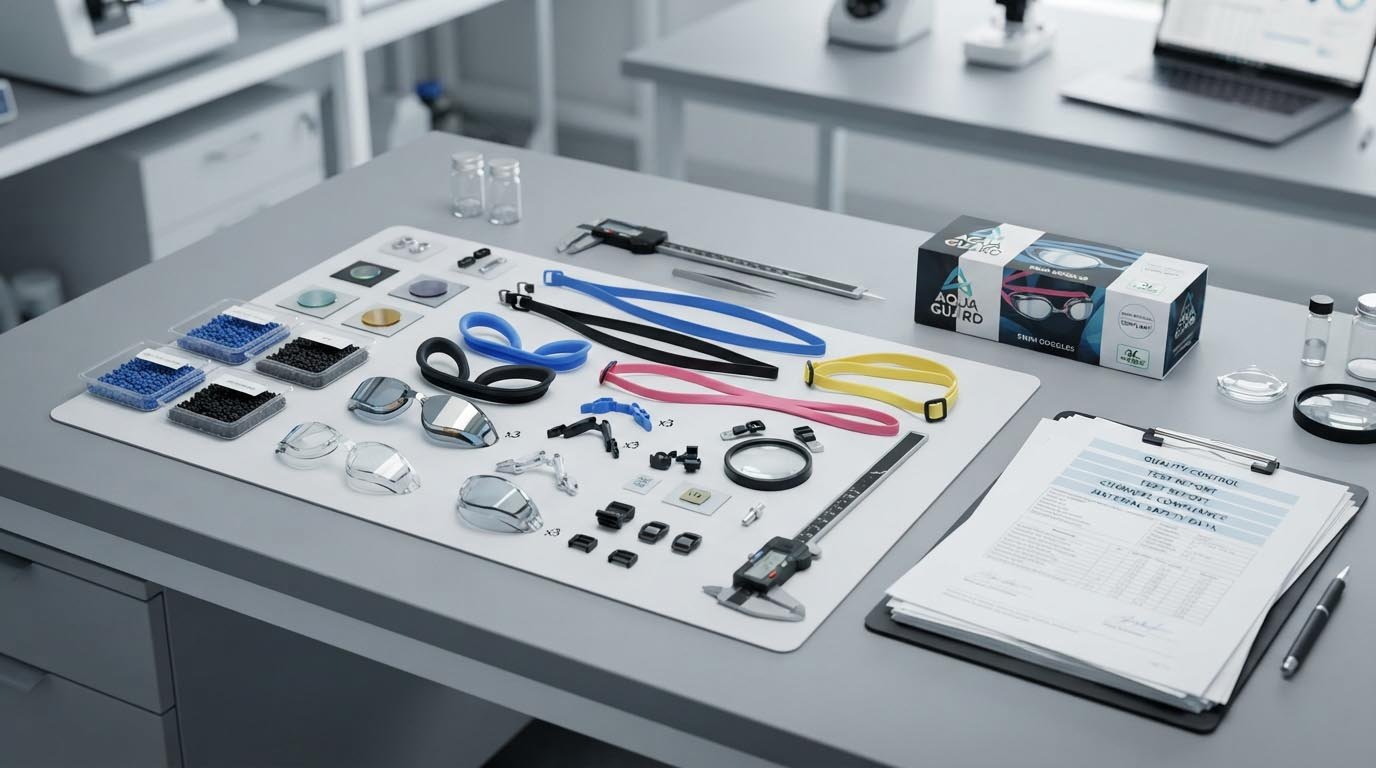
This guide explains what importers should check before mass production and why a generic "Prop 65 compliant" statement may not be enough.
Important: This article provides practical sourcing and compliance guidance, not legal advice. Proposition 65 decisions should be confirmed using current California OEHHA information and, where necessary, qualified legal or testing professionals.
Quick Answer: What Should Swimming Goggle Importers Check for Prop 65?
Before placing a production order, importers should check five areas:
- Complete BOM — lenses, gaskets, straps, frames, buckles, coatings, inks, cases, and packaging.
- Material declarations — especially for flexible plastics, pigments, coatings, and printed components.
- Configuration-specific test evidence — the tested material, color, coating, and component should represent the actual order.
- Potential exposure and warning requirements — Prop 65 is based on exposure to listed chemicals, not simply whether a chemical is present somewhere in the product.
- Change control — a new pigment, resin supplier, coating, ink, or packaging component may require another review.
California’s Office of Environmental Health Hazard Assessment, or OEHHA, explains that Proposition 65 requires warnings for certain exposures to listed chemicals unless the exposure does not require a warning under applicable rules or exposure levels.
The key point is:
Prop 65 is not a universal product certification. It is an exposure-warning framework.
What Is California Proposition 65?
California Proposition 65, formally the Safe Drinking Water and Toxic Enforcement Act of 1986, requires businesses to provide warnings before knowingly and intentionally exposing people to listed chemicals associated with cancer, birth defects, or reproductive harm, unless an exemption or applicable exposure threshold applies.
OEHHA maintains the official Proposition 65 chemical list, so importers should check current official information rather than relying on old internal chemical lists.
Does a Swimming Goggle "Pass" Prop 65?
Not in the same way that a product may pass a single technical standard.
There is no universal government-issued:
"Prop 65 Certificate for Swimming Goggles."
Instead, the analysis may involve:
- which listed chemical is present,
- which component contains it,
- how the consumer may be exposed,
- the expected exposure level,
- whether an OEHHA safe-harbor level applies,
- and whether a warning is required.
So when a supplier says:
"Our goggles pass Prop 65."
the buyer should ask:
Which materials, colors, components, chemicals, and reports does that statement cover?
Which Swimming Goggle Components Should Importers Review?
A swimming goggle combines multiple materials and manufacturing processes.
A typical BOM may include:
- polycarbonate lenses,
- anti-fog coatings,
- mirror or tint coatings,
- silicone or TPE gaskets,
- silicone or elastomer straps,
- nose bridges,
- frame components,
- adjustment buckles,
- printed logos,
- storage cases,
- retail packaging,
- labels and printing inks.
The best starting point is therefore not:
"Test the goggles."
It is:
Break the product into components and determine what evidence supports each relevant material and finish.
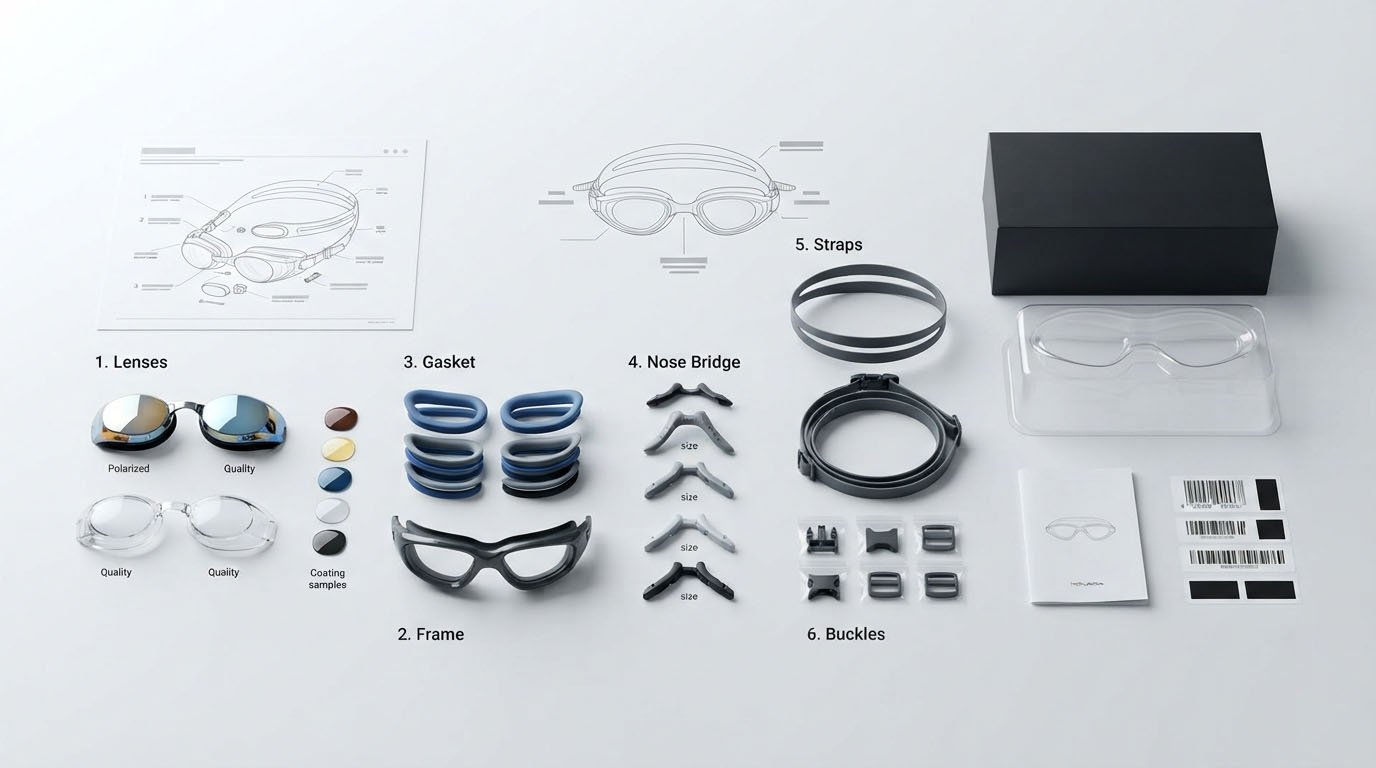
Zone 1: Direct Skin-Contact Components
These components usually deserve early attention because they remain in direct contact with the user.
Gaskets and Eye Seals
Depending on the model, seals may use silicone, TPE, or other soft elastomers.
Importers should confirm:
- base material,
- pigment or color system,
- material supplier,
- relevant additives,
- whether available evidence matches the actual formulation.
Head Straps
Customized straps may involve more than the base polymer, including:
- pigments,
- printed logos,
- inks,
- coatings.
A report for a transparent strap should not automatically be assumed to cover every customized color.
Nose Bridges
Flexible nose bridges may use a different polymer from the main frame and should appear separately on the BOM rather than under a generic description such as "plastic parts."
Zone 2: Lenses, Frames, Buckles, and Coatings
Rigid and optical components may include:
- polycarbonate lenses,
- PC or nylon frames,
- POM adjustment parts,
- mirror coatings,
- lens tints,
- anti-fog treatments,
- decorative printing.
Do not assume every resin or coating presents the same Prop 65 question.
Instead, review the actual:
material → formulation → supplier evidence → exposure scenario
If a mirrored version uses a different coating from a clear-lens version, the compliance file should reflect that difference.
Zone 3: Packaging and Accessories
Packaging is often overlooked.
Depending on the product, this may include:
- plastic packaging,
- soft storage pouches,
- EVA or hard cases,
- zippers,
- printed inserts,
- labels,
- inks and coatings.
Historical California Prop 65 settlement summaries published by SGS and Bureau Veritas have specifically referenced swim goggles and related packaging in connection with phthalates.
That makes packaging part of the compliance review—not an afterthought.
Which Chemical Risks Should Swimming Goggle Importers Review?
There is no single chemical checklist that applies identically to every swimming goggle.
Screening should be based on the actual BOM, materials, manufacturing processes, and exposure considerations.
Phthalates in Flexible Components
Phthalates have historically been an important Prop 65 enforcement area for flexible-plastic consumer products.
For swimming goggles, review may be relevant for:
- flexible polymer parts,
- PVC components where used,
- soft plastic packaging,
- printed or coated components,
- certain accessories.
SGS and Bureau Veritas have published settlement information specifically involving swim goggles and packaging and certain phthalates.
However:
A concentration criterion from a specific settlement is not automatically a universal California statutory limit for every swimming goggle.
Settlement terms can be useful compliance references, but they should not be presented as universal legal limits.
Lead, Cadmium, and Other Metals
Depending on the design, pigments, prints, decorative coatings, and accessories may justify reviewing metals such as lead or cadmium.
Instead of applying one blanket ppm rule, determine:
- which component may present the risk,
- which listed chemical is relevant,
- the potential exposure route,
- and what testing or documentation is appropriate.
BPA and Material-Specific Questions
Bisphenol A is included on California’s Proposition 65 list.
However, the fact that a material family may historically involve BPA does not mean every finished swimming goggle automatically requires a warning.
The correct question is:
Does the actual material and expected consumer exposure create a Prop 65 warning issue?
That is why material-specific declarations and exposure review matter more than assumptions based only on the polymer name.
Safe Harbor Levels vs Settlement Limits: What Is the Difference?
This distinction is critical.
OEHHA Safe-Harbor Levels
OEHHA establishes safe-harbor levels for many listed chemicals, including:
- NSRLs — No Significant Risk Levels
- MADLs — Maximum Allowable Dose Levels
These relate to exposure, not simply material concentration.
A ppm concentration inside a component is therefore not automatically equivalent to a Prop 65 safe-harbor exposure level.
Settlement-Derived Limits
Prop 65 settlements may establish reformulation criteria for particular products, defendants, or materials.
Historical settlement summaries involving swimming goggles have included concentration-based criteria for certain phthalates.
These criteria may help with:
- sourcing specifications,
- supplier agreements,
- targeted testing,
- risk management.
But:
Settlement limits are not the same as universal statutory Prop 65 safe-harbor levels.

Why Can a Generic Prop 65 Test Report Fail to Cover Your Order?
One common sourcing mistake is accepting a report without checking whether it represents the actual purchase order.
Suppose a supplier provides a report for:
clear gasket + clear lens + blue strap.
But your order uses:
black gasket + mirrored lens + red strap + printed logo.
The model may be the same, but the chemical configuration is not necessarily identical.
Check These Four Areas
1. Product and Component
What exactly was tested?
A strap report does not automatically cover:
- lenses,
- coatings,
- gaskets,
- packaging,
- printed logos.
2. Material
Does the tested sample use the same resin, elastomer, ink, or coating as production?
3. Color and Finish
A different color may involve another pigment, masterbatch, coating, or printing system.
That does not mean the new color fails. It means the old evidence may not represent it.
4. Supplier Configuration
Does production use the same approved:
- resin supplier,
- pigment,
- coating,
- ink,
- component vendor,
- packaging material?
The rule is simple:
A test report is only as useful as its relationship to the actual goods being purchased.
What Prop 65 Documents Should Importers Collect Before Production?
A strong compliance file should create an evidence chain from raw materials to the purchase order.
1. Engineering Bill of Materials
The BOM should identify relevant components clearly.
| Component | Material / Finish | Color | Supplier / Code | Evidence Status |
|---|---|---|---|---|
| Lens | PC + anti-fog coating | Clear | Approved specification | Review |
| Gasket | Silicone / TPE | Black | Material code | Review |
| Strap | Elastomer | Red | Masterbatch code | Review |
| Buckle | Rigid plastic | Black | Material code | Review |
| Logo | Printed ink | White | Ink system | Review |
| Case | EVA / plastic | — | Packaging supplier | Review |
The principle is straightforward:
You cannot verify what you have not identified.
2. Supplier Material Declarations
Collect relevant declarations from:
- polymer suppliers,
- masterbatch suppliers,
- coating suppliers,
- ink suppliers,
- packaging suppliers,
- component subcontractors.
Where practical, declarations should reference actual materials or codes.
A generic statement saying:
"All materials comply with Prop 65."
is weaker than documentation tied to identifiable components.
3. Configuration-Matched Laboratory Reports
Where testing is appropriate, check:
- tested component,
- sample description,
- color,
- material,
- test scope,
- laboratory,
- test date,
- target chemicals.
For uncertain or higher-risk components, qualified third-party laboratories can help define the appropriate test scope.
4. Gap Analysis
After collecting the evidence, identify what remains unsupported.
| Component | Declaration | Relevant Report | Gap |
|---|---|---|---|
| Clear lens | Yes | Yes | None identified |
| Black gasket | Yes | Yes | Confirm match |
| Red strap | Yes | No matching report | Evaluate |
| Printed logo | Partial | No | Evaluate ink |
| Plastic packaging | Yes | Old report | Review scope |
This is more useful than simply asking:
"Do you have a Prop 65 certificate?"
A 4-Step Prop 65 Pre-Order Verification Process
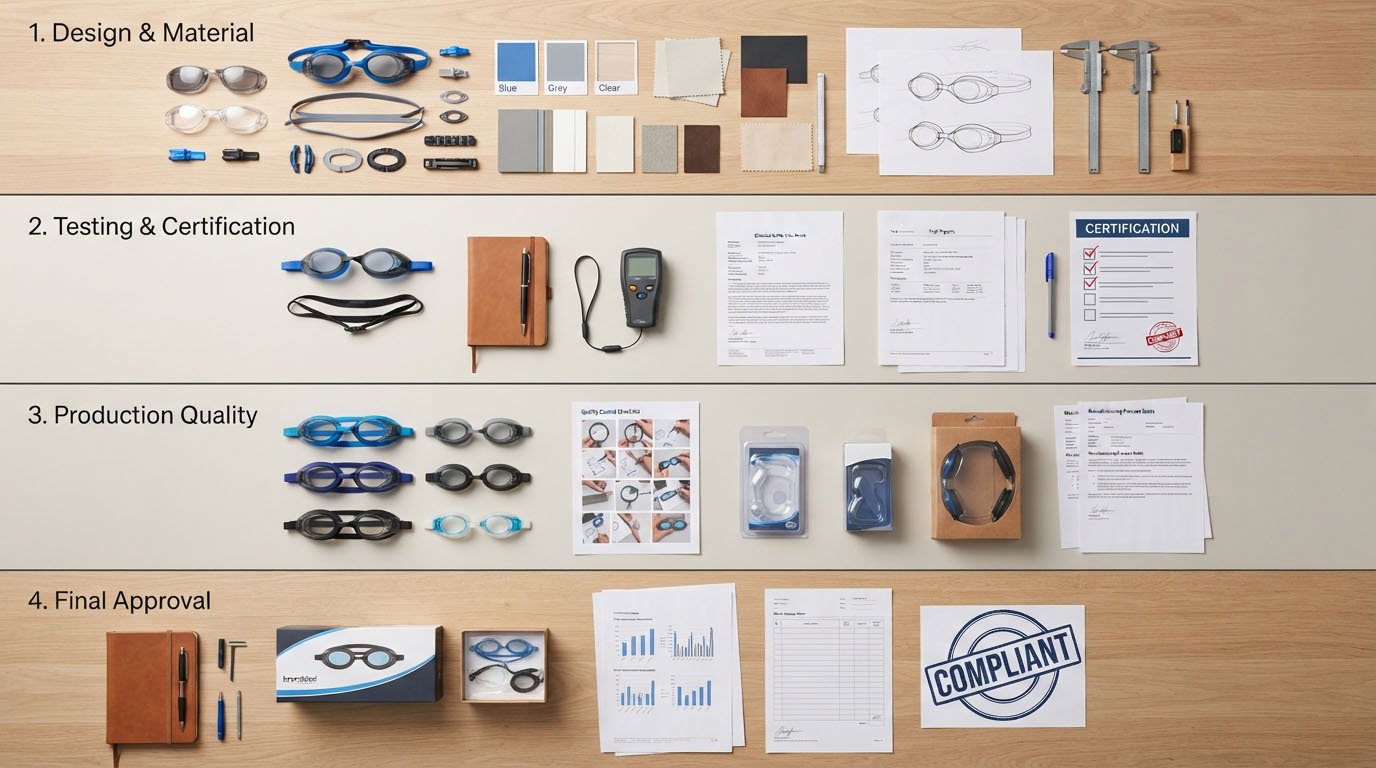
Step 1 — Freeze the BOM
Confirm the final:
- materials,
- colors,
- coatings,
- inks,
- components,
- packaging,
- relevant suppliers.
Do this before final compliance review whenever possible.
Step 2 — Map the Evidence
For each relevant component, identify:
- supplier declarations,
- supporting material documents,
- available test reports,
- report scope,
- material code,
- color or finish.
Do not assume one report covers the entire product.
Step 3 — Identify and Test the Gaps
Instead of automatically ordering a broad "Prop 65 test," ask:
Which component, material, or exposure question still lacks sufficient evidence?
Testing can then focus on the actual gap.
Step 4 — Approve the Final Configuration
Link the approved evidence to the production order.
The purchasing specification can identify:
- approved BOM,
- approved colors,
- approved suppliers,
- approved coatings,
- approved packaging,
- change-control requirements.
This moves compliance review upstream instead of leaving it until shipment.
When Should Prop 65 Evidence Be Rechecked?
Evidence should be reconsidered whenever relevant parts of the configuration change.
New Color
A new pigment or masterbatch may require document review.
New Strap or Gasket Material
Changing from one elastomer system to another changes the evidence chain.
New Lens or Anti-Fog Coating
Review the new coating formula and supplier information.
New Print or Logo Method
Printing may introduce new inks or coatings that should be added to the BOM review.
New Raw-Material Supplier
Visually identical components can use different formulations.
New Packaging Supplier
Replacement packaging should also be reviewed, especially where flexible plastic materials are involved.
The better rule is:
Recheck when something relevant changes—not simply because another calendar year has passed.
Prop 65 vs CPSIA vs REACH vs Swimming Goggle Standards
Passing one compliance program does not automatically cover another.
| Requirement | Main Focus | Replaces Prop 65? |
|---|---|---|
| California Prop 65 | Exposure to California-listed chemicals and warning obligations | — |
| CPSIA | U.S. children’s product safety requirements | No |
| REACH | EU chemical restrictions and chemical regulation | No |
| Swimming goggle standards | Product performance and safety | No |
For example:
CPSIA compliance does not automatically establish Prop 65 compliance.
Likewise:
A REACH report does not automatically answer the California exposure-warning question.
Each framework has a different scope and compliance method.
Should Importers Rely on Historical Prop 65 Settlements?
Settlements can be useful because they may show:
- chemicals that have attracted enforcement,
- product categories involved,
- reformulation criteria used,
- practical testing considerations.
This matters for swimming goggles because historical settlement summaries have specifically referenced swim goggles and packaging in relation to phthalates.
However, settlements should be used as:
risk-management references
rather than treated automatically as:
California’s universal legal limits for all swimming goggles.
For the current regulatory framework, OEHHA should remain the primary official reference.
California Prop 65 Swimming Goggle Importer Checklist
Before approving mass production, ask:
- [ ] Do we have the final BOM?
- [ ] Are lenses, coatings, gaskets, straps, buckles, prints, cases, and packaging included?
- [ ] Do we know the materials and relevant suppliers?
- [ ] Are custom colors and masterbatches documented?
- [ ] Do supplier declarations identify what they actually cover?
- [ ] Do test reports match the relevant component and configuration?
- [ ] Have we separated Prop 65 from CPSIA, REACH, and other standards?
- [ ] Have chemical risks been identified from the real BOM rather than a generic checklist?
- [ ] Have documentation or testing gaps been identified before mass production?
- [ ] Is there a process for approving material or supplier substitutions?
- [ ] Will a new color, coating, ink, resin, or packaging supplier trigger review?
- [ ] Has qualified advice been obtained where exposure or warning requirements remain uncertain?
Frequently Asked Questions
Does a Swimming Goggle Need a Prop 65 Certificate?
There is no universal government-issued Prop 65 product certificate.
Importers should instead maintain evidence covering relevant materials, declarations, testing, exposure considerations, and warning requirements.
Does One Prop 65 Test Cover Every Color?
Not necessarily.
A new color may use a different pigment or masterbatch, so previous evidence should be reviewed before assuming it applies.
Does CPSIA Testing Cover California Prop 65?
No.
CPSIA and Proposition 65 are separate regulatory frameworks. Children’s swimming goggles may need to address both.
Does REACH Compliance Mean the Goggle Meets Prop 65 Requirements?
No.
REACH is an EU regulatory framework, while Prop 65 has its own chemical list, exposure approach, warning requirements, and enforcement system.
Is 1,000 ppm the Universal Prop 65 Limit for Phthalates in Swimming Goggles?
No.
Certain historical settlements involving swimming goggles and packaging have used concentration-based reformulation criteria for specific phthalates, but these settlement criteria are not universal statutory Prop 65 safe-harbor exposure levels.
When Should Importers Recheck Prop 65 Documentation?
Review the evidence when relevant materials, colors, pigments, coatings, formulas, suppliers, components, or packaging change.
Final Takeaway
California Prop 65 compliance for swimming goggles should not start with:
"Can you send me a Prop 65 certificate?"
A better question is:
"Can you show me the material and testing evidence that matches my exact goggle configuration?"
For importers, the practical process is:
BOM → Component Mapping → Supplier Declarations → Evidence Review → Targeted Testing → Configuration Approval → Change Control
Swimming goggles combine multiple materials, colors, coatings, printed parts, and packaging components. Changing just one may affect the evidence supporting the final product.
Historical Prop 65 settlements involving swimming goggles also show why phthalates and packaging deserve attention, but settlement criteria should not be confused with universal statutory safe-harbor levels.
For California-bound swimming goggles, the most defensible approach is:
Know what is in the product, know which evidence supports it, and recheck the compliance file whenever the approved configuration changes.