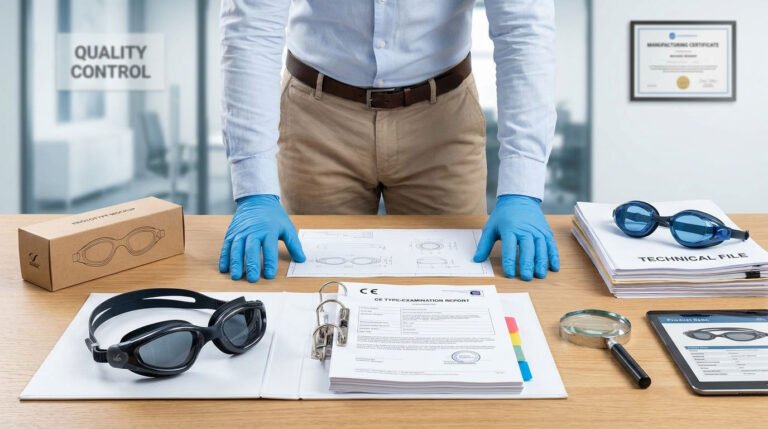
For European swimming goggle importers, chemical compliance should begin before bulk production. A product may pass performance tests and look well-made, yet still contain substances that require assessment under EU chemical regulations.
REACH requirements for swimming goggles include complying with applicable chemical restrictions, evaluating Substances of Very High Concern (SVHCs), and maintaining reliable documentation for lenses, gaskets, straps, buckles, coatings, and colorants.
A general supplier certificate or an outdated laboratory report cannot establish compliance for every product configuration.
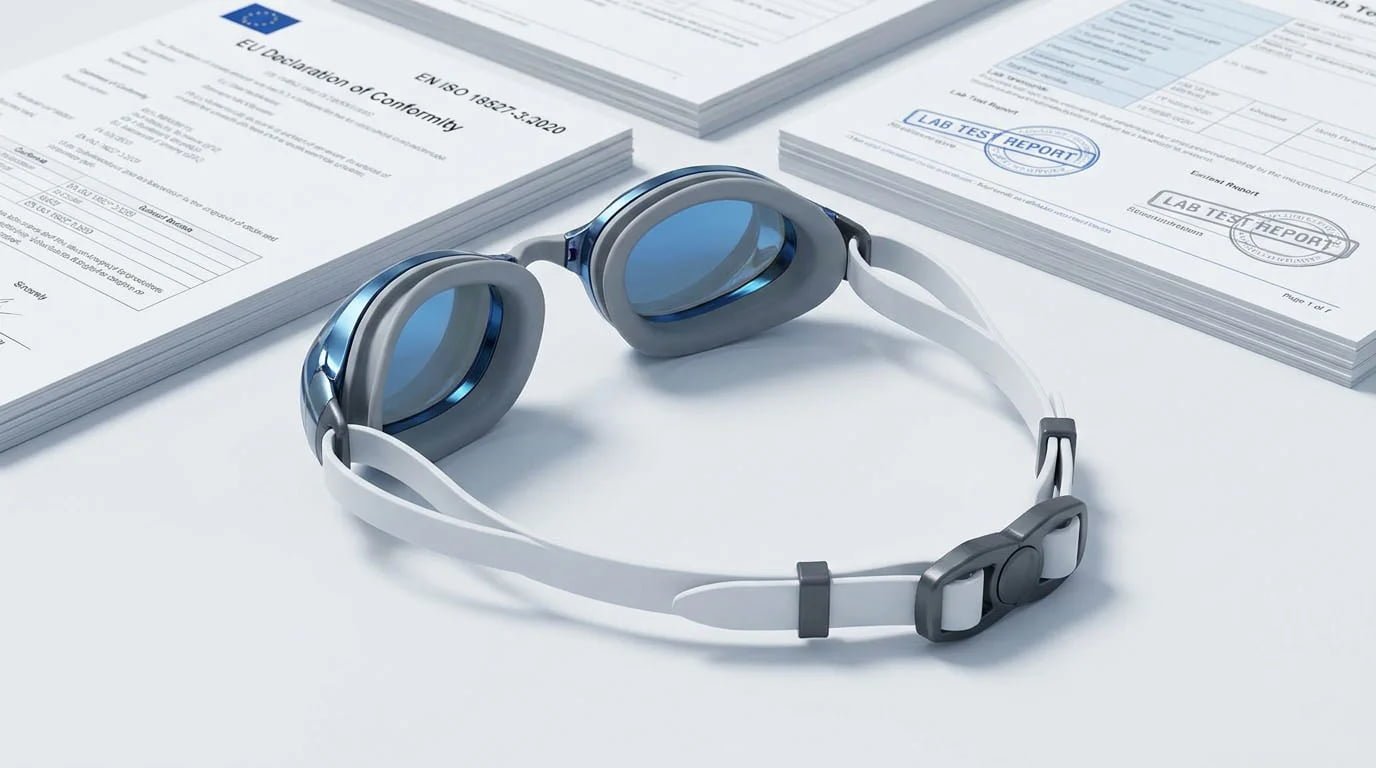
This guide explains the key REACH obligations, component-level chemical risks, and practical documentation checks that EU importers should complete before approving custom swimming goggle orders.
Quick Answer: What Are the REACH Requirements for Swimming Goggles?
Swimming goggles sold in the EU must meet applicable requirements under REACH Regulation (EC) No 1907/2006.
The main obligations depend on the substances present, their concentrations, and the responsibilities of the businesses involved.
| Requirement | What Swimming Goggle Importers Should Know |
|---|---|
| Annex XVII | Applicable restricted substances must meet their specific legal limits and conditions. |
| SVHC Candidate List | Relevant components must be assessed for listed substances. |
| REACH Article 33 | SVHCs above 0.1% w/w in an article trigger information communication duties. |
| REACH Article 7(2) | ECHA notification may apply when relevant concentration and annual quantity thresholds are met, subject to exemptions. |
| SCIP | Certain EU suppliers must report articles containing Candidate List SVHCs above 0.1% w/w under the Waste Framework Directive. |
There is no single universal REACH certificate for swimming goggles. Importers need evidence that the actual materials and product configurations meet applicable requirements.
The most effective approach is to assess components individually, verify supporting documentation, and control material changes during production.
Step 1. Understand Which REACH Rules Apply to Swimming Goggles
REACH stands for Registration, Evaluation, Authorisation and Restriction of Chemicals.
Swimming goggles are generally considered articles because their shape and design determine their function.
For EU importers, three areas deserve particular attention: restricted substances, SVHC communication duties, and applicable notification requirements.
1.1 REACH Annex XVII: Restricted Substances
Annex XVII restricts specific substances in defined materials, products, or applications.
Potential concerns for swimming goggles include:
- Phthalates: Particularly relevant to certain plasticized materials, such as some flexible PVC formulations.
- Polycyclic aromatic hydrocarbons (PAHs): Relevant to certain rubber or plastic components involving prolonged or repetitive skin contact.
- Certain heavy metals and organotin compounds: Depending on the substance, material, and applicable restriction.
- Coating and printing substances: Where the relevant chemical restriction applies.
For example, Annex XVII Entry 51 restricts specified phthalates, including DEHP, DBP, BBP, and DIBP, in applicable plasticized materials.
Entry 50 addresses specified PAHs in certain rubber or plastic components under defined skin-contact conditions.
These requirements do not mean every swimming goggle must undergo identical chemical testing.
Buyer action: Identify the component materials first, then determine which Annex XVII restrictions and test methods are relevant.
1.2 SVHC Candidate List and Article 33
The European Chemicals Agency (ECHA) maintains the Candidate List of Substances of Very High Concern.
Under Article 33, an article containing a Candidate List SVHC above 0.1% by weight (w/w) triggers information communication duties.
Suppliers must provide sufficient information for safe use to relevant recipients, including at least the substance name. Consumers may request this information and must receive a response within 45 days.
Importantly, the threshold applies to each relevant article within an assembled product, not simply to the complete swimming goggle’s total weight.
For example, a separate strap or buckle may require its own SVHC assessment.
The 0.1% threshold is not a universal prohibition limit. It can trigger communication duties even where the substance is not prohibited in that application.
1.3 SCIP and Article 7(2) Notifications
SCIP operates under the EU Waste Framework Directive, rather than REACH itself.
Certain EU suppliers must submit SCIP information when articles placed on the EU market contain Candidate List SVHCs above 0.1% w/w.
Separately, REACH Article 7(2) may require notification to ECHA when a Candidate List substance exceeds 0.1% w/w in relevant articles and totals more than one tonne per producer or importer annually, subject to applicable exemptions.
These obligations should be evaluated separately rather than treated as one certification requirement.
For an overview of REACH alongside CE, ISO 18527-3, and other regulations, see Jerry’s Swimming Goggles Compliance Guide.
Step 2. Identify Chemical Risks in Swimming Goggle Components
Swimming goggles combine rigid plastics, flexible elastomers, coatings, pigments, and decorative materials.
A compliant lens does not automatically establish compliance for the strap or gasket.
Importers should connect each component in the Bill of Materials (BOM) to relevant chemical risks and supporting evidence.

2.1 Component-to-REACH Evidence Matrix
| Component | Common Material | Potential Chemical Concerns | Recommended Evidence |
|---|---|---|---|
| Lens | Polycarbonate (PC) | Relevant additives and coating substances | Material declaration and applicable test evidence |
| Eye gasket | Silicone, TPE | Additives, pigments, relevant SVHCs | Compound declaration and supporting tests |
| Head strap | Silicone, TPE, rubber, PVC | Applicable phthalates, PAHs, colorants | Material-specific declarations and targeted testing |
| Nose bridge | TPU, TPE, silicone | Polymer additives and pigments | Material specifications |
| Buckle/frame | ABS, PP, PC | Pigments and stabilizers | Resin and colorant documentation |
| Anti-fog coating | Proprietary formulation | Applicable restricted or residual substances | Coating specification and chemical assessment |
| Printed logo | Ink or transfer material | Relevant pigments and additives | Ink declaration or targeted testing |
This matrix supports risk assessment. It is not a mandatory testing list for every swimming goggle.
2.2 Why Color and Material Formulations Matter
Consider three versions of the same swimming goggle:
- Transparent silicone strap
- Fluorescent yellow silicone strap
- Black TPE strap
Although their designs may be identical, their chemical formulations can differ.
Different pigments, masterbatches, or polymer additives may introduce additional substances requiring evaluation.
However, every color change does not automatically require complete finished-product retesting.
Suitable supplier declarations, representative testing, and documented formulation controls may support multiple variants.
The key question is whether existing evidence adequately covers the actual materials used.
2.3 What About Anti-Fog Coatings and Packaging?
Anti-fog coatings may contain surfactants, polymers, and other formulation ingredients. Their chemical composition should be considered against relevant restrictions.
Buyers should request appropriate coating information and confirm whether changes in formulation affect earlier evidence.
Packaging also deserves attention. Plastic cases, pouches, and other packaging articles can have separate chemical obligations.
The compliance review should clearly define whether it includes only the goggles or also the supplied accessories and packaging.
Step 3. Verify REACH Test Reports and Supplier Documentation
A laboratory report is only useful when its scope matches the materials being purchased.
A report stating "Pass" does not establish compliance with every REACH obligation.
Likewise, a supplier declaration should be evaluated against the actual product specification and supporting information.
3.1 What Evidence Should Buyers Request?
For a swimming goggle sourcing project, the documentation package may include:
- Component-level BOM: Identifies material types, component suppliers, and relevant color variants.
- Material declarations: Provide information about substances used in the supplied materials.
- Annex XVII test reports: Support assessment against applicable substance restrictions.
- SVHC declarations or screening evidence: Support Candidate List evaluation.
- Coating and ink information: Covers chemical treatments and decorative materials.
- Material change records: Show whether production specifications have changed.
Not every document is legally required in this exact format. Together, however, they provide a practical evidence trail.
3.2 Does the Report Match the Actual Product?
Consider an approved swimming goggle using:
- Clear PC lenses
- Transparent silicone gaskets
- Black silicone straps
The buyer later changes to mirrored lenses and blue TPE gaskets.
The original report may still support unchanged components, but it may not adequately cover the new coating or gasket formulation.
Before approving production, the buyer should determine whether additional declarations or targeted tests are needed.
Testing evidence should match the relevant material, chemical scope, and product configuration.

3.3 When Should Existing Evidence Be Reviewed?
There is no universal REACH requirement to repeat all swimming goggle tests every six months.
Instead, review documentation when:
- Relevant restrictions or Candidate List entries change.
- A material formulation or supplier changes.
- New pigments, coatings, or printing inks are introduced.
- Existing evidence no longer adequately covers the product.
A previous report does not automatically become invalid after every change. Its continued relevance must be assessed.
For detailed guidance on report identification, testing scope, and laboratory information, see How to Read a Swimming Goggle Test Report.
Step 4. Control Material Changes During OEM/ODM Production
Chemical compliance should remain connected to approved materials throughout production.
A common sourcing risk arises when the materials used in bulk manufacturing differ from those covered by earlier compliance evidence.
4.1 Which Production Changes Require Reassessment?
Typical triggers include:
- Changing resin or silicone-compound suppliers.
- Introducing a new color masterbatch.
- Replacing TPE with another elastomer.
- Changing anti-fog coating formulations.
- Switching printing inks or adhesives.
- Substituting alternative components.
These changes do not automatically require every test to be repeated. They require evaluation of the new material and the continued applicability of existing evidence.
4.2 Example: A New Strap Color
Consider a brand that approves a black silicone strap and later requests a fluorescent yellow version.
The manufacturer should:
- Identify the new color masterbatch and supplier.
- Obtain updated chemical information.
- Compare the formulation with the approved material.
- Evaluate whether existing documentation remains applicable.
- Arrange targeted testing if necessary.
This process helps prevent unverified material substitutions without creating unnecessary testing costs.
4.3 Connect Material Evidence to Production Records
A useful traceability sequence is:
Approved BOM → Material Evidence → Approved Sample → Change Review → Production Batch
Where possible, importers should be able to connect relevant supplier information to the materials used in production.
Jerry’s Quality Assurance processes include incoming-material inspection, production monitoring, and final verification. These controls help maintain consistency between approved specifications and bulk manufacturing.
However, normal quality inspections do not replace the chemical assessments and documentation needed for REACH compliance.
Step 5. Complete a REACH Compliance Checklist Before Bulk Orders
Chemical compliance should be reviewed during sourcing and sampling, not left until goods are ready for shipment.
The following workflow helps buyers organize responsibilities before production approval.
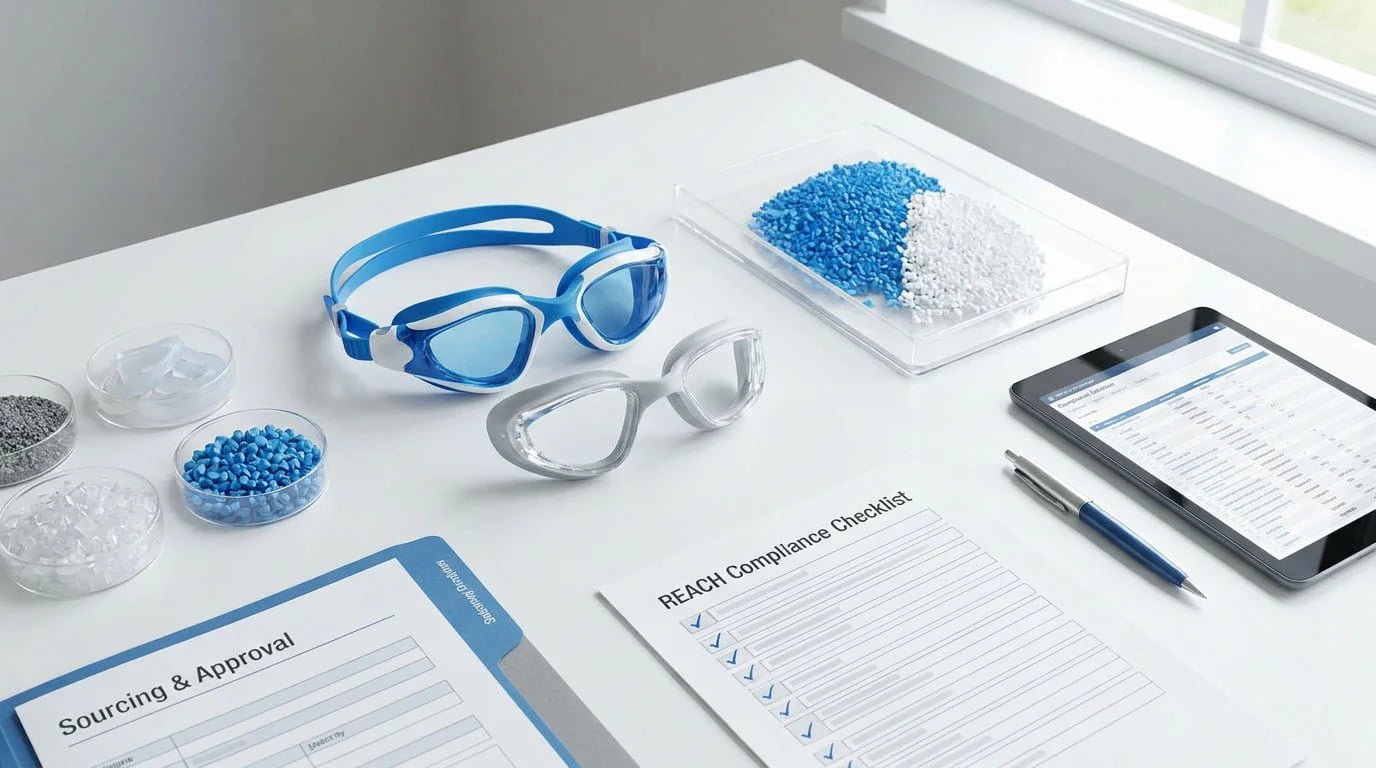
Stage 1: Confirm the Product BOM
Identify the model, component materials, coatings, colors, and accessories.
Mark the components that differ between SKUs so that compliance evidence can be matched to the correct configurations.
Stage 2: Identify Applicable Requirements
Determine which Annex XVII restrictions apply.
Review the current SVHC Candidate List and assess relevant Article 33, Article 7(2), and SCIP obligations.
Stage 3: Collect Supporting Evidence
Request supplier declarations, relevant reports, and chemical information for the approved components.
Resolve significant gaps before mass production.
Stage 4: Establish Change-Notification Rules
Agree on which material, supplier, or formulation changes require notification and review.
Confirm who will evaluate the effect on existing compliance evidence.
Stage 5: Review Documentation Before Shipment
Check that the final materials correspond to approved specifications and that required communication or reporting obligations have been addressed by the responsible parties.
Swimming Goggle REACH Procurement Checklist
- [ ] Complete component-level BOM is available.
- [ ] Relevant material and color formulations are identified.
- [ ] Applicable Annex XVII restrictions are assessed.
- [ ] Current SVHC Candidate List has been considered.
- [ ] Article 33 obligations are evaluated.
- [ ] SCIP and Article 7(2) duties are assessed where applicable.
- [ ] Relevant supplier declarations are available.
- [ ] Laboratory evidence corresponds to the supplied materials.
- [ ] Material changes are documented and reviewed.
- [ ] Outstanding compliance questions are resolved before shipment.
For newly developed products, these checks should form part of the OEM & ODM swimming goggles development process, alongside material selection, prototyping, sample approval, and production planning.
Frequently Asked Questions
1. Do Swimming Goggles Need a REACH Certificate?
There is no single official REACH certificate covering all swimming goggles.
Importers should obtain suitable evidence of compliance with the applicable obligations, including relevant material declarations, substance information, and laboratory reports.
A test report supports only the scope and sample actually assessed.
2. What Does the 0.1% SVHC Threshold Mean?
Under Article 33, a Candidate List SVHC above 0.1% w/w in an article triggers information communication requirements.
For an assembled product, the threshold applies to each relevant component article rather than simply the total product weight.
It does not automatically mean the substance is prohibited.
3. Do Different Swimming Goggle Colors Need Separate Testing?
Not necessarily.
Different colorants can introduce different chemicals, so each formulation should be evaluated.
However, suitable supplier declarations and representative testing may support several variants. Additional testing should be based on chemical risk and the adequacy of available evidence.
4. How Often Should REACH Test Reports Be Updated?
There is no universal fixed retesting interval for every swimming goggle model.
Importers should review evidence after relevant regulatory updates or material changes, then determine whether additional information or testing is necessary.
5. Do EU Importers Need SCIP Notifications for Swimming Goggles?
A SCIP notification may be required if relevant components contain Candidate List SVHCs above 0.1% w/w and the supplier falls within the applicable reporting obligations.
Importers should evaluate their responsibilities for the specific product rather than assuming that the overseas manufacturer has completed all EU reporting duties.
Conclusion: Build REACH Compliance Into Material Sourcing
REACH compliance for swimming goggles requires more than collecting a supplier certificate.
European importers should identify applicable chemical restrictions, evaluate relevant components, match evidence to approved materials, and control changes throughout production.
A reliable manufacturer can support these efforts through material sourcing, documentation coordination, sampling, and traceability. The EU business must still fulfill the legal obligations applicable to its role.
Developing custom swimming goggles for the European market?
Jerry works with international brands, importers, and distributors on swimming goggle manufacturing, material selection, sampling, and production quality control.
Contact Jerry to discuss your product specifications and documentation requirements before starting your next OEM/ODM project.
Compliance note: This article provides general sourcing and manufacturing guidance, not legal advice. Applicable substance restrictions and Candidate List entries may change. Confirm current requirements with the relevant EU authorities or qualified compliance specialists.