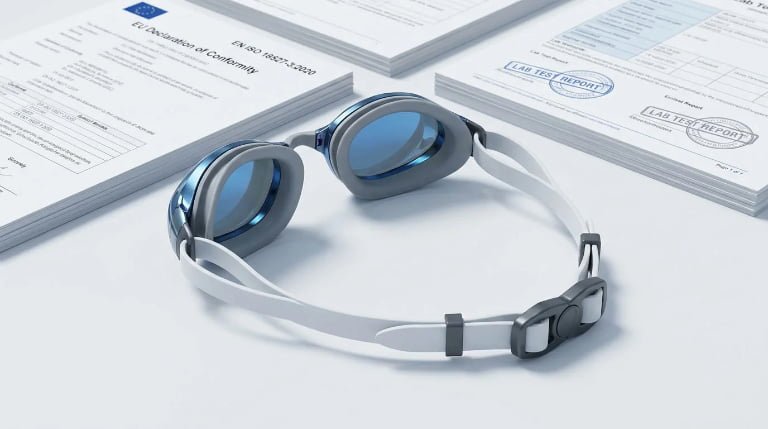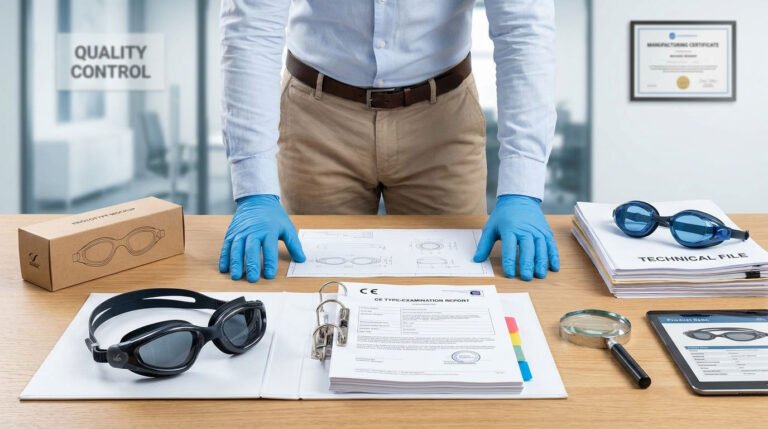
A swimming goggle strap may look strong and flexible, yet fail during repeated adjustments or normal use. For swimming goggle brands, weak straps can lead to customer complaints, product returns, and inconsistent bulk production quality.
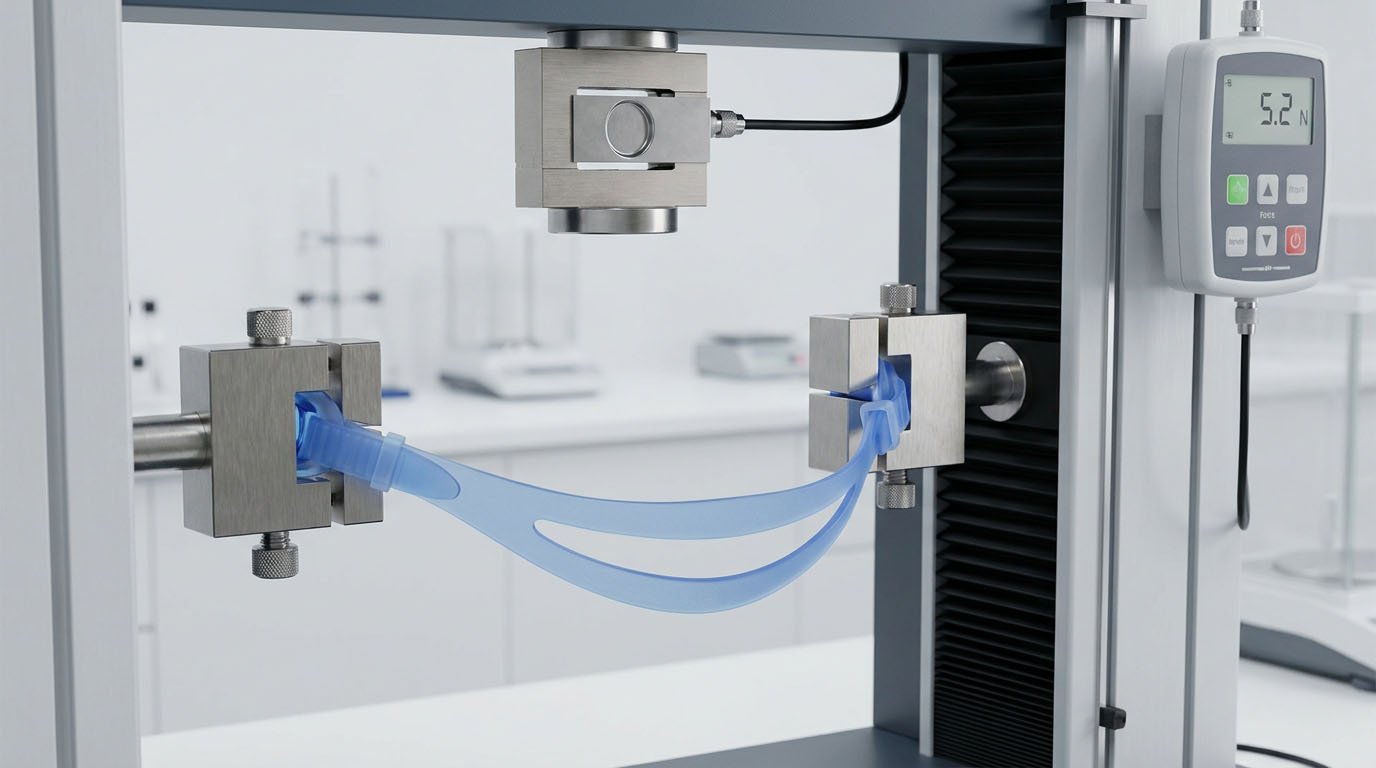
To test swimming goggle strap tensile strength, use a calibrated tensile testing machine, secure the specimen with suitable grips, apply a controlled pulling force, and record the maximum force, elongation, and failure location. The test conditions and acceptance criteria must be defined before testing.
However, measuring the breaking force of an individual silicone strap is not the same as verifying the strength of a complete swimming goggle headband assembly.
This guide explains both approaches and shows OEM/ODM buyers how to evaluate strap performance before mass production.
Quick Answer: How Is Swimming Goggle Strap Strength Tested?
A reliable test uses controlled equipment and documented procedures rather than relying on hand-pulling alone.
The first decision is what you actually need to verify.
| Test Type | What It Evaluates | Main Purpose |
|---|---|---|
| Headband strength test | Assembled headband and relevant connections | Verify the strength of the goggle assembly |
| Strap material tensile test | Individual strap or prepared material specimen | Measure breaking force and elongation |
| Strap recovery test | Stretching and recovery after release | Evaluate permanent deformation |
| Headband slip resistance test | Strap adjustment and retention system | Determine whether the adjustment mechanism holds |
These tests answer different questions. A strap may resist a high pulling force while still stretching permanently or slipping through its adjustment buckle.
For brands and importers, the goal is to verify strength, flexibility, retention, and production consistency, using appropriate methods for each property.
Step 1. Define What You Need to Test
Before preparing the equipment, determine whether you are testing the strap material or the assembled swimming goggles.
Headband Strength vs. Strap Material Strength
A headband strength test evaluates the relevant mechanical integrity of the headband assembly under a defined procedure.
A separate strap material test focuses on the material’s behavior under tension.
For a custom swimming goggle project, both evaluations may be useful.
| Evaluation | Typical Questions |
|---|---|
| Finished headband | Will the assembly withstand the specified load? |
| Individual strap | What force causes the strap to break? |
| Buckle and adjustment | Does the strap slip under the specified load? |
| Elastic recovery | Does the strap return close to its original length? |
| Strap-to-frame connection | Does the connection remain secure under load? |
A high breaking-force result does not automatically demonstrate satisfactory performance in every other category.
Understand Force, Tensile Strength, and Elongation
These terms should not be used interchangeably.
- Maximum force (N): The highest recorded pulling force during the test.
- Tensile strength (MPa): The maximum tensile stress calculated from force and the original cross-sectional area, where the test method supports this calculation.
- Elongation (%): The change in specimen length relative to its original measured length.
- Permanent deformation: Residual length change after unloading and an agreed recovery period.
For finished straps with varying widths, holes, ribs, or thicknesses, maximum force alone cannot reliably compare the intrinsic strength of different materials.
This distinction is important when comparing supplier data.
Step 2. Prepare the Samples and Testing Equipment
Reliable results begin with representative specimens and suitable equipment.
For OEM/ODM projects, the selected samples should match the intended production specification, including strap material, dimensions, color, and relevant construction details.
If a new strap design is still in development, testing should be incorporated into the sampling and prototyping process before final sample approval.
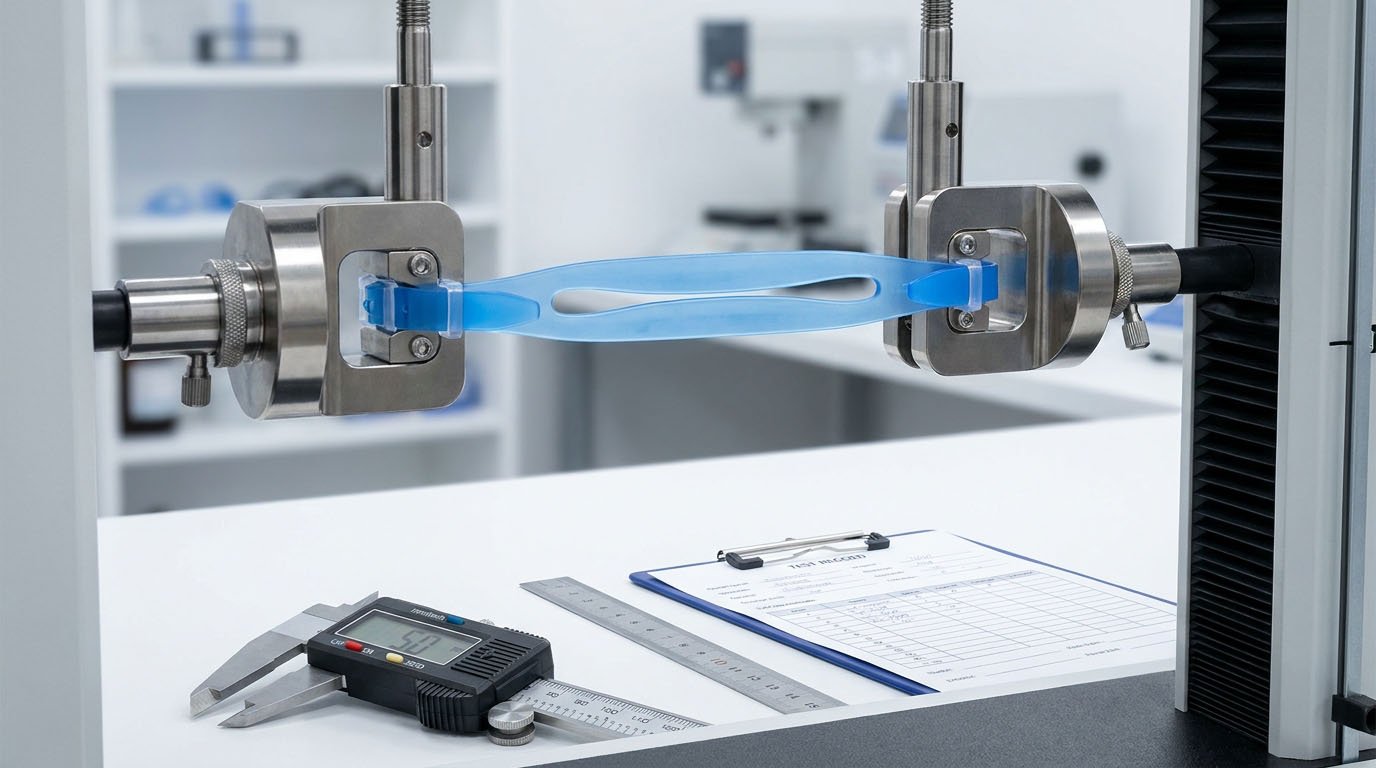
Equipment Required
A typical instrumented evaluation may require:
- Calibrated universal tensile testing machine
- Appropriate load cell for the expected force range
- Non-slip grips compatible with flexible straps
- Tools for measuring width, thickness, and initial length
- Data-recording software or an approved test sheet
- Sample identification and traceability records
The equipment should be appropriate for the selected standard or internal test method.
Select Suitable Clamps
Poor clamping is a common source of unreliable results.
If the grips are too loose, the strap may slip. Excessive gripping pressure or sharp edges can damage the specimen and cause premature failure.
Depending on the strap geometry and approved procedure, suitable fixtures may include cushioned flat grips or roller-type grips.
The objective is to hold the specimen securely without introducing unintended damage.
Inspect Samples Before Testing
Check each specimen for:
- Visible cracks or surface defects
- Uneven thickness or molding defects
- Damaged adjustment holes or notches
- Material contamination
- Incorrect dimensions
Record any pre-existing defects before testing. Do not silently remove defective production samples from the test population, as doing so can conceal a genuine quality issue.
Step 3. Set Up Consistent Test Conditions
Two identical straps can produce different test results when equipment settings or preparation conditions change.
For meaningful comparisons, define the test conditions before starting.
Key Parameters to Control
| Parameter | Why It Matters |
|---|---|
| Specimen preparation | Ensures consistent sample geometry and condition |
| Grip configuration | Reduces slipping or unintended damage |
| Initial gauge length | Provides a reference for elongation |
| Crosshead speed | Influences measured force and deformation behavior |
| Test temperature | Can affect elastomer performance |
| Stopping criteria | Determines when the test ends |
| Acceptance criteria | Defines the required result |
Exact settings should follow the applicable test method or an agreed, validated internal procedure.
There is no reason to apply the same arbitrary gauge length or pulling speed to every swimming goggle strap.
Record the Initial Length
For elongation measurement:
[
\text{Elongation (\%)}=\frac{L-L_0}{L_0}\times100
]
Where:
- (L_0) = initial measured length
- (L) = measured length at the specified stage of extension
For example, increasing a measured length from 50 mm to 100 mm represents 100% elongation.
This is a calculation example, not a required testing condition or passing criterion.
For high-extension materials, use a measurement technique appropriate to the method. Machine crosshead displacement should not automatically be treated as specimen elongation if grip movement or slippage could distort the reading.
Step 4. Perform the Swimming Goggle Strap Tensile Test
Once the equipment and test conditions are confirmed, follow the approved procedure.
The following sequence describes a general laboratory workflow for a controlled strap pull test. It does not replace the specific procedures prescribed by an applicable standard.
1. Mount the Specimen
Position the strap in the selected grips.
Keep the specimen aligned with the pulling direction and avoid unintended twisting or uneven loading.
Check that the grips hold the specimen without slipping or damaging it.
2. Initialize the Measurement
Confirm the machine settings and establish the initial measurement references.
Record the specimen identification, dimensions, equipment, and relevant environmental conditions.
3. Apply the Controlled Tensile Load
Start the machine using the approved loading rate or other prescribed loading sequence.
During the test, monitor:
- Applied force
- Specimen extension
- Slippage
- Visible damage
- Sudden changes in the force-displacement curve
Where the procedure is a pull-to-break test, continue until the specified termination condition is reached.
Where the procedure is a proof-load or finished-headband test, use its prescribed loading and evaluation criteria instead.
4. Record the Failure
Document the maximum force and the physical condition of the specimen.
Record whether the observed failure involved:
- Strap body rupture
- Tearing near an adjustment hole or notch
- Connection failure
- Buckle slippage
- Grip-related damage
Do not assume every rupture is a material failure. The location and test setup both matter.
5. Conduct Recovery or Repeated-Loading Tests When Required
A pull-to-break result does not describe how a strap behaves after repeated adjustments.
For applications requiring additional durability evaluation, a separate procedure may stretch the strap to a specified load or extension, release it, and measure residual deformation after a defined recovery period.
Repeated-loading tests can also reveal progressive damage.
These are separate evaluations and should be reported with their own methods and criteria rather than combined into one tensile-strength result.
Step 5. Interpret Test Results and Identify Failure Modes
The highest recorded force is only one part of the result.
A useful evaluation considers the complete force-extension behavior, the failure location, and whether the measurement was valid.
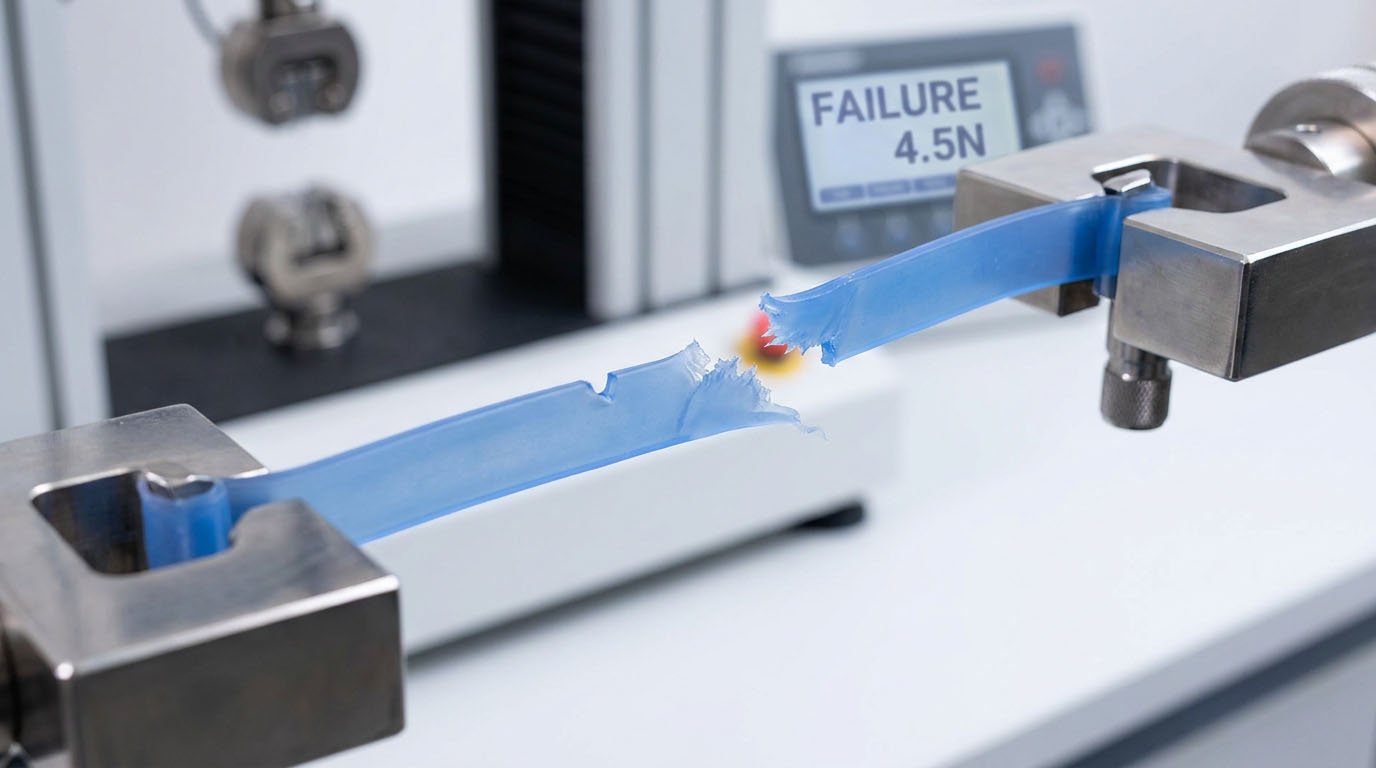
Common Failure Modes
| Failure Mode | Possible Cause | What to Investigate |
|---|---|---|
| Strap body rupture | Material properties, molding variation, local defects | Material specification and production conditions |
| Tear at adjustment notch | Local stress concentration or edge defects | Notch geometry and molding quality |
| Connection failure | Weak attachment or assembly variation | Connection design and assembly |
| Buckle slippage | Insufficient retention or dimensional mismatch | Buckle and strap compatibility |
| Break at clamp edge | Grip-induced damage or a genuine local weakness | Fixture setup and validity criteria |
| Excessive permanent stretch | Poor elastic recovery under the test conditions | Material selection and processing |
These are possible explanations, not automatic diagnoses. Confirm the cause through inspection and, where necessary, additional testing.
How to Read the Force-Displacement Curve
A tensile machine typically records force against displacement or extension.
A force-displacement curve can help identify:
- Maximum recorded force
- Changes in stiffness
- Sudden loss of load
- Progressive deformation
- Final rupture
A sudden force drop may indicate a tear, grip slippage, or another event. Examine the specimen and test setup before assigning the cause.
How Much Tensile Force Should a Swimming Goggle Strap Withstand?
There is no single breaking-force value that should be applied indiscriminately to all swimming goggle straps.
The required performance depends on the applicable product standard, the intended test, and the approved product specification.
For an OEM/ODM project, the buyer and manufacturer should agree on:
- Test method
- Relevant product configuration
- Acceptance limits
- Number and selection of test samples
- Actions required when results do not meet the specification
A numerical result is meaningful only when the test conditions and acceptance requirements are known.
Step 6. Verify Strap Strength Across Production Batches
A successful development sample does not prove that every production batch will perform identically.
Production variability may result from changes in material lots, molding conditions, pigmentation, dimensions, or assembly.
For customized swimming goggles, tensile verification should therefore be connected to the factory’s production control plan.
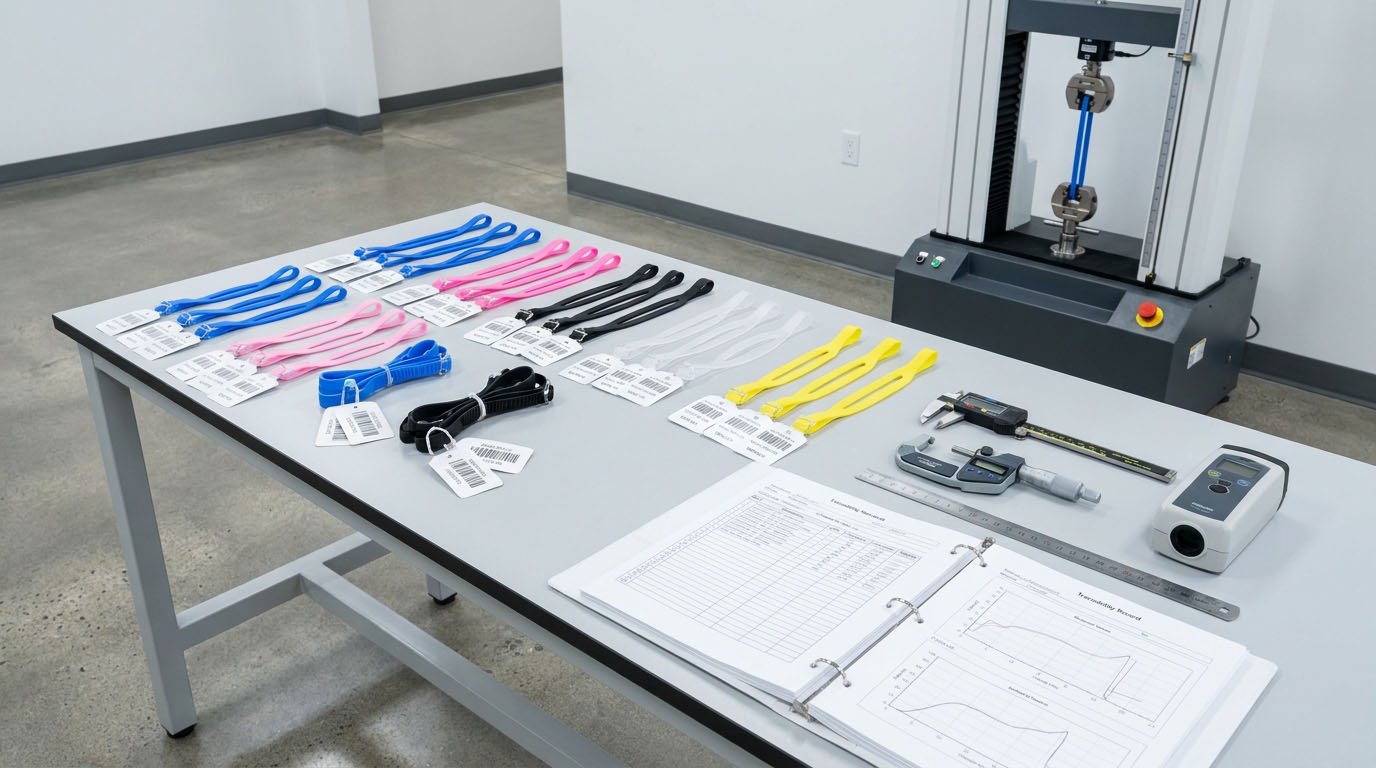
Establish a Batch Verification Procedure
A practical approach includes:
- Identify production lots and relevant material batches.
- Select representative samples according to the approved sampling plan.
- Apply the same documented test procedure.
- Compare the results with approved limits and reference data.
- Investigate abnormal trends or failures.
- Record corrective actions and retest when required.
Different colors or material formulations should be evaluated for their potential effect on performance. A color change does not automatically mean the strap will be weaker, but changes in compounds or additives can justify additional verification.
What Happens When a Batch Fails?
When a result falls outside the approved criteria, the manufacturer should investigate before releasing the affected product.
Possible actions include:
- Hold affected material or production lots
- Verify the test setup and result validity
- Inspect molding and curing records where relevant
- Check material identification and dimensional consistency
- Determine whether further testing or corrective action is needed
- Document the final disposition
Because destructive tensile testing damages specimens, its sampling plan should be defined separately from routine visual or dimensional inspections.
At Jerry, these decisions fit within the broader quality assurance process, which covers incoming materials, in-process monitoring, and final quality verification.
What Does ISO 18527-3 Require for Swimming Goggle Headbands?
ISO 18527-3:2020 covers requirements and test methods for eyewear intended for surface swimming, including recreational and competitive swimming goggles. Amendment 1 was published in 2025.
For headband-related mechanical performance, the standard identifies separate test methods, including:
- Clause 11.4: Slip resistance of the headband
- Clause 11.5: Strength of the headband
- Clause 11.6: Tensile strength and slip resistance of the nosebridge strap
These are distinct evaluations and should not be treated as interchangeable.
ISO 18527-3 vs. Material Tensile Testing
A supplier may also conduct additional material testing using an appropriate method.
For example, ISO 37:2024 addresses tensile stress-strain properties of vulcanized and thermoplastic rubbers. It is relevant to rubber material characterization when suitable specimens and the prescribed procedure are used.
However, a material test does not automatically establish the finished swimming goggle’s compliance with ISO 18527-3.
| Standard or Method | Primary Focus |
|---|---|
| ISO 18527-3 | Finished surface-swimming eyewear requirements and specified product tests |
| ISO 37 | Tensile stress-strain properties of rubber materials |
| Validated factory procedure | Additional product- or project-specific mechanical evaluation |
When a manufacturer claims compliance with a particular standard, buyers should request evidence based on the applicable edition, relevant clauses, and prescribed procedures.
Internal tests can support product development and factory quality control, but they should not be presented as certification tests unless the method and required conditions have been satisfied.
Swimming Goggle Strap Tensile Test Record Checklist
A useful test record should make it possible to understand exactly what was tested, how the test was performed, and how the result was judged.
The following template can be adapted for OEM/ODM projects.
| Record Field | Information Required |
|---|---|
| Product information | Model, strap type, material and color |
| Traceability | Sample ID, production lot and material batch |
| Test method | Applicable standard or approved internal procedure |
| Test equipment | Machine identification and calibration status |
| Test settings | Grip type, gauge length, loading speed and conditions |
| Results | Maximum force, elongation and relevant observations |
| Failure description | Break location, slippage or deformation |
| Acceptance decision | Applicable criteria and Pass/Fail result |
| Verification | Test date, operator and reviewer |
For compliance-related testing, the record must also include the additional information required by the applicable standard.
If buyers need to verify the authenticity, scope, and relevance of a laboratory document, see our guide on how to read a swimming goggle test report.
This article focuses on performing and interpreting strap tests rather than the broader process of auditing laboratory reports.
Frequently Asked Questions
Can You Test Swimming Goggle Strap Strength by Hand?
Hand-pulling can identify some obvious defects, but it cannot provide reliable measurements of force, elongation, or loading speed.
For quantitative verification, use appropriate calibrated equipment and a documented procedure.
Is a Stronger Strap Always Better?
Not necessarily.
A strap must provide sufficient mechanical strength while retaining suitable flexibility, comfort, and adjustability.
A higher breaking force does not automatically mean better elastic recovery or overall product performance.
Why Do Swimming Goggle Straps Tear Near Adjustment Holes?
Adjustment holes and notches can create local stress concentrations.
Potential contributing factors include sharp corners, surface defects, unsuitable material properties, or manufacturing variation.
The failure should be investigated using the actual specimen and relevant production information rather than assuming one cause.
Can One Approved Sample Represent an Entire Production Order?
One passing sample provides limited evidence.
For bulk manufacturing, an appropriate verification plan should consider production lots, material changes, and consistency with the approved product specification.
The required sampling frequency depends on the project and agreed quality requirements.
Should Custom Swimming Goggle Straps Be Retested After Design Changes?
Re-evaluation may be necessary when a change could affect mechanical performance.
Examples include:
- Different strap materials or formulations
- Changes in strap width or thickness
- New adjustment hole or notch designs
- Modified buckles or connection geometry
- Changes to material suppliers or processing
These decisions should be reviewed during OEM/ODM swimming goggle development, before final production approval.
Conclusion
Testing swimming goggle strap tensile strength requires more than stretching a strap until it breaks.
Reliable evaluation starts by identifying the correct test, controlling equipment and measurement conditions, recording force and deformation, and examining how the specimen fails.
For swimming goggle brands and importers, the most important distinction is between material performance, finished headband strength, adjustment-system retention, and production consistency.
Each requires appropriate evidence.
By establishing clear testing requirements during product development and maintaining traceable verification during bulk production, brands can identify potential weaknesses earlier and make better manufacturing decisions.
Developing custom swimming goggles? Contact Jerry Goggles to discuss your strap design, material requirements, sampling, and quality verification needs before mass production.