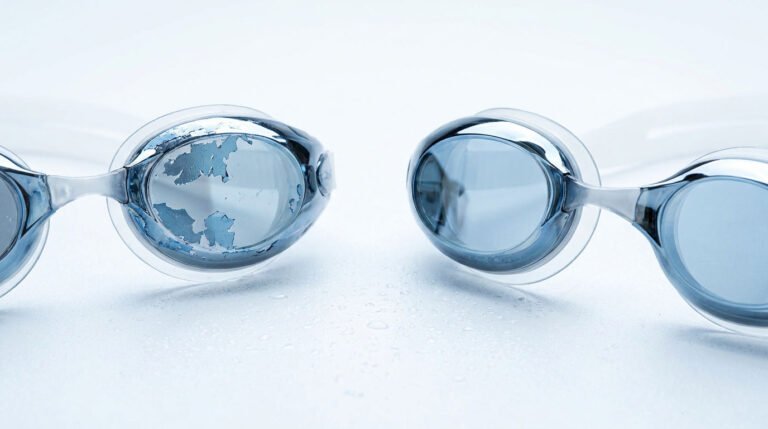
A swimming goggle test report may say "Pass," but that does not automatically mean the goggles meet your product specifications, intended claims, or target-market requirements.
The tested sample might have a different lens coating, gasket material, or product version from the goggles you plan to order. The report may also cover only selected test items rather than the entire product.
To read a swimming goggle test report correctly, verify the tested sample first. Then review the test scope, applicable standards, methods, results, acceptance criteria, and laboratory information. Finally, confirm that the report remains relevant to your approved production specification.
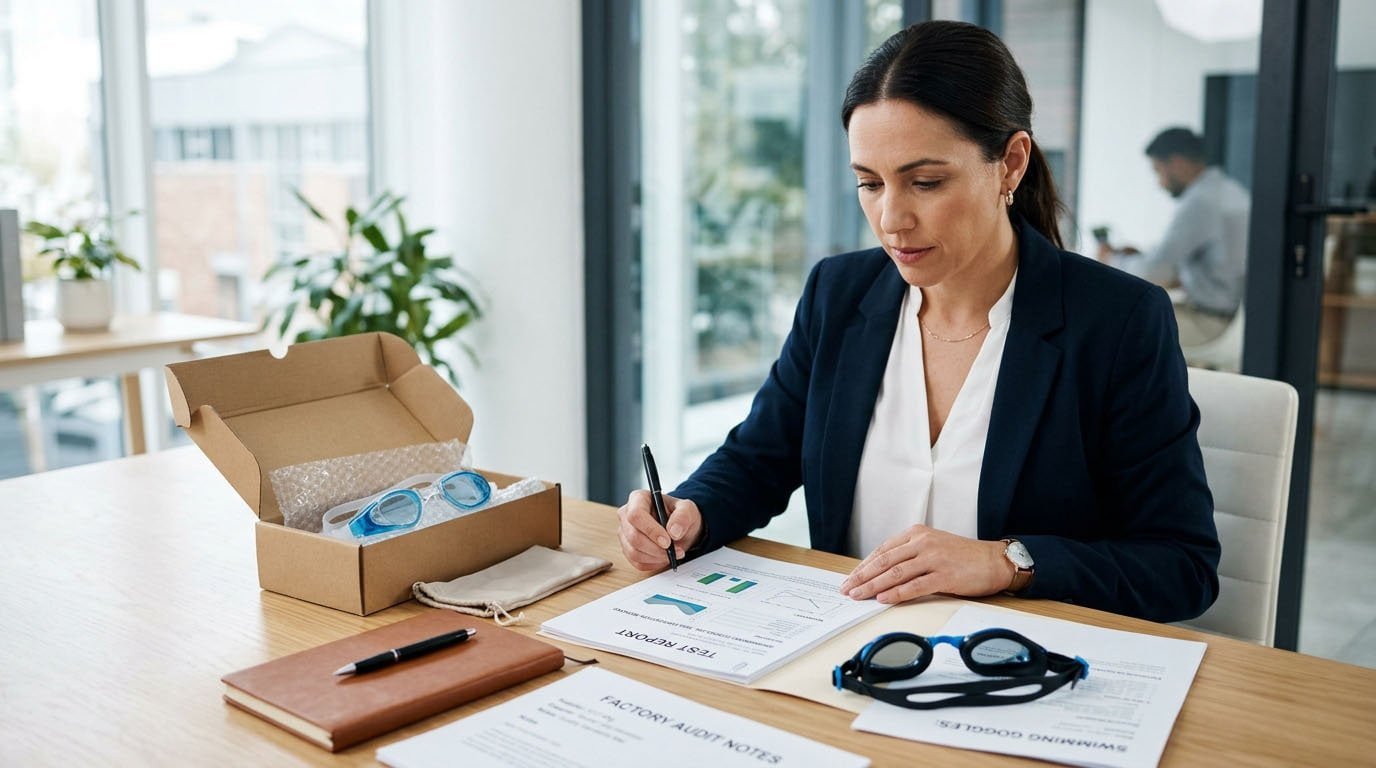
For swimwear brands, importers, distributors, and OEM/ODM buyers, a test report should be treated as a product verification tool—not simply a certificate to file away.
This guide explains how to review a swimming goggle test report step by step, identify common warning signs, and decide whether the available evidence is sufficient for your purchasing decision.
Quick Answer: What Should Buyers Check in a Swimming Goggle Test Report?
The seven most important checks are sample identity, test standard, test scope, test method, actual results, acceptance criteria, and laboratory information.
| What to Check | Key Question |
|---|---|
| Sample identity | Does the tested model match the goggles I am ordering? |
| Test standard | Which standard, edition, and amendments were used? |
| Test scope | Which requirements or properties were actually tested? |
| Test method | How was the test performed? |
| Results | What measurements or observations were recorded? |
| Acceptance criteria | What requirements determined Pass or Fail? |
| Laboratory information | Who performed the testing, and is the laboratory appropriately qualified? |
The most important rule is:
Do not read the word "Pass" first. Read what was tested first.
A passing result applies to the identified sample and the specific requirements evaluated under the reported conditions. It does not automatically establish that every product feature, claim, or future production batch is compliant.
If you are still deciding which documents to request from your supplier, start with our guide to what test reports a swimming goggle manufacturer should provide.
Once you receive the reports, follow the six steps below.
Step 1: Verify the Tested Sample and Report Identity
Before evaluating any technical result, confirm that the laboratory tested the swimming goggles you actually intend to purchase.
A genuine test report can still be unsuitable for your order if the sample differs from your final product.
Check the Report Identification Details
Start with the report’s identifying information:
- Laboratory name and report number
- Applicant or customer name
- Product name and model number
- Sample description and photographs, where available
- Sample receipt and testing dates
- Report issue date
- Authorized report approval
- Any limitations or notes concerning sample identification
A missing photograph does not automatically invalidate a report. However, the product should be traceable through sufficiently clear descriptions, identifiers, or supporting records.
If important details are unclear, ask the supplier or laboratory to clarify them.
Compare the Tested Sample With Your Product
Consider an illustrative example.
A report identifies the tested goggles as:
Model SG-102
- Clear polycarbonate lens
- Standard anti-fog coating
- Silicone gasket
- Black silicone strap
However, your purchase order specifies:
Model SG-102
- Mirrored lens
- Modified anti-fog coating
- Blue silicone gasket
- Different strap buckle
Although both products use the same model number, their specifications are not identical.
The original report may remain relevant to certain unchanged features, but it should not automatically be treated as evidence for every changed component.
Use the following comparison when reviewing your specification sheet or Bill of Materials (BOM).
| Component | What Buyers Should Compare |
|---|---|
| Lens | Material, tint, mirror finish, coating |
| Frame | Material, construction, mold version |
| Gasket | Material, formulation, geometry |
| Strap | Material, dimensions, design |
| Nose bridge | Fixed, adjustable, or replaceable design |
| Buckle | Material and adjustment mechanism |
| Anti-fog treatment | Coating specification and application |
| Colorway | Pigments, lens colors, component variations |
Maintain Sample and BOM Traceability
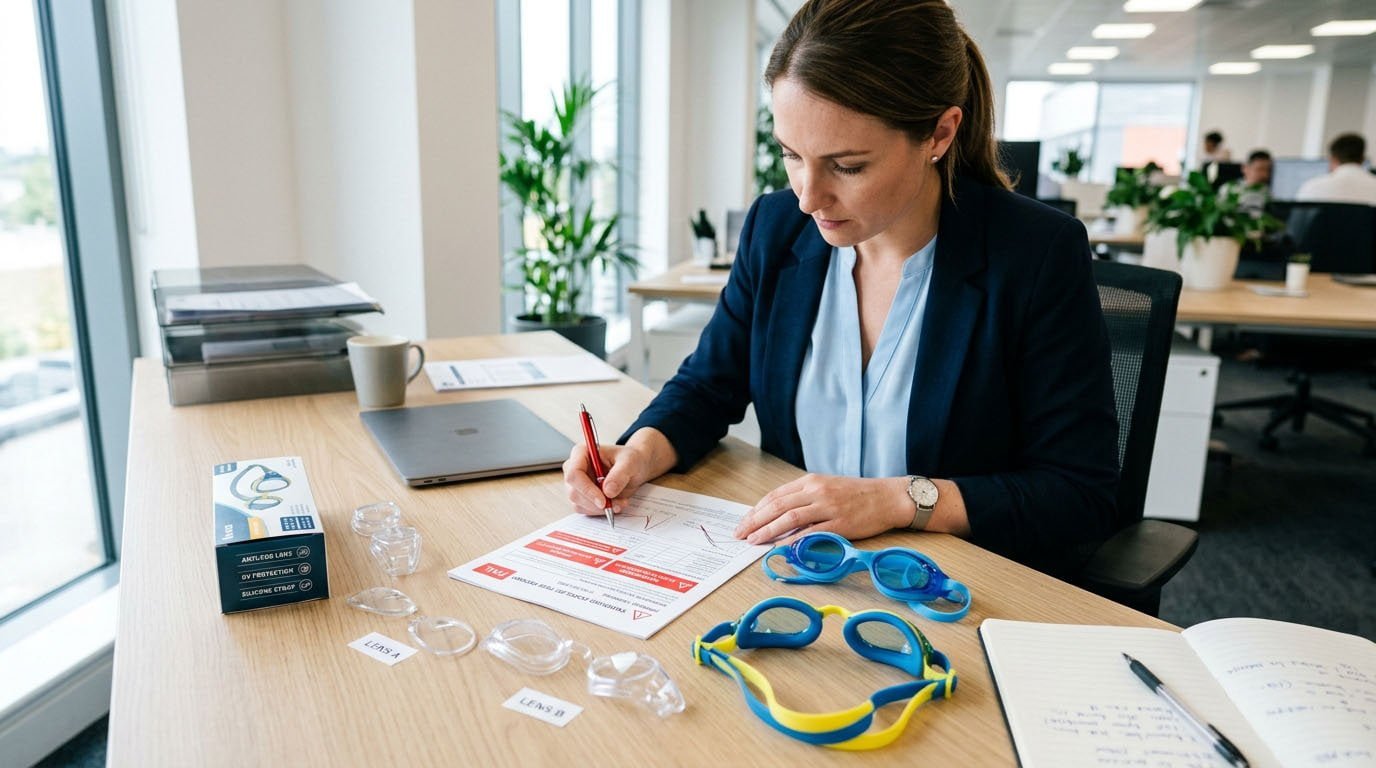
For custom swimming goggles, the most useful documentation connects:
Tested Sample → Approved Sample → Final BOM → Production Specification
If the factory changes a lens material, coating, or component after testing, determine whether the previous evidence remains applicable.
This is particularly important during sampling and prototyping, when several revisions may occur before a brand approves its final product.
Buyer takeaway: Never approve a report solely because the model number looks familiar. Verify the exact product configuration.
Step 2: Check the Test Scope and Applicable Standard
Once the sample identity is confirmed, determine what the report actually covers.
A lengthy report does not necessarily mean that every requirement for swimming goggles has been evaluated.
Some reports cover a complete set of applicable requirements, while others address selected clauses, individual materials, or specific performance claims.
Identify the Standard and Its Edition
For eyewear intended for surface swimming, one relevant international standard is:
ISO 18527-3:2020 — Eye and face protection for sports use — Part 3: Requirements and test methods for eyewear intended to be used for surface swimming.
It addresses areas including materials, construction, optical properties, testing, marking, and information supplied by the manufacturer.
As of October 2026, ISO 18527-3:2020 remains current and has an amendment:
ISO 18527-3:2020/Amd 1:2025
This highlights why buyers should check more than the standard number.
Verify:
- Standard reference and edition
- Applicable amendments
- Specific clauses evaluated
- Product type covered
- Any exclusions or limitations
A report may reference ISO 18527-3 without covering every requirement in the standard.
Also, compliance with a technical standard does not automatically establish that all legal obligations in every target market have been fulfilled.
For a broader explanation of regional requirements, see our Swimming Goggles Compliance Guide.
Check Which Tests Were Actually Included
A report may cover:
| Testing Scope | What It Means for Buyers |
|---|---|
| Full applicable assessment | The report evaluates the stated set of applicable requirements |
| Selected standard clauses | Only identified requirements were tested |
| Optical tests | Evidence concerns specified lens or optical properties |
| Mechanical tests | Evidence concerns specified structural performance |
| Material tests | Evidence concerns identified materials or substances |
| Customer-specific tests | Results are based on an agreed test specification |
Selected testing is not necessarily a problem.
For example, a brand may deliberately request an additional anti-fog evaluation after changing its coating.
The concern arises when a partial report is presented as evidence that the entire product meets every applicable requirement.
Match the Scope to Your Product Claims
Before approving retail packaging, compare important claims with their supporting evidence.
| Product Claim | Buyer Verification |
|---|---|
| Anti-fog | Relevant anti-fog test or performance evidence |
| UV protection | Appropriate optical or UV-related test results |
| Impact resistance | Applicable impact or mechanical evaluation |
| Optical clarity | Relevant optical measurements |
| Strap durability | Appropriate mechanical or durability evidence |
| Leak resistance | Relevant functional evaluation and fit considerations |
Not every claim will necessarily be evaluated by the same report or standard.
Buyer takeaway: The question is not simply whether the report passes. It is whether the tested requirements support the product and claims you intend to sell.
Step 3: Read Test Methods, Results, and Acceptance Criteria
After confirming the product and testing scope, examine the actual results.
A test result cannot be interpreted reliably without understanding the method, conditions, and acceptance criteria.
The correct reading sequence is:
Test Method + Test Conditions + Actual Result + Acceptance Criteria
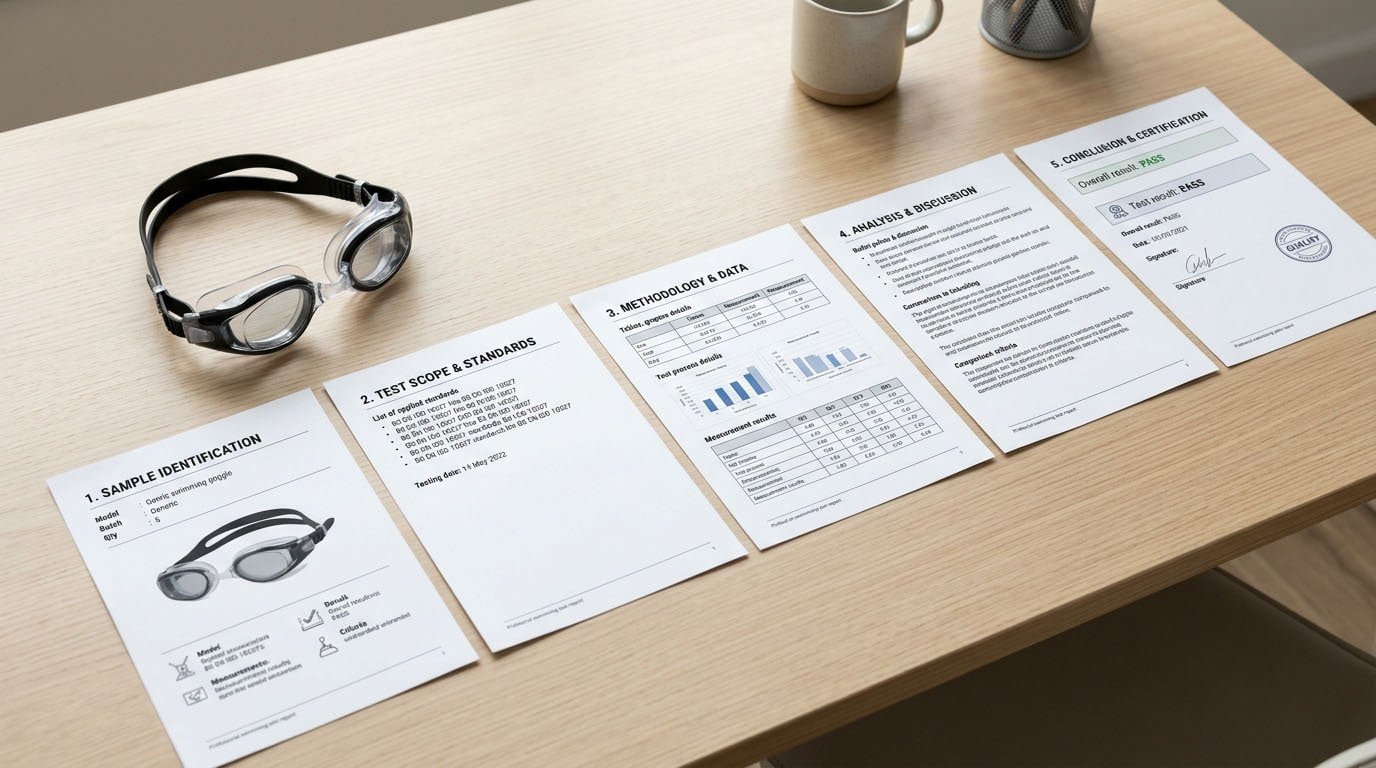
Understand What Each Column Means
| Report Information | What Buyers Should Understand |
|---|---|
| Test item | Which characteristic was evaluated? |
| Method or clause | How was the characteristic tested? |
| Test conditions | Under what conditions was testing performed? |
| Result | What measurement or observation was recorded? |
| Acceptance criteria | What requirement was used for comparison? |
| Conclusion | Did the result satisfy that stated requirement? |
For example, a report might show a measurement alongside a requirement and a Pass conclusion.
Do not evaluate that number in isolation.
Determine whether the method was appropriate, whether the reported conditions matched the intended evaluation, and which criterion was applied.
Example: How to Interpret a Test Report Entry
The following is an illustrative example, not an actual laboratory test result.
| Report Field | Example Entry | Buyer Interpretation |
|---|---|---|
| Sample ID | SG-EXAMPLE-01 | Confirm the product identity |
| Test item | Optical property | Identify the characteristic |
| Method | Specified standard clause | Check the referenced method |
| Result | Recorded measurement | Review the actual measured value |
| Acceptance criteria | Requirement in the applicable specification | Understand the pass limit |
| Conclusion | Pass | Confirm what the result proves |
This simple exercise shows why the final conclusion is only one part of the report.
Check the Laboratory Information
Buyers should also confirm:
- The laboratory’s legal name and testing location
- Report number and issue date
- Relevant testing dates
- Report approval or authorization
- Accreditation information, where applicable
- Whether the particular test falls within the laboratory’s accredited scope, if accredited testing is required
ISO/IEC 17025 concerns laboratory competence, impartiality, and consistent operation.
However, an ISO/IEC 17025-accredited laboratory is not automatically accredited for every test it performs.
The relevant scope must be checked when accreditation matters to your project.
Laboratory accreditation and product compliance are different questions. A laboratory’s competence does not, by itself, establish market approval for the goggles.
For report authentication concerns, buyers can request confirmation using the report number and laboratory details.
Buyer takeaway: Read the complete report—not only the first page, laboratory logo, or final Pass/Fail column.
Step 4: Review Key Swimming Goggle Performance Results
Swimming goggles combine optical components, coatings, flexible seals, straps, and adjustment mechanisms.
Different test items therefore answer different product-quality questions.
Rather than treating all tests as equivalent, focus on the properties relevant to your intended product and claims.
Key Results Buyers Should Understand
| Test Area | What to Review | Common Buyer Concern |
|---|---|---|
| Optical performance | Relevant optical measurements and limits | Does the lens meet the specified optical requirements? |
| Anti-fog | Test method, conditions, coating identity, results | Is the anti-fog claim supported? |
| UV-related performance | Measurement method, applicable range, results | Does the tested lens support the stated UV claim? |
| Mechanical performance | Test setup, loads or conditions, observed results | Are the relevant components adequately evaluated? |
| Leak or fit-related performance | Specified evaluation procedure and findings | What do the results establish about sealing performance? |
| Material-related tests | Sampled material, analytes, limits, results | Does the evidence address the intended material requirement? |
Not every report includes all these areas. The appropriate test selection depends on the product, applicable requirements, and agreed specifications.
Optical Test Results
Swimming goggle reports may contain evaluations concerning refractive properties, optical quality, light transmission, or other specified lens characteristics.
When examining these results, check:
- Which optical property was measured?
- Which test method and acceptance limit applied?
- What value was recorded?
- Which lens configuration was tested?
A clear lens and a mirrored lens should not automatically be treated as equivalent for every optical assessment.
Changes to tint, coating, lens material, or construction may affect the relevance of existing evidence.
Anti-Fog Test Results
Anti-fog performance is a common selling point for swimming goggles.
However, a report indicating that a sample passed a particular anti-fog test should not be interpreted as a guarantee that the coating will never fog or that it will maintain the same performance indefinitely.
Review the test method, conditions, acceptance criteria, and coating specification.
Also distinguish between an initial anti-fog performance check and a durability evaluation involving repeated use, cleaning, or other defined exposure conditions.
If the coating formula or application process changes after testing, the existing result may require reassessment.
UV Protection Results
For UV-related claims, determine which property was measured and which wavelengths or other parameters were included in the evaluation.
Check the tested lens against the lens specified for production.
A change in material, tint, or surface treatment may affect the applicability of earlier results.
Avoid assuming that every lens option automatically provides identical UV-related performance.
Mechanical and Functional Results
Mechanical evaluations may involve the lens, frame, strap, buckle, bridge, or other components.
When reviewing a result, ask what type of failure or performance condition the test was intended to assess.
A strap-related result does not establish lens impact performance. Similarly, a lens result does not demonstrate the durability of every adjustment component.
For functional leakage assessments, distinguish between structural or sealing defects and individual facial fit. A particular test result may not represent every swimmer’s fit experience.
Buyer takeaway: Each test result supports a defined conclusion. Do not extend it to unrelated product features.
Step 5: Check Product Changes and Report Coverage
One of the most common problems in custom swimming goggle projects occurs when the product changes after testing.
The original report may remain valid as a record of the tested sample, but its relevance to the revised product must be evaluated.
Can One Report Cover Multiple Models or Colors?
Possibly, but coverage should never be assumed.
Two models may share the same basic design while using different materials, lenses, coatings, or components.
Likewise, a color change may have little significance for one test but matter for another.
| Product Change | What Buyers Should Consider |
|---|---|
| Logo or packaging change | Whether product claims, identification, or applicable obligations change |
| Frame color change | Whether pigments or material formulation affect relevant requirements |
| Lens tint change | Whether optical properties or UV-related performance are affected |
| Mirror coating change | Whether coating-related performance needs reassessment |
| Anti-fog coating change | Whether existing anti-fog evidence remains applicable |
| Gasket formulation change | Whether material or functional performance could change |
| Strap or buckle redesign | Whether mechanical evaluation is affected |
| Mold or geometry change | Whether fit, construction, or functional performance changes |
A change does not automatically mean that every test must be repeated.
Instead, determine which previously tested properties could be affected and whether the existing evidence remains sufficient.
Keep Testing Connected to Production
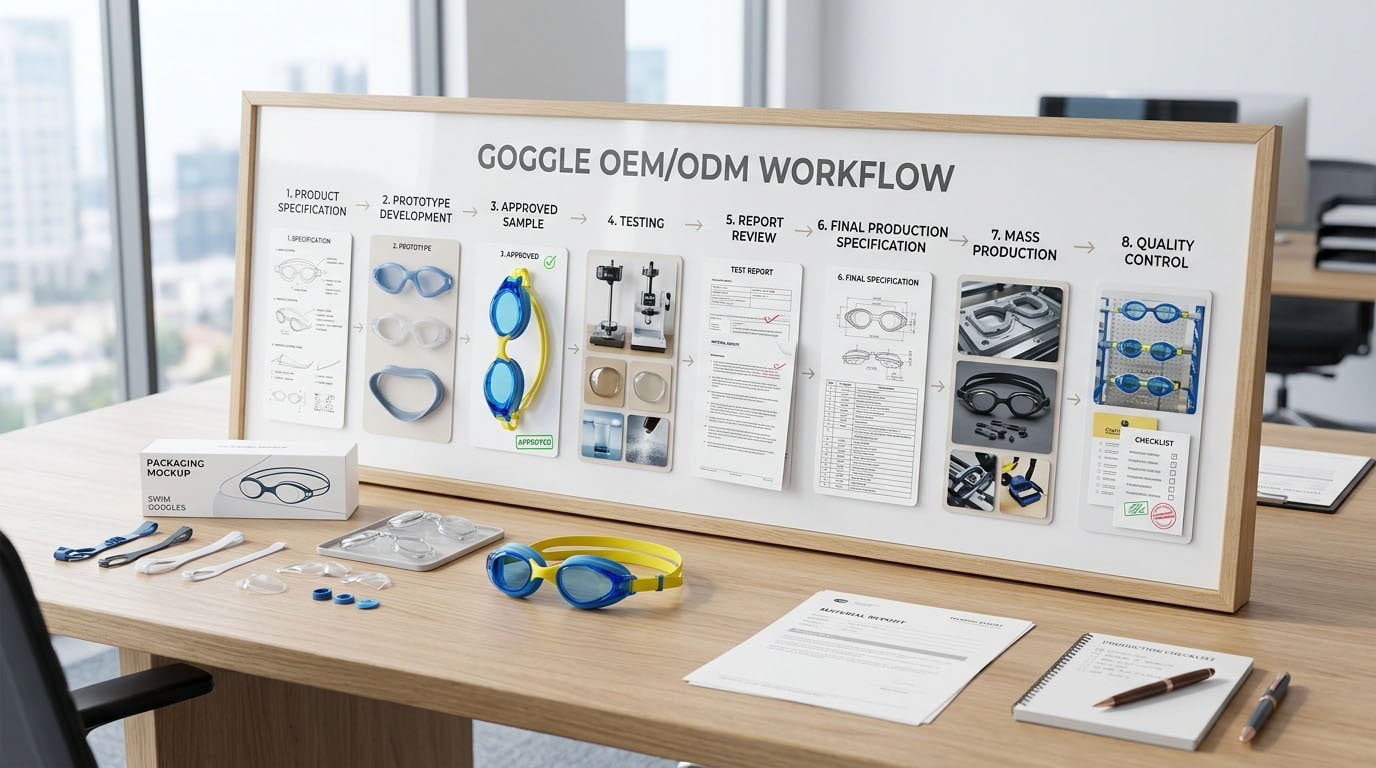
For OEM/ODM manufacturing, testing should be integrated into product development rather than handled as an isolated administrative step.
A practical sequence is:
Product Specification → Prototype → Approved Sample → Testing → Report Review → Final Production Specification → Mass Production → QC
If testing identifies a problem and the sample is modified, document the changes and determine whether further verification is needed before approval.
During bulk production, use controlled material specifications, production records, and inspections to maintain consistency with the approved configuration.
This is where Jerry’s quality assurance process becomes relevant.
Third-party laboratory reports and factory QC records serve different purposes:
- Laboratory testing provides evidence concerning identified samples and specified requirements.
- Factory QC helps verify that production follows approved specifications and defined inspection criteria.
For custom product development, an organized OEM & ODM manufacturing process helps connect design approval, component specifications, testing, and production control.
Buyer takeaway: The central question is whether the goggles being manufactured still match the configuration supported by the testing evidence.
Step 6: Decide Whether to Accept, Clarify, or Request More Evidence
After reviewing the report, turn your findings into a purchasing decision.
The objective is not to collect the largest number of test reports. It is to obtain reliable evidence that addresses the requirements of your actual product.
Use This Buyer Decision Matrix
| Review Finding | Recommended Action |
|---|---|
| Sample matches, relevant tests covered, acceptable results | Accept the testing evidence for its defined purpose |
| Model or material information is unclear | Request clarification |
| Important claim lacks supporting evidence | Request additional documentation or testing |
| Product changed after testing | Evaluate the effect of the change |
| Important test failed | Investigate, correct, and verify before approval |
| Report refers to a different product | Do not rely on it without justified supporting evidence |
| Laboratory information or report authenticity is uncertain | Verify with the laboratory |
When Can You Accept the Testing Evidence?
Accept the evidence for the intended review when:
- The tested sample is adequately identified.
- Relevant product requirements are covered.
- The methods and standards are appropriate.
- Results satisfy applicable acceptance criteria.
- The report remains relevant to the approved product version.
- Material discrepancies have been resolved.
Accepting test evidence is not the same as granting final approval for mass production or declaring complete legal compliance.
Other product, quality, and target-market requirements may still need to be satisfied.
When Should You Ask for Clarification?
Ask your supplier or the testing laboratory when the report does not clearly explain the sample, method, result, or scope.
For example:
- The model number differs from the purchase specification.
- The lens description is incomplete.
- Only selected standard clauses were evaluated.
- The reported result lacks a clear acceptance criterion.
- The product was modified after testing.
An unclear report is not necessarily a failed report. It means the available evidence needs further explanation.
When Is Additional Testing Appropriate?
Further testing may be appropriate when an important property has not been evaluated, a previous test failed, or a product change affects the existing evidence.
A change in target market may also create new requirements that the original report does not cover.
Where the decision is uncertain, consult the relevant laboratory or a qualified compliance professional rather than assuming either that every variation needs new testing or that the original report covers everything.
Common Red Flags in Swimming Goggle Test Reports
Even a professional-looking report can contain information that makes it unsuitable for a particular purchasing decision.
| Red Flag | Why It Matters | Recommended Action |
|---|---|---|
| Wrong model number | Tested sample may not match the order | Verify product identity |
| Different lens or coating | Relevant performance may differ | Compare specifications |
| Incomplete sample identification | Traceability is weak | Request supporting records |
| Only selected tests provided | Important requirements may be missing | Check the complete required scope |
| Unclear test method | Results are difficult to interpret | Request method details |
| Missing acceptance criteria | Pass/Fail conclusion lacks context | Obtain applicable requirements |
| Standard edition unclear | Applicability may be uncertain | Confirm version and amendments |
| Product changed after testing | Original evidence may no longer be representative | Conduct a documented change review |
| Marketing claims exceed evidence | Important claims may be unsupported | Obtain suitable evidence |
| Incomplete report supplied | Limitations or supporting results may be missing | Request the full report |
These are warning signs requiring further review, not automatic proof that a supplier or laboratory is unreliable.
For example, a missing photograph can sometimes be resolved through a reliable sample identification record.
Similarly, selected testing may be appropriate when it was intentionally requested for a specific purpose.
The problem is relying on evidence for a broader conclusion than it actually supports.
A 5-Minute Swimming Goggle Test Report Checklist
Use this checklist before accepting a test report as evidence for your product.
Product Identity
- [ ] Model and sample identification match the intended product.
- [ ] Lens, coating, gasket, strap, and other relevant components are confirmed.
- [ ] The tested version can be traced to the approved specification.
Test Scope and Standards
- [ ] Relevant test items and clauses are identified.
- [ ] Standard editions and applicable amendments are checked.
- [ ] Important product claims have suitable supporting evidence.
Test Results
- [ ] Methods and conditions are understood.
- [ ] Actual measurements or observations have been reviewed.
- [ ] Acceptance criteria and conclusions are consistent.
Laboratory and Production
- [ ] Laboratory identity and report details are verified.
- [ ] Relevant accreditation scope is checked when required.
- [ ] Product changes after testing have been evaluated.
- [ ] Final production specifications remain aligned with the approved configuration.
If any critical item cannot be confirmed, request clarification before relying on the report for that decision.
Frequently Asked Questions
Does "Pass" Mean My Swimming Goggles Are Fully Compliant?
No.
"Pass" means that the identified samples satisfied the stated acceptance requirements for the tests performed.
It does not automatically establish complete compliance with every applicable product, labeling, documentation, or target-market requirement.
Review the test scope and any other requirements relevant to the product.
Can One Swimming Goggle Test Report Cover Multiple SKUs?
Possibly.
Coverage depends on the product differences, the applicable requirements, the testing approach, and the supporting documentation.
For example, multiple SKUs may share the same construction but use different lens coatings or material formulations.
The relevance of existing test evidence should be assessed for each variation rather than assumed from model similarity alone.
What If My Supplier Only Provides the First Page of a Report?
Ask for the complete report when reviewing the evidence for an important purchasing or compliance decision.
The first page may show the overall result without explaining the sample description, individual test methods, measurements, acceptance criteria, or limitations.
These details may appear elsewhere in the document.
If authenticity is uncertain, use the report number to request verification from the issuing laboratory.
Does a Private-Label Brand Need New Testing?
Not necessarily in every situation.
Existing factory test reports may provide relevant evidence when the branded product uses the same tested construction and materials.
However, brands must assess whether the documentation adequately covers their own product configuration, claims, and applicable obligations.
Changes to lenses, coatings, materials, or construction may require additional evaluation.
A new logo or packaging design does not automatically invalidate every technical test result, but product identification, documentation, and labeling obligations still need review.
Should I Request New Testing When the Lens or Coating Changes?
At minimum, conduct a documented change assessment.
A different lens material, tint, mirror finish, or anti-fog coating may affect properties previously evaluated.
Compare the original and revised specifications, identify potentially affected test items, and determine whether existing evidence remains appropriate.
If the impact cannot be established reliably, seek further evaluation or testing.
Conclusion: Read the Evidence, Not Just the Pass Result
Learning how to read a swimming goggle test report is an important part of evaluating products before sourcing, brand launch, or bulk production.
The review process comes down to one sequence:
Sample → Scope → Standard → Method → Result → Acceptance Criteria → Production Product
First, verify that the tested sample matches the swimming goggles you intend to sell.
Next, confirm what was tested, how it was tested, and which requirements the results satisfied.
Finally, determine whether the product has changed and whether the testing evidence remains relevant to the final production configuration.
The most useful test report is not necessarily the longest one. It is the report that provides relevant, traceable evidence for the exact swimming goggles you are purchasing.
For brands developing private-label or custom swimming goggles, Jerry can help coordinate product specifications, sample development, testing requirements, and production preparation.
Contact Jerry to discuss your swimming goggle project and the documentation needed before mass production.