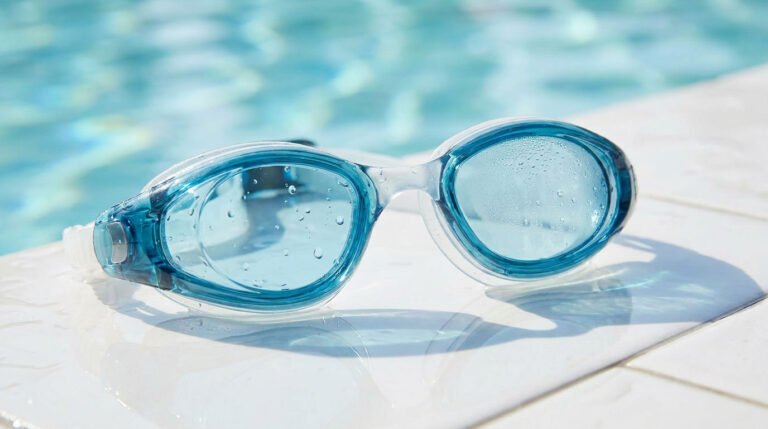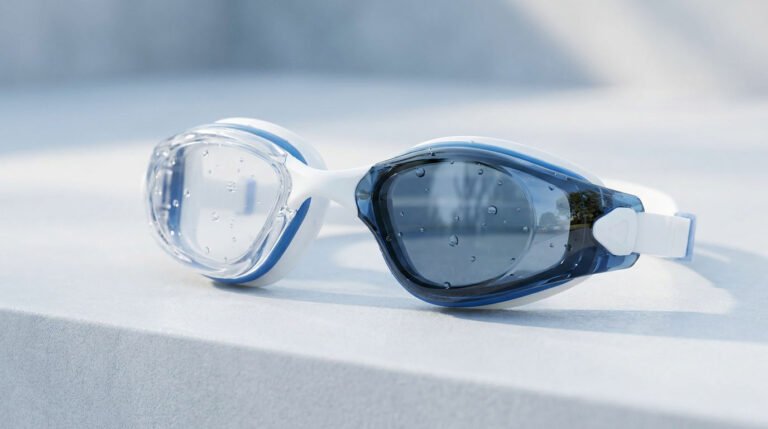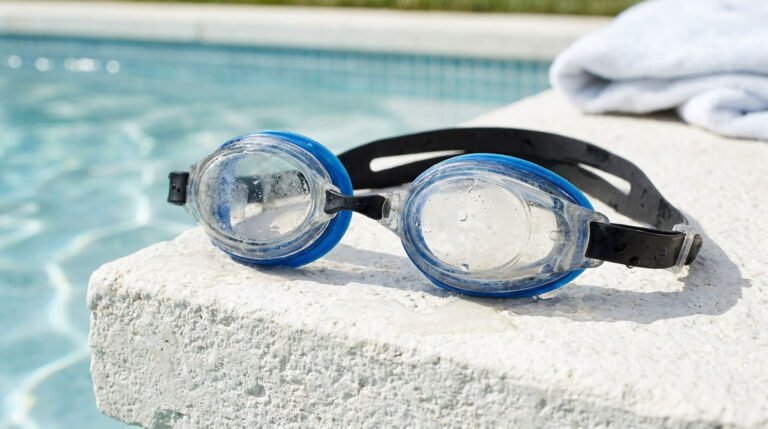
Mirror swimming goggles look premium when new, but peeling, flaking, or patchy mirror finishes can quickly become a problem for swimmers and the brands selling them.
For swimming goggle manufacturers and private-label brands, the key question is whether the damage comes from a manufacturing problem, normal wear, or improper exposure.
Mirror coating can peel off swimming goggle lenses because of weak coating adhesion, mechanical abrasion, chemical exposure, excessive heat, or a combination of these factors. Early peeling across multiple unused or lightly used goggles may suggest a manufacturing issue, while localized damage associated with scratches or repeated rubbing may indicate wear.
However, appearance alone cannot confirm the root cause. The coating structure, damage pattern, usage history, and production batch all matter.
This guide explains how to identify mirror coating failures, investigate complaints, and reduce the risk of peeling in OEM and private-label swimming goggles.
Step 1. What Does Mirror Coating Peeling Look Like?
Not every damaged mirror finish is actually peeling.
Swimming goggle lenses may develop scratches, discoloration, cloudy areas, or visible coating separation. These conditions can look similar in customer photographs but may have different causes.
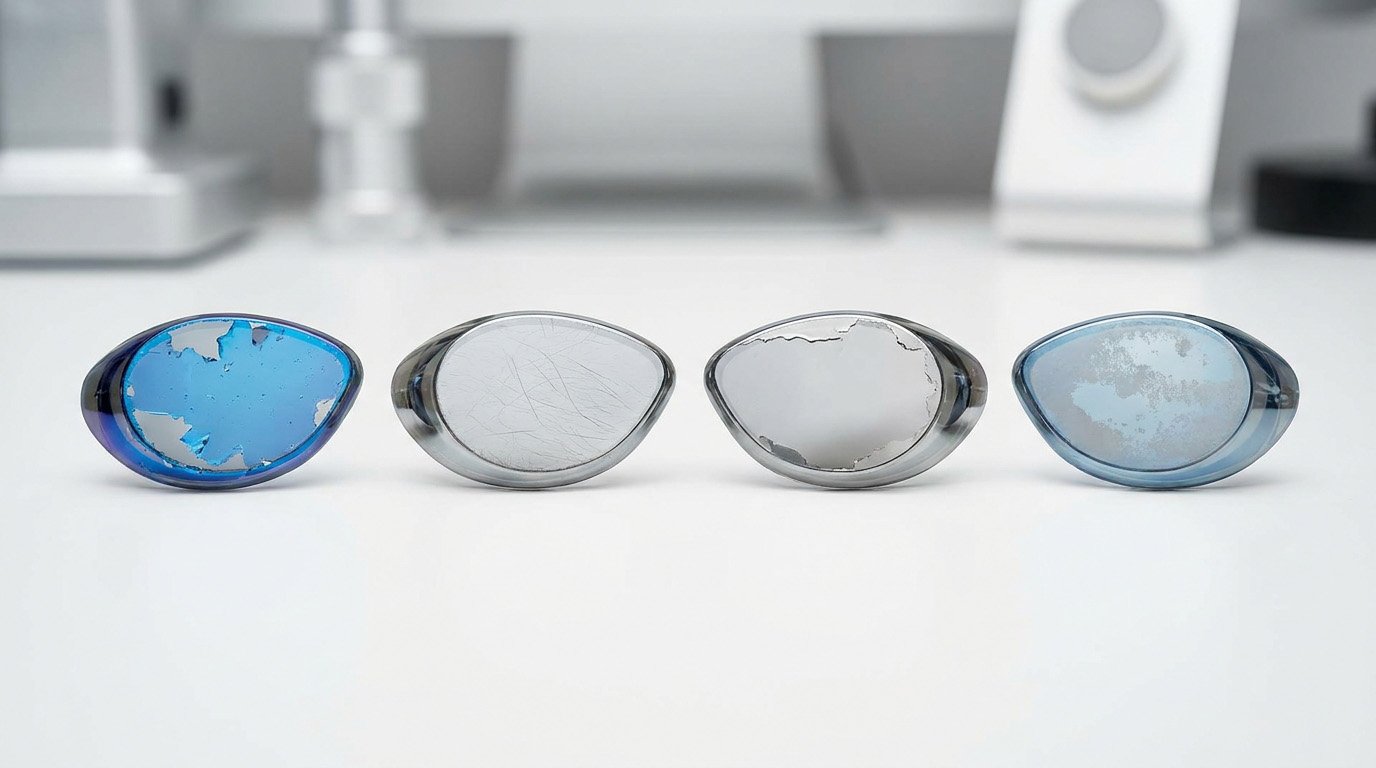
Common Mirror Coating Failure Patterns
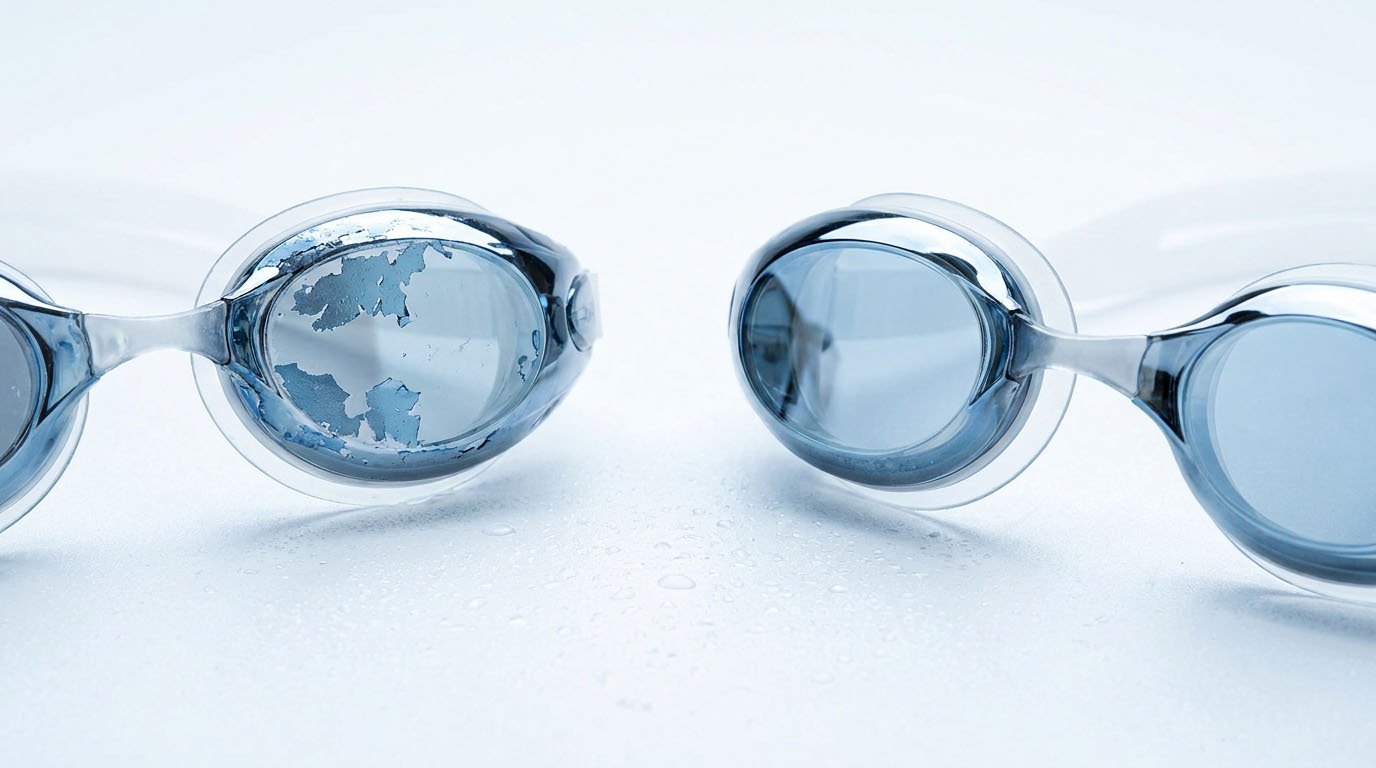
1. Flaking or delamination
Small pieces or larger sections of the reflective finish separate from the lens. This may indicate weak bonding between layers, physical damage, or environmental deterioration.
2. Localized scratching
Fine lines appear where the lens has contacted a towel, fingers, swimming equipment, or another abrasive surface. Scratching can remove or damage the mirror finish without indicating a broader adhesion defect.
3. Edge peeling
Coating damage begins near the lens perimeter and gradually extends inward. Possible contributors include edge exposure, contact with surrounding components, abrasion, or coating adhesion problems.
4. Patchy fading or uneven reflectivity
Certain areas appear less reflective than others. This may involve coating wear, contamination, or changes in the optical film. It does not necessarily mean the coating is physically peeling.
Why the Damage Pattern Matters
A few scratches on one heavily used pair of goggles require a different investigation from widespread flaking on multiple new products.
Before identifying the cause, brands should record:
- The location and appearance of the damage
- Whether the reflective layer is lifting or simply scratched
- When the problem first appeared
- Whether other goggles from the same batch show similar symptoms
The purpose of this first inspection is to identify possible causes, not assign responsibility.
Step 2. What Causes Mirror Coating to Peel Off Swimming Goggles?
Mirror-coated swimming goggles typically use a reflective treatment associated with the lens surface. Depending on the design, this may involve thin metallic or dielectric layers and additional protective coatings.
The exact construction varies between manufacturers and lens technologies.
Four main categories should be considered when investigating coating failure.
1. Manufacturing and Coating Adhesion Problems
Mirror coating must bond properly to the underlying lens or intermediate coating layer.
If bonding is inconsistent, premature peeling may occur.
Potential manufacturing-related factors include:
- Surface contamination before coating
- Inadequate surface preparation
- Incompatible coating and substrate materials
- Variation in deposition or protective-layer processing
- Handling damage during production or assembly
For example, residual contaminants on a lens may interfere with coating adhesion. However, identifying contamination as the actual cause requires supporting inspection or testing evidence.
A coating that looks acceptable immediately after production may still perform poorly during repeated exposure if its adhesion or durability is insufficient.
For a broader explanation of lens molding and coating production, see How Swimming Goggles Are Made.
2. Mechanical Friction and Abrasion
Mechanical damage is another common reason mirrored goggles lose their reflective appearance.
Potential sources include rubbing the lens with a towel, cleaning a dry surface, contact with fingernails, or carrying goggles loose alongside other equipment.
Fine abrasive particles can also scratch the surface.
Repeated contact may gradually wear away the reflective or protective finish. If the coating structure is already weakened, physical contact can contribute to more extensive damage.
Important: Visible scratches suggest mechanical contact, but they do not automatically prove that improper handling was the only cause.
3. Pool Chemicals, Sunscreen, and Cleaning Products
Swimming goggles regularly encounter chlorinated pool water, saltwater, sunscreen, body oils, and cleaning substances.
The effect of these exposures depends on the coating formulation, protective layers, concentration, contact duration, and cleaning method.
Pool-water residue may remain after water evaporates. Rubbing the lens while particles or deposits are present can increase abrasion risk.
Some incompatible chemical products may also affect susceptible coating systems.
However, chlorine or sunscreen exposure should not automatically be treated as proof of chemical damage.
A reliable investigation may require controlled compatibility testing.
4. Excessive Heat and Improper Storage
Leaving goggles inside a hot vehicle, near heating equipment, or under prolonged direct sunlight can expose the product to unnecessary thermal stress.
Different lens and coating materials may respond differently to temperature changes.
Depending on the construction, excessive heat may contribute to coating cracking, loss of adhesion, or other appearance changes.
Storing wet goggles without adequate drying can also prolong exposure to moisture and residues.
These factors increase potential risks, but no universal storage temperature or exposure duration can predict when every mirror coating will fail.
Step 3. Is Mirror Coating Peeling a Manufacturing Defect or Normal Wear?
This is often the most important question for swimming goggle brands handling customer returns.
Early coating failure is not automatically a factory defect, and damage after repeated use is not automatically customer misuse.
A more reliable judgment combines visual observations, product history, batch information, and verification testing.
Manufacturing Defect vs. Wear: Diagnostic Comparison
| Investigation Factor | Possible Manufacturing Issue | Possible Wear or Exposure |
|---|---|---|
| Damage timing | Appears before use or unusually early | Develops gradually with use |
| Surface appearance | Coating lifts without obvious abrasion | Scratches or contact marks are visible |
| Batch distribution | Multiple units from the same lot show similar damage | Complaints are scattered across different lots |
| Damage location | Similar failure areas across several units | Damage corresponds with repeated contact |
| Reference samples | Unused samples show similar coating weakness | Unused samples remain intact |
These indicators guide investigation; none independently establishes the root cause.
Example: Several Goggles Peel After Limited Use
Suppose a brand receives multiple complaints from customers who purchased goggles from the same production batch.
The reported lenses show similar areas of reflective coating separation, with no obvious surface scratches.
This pattern raises a reasonable concern about production consistency.
The next step should be to compare returned goggles with unused products from the same batch and review relevant coating records.
Now consider a different situation: one customer reports surface damage after extended use, and inspection reveals repeated scratches across the affected area.
Mechanical abrasion becomes a stronger possibility, but further evidence may still be needed.
The key lesson for brand owners is simple:
Treat peeling as a quality investigation, not an immediate verdict about who is responsible.
Step 4. How Should Brands Investigate Mirror Coating Complaints?
A structured investigation helps brands respond consistently, avoid premature conclusions, and identify possible recurring production problems.
For OEM and private-label buyers, the following four-step workflow provides a practical starting point.
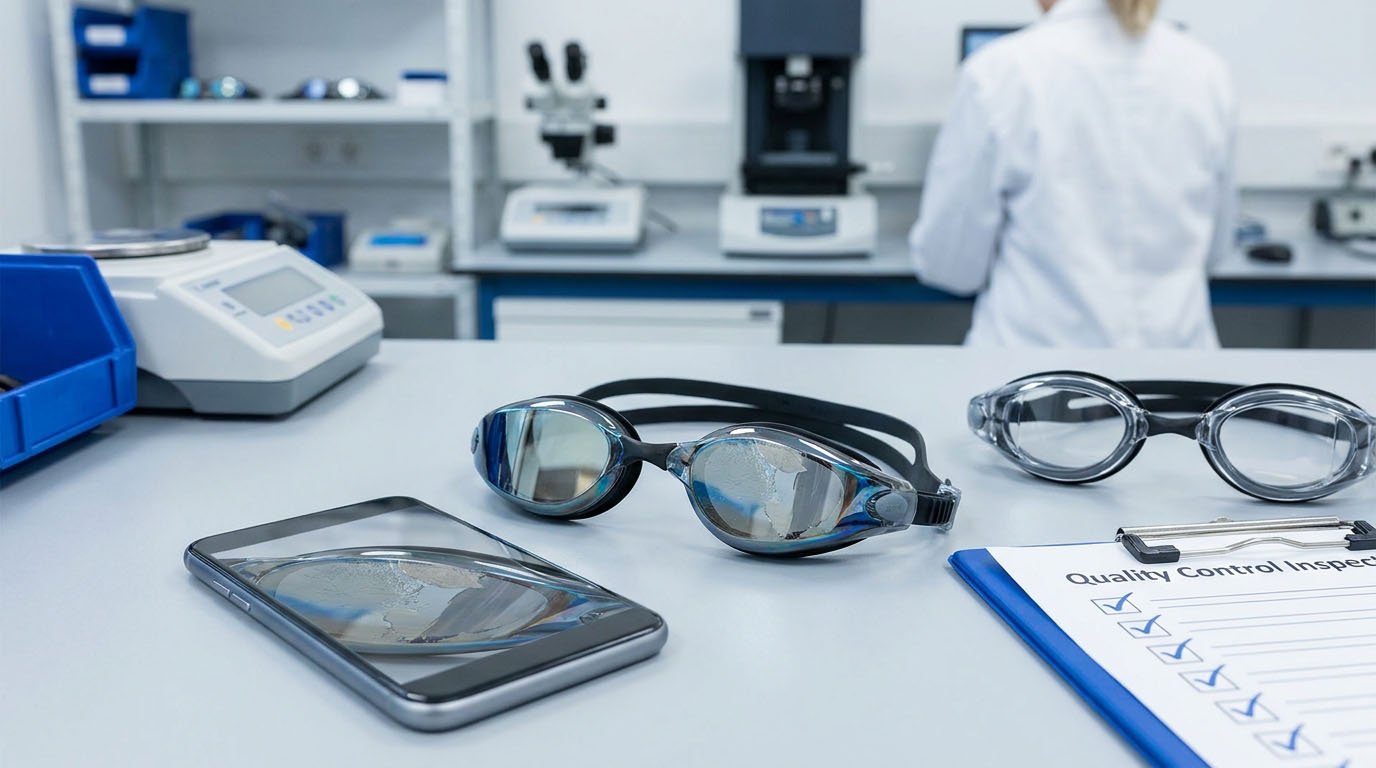
1. Collect Clear Photographs and Product Information
Request photographs showing the complete goggles, both lens surfaces, affected areas, and any visible scratches.
Use consistent lighting where possible.
Record the product model, lens color, purchase date, production lot or traceability code, and approximate date when the damage first appeared.
Avoid cleaning or scraping a returned lens before its original condition has been documented.
2. Review Usage and Storage History
Ask neutral, specific questions:
- How frequently were the goggles used?
- Were they used in a swimming pool, seawater, or both?
- How were the lenses rinsed and dried?
- Were cleaning products, sunscreen, or anti-fog solutions used?
- Where were the goggles stored between swimming sessions?
These details help establish an exposure timeline without automatically blaming the customer.
3. Compare Returned Products With Reference Samples
When repeated complaints arise, physical sample comparison becomes especially useful.
Compare affected products with unused samples of the same model, lens configuration, and production batch whenever available.
Check whether the damage is isolated or repeated, whether similar patterns occur on different units, and whether the remaining coating shows unusual weakness.
Additional examination may include microscopy, carefully controlled abrasion evaluation, or adhesion assessment.
Any adhesion test must be appropriate for the actual curved lens, substrate, and multilayer coating system. A generic tape or cross-hatch test should not be presented as universally suitable for every swimming goggle mirror finish.
Test results must be interpreted alongside the sample condition and established acceptance criteria.
4. Review Batch Records and Decide the Next Action
Where a possible production issue is identified, review relevant manufacturing information, such as coating configuration, material specifications, approved reference samples, process changes, and batch inspection records.
If the evidence points toward a recurring problem, the brand and manufacturer should agree on further testing, corrective actions, and affected-stock handling.
Document the outcome, including any unresolved uncertainty.
When supporting test reports are available, buyers can use our guide on How to Read a Swimming Goggle Test Report to understand the sample identity, test scope, results, and acceptance criteria.
A test report is useful only when its results apply to the product being investigated.
Step 5. Can Peeling Mirror Coating Be Repaired or Prevented?
Once a reflective film has physically separated from the lens, routine cleaning cannot restore the original factory coating.
Mirror finishes generally require specialized manufacturing processes, so home repair is not a reliable way to recreate their optical appearance or durability.
Can Damaged Mirror Goggles Still Be Used?
Minor cosmetic marks outside the main viewing area may not immediately make goggles unusable.
However, significant coating loss can create uneven light transmission, glare, or distracting patches in the field of view.
If damage interferes with visibility, the lens is cracked, or loose material may contact the eye, stop using the goggles and replace them.
Avoid polishing, scraping, or applying solvents to remove the remaining mirror finish.
How to Reduce Mirror Coating Damage
For most conventionally mirror-coated swimming goggles, sensible care practices include:
Rinse gently after swimming. Use clean freshwater to help remove pool-water or saltwater residues, following the product’s care instructions.
Avoid rubbing lens surfaces. Do not scrub the mirror finish with towels, clothing, or abrasive cleaning tools.
Allow proper drying. Let goggles air-dry in a shaded, ventilated location before storage.
Use a protective case. Keep lenses separated from sharp or abrasive equipment during transportation.
Avoid excessive heat and unapproved chemicals. Do not leave goggles in hot vehicles or clean them with solvents or other products not approved by the manufacturer.
Careful handling can reduce avoidable damage, but it cannot guarantee that a coating will never wear or peel.
For swimming goggle brands, clear care instructions should accompany the product rather than relying on unsupported promises about coating lifespan.
Step 6. How Can OEM Buyers Reduce Mirror Coating Failures Before Mass Production?
For brands ordering custom mirrored swimming goggles, preventing avoidable coating complaints begins before the final production order.
The most useful approach is to define the mirror finish, approve a representative sample, and agree on suitable quality verification.
Define the Exact Lens and Coating Configuration
Different mirror finishes may use different optical structures and protective layers.
A buyer should identify the approved lens material, mirror color, coating construction, and any relevant protective treatment.
Mirror coating and anti-fog coating should not be confused.
The mirror treatment generally manages reflection and visible-light transmission, while the inner anti-fog treatment helps limit condensation-related visibility problems.
The two functions require separate performance considerations, even when both are incorporated into the same lens.
Agree on Coating Verification Before Approval
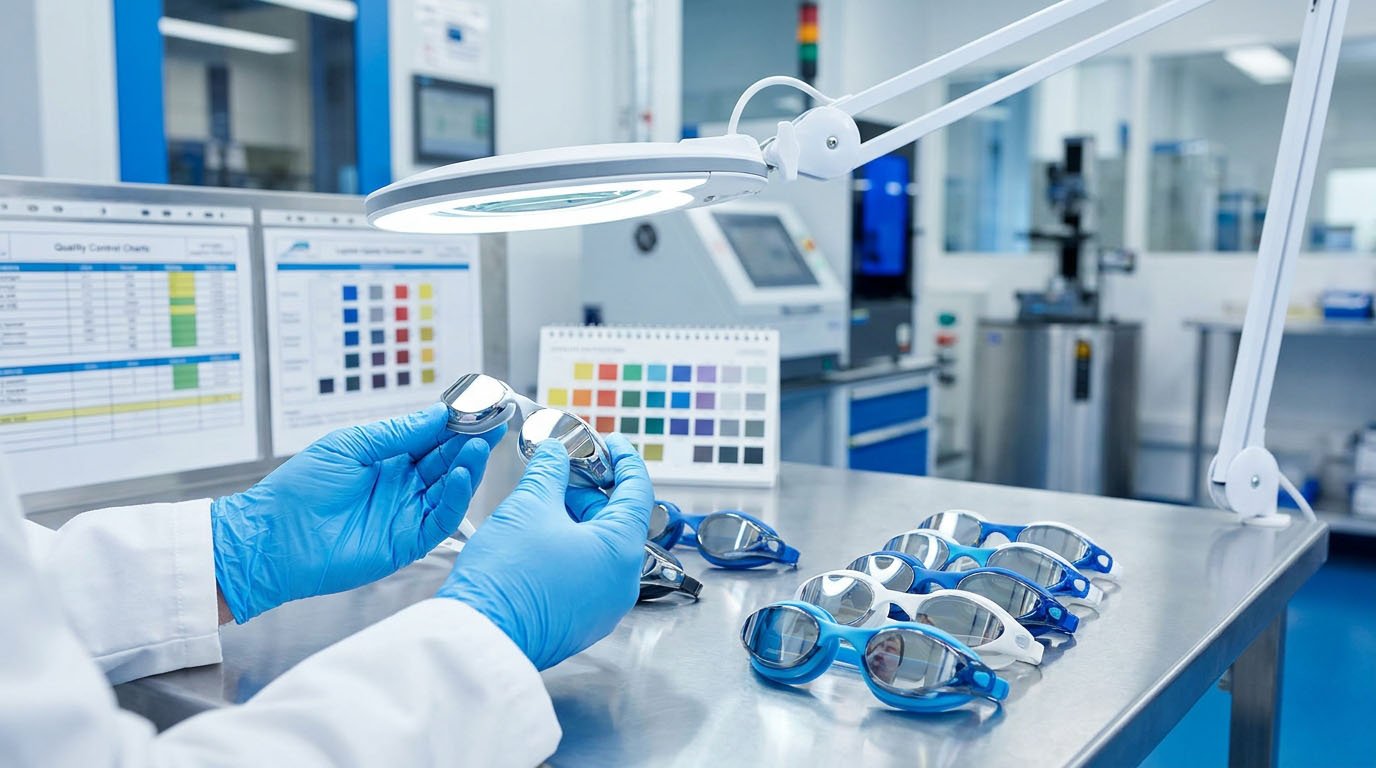
The appropriate verification plan should reflect the lens construction, intended swimming conditions, and the buyer’s quality requirements.
| Verification Area | What Buyers Should Confirm |
|---|---|
| Appearance consistency | Approved mirror color, coverage, and visible defects |
| Coating adhesion | Suitable method and agreed acceptance criteria |
| Abrasion resistance | Defined contact or wear conditions |
| Environmental durability | Relevant moisture, pool-water, or thermal exposure conditions |
| Batch traceability | Ability to connect affected products with production records |
These are verification categories, not claims that one universal test method or acceptance limit applies to every mirrored swimming goggle.
The supplier and buyer should establish the applicable methods and criteria before testing.
During product development, Sampling & Prototyping helps buyers evaluate the intended configuration before committing to bulk production.
Compare Bulk Production With the Approved Sample
An approved sample is useful only when its specifications remain connected to mass production.
Brands should record significant changes in lens materials, mirror treatments, coating suppliers, protective layers, or processing conditions.
If a relevant change occurs after approval, determine whether additional verification is required.
For recurring orders, consistent product specifications and traceability make coating complaints easier to investigate.
At Jerry, our Quality Assurance framework covers multiple inspection stages, from incoming materials to production and final inspection.
For mirror-coated projects, buyers can discuss coating-specific verification requirements during product development rather than assuming that general visual inspection covers long-term adhesion performance.
Establish a Clear Complaint and Corrective-Action Process
A practical OEM quality agreement should explain how coating complaints will be recorded, what evidence is needed, and how potential batch issues will be investigated.
If repeated defects are confirmed, corrective actions may involve reviewing the coating specification, process controls, material compatibility, or handling procedures.
The effectiveness of any correction should be verified before the same configuration is released again.
This approach helps brands manage product quality without assuming that every peeling complaint has the same cause.
Frequently Asked Questions
Does Mirror Coating Peeling Always Mean the Swimming Goggles Are Defective?
No. Coating peeling or loss may result from a manufacturing problem, mechanical abrasion, environmental exposure, or several interacting factors.
Early and repeated peeling across the same production batch deserves investigation, but root cause should be supported by evidence rather than appearance alone.
Can Chlorine Cause Mirror Coating to Peel Off Swimming Goggles?
Chlorinated pool water may contribute to deterioration in susceptible coating systems over time. Actual damage depends on coating construction, exposure conditions, and product care.
Chlorine alone should not be identified as the cause without reviewing other potential factors.
Can You Fix a Peeling Mirror Coating at Home?
Generally, no. Once the reflective layer has separated, ordinary rinsing, polishing, or aftermarket sprays cannot reliably restore the original factory finish.
If the damage interferes with visibility, replacing the goggles is the safer option.
How Long Should Mirror Coating Last on Swimming Goggles?
There is no universal lifespan for mirror coating.
Durability varies with coating construction, manufacturing quality, swimming frequency, cleaning habits, and environmental exposure.
Brands should support specific durability claims with appropriate testing rather than promising a fixed number of months or swimming sessions.
Conclusion: Diagnose Mirror Coating Peeling Before Assigning Responsibility
Mirror coating peeling is not always a simple manufacturing defect or a result of improper care.
Weak adhesion, abrasion, chemical exposure, and heat can all contribute to mirror finish deterioration. The right conclusion depends on the damage pattern, usage history, and supporting product evidence.
For swimmers, gentle rinsing, avoiding lens rubbing, and proper storage can reduce unnecessary damage.
For swimming goggle brands, the priority is to approve the right coating configuration, verify its performance, maintain batch traceability, and investigate recurring complaints systematically.
At Jerry Goggles, we support brands developing custom swimming goggles through OEM & ODM manufacturing, product development, and quality management.
If you are planning a custom mirror-coated swimming goggle line or reviewing coating performance requirements for an upcoming order, contact Jerry to discuss your product specifications and project needs.