UV400 is a common feature advertised on swimming goggles, especially models designed for outdoor pools and open-water swimming. But what does UV400 actually mean, and does every swimming goggle provide the same protection?
For swimmers, UV protection helps reduce exposure to ultraviolet radiation. For swimming goggle brands and OEM buyers, the challenge is verifying that the lens performs as advertised.
UV400 swimming goggles are designed to filter ultraviolet light at wavelengths up to 400 nanometers (nm), covering the UVA and UVB ranges. However, UV400 does not indicate lens darkness, polarization, anti-fog performance, or overall product quality. The claim should be supported by appropriate optical testing.
This guide explains how UV400 works, how it differs from other lens features, and what brands should verify before ordering custom swimming goggles.
Quick Answer: What Does UV400 Mean on Swimming Goggles?
UV400 refers to UV filtering across wavelengths up to 400 nm, including the UVA and UVB portions of sunlight.
Here are five important facts:
- UV400 is about UV filtering: It describes a lens protection target, not lens darkness.
- Clear lenses can provide UV400: A dark tint is not required for effective UV blocking.
- UV400 is different from polarization: Polarization reduces reflected glare, while UV400 addresses ultraviolet light.
- UV400 is not an ISO certification: It is a product performance claim that needs suitable evidence.
- Verification matters: Brands should confirm that test results represent the actual lens material, color, and coating used in production.
The key point is simple: a UV400 label is not a substitute for measured lens performance.
Key 1: What Does UV400 Actually Block?
The number 400 refers to a wavelength of 400 nanometers, near the boundary between ultraviolet radiation and visible violet light.
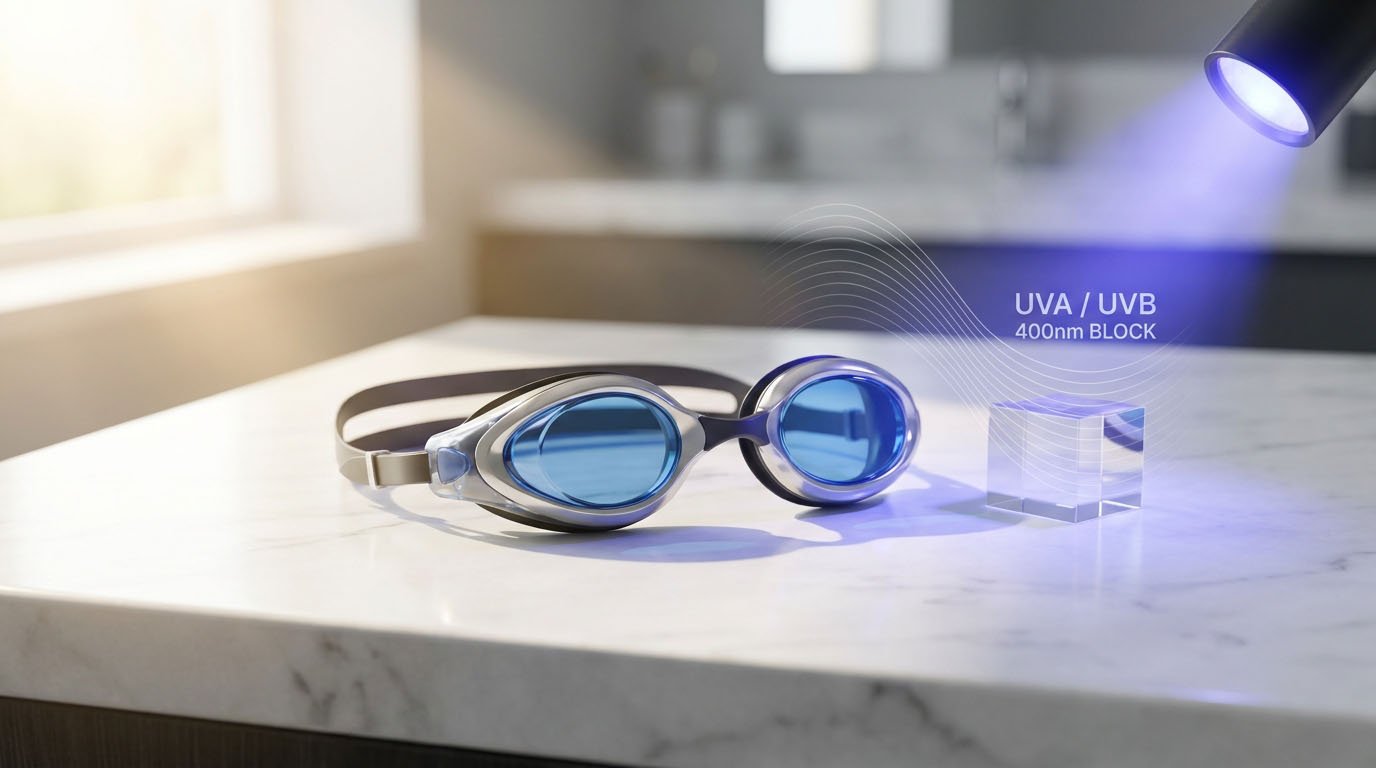
Ultraviolet radiation is commonly divided into three categories:
| UV Type | Wavelength Range | Relevance to Swimming Goggles |
|---|---|---|
| UVA | 315–400 nm | Important for sunlight exposure and UV protection claims |
| UVB | 280–315 nm | Can contribute to acute and long-term eye damage |
| UVC | 100–280 nm | Solar UVC is largely absorbed by the atmosphere |
For outdoor swimming, UVA and UVB are the main concerns because they reach the Earth’s surface.
Does UV400 Mean 100% UV Protection?
Not automatically.
UV400 describes the wavelength range covered by a UV-filtering claim. The exact transmittance limit used to substantiate that claim depends on the applicable specification or market requirements.
Similarly, phrases such as "99% UV protection" and "100% UV protection" are numerical performance claims that require supporting test evidence.
A manufacturer should be able to explain:
- Which wavelengths were evaluated
- How much UV radiation passed through the lens
- Which test method and acceptance criteria were used
- Whether the results support the intended packaging statement
For brands, avoid treating UV400, 100% UV protection, and ISO compliance as interchangeable terms.
Key 2: How Do Swimming Goggle Lenses Provide UV400 Protection?
Most swimming goggles use polycarbonate (PC) lenses because the material offers a useful combination of optical clarity, impact resistance, and manufacturing flexibility.
However, the base material alone does not guarantee a particular UV400 claim.
UV Absorption in Polycarbonate Lenses
Polycarbonate inherently absorbs substantial ultraviolet radiation, particularly at shorter wavelengths.
Its UV filtering behavior near approximately 380–400 nm depends on the specific resin grade, formulation, lens thickness, and any additional treatments.
Manufacturers may achieve the required UV performance through:
- UV-absorbing additives incorporated into the lens material
- Suitable lens tints or pigments
- UV-filtering surface treatments or coatings
- Combinations of material formulation and surface treatments
Integrated UV Absorbers vs Surface Coatings
UV absorbers incorporated into the lens material are not dependent on a separate surface layer remaining intact.
A coating-based solution may also provide effective UV filtering, but its durability depends on coating chemistry, adhesion, and exposure conditions.
Neither approach should be described as permanently effective without suitable supporting evidence.
For custom swimming goggles, the finished lens configuration matters more than the manufacturing method alone.
Brands comparing optical plastics can learn more in Jerry’s Swim Goggle Lens Materials: PC vs Acrylic & Performance guide.
Buyer takeaway: Do not assume that every PC lens automatically meets UV400 requirements. Verify the specific lens configuration.
Key 3: UV400 vs Polarized vs Mirrored Swimming Goggles
UV400, polarization, and mirrored coatings are often advertised together, but they perform different functions.
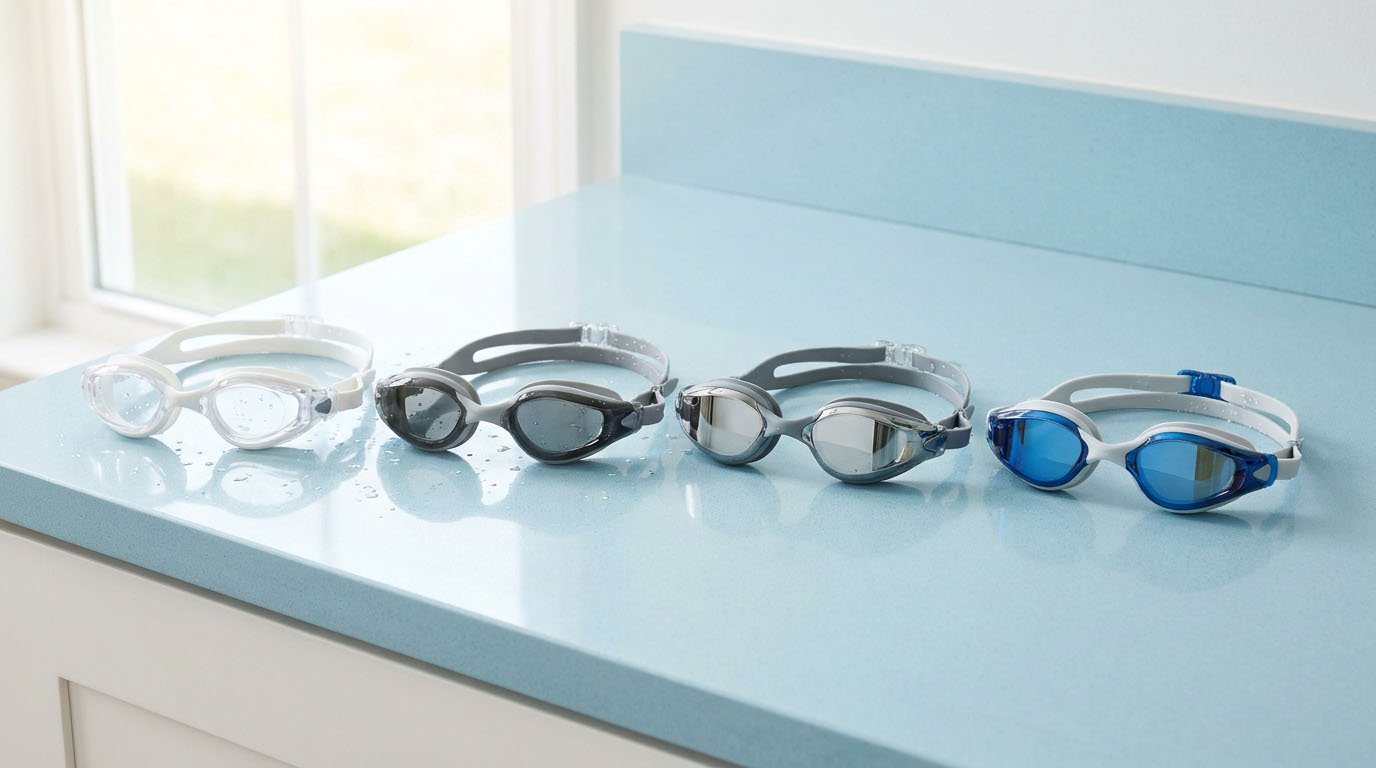
A swimming goggle may combine these features, or provide only one of them.
| Lens Feature | Primary Function | Does It Automatically Guarantee UV400? |
|---|---|---|
| UV400 | Filters ultraviolet radiation up to the stated wavelength target | Requires verification |
| Dark tint | Reduces visible light transmission | No |
| Mirrored coating | Reflects part of the incoming light, reducing brightness | No |
| Polarized lens | Reduces certain reflected glare, especially from water | No |
| Anti-fog coating | Helps reduce condensation on the lens | No |
Can Clear Swimming Goggles Have UV400?
Yes.
UV protection is not determined by how dark a lens appears. A properly formulated clear lens can provide strong UV filtering while allowing high visible light transmission.
Conversely, a dark lens should not be assumed to meet a specific UV400 claim without evidence.
Are Polarized Goggles Better Than UV400 Goggles?
They address different needs.
Polarized lenses help reduce reflected glare from water, which can improve visual comfort during outdoor swimming.
UV400 addresses ultraviolet exposure.
For example, an open-water swimming goggle may combine verified UV400 protection with a polarized or mirrored lens to manage different lighting conditions.
For a more detailed explanation of glare control and lens finishes, see Mirrored vs Polarized Swimming Goggles: What’s the Difference?.
Key 4: Is UV400 the Same as ISO 18527-3 Compliance?
No. This distinction is particularly important for swimming goggle brands, importers, and distributors.
UV400 describes a UV-filtering performance claim, while ISO 18527-3 is a product standard covering eyewear intended for surface swimming.
What Does ISO 18527-3 Cover?
ISO 18527-3:2020, together with its applicable amendments, specifies requirements and test methods for surface-swimming eyewear.
Its scope includes areas such as:
- Optical performance
- UV and visible light transmittance
- Materials and construction
- Relevant mechanical properties
- Product marking and manufacturer information
The standard addresses UV transmittance, including the 380–400 nm region, but conformity does not automatically establish the stronger filtering performance implied by every UV400 marketing claim.
How Is UV Transmittance Measured?
ISO 18526-2:2020 provides reference methods for evaluating physical optical properties, including ultraviolet transmittance.
A laboratory may use a calibrated UV-visible spectrophotometer to measure how much light passes through a lens across relevant wavelengths.
These measurements can help establish whether the lens meets the applicable standard requirements and whether a separate UV400 statement is adequately supported.
Important: A report confirming ISO 18527-3 conformity should not automatically be presented as a UV400 certificate. The tested wavelengths, measured results, and claimed performance must be reviewed separately.
For OEM buyers, the practical goal is to obtain evidence that supports the exact claim intended for the finished product.
Key 5: How Can Brands Verify UV400 Swimming Goggles?
A supplier may advertise UV400 on its website, quotation, or packaging. However, buyers should confirm that the supporting evidence applies to the actual lens configuration being ordered.
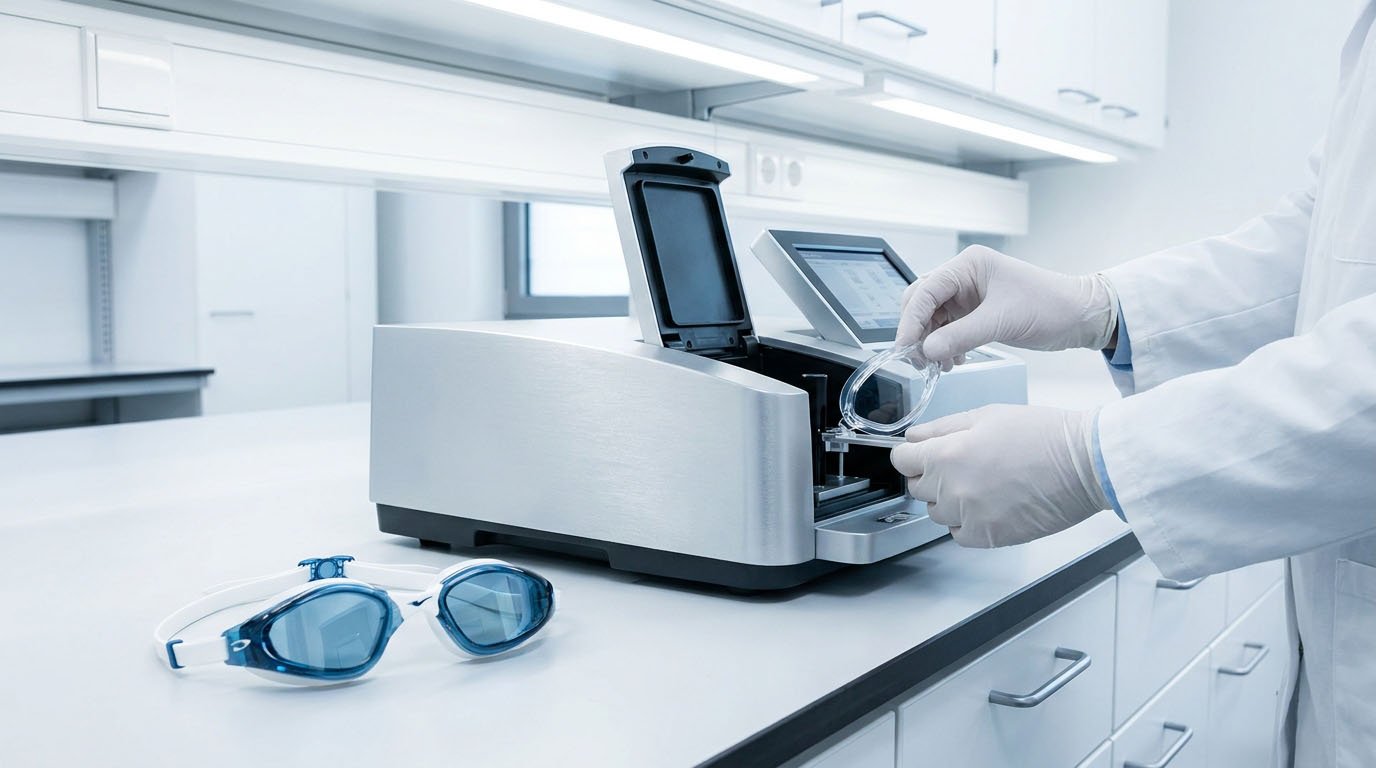
Step 1: Request Relevant UV Transmission Test Results
Ask the manufacturer for documentation showing the relevant optical measurements.
Depending on the testing scope, useful information may include:
- Applicable standard or test method
- UV wavelength range evaluated
- Measured transmittance results
- Lens model and material identification
- Color or coating configuration
- Testing laboratory and report date
The relevant acceptance criteria should be clear.
Step 2: Match the Tested Lens to Your Product
Suppose a manufacturer provides a UV test report for a clear PC lens.
Your order, however, uses a blue mirrored lens with a different pigment and surface coating.
The original test report may not automatically substantiate the UV400 claim for the new configuration.
Buyers should confirm whether the tested sample represents the production design or whether additional testing is necessary.
Step 3: Review Changes Before Mass Production
Changes in resin formulation, color masterbatch, UV additives, or coating specifications may influence optical transmittance.
When a significant change occurs, the brand and manufacturer should determine whether the existing evidence remains applicable.
An approved sample and documented material specifications help maintain consistency between testing and production.
Step 4: Check the Final Marketing Claim
Before approving retail packaging, compare the wording with the available evidence.
For example:
- Does the documentation support the UV400 designation?
- Does it support a specific percentage of UV absorption?
- Does the claim apply to every advertised colorway?
- Are the relevant test results consistent with the final production specification?
Avoid using stronger claims than the results can substantiate.
A UV400 claim should be traceable from the tested lens to the product being sold.
For a broader explanation of how to interpret laboratory documentation, refer to Jerry’s How to Read a Swimming Goggle Test Report.
Key 6: Which Swimming Goggles Need UV400 Protection?
UV protection is particularly relevant when swimming outdoors, although the appropriate overall lens configuration depends on lighting conditions and intended use.
| Swimming Environment | UV Protection Consideration | Other Lens Priorities |
|---|---|---|
| Indoor swimming pools | Evaluate UV exposure, especially where sunlight enters | High visibility and anti-fog performance |
| Outdoor swimming pools | Verified UV protection is particularly valuable | Comfortable visible light transmission |
| Open-water swimming | Strong UV filtering is an important consideration | Glare reduction and changing visibility |
| Children’s outdoor swimming | Consider UV protection and age-appropriate fit | Secure sealing, comfort, and optical quality |
Outdoor Swimming Pools
Swimmers may face direct sunlight during training, particularly when swimming on their backs or looking toward the sky.
UV filtering helps reduce ultraviolet exposure, while lens tint controls visible brightness.
Open-Water Swimming
Open-water environments introduce direct sunlight, reflections, and changing lighting conditions.
A suitable goggle may combine verified UV protection with a tinted, mirrored, or polarized lens, depending on the swimmer’s requirements.
Indoor Swimming Pools
Clear lenses are often preferred where lighting is limited.
UV400 protection can still be incorporated into a clear lens, but it should not come at the expense of the visibility required for safe swimming.
Brands developing multiple models can explore Jerry’s Swimming Goggles product range as a starting point for discussing different lens and application requirements.
The best choice combines verified UV protection, appropriate visible light transmission, reliable anti-fog performance, and comfortable fit.
Key 7: What Should Brands Confirm Before Ordering Custom UV400 Swimming Goggles?
For private-label and OEM projects, UV400 should be specified during product development rather than added to packaging after production.
Before approving an order, confirm the following five points.
1. Define the Required UV Claim
Clarify whether the product needs a general UV protection statement, a UV400 claim, or a specified UV absorption percentage.
Use measurable acceptance criteria agreed upon with the manufacturer.
2. Confirm the Lens Configuration
Document the lens material, color, tint, surface coatings, and any relevant UV-filtering treatments.
Different colorways may require separate evaluation.
3. Review Supporting Test Evidence
Request relevant results for the intended lens configuration and target market.
Agree on additional verification where existing reports do not cover the customized product.
4. Connect Testing With Production
Confirm that approved material and coating specifications will be maintained during production.
Define how important material or process changes will be reviewed.
5. Approve Packaging Claims Before Printing
UV400 labels, percentage claims, and references to product standards should accurately reflect the available evidence.
This helps avoid packaging revisions, misleading product descriptions, and disputes over specifications.
For brands developing customized lens colors, coatings, and packaging, Jerry’s OEM & ODM Swimming Goggles services provide a starting point for discussing product development and verification requirements.
Frequently Asked Questions About UV400 Swimming Goggles
Do All Swimming Goggles Have UV Protection?
Not necessarily the same level of protection.
Many polycarbonate swimming goggle lenses provide substantial UV filtering because of the material’s inherent properties. However, the exact protection, especially near 400 nm, depends on the lens formulation and treatments.
A specific UV400 claim should be verified rather than assumed.
Is UV400 Better Than UV380?
UV400 refers to filtering that extends to a longer wavelength than UV380.
Because the UVA range extends to 400 nm, a properly substantiated UV400 specification addresses more of that wavelength range.
However, the actual degree of protection depends on measured transmittance, not simply the number printed on the packaging.
Does UV400 Protection Wear Off?
It depends on how the UV-filtering performance is achieved.
UV absorbers incorporated into the lens material are generally less exposed to direct surface wear than a separate coating. Nevertheless, material aging, chemical exposure, and coating durability can affect long-term lens performance.
No universal UV400 lifetime should be assumed without appropriate evidence.
Are UV400 Swimming Goggles Necessary for Children?
UV protection is particularly worth considering for children who swim outdoors.
However, UV400 should not be treated as a universal legal requirement for every children’s swimming goggle.
Brands must consider the intended use, applicable product requirements, verified lens performance, and appropriate fit.
Can UV400 Swimming Goggles Still Cause Eye Discomfort?
Yes.
UV400 addresses ultraviolet filtering, not every factor affecting visual comfort.
Excessive brightness, poor optical quality, incorrect fit, lens fogging, or inadequate sealing can still cause problems.
A suitable swimming goggle must balance UV filtering with the other performance characteristics needed for its intended use.
Conclusion
UV400 swimming goggles are designed to filter ultraviolet radiation up to 400 nm, but the UV400 label alone does not prove the performance of a particular lens.
For swimmers, it is important to understand that UV protection, lens darkness, polarization, and anti-fog performance serve different purposes.
For swimming goggle brands and OEM buyers, the priority is to match UV protection claims with appropriate test evidence, approved lens specifications, and actual production configurations.
A reliable supplier should help clarify what performance is required, what testing supports the claim, and whether customization affects the original results.
Developing custom swimming goggles with UV protection?
Jerry supports OEM and ODM swimming goggle development, including lens configuration, color customization, sampling, and production coordination.
Contact our team to discuss your target market, UV protection requirements, and custom swimming goggle project before finalizing your product specifications.