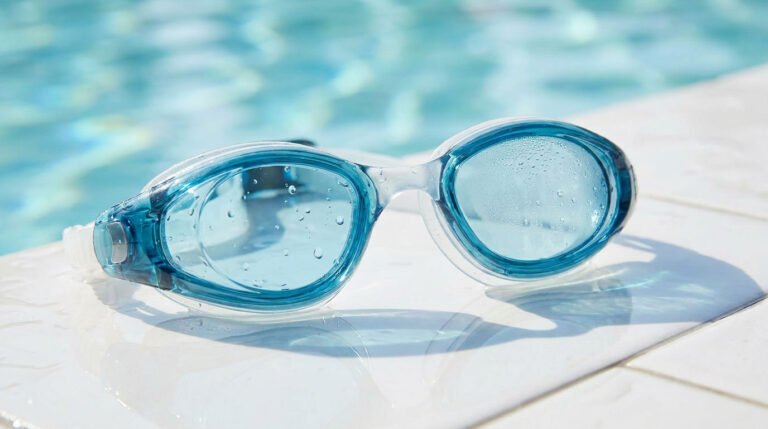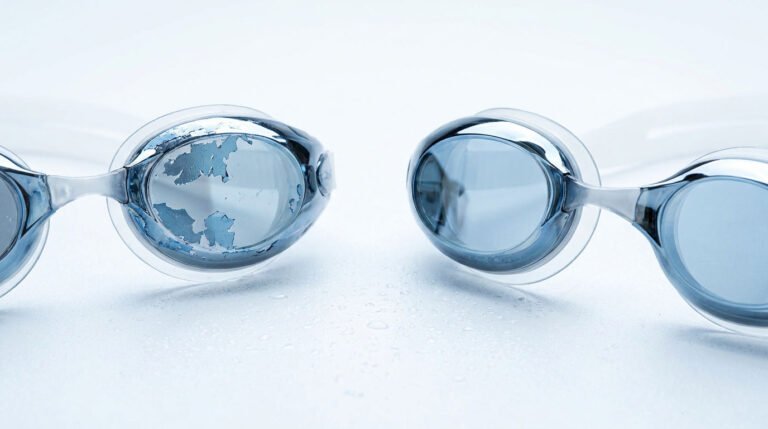
Choosing the right swim goggle lens material affects more than appearance. It influences optical clarity, impact resistance, scratch durability, weight, and how reliably a product performs after repeated use.
For swimming goggle brands and OEM buyers, the challenge is deciding which material offers the best balance of performance, manufacturability, and cost.
Polycarbonate (PC) is the most widely used material for swimming goggle lenses because it combines good optical transparency, impact resistance, low weight, and molding flexibility. However, material choice alone does not guarantee performance. Lens geometry, thickness, molding quality, and surface treatments also matter.
This guide compares common lens materials, explains their performance trade-offs, and shows what buyers should verify before approving production.
Quick Answer: Which Swim Goggle Lens Material Is Best?
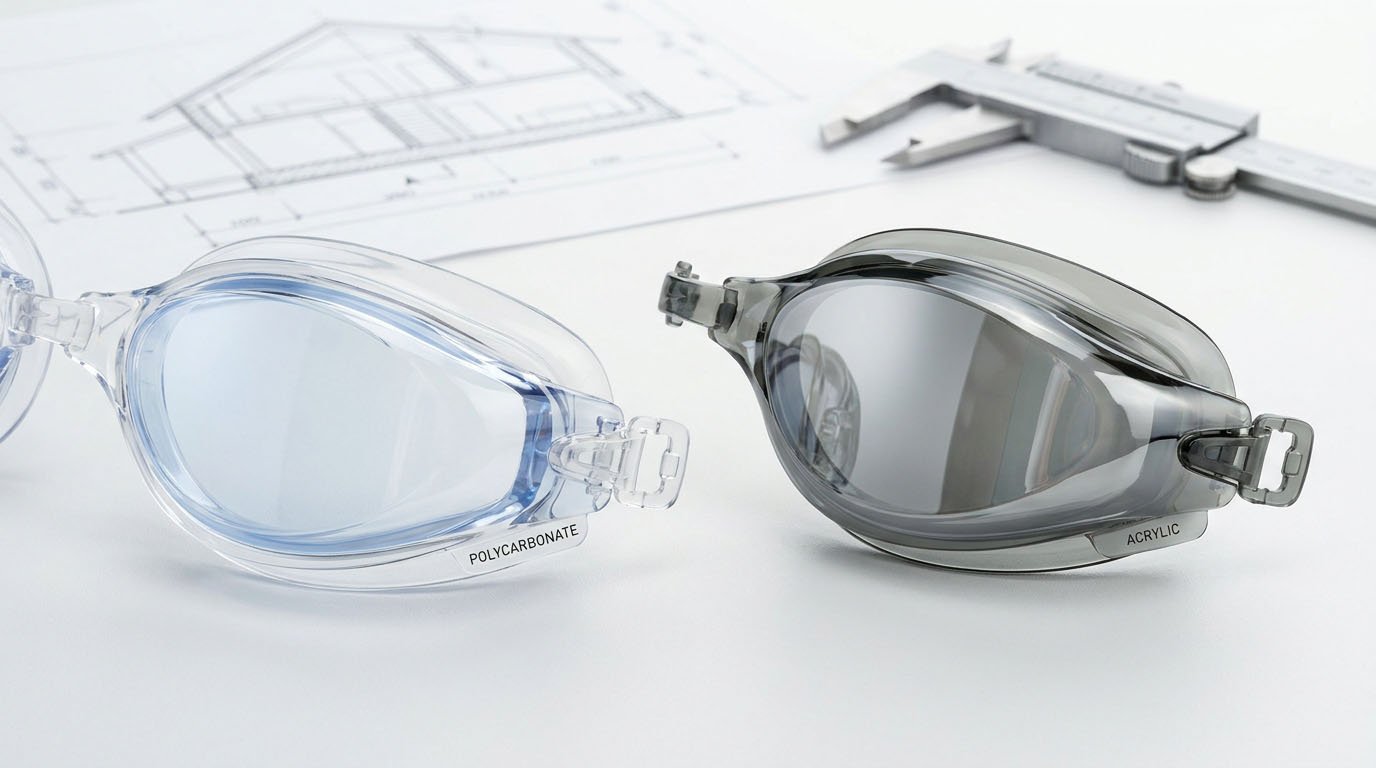
For most recreational, competitive, and training swimming goggles, optical-grade polycarbonate (PC) is the preferred starting point.
Other transparent plastics, including acrylic (PMMA) and specialty materials, may offer certain advantages but require careful evaluation before being used in swimming eyewear.
Swim Goggle Lens Materials Comparison
| Lens Material | Main Strength | Main Limitation | Suitability |
|---|---|---|---|
| Polycarbonate (PC) | Impact resistance, clarity, low weight | Can scratch without suitable protection | Most swimming goggles |
| Acrylic (PMMA) | High transparency, relatively hard surface | Lower impact toughness than PC | Selected specialty applications |
| Cellulose Propionate (CP) | Alternative optical polymer properties | Limited relevance to conventional molded swim goggles | Specialized designs requiring validation |
Key takeaway: A well-designed PC lens is generally a better choice than selecting an alternative plastic purely for higher transparency or surface hardness.
The final decision should consider the intended swimmer, lens shape, coating requirements, and finished-product testing.
Key 1: Polycarbonate vs Acrylic vs Other Lens Materials
Polycarbonate (PC): The Standard Choice for Swim Goggles
Polycarbonate is widely used in swimming eyewear because it provides a practical balance of strength and optical performance.
Its main advantages include:
- Impact resistance: PC generally withstands sudden impact better than acrylic.
- Optical clarity: Optical-grade PC can provide clear vision when properly molded.
- Lightweight construction: Suitable for compact racing goggles and larger recreational designs.
- Molding flexibility: Supports different lens shapes and curvatures.
- Surface treatment compatibility: Can be combined with suitable anti-fog, tint, mirror, and protective coatings.
However, PC has limitations.
Its surface is relatively susceptible to scratching, and material formulation, manufacturing stress, or environmental exposure can affect long-term appearance.
Buyers should specify the appropriate resin grade and verify the finished lens rather than relying only on the material name.
For a detailed explanation of discoloration risks, see our guide on why clear PC swimming goggle lenses turn yellow.
Acrylic (PMMA): Excellent Transparency, Different Mechanical Properties
Acrylic is another transparent plastic used in optical and other clear-component applications.
It offers good light transmission and generally greater inherent surface hardness than uncoated PC.
However, acrylic has substantially lower impact toughness than polycarbonate. This is an important consideration for swimming goggles exposed to accidental drops, handling pressure, and contact during swimming.
Acrylic should not be treated as a direct replacement for PC simply because it has excellent transparency.
Any proposed acrylic lens needs product-specific evaluation for optical quality, impact performance, geometry, and applicable safety requirements.
Cellulose Propionate (CP): A Specialty Alternative
Cellulose propionate is used in certain optical and specialty plastic applications, but it is not a mainstream substitute for injection-molded PC swimming goggle lenses.
Its suitability depends on the intended construction and processing method.
Brands considering CP or another specialty polymer should first confirm:
- Whether the material suits the proposed lens structure
- Whether it can achieve the required optical and mechanical performance
- Whether compatible coatings and production processes are available
For conventional swimming goggles, optical-grade PC generally remains the more established option.
Key 2: How Do Lens Materials Affect Clarity, Impact Resistance, and Durability?
A material datasheet describes the properties of a resin, but swimmers experience the performance of a finished lens.
This distinction is important because two lenses made from the same material can perform differently.
Optical Clarity and Visual Distortion
Clear vision depends on more than the transparency of the plastic.
Important factors include:
- Optical quality of the resin
- Lens curvature and thickness uniformity
- Mold surface quality
- Residual stress from manufacturing
- Surface defects, haze, and coating quality
For example, a poorly molded PC lens may produce unwanted visual distortion even when the resin itself has excellent transparency.
Highly curved lenses also need careful design because geometry and thickness variation can influence their optical properties.
Brands should evaluate actual molded samples rather than assuming that a premium resin grade will automatically produce better vision.
Impact Resistance and Structural Durability
Polycarbonate generally offers stronger impact resistance than acrylic, making it suitable for most swimming goggle applications.
However, impact resistance is a finished-product performance requirement, not simply a material label.
Actual results can be affected by lens thickness, shape, residual stress, mounting structure, and manufacturing quality.
A poorly designed PC lens may fail where a properly engineered PC lens would perform reliably.
Scratch Resistance and Long-Term Appearance
Scratch resistance is another area where material properties and coatings must be considered separately.
Uncoated acrylic generally has higher surface hardness than uncoated PC. However, a compatible hard coating can improve the abrasion resistance of a PC lens.
No conventional plastic swimming goggle lens should be marketed as completely scratch-proof without appropriate supporting evidence.
For brands, the practical goal is to select a lens system that maintains acceptable clarity under the intended conditions of use and handling.
Key 3: Why Do Lens Thickness and Molding Quality Matter?
Lens thickness is frequently mistaken for a simple indicator of quality.
In reality, thicker does not automatically mean better.
Thickness affects lens weight, stiffness, geometry, and mechanical behavior, but the relationship depends on the complete design.
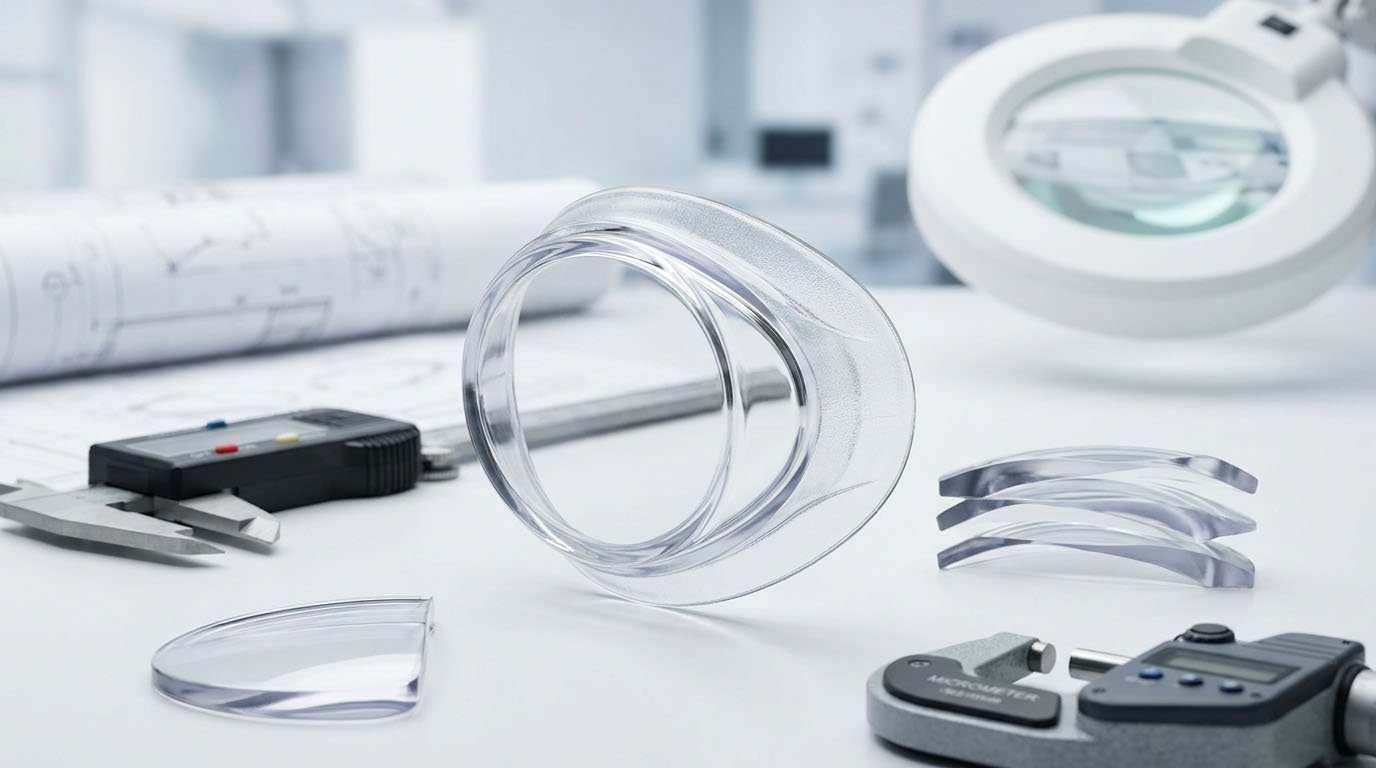
How Thickness Changes Lens Performance
| Design Factor | Performance Consideration |
|---|---|
| Thinner lens | May reduce weight, depending on shape and construction |
| Thicker lens | May increase stiffness and weight |
| Uneven thickness | Can contribute to optical distortion or molding variation |
| Curved geometry | Influences peripheral vision and optical consistency |
| Poor molding control | Can create stress, warpage, haze, or defects |
A lightweight racing lens still needs sufficient mechanical strength. Likewise, an open-water lens does not automatically require thicker material simply because it is used outdoors.
The correct thickness should come from engineering evaluation and testing.
Why Molding Quality Is Just as Important
Important manufacturing variables include material drying, mold temperature, injection conditions, cooling, and surface finishing.
Poor control can introduce residual stress or dimensional variation, even when the correct resin is used.
Buyers interested in the full manufacturing sequence can review how swimming goggles are made, which covers lens molding, assembly, coatings, and production quality control.
For material selection, the important principle is simple:
Approve the finished lens design and its measured performance, not just the resin specification.
Key 4: How Do Coatings Change Swim Goggle Lens Performance?
Surface treatments add functions that the base material may not provide adequately on its own.
These can include anti-fog performance, improved abrasion resistance, reflective finishes, and additional UV filtering.
Anti-Fog Performance
Anti-fog performance depends primarily on the surface treatment system rather than on whether a lens is made from thicker or thinner PC.
Many anti-fog treatments use hydrophilic chemistry to help condensed moisture spread more evenly across the surface instead of forming light-scattering droplets.
Performance depends on coating compatibility, application quality, curing, handling, and use conditions.
A good initial anti-fog result does not guarantee long-term durability.
For testing methods and production consistency, see our anti-fog durability testing guide.
UV Protection and Lens Tint
UV protection and visible light transmission are different properties.
Polycarbonate naturally absorbs a substantial portion of ultraviolet radiation, but its exact spectral performance depends on the material grade and finished lens configuration.
An additional UV-absorbing formulation or treatment may be required to achieve a particular UV protection specification.
A dark or mirrored lens does not automatically provide better UV protection.
Buyers should distinguish between:
| Feature | Main Purpose |
|---|---|
| UV filtering | Reduces transmission of specified ultraviolet wavelengths |
| Lens tint | Controls visible light transmission |
| Mirror coating | Changes reflective appearance and visible light transmission |
| Polarizing filter | Reduces certain reflected glare when incorporated into a suitable lens system |
A UV400 claim should be supported by appropriate spectral transmission evidence for the finished product.
Hard Coatings and Surface Protection
Suitable protective coatings can improve surface durability, particularly on materials such as PC that are relatively susceptible to scratching.
However, coating performance also depends on adhesion and compatibility with the substrate.
When comparing suppliers, brands should evaluate the complete lens-and-coating combination instead of comparing isolated marketing features.
Key 5: Which Lens Materials Work Best for Different Swimming Applications?
There is no need to use a different base polymer for every swimming category.
In many projects, optical-grade PC can support several product segments. The primary differences come from lens geometry, coating selection, visible light transmission, fit, and validated performance.
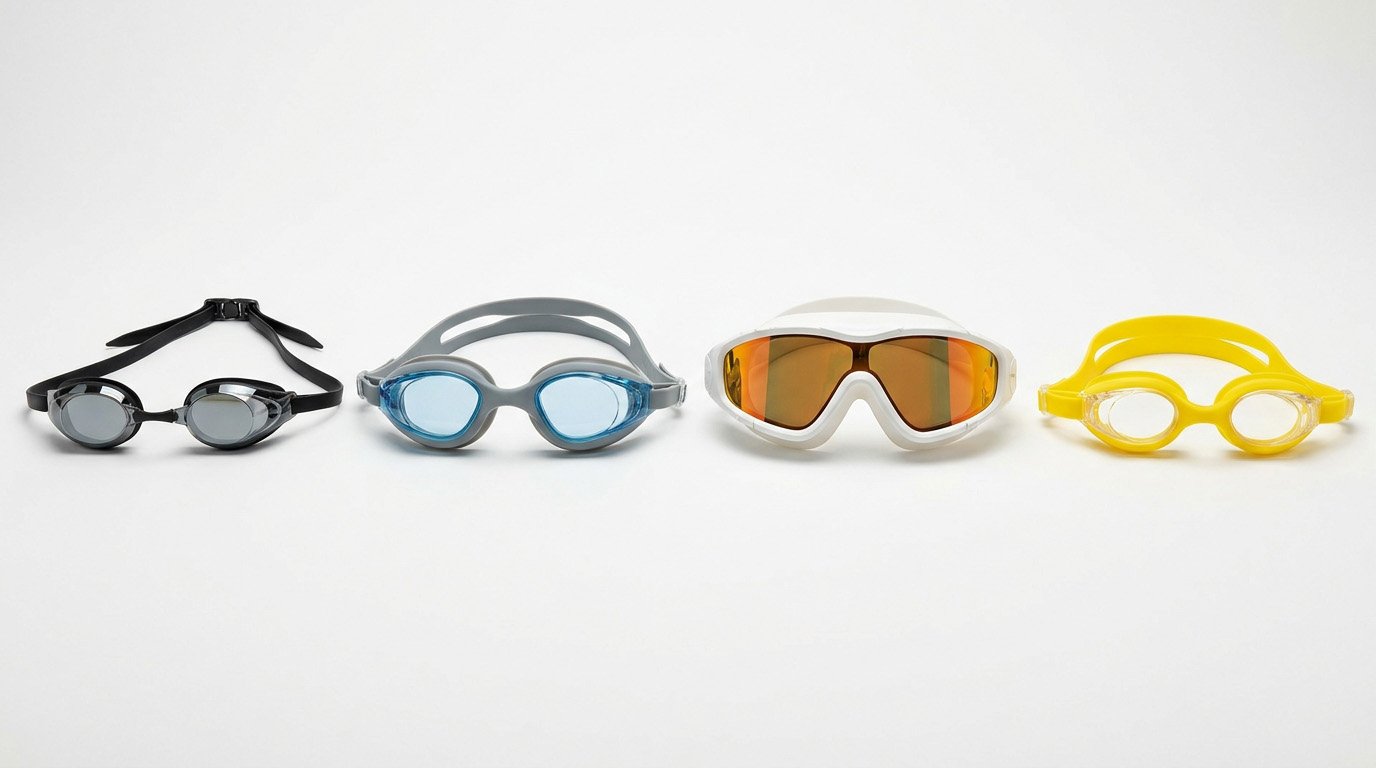
Lens Selection by Swimming Application
| Application | Recommended Starting Point | Main Performance Priority |
|---|---|---|
| Competitive racing | Optical-grade PC | Optical consistency, compact design, low weight |
| Daily pool training | Optical-grade PC | Clarity, durability, coating performance |
| Open-water swimming | Optical-grade PC with suitable lens options | UV protection, visibility, glare management |
| Children’s swimming | Impact-resistant PC lens system | Mechanical safety, clarity, suitable product design |
| Specialty eyewear | Application-specific material evaluation | Defined optical and mechanical requirements |
Racing Goggles
Racing goggles often prioritize a compact profile, secure fit, and consistent vision.
Low weight is useful, but reducing thickness should not compromise mechanical performance.
The design must still meet the relevant product requirements.
Training and Recreational Goggles
Daily training goggles generally benefit from a balance of clarity, durability, comfort, and reliable coatings.
For these products, consistent manufacturing quality often matters more than choosing an unusual lens polymer.
Open-Water Goggles
Outdoor swimming introduces additional light conditions.
Brands may select tinted, mirrored, or polarized lens configurations depending on the intended environment.
These options should be evaluated separately from the underlying PC material.
If you are comparing existing product platforms, Jerry’s swimming goggles collection provides examples of different swimming goggle configurations.
Key 6: What Should Brands Verify Before Mass Production?
For OEM and private label projects, choosing a suitable lens material is only the beginning.
The supplier must also demonstrate that the selected specification can be reproduced in production.
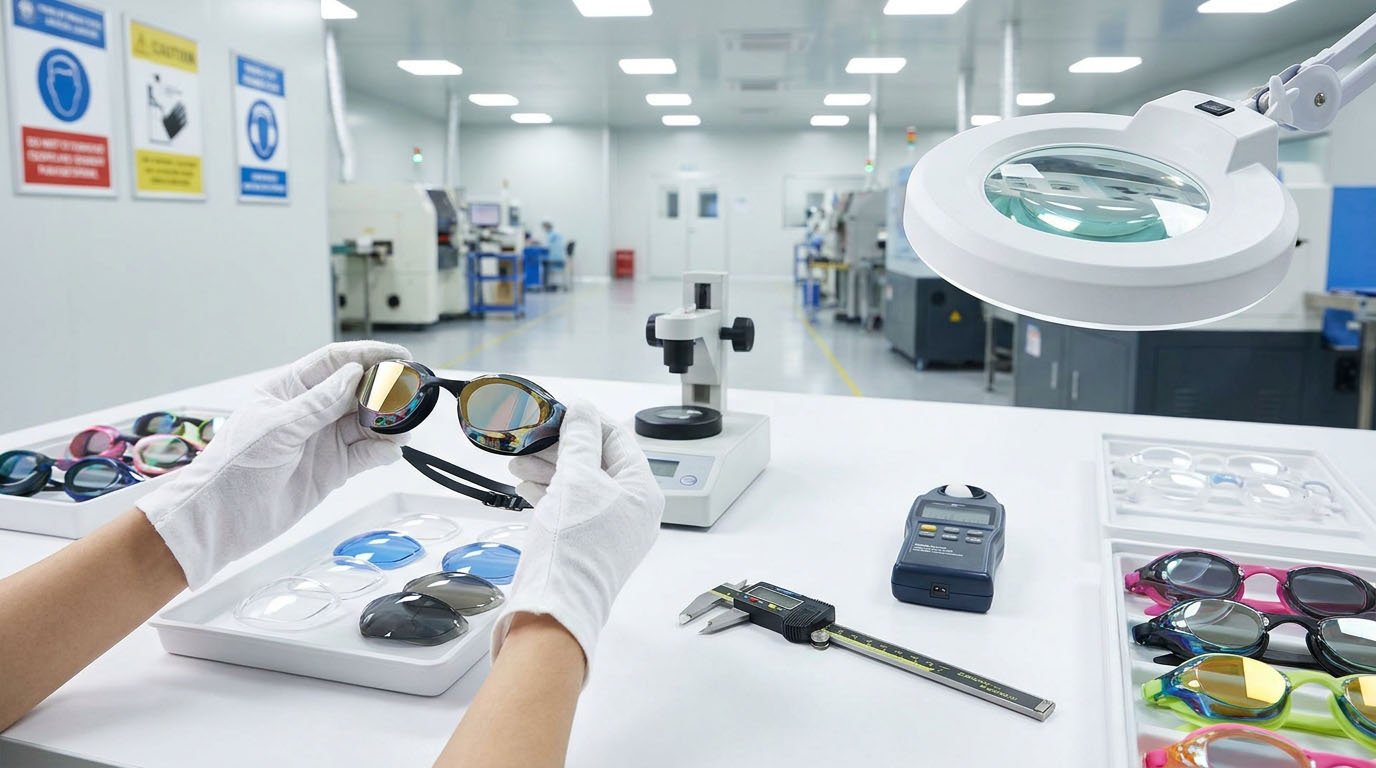
Swim Goggle Lens Material Verification Checklist
| Verification Item | What Buyers Should Confirm |
|---|---|
| Material identity | Resin type, grade, supplier information, and traceability |
| Optical performance | Clarity, distortion, haze, and relevant optical requirements |
| Mechanical performance | Impact resistance and structural integrity of the finished design |
| UV performance | Spectral transmission evidence matching product claims |
| Coating performance | Anti-fog, abrasion, or other specified coating requirements |
| Sample consistency | Approved development sample versus pilot-production samples |
| Production traceability | Material and process records linked to the tested configuration |
Confirm the Appropriate Testing Requirements
For swimming eyewear intended for surface swimming, ISO 18527-3:2020, including Amendment 1:2025, provides relevant requirements and test methods covering areas such as materials, construction, and optical properties.
The applicable tests should be selected according to the product type, intended market, and current requirements.
Brands should avoid assuming that a generic plastic material certificate proves the performance of a finished swimming goggle.
Similarly, a laboratory report should be checked against the actual product configuration.
Our guide on how to read a swimming goggle test report explains how buyers can review sample identification, reported tests, and supporting evidence.
Approve Materials Before Locking Production
A practical development sequence is:
- Define the target swimmer and required performance.
- Select the proposed lens material and grade.
- Review lens geometry and coating compatibility.
- Produce and evaluate representative samples.
- Verify the required optical and mechanical performance.
- Approve the material, construction, and finish.
- Confirm consistency in pilot production before bulk release.
For new lens designs, changes in resin, geometry, or coating may require additional validation.
Jerry’s sampling and prototyping services support brands during the development and approval stages.
The key purchasing decision is not simply whether the supplier uses PC. It is whether the approved PC lens system can be reproduced consistently.
Frequently Asked Questions
What Is the Most Common Material for Swimming Goggle Lenses?
Polycarbonate (PC) is the most common material for conventional swimming goggle lenses.
It provides a useful balance of impact resistance, clarity, low weight, and manufacturing flexibility.
Is Polycarbonate Better Than Acrylic for Swimming Goggles?
For most swimming goggles, polycarbonate is generally the better starting point because of its impact toughness.
Acrylic offers excellent transparency and relatively good surface hardness, but its lower impact resistance makes it less suitable as a direct replacement without additional design validation.
Does Lens Material Affect Anti-Fog Performance?
The material can influence coating compatibility, but effective anti-fog performance mainly depends on the treatment system and how it is applied.
Lens thickness or material name alone cannot establish anti-fog durability.
Are Thicker Swimming Goggle Lenses Safer?
Not necessarily.
Thickness is only one factor. Material properties, lens geometry, mounting structure, molding quality, and finished-product testing all contribute to mechanical performance.
Do Polycarbonate Swimming Goggle Lenses Provide UV Protection?
Polycarbonate naturally absorbs substantial ultraviolet radiation. However, the exact protection depends on the resin grade and finished lens.
Brands should verify spectral performance before making UV400 or other specific protection claims.
Can Brands Change Lens Materials Without Developing a New Mold?
Not always.
Different polymers can have different shrinkage behavior, processing requirements, and mechanical properties.
A material substitution may require engineering review, tooling adjustments, additional sampling, and performance testing.
Conclusion: Choose the Lens System, Not Just the Material
Swim goggle lens materials influence optical clarity, durability, impact resistance, weight, and manufacturing performance.
For most conventional swimming goggles, optical-grade polycarbonate offers the best practical starting point.
However, successful product development depends on more than selecting PC.
The finished lens must combine suitable material properties, controlled geometry, appropriate coatings, and verified manufacturing quality.
For brands and importers, the most reliable approach is to define the intended use, approve representative samples, verify important performance claims, and ensure that production matches the approved specification.
Developing a new swimming goggle product?
Jerry supports OEM and ODM swimming goggle development, including lens material selection, prototype evaluation, coating options, and production quality control.
Contact Jerry to discuss your lens specifications and custom swimming goggle requirements.