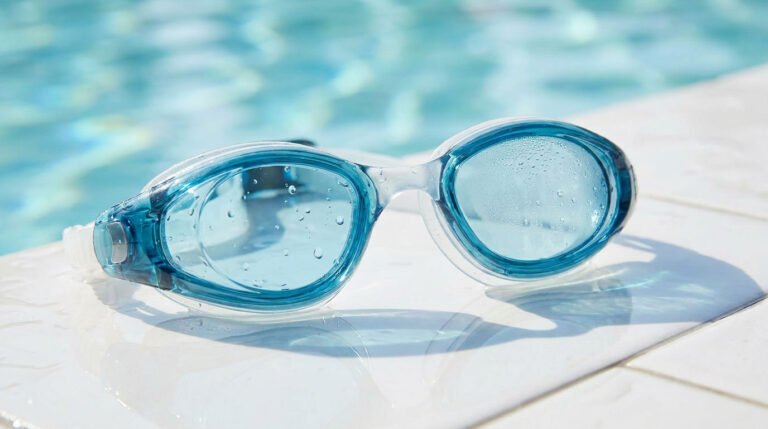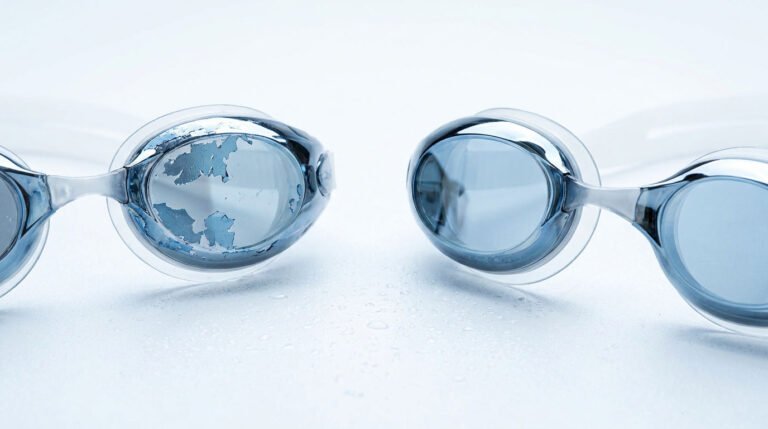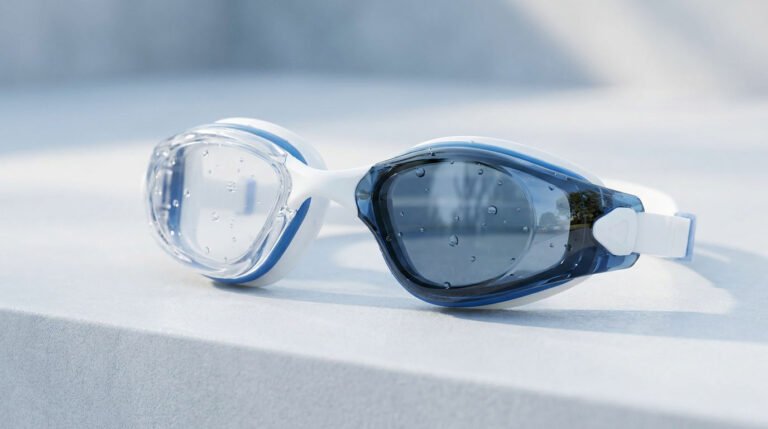
Clear swimming goggle lenses should maintain good optical clarity during normal use. However, some develop a yellow tint after repeated swimming, prolonged storage, or even before reaching customers.
For swimming goggle brands and importers, unexpected discoloration raises important questions: Is it caused by chlorine, UV exposure, anti-fog coating damage, or the polycarbonate material itself? Does it indicate a manufacturing defect?
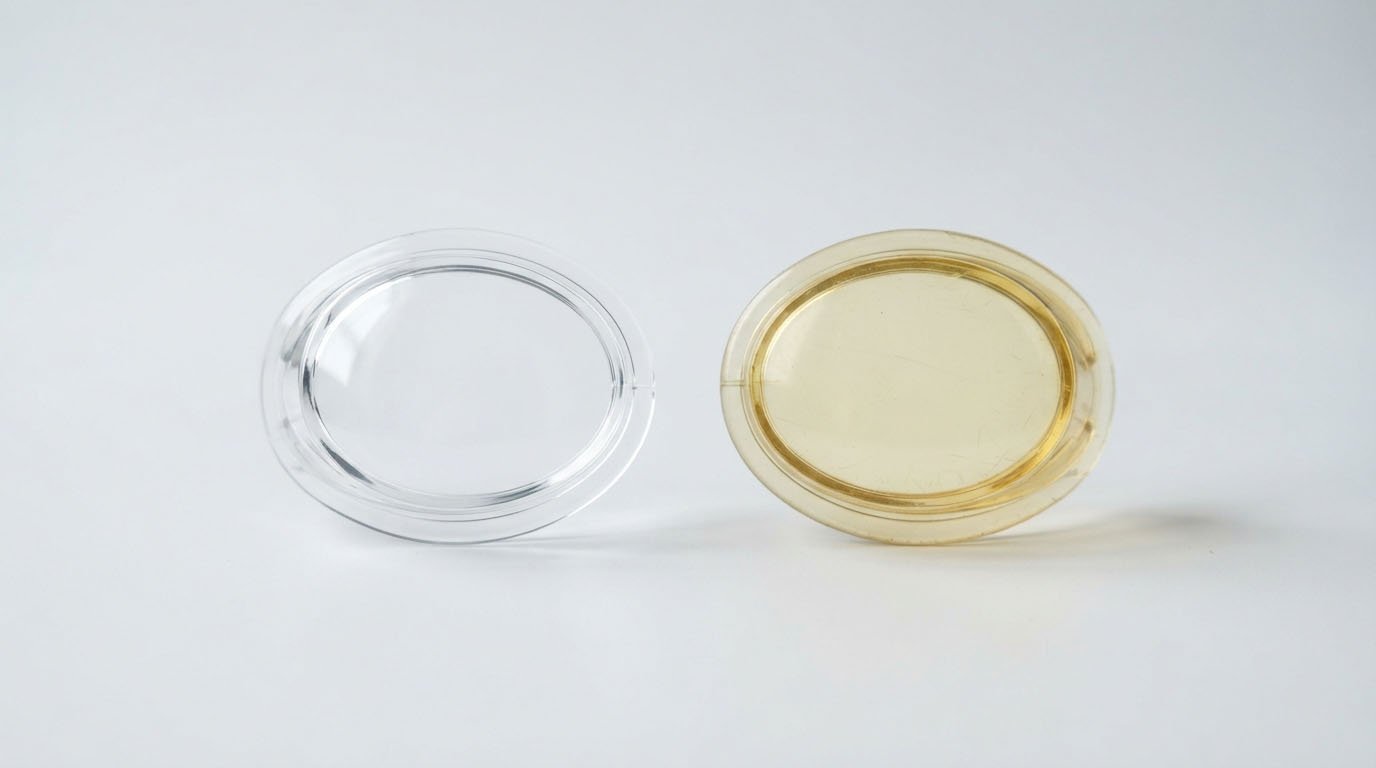
Clear PC swimming goggle lenses may turn yellow because of surface contamination, coating deterioration, UV and heat exposure, or changes in the polycarbonate substrate. The correct diagnosis depends on where the discoloration occurs and when it first appeared.
Not every yellow-looking lens is permanently damaged. Some cases involve removable residue, while others require coating or material investigation.
This guide explains the main causes, diagnostic steps, and quality controls manufacturers should consider to prevent premature yellowing.
Quick Answer: Why Do Clear PC Swimming Goggle Lenses Turn Yellow?
Yellowing can originate in three main areas: the lens surface, a functional coating, or the PC substrate.
| Observed Symptom | Possible Cause | Initial Check |
|---|---|---|
| Yellowish film or stains | Sunscreen, oils, or deposits | Check whether approved rinsing removes residue |
| Patchy yellow haze | Coating contamination or deterioration | Inspect coating condition |
| Uniform yellow tint | PC aging, formulation, or coating change | Compare with an unused reference |
| Staining near the gasket | Contamination or material interaction | Inspect contact areas |
| Yellowing before use | Resin, processing, or coating variation | Review production records |
The first step is to distinguish removable contamination from persistent changes in the coating or lens material.
Photographs can help document complaints, but they rarely establish the root cause.
Key 1: What Causes Clear PC Swimming Goggle Lenses to Turn Yellow?
Polycarbonate (PC) is widely used for swimming goggle lenses because of its impact resistance, low weight, and optical clarity.
However, the finished lens may contain additional surface treatments, each with different aging characteristics.
Surface Contamination and Deposits
Swimming goggles contact pool water, sunscreen, sweat, body oils, and other substances.
As water evaporates, minerals and organic residues may remain on the lens surface, producing cloudy or yellowish stains.
Common indicators include:
- Uneven surface discoloration
- Residue around lens edges
- Staining after repeated swimming
- Improved clarity after approved rinsing
Mineral scale is often whitish, while yellow or brown staining may involve organic contamination or certain dissolved metals.
If residue can be removed safely, the PC substrate may remain unaffected.
Anti-Fog or Other Coating Deterioration
Many goggles have an inner anti-fog coating. Some also include additional optical or protective treatments.
Depending on their formulations, coatings may develop haze, uneven appearance, or discoloration following environmental exposure, improper cleaning, or manufacturing variation.
Possible signs include patchy cloudiness, peeling, surface irregularities, or persistent staining.
However, reduced anti-fog performance does not automatically indicate coating yellowing. Fogging and discoloration are different symptoms.
For related coating behavior, see how chlorine affects swimming goggle anti-fog coating.
Polycarbonate Substrate Aging
UV radiation and environmental stress can trigger chemical changes in susceptible PC formulations.
Photo-oxidation and other degradation reactions may form colored products, gradually shifting the material toward a yellow or amber appearance.
Potential consequences include persistent discoloration, haze, or reduced optical transmission.
Once the polymer itself has chemically degraded, ordinary cleaning cannot restore its original clarity.
Nevertheless, persistent yellowing alone does not prove substrate oxidation. Other causes must first be excluded.
Key 2: How Can You Identify Surface, Coating, or Substrate Yellowing?
A reliable investigation follows a consistent sequence rather than assuming the resin or chlorine caused the problem.
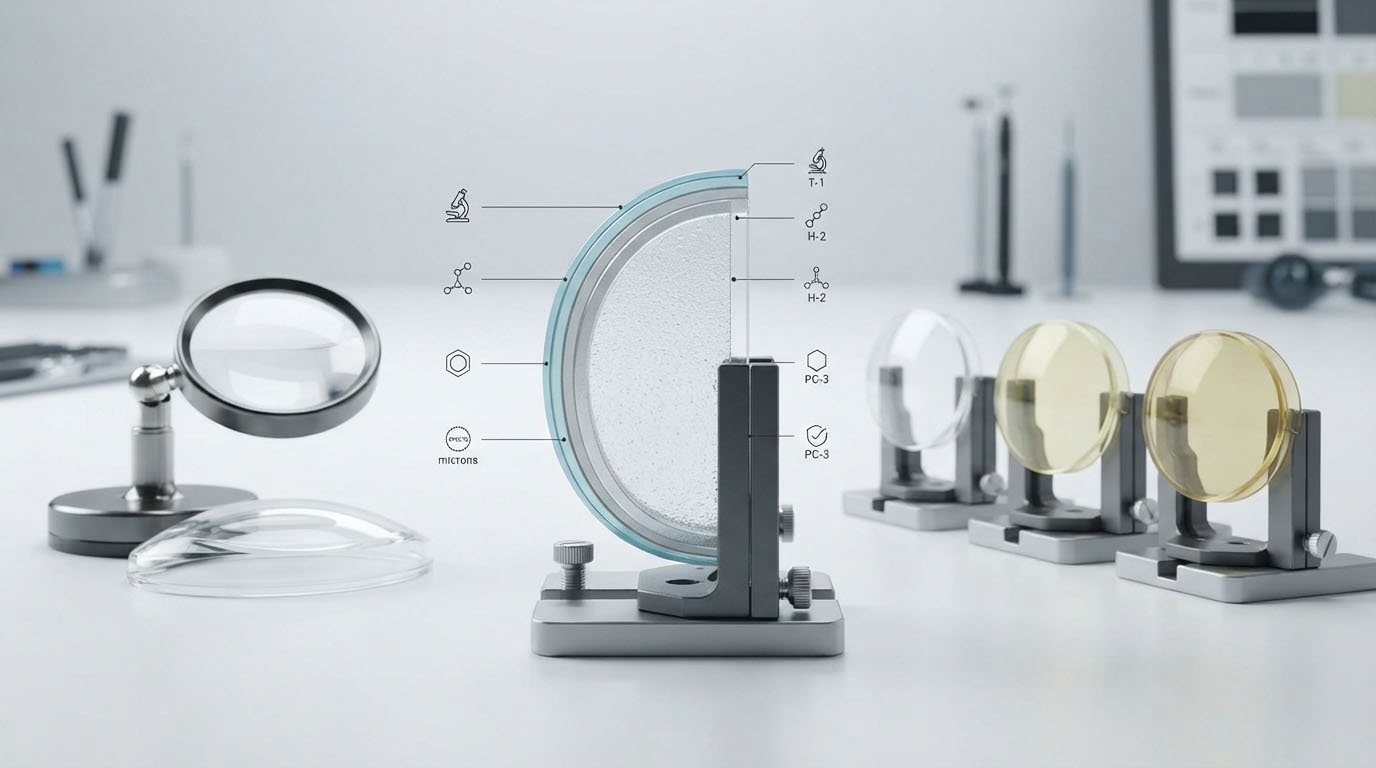
Step 1: Identify When Yellowing Appeared
The timing of discoloration helps narrow the investigation.
| When Yellowing Appears | Investigation Priority |
|---|---|
| Immediately after molding | Resin, processing, contamination |
| After coating | Coating formulation and curing |
| During storage | Packaging, heat, material interactions |
| After swimming | Surface residue, chemical exposure |
| After prolonged outdoor use | UV exposure and material aging |
A lens that yellows before use should not automatically be attributed to consumer handling.
Step 2: Compare With an Approved Reference
Compare the affected lens with an unused, approved sample of the same model and configuration.
Use consistent lighting and a neutral background.
Check whether discoloration is uniform, localized, or concentrated near coatings and gaskets.
An approved reference also helps distinguish unintended yellowing from a slight tint present in the original product.
Step 3: Check for Removable Deposits
Follow the manufacturer’s care instructions.
Gentle rinsing with clean, cool or lukewarm freshwater may remove surface contamination.
Avoid rubbing the inner anti-fog coating or using detergents, solvents, or abrasive cleaners unless specifically permitted.
If discoloration remains, continue investigating the coating and substrate.
Step 4: Inspect Coating Condition
Examine the affected lens under suitable lighting and magnification.
Look for peeling, haze, uneven treatment, or localized defects.
Coating irregularities can suggest deterioration, but visual inspection alone cannot establish the exact chemical mechanism.
Where necessary, compare coated and uncoated reference samples.
Step 5: Evaluate the PC Substrate
If cleaning and coating inspection do not explain the discoloration, investigate the polycarbonate itself.
Possible checks include:
- Optical color and transmittance comparison
- Haze measurement
- Resin grade and processing records
- Affected versus unaffected production samples
- Additional material analysis when justified
A uniform amber tint may suggest substrate-related changes, but laboratory evidence is needed before confirming photo-oxidation.
Key 3: How Do UV, Chlorine, Heat, and Storage Affect Lens Yellowing?
Environmental factors can influence lens appearance, although their effects vary by material and coating system.
UV Exposure
UV radiation may initiate degradation reactions in PC materials, changing color and optical properties over time.
The degree of resistance depends on resin formulation, UV stabilizers, coatings, and exposure conditions.
Importantly, UV-blocking performance and resistance to UV-induced yellowing are not identical properties.
A lens designed to block UV radiation is not necessarily immune to long-term discoloration.
Chlorine and Pool Chemicals
Chlorine is often blamed for yellowing, but pool exposure involves disinfectants, dissolved minerals, and contaminants from swimmers.
These may influence surface deposits or susceptible coatings.
Chlorine exposure alone does not prove that the PC substrate has degraded.
Manufacturers should review actual pool conditions and exposure history before identifying the cause.
Heat and Storage
Excessive heat can accelerate material aging and affect certain surface treatments.
Potentially unfavorable conditions include hot vehicles, direct sunlight, or prolonged storage under high temperatures.
For unused products, manufacturers should also inspect packaging materials and gasket contact areas.
Localized staining may suggest contamination or material interaction, but additional evidence is required before assigning a cause.
Key 4: Can Yellowed Swimming Goggle Lenses Be Cleaned or Restored?
Whether yellowing can be removed depends on its origin.
| Type of Discoloration | Can It Be Restored? | Recommended Action |
|---|---|---|
| Surface residue | Sometimes | Approved freshwater rinsing |
| Persistent surface staining | Uncertain | Investigate contamination |
| Degraded anti-fog coating | Usually not through normal cleaning | Evaluate replacement |
| Chemically aged PC | No, not through routine cleaning | Replace affected lenses or goggles |
| Intended slight tint | Restoration unnecessary | Check approved specification |
Avoid bleach, strong solvents, abrasive polishing, or aggressive rubbing.
These methods can damage coatings and optical surfaces.
If discoloration significantly affects visibility, the goggles should not continue to be used until their condition has been assessed.
Key 5: Can Resin Quality and Manufacturing Cause Premature Yellowing?
Yes. Some yellowing problems originate during material selection, molding, coating, or storage rather than consumer use.
PC Resin Grade and Formulation
Different PC grades have different optical, processing, and aging characteristics.
Buyers should specify an approved resin grade and suitable optical requirements instead of relying on descriptions such as "premium PC."
Any changes in material formulation should be evaluated for possible color differences.
Injection Molding Conditions
Unsuitable processing conditions may contribute to discoloration.
Potential factors include excessive thermal exposure, prolonged melt residence time, contamination, or inconsistent material handling.
Manufacturers should review processing records and compare affected lenses with approved samples.
Coating Application and Curing
Anti-fog and other coatings can change the finished lens’s appearance.
Relevant controls include coating formulation, surface preparation, application consistency, and curing conditions.
Comparing lenses before and after coating helps determine when the color change appeared.
For a broader explanation of lens production, see how swimming goggles are made.
Why Do Some New PC Lenses Look Slightly Yellow?
Not every slight yellow tint represents degradation.
Certain resin formulations, UV absorbers, or coating systems may influence initial lens color.
The important question is whether the finished lens matches the approved reference and optical specification.
An unexpected difference should trigger an investigation before mass production approval.
Key 6: How Should Brands Test PC Lens Yellowing Before Mass Production?
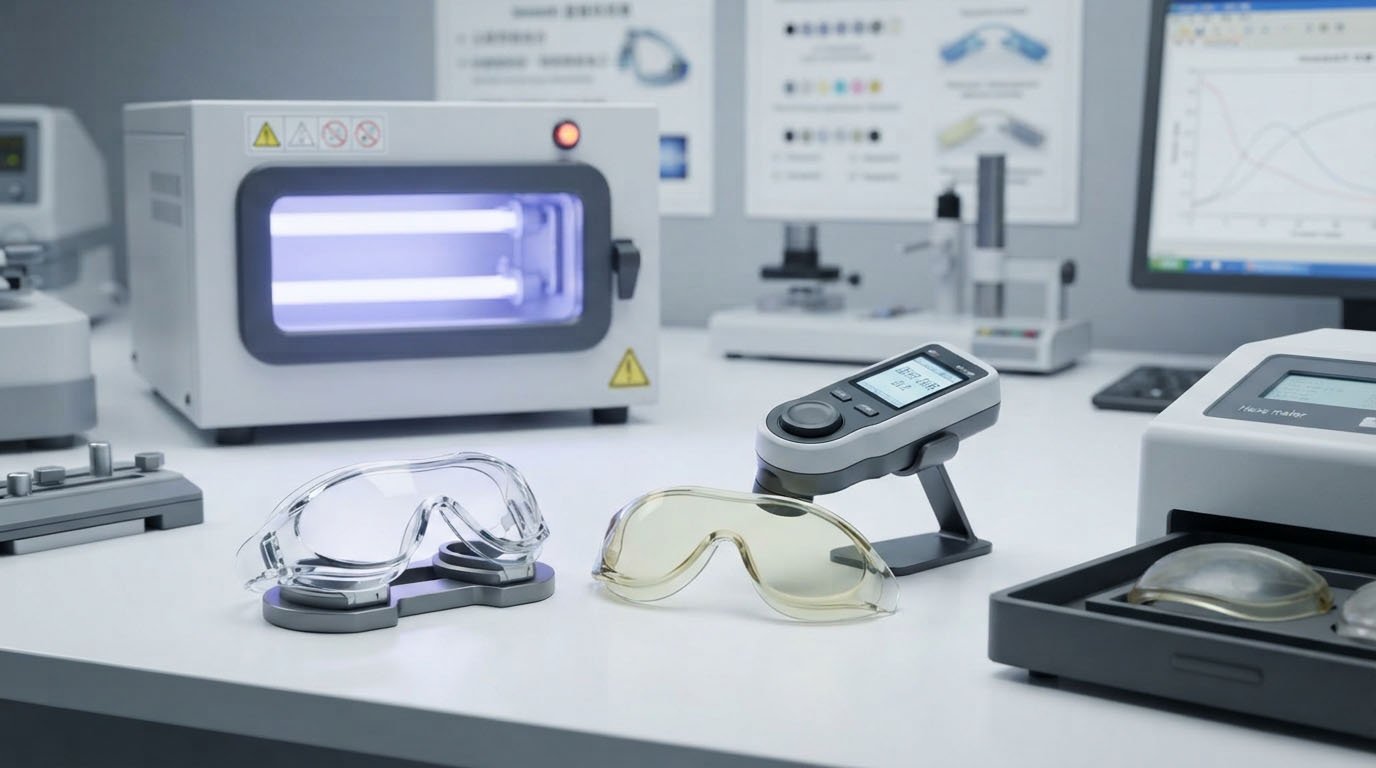
Visual inspection cannot fully establish long-term color stability.
For products with demanding outdoor-use requirements, brands should consider controlled environmental testing and documented optical measurements.
Step 1: Establish Baseline Optical Appearance
Before environmental exposure, record the approved sample’s optical condition.
Relevant measurements may include:
- Visual color against a reference
- Yellowness Index (YI), where applicable
- Luminous transmittance
- Haze and coating appearance
ASTM E313 provides a practice for calculating yellowness and whiteness indices from color measurements.
It does not define a universal acceptable YI value for swimming goggles.
For curved or transparent lenses, measurement procedures must be suitable for the specimen.
Step 2: Select Relevant Aging Tests
Depending on the project, possible testing methods include:
| Test Method | Main Purpose |
|---|---|
| ASTM G154 / ISO 4892-3 | Fluorescent UV exposure |
| ASTM G155 / ISO 4892-2 | Xenon-arc exposure |
| ASTM E313 | Yellowness Index calculation |
| Project-specific thermal aging | Temperature-related changes |
| Project-specific pool-water exposure | Chemical and coating response |
These methods serve different purposes and do not automatically define swimming goggle pass/fail limits.
Exposure conditions and acceptance criteria should be selected according to the product’s intended use.
Step 3: Compare Before and After Exposure
A useful testing sequence is:
Baseline Measurement → Controlled Exposure → Post-Exposure Measurement → Evaluation
When YI is used:
ΔYI = YI after exposure − YI before exposure
A positive ΔYI generally indicates increased measured yellowness under comparable conditions.
However, the result must be interpreted using the agreed measurement procedure and product requirements.
There is no universal ΔYI threshold appropriate for every swimming goggle lens.
Step 4: Verify Finished-Lens Performance
An uncoated PC specimen and a finished coated lens may respond differently to environmental exposure.
Testing should consider the actual approved lens configuration.
Anti-fog coating durability should be evaluated separately where relevant.
For detailed procedures, see anti-fog durability testing before mass production.
Step 5: Maintain Traceable Test Records
For OEM projects, results should be linked to the production configuration.
| Record Item | What Buyers Should Check |
|---|---|
| Sample identity | Model, resin, coating |
| Baseline result | Initial color or optical measurements |
| Test conditions | Method, duration, temperature, exposure |
| Post-test result | Recorded optical changes |
| Acceptance criteria | Agreed project limits |
| Traceability | Relevant production and material batches |
A report stating only "PASS" provides limited value without the test scope, conditions, and acceptance criteria.
Our swimming goggle test report guide explains how buyers can review testing evidence.
Key 7: How Can Brands Prevent Premature PC Lens Yellowing?
Prevention requires controls throughout product development, manufacturing, and storage.
Before Production
- Approve the PC resin and coating configuration.
- Define initial optical appearance.
- Select relevant aging tests.
- Establish project-specific acceptance criteria.
- Retain approved reference samples.
During Manufacturing
Monitor material handling, molding conditions, coating consistency, and final optical appearance.
Changes to approved materials or processes should be reviewed before production release.
Pilot-run verification can help confirm repeatability.
During Storage and Use
Avoid prolonged exposure to excessive heat and unnecessary direct sunlight.
Use packaging suitable for the finished product and investigate possible contact-related discoloration.
For customers, provide clear care instructions: rinse gently with freshwater, avoid rubbing anti-fog coatings, air-dry in a shaded location, and store goggles in a protective case.
These measures reduce avoidable risks but cannot guarantee unlimited color stability.
Frequently Asked Questions
Does Chlorine Turn Clear PC Swimming Goggle Lenses Yellow?
Chlorine may contribute to surface or coating changes under certain conditions. However, UV exposure, heat, contamination, and material formulation may also influence discoloration.
Can UV Protection Prevent PC Lens Yellowing?
UV stabilizers and suitable protective treatments may improve resistance. However, UV protection does not guarantee permanent color stability.
Why Do New Swimming Goggle Lenses Look Yellow?
Possible causes include intended material tint, resin formulation, processing variation, coating appearance, or contamination. Compare them with approved reference samples.
Can Yellowed PC Swimming Goggle Lenses Become Clear Again?
Surface deposits may be removable. Permanent chemical degradation of the PC substrate or coating generally cannot be reversed through routine cleaning.
Does Anti-Fog Coating Damage Always Cause Yellowing?
No. Anti-fog deterioration may cause fogging or haze without yellowing. Coating failure and substrate discoloration should be assessed separately.
Is There a Standard Acceptable Yellowness Index for Swimming Goggles?
There is no single universal YI limit for all swimming goggle lenses. Manufacturers and buyers should agree on appropriate test methods and project-specific acceptance criteria.
Conclusion: Diagnose the Cause Before Blaming the Material
Clear PC swimming goggle lenses can turn yellow for several reasons, but similar discoloration does not always indicate the same failure.
A reliable investigation starts by distinguishing:
Surface Contamination → Coating Change → PC Substrate Change
Then examine when the problem appeared, compare affected lenses with approved references, and review the relevant manufacturing and exposure evidence.
For swimming goggle brands, the objective is not simply to choose "high-quality PC." It is to define optical requirements, verify suitable aging resistance, and maintain production consistency.
Jerry supports OEM and ODM swimming goggle development, including lens customization, sampling, material selection, and quality assurance.
If your brand is investigating lens yellowing or developing a new swimming goggle product, contact Jerry to discuss your requirements.