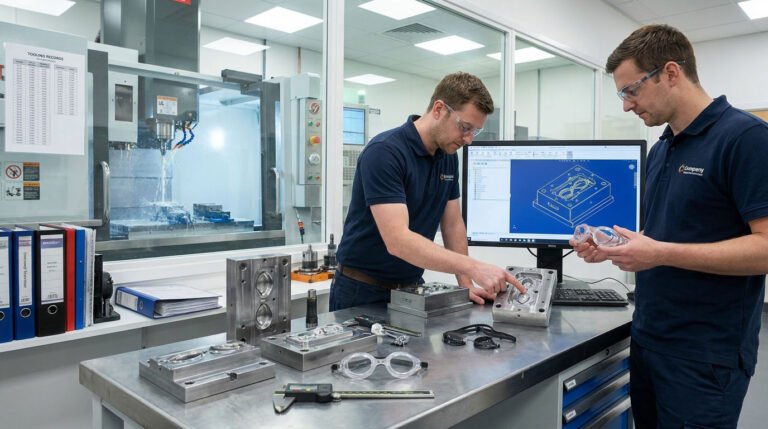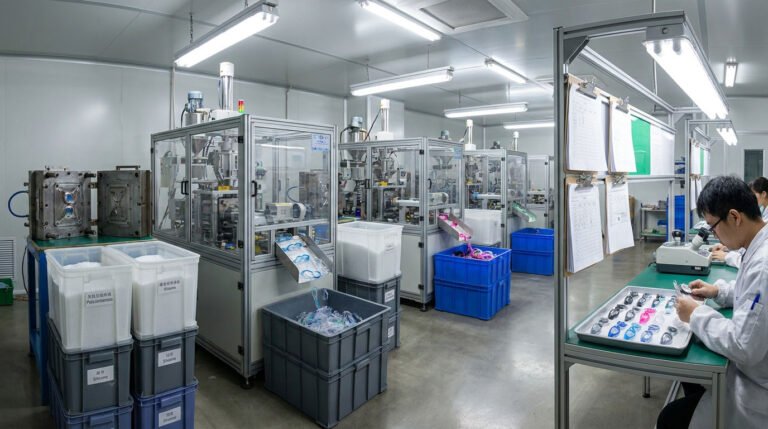
You found a swimming goggle supplier with competitive pricing, attractive samples, and a reasonable MOQ.
But before placing a bulk order, there is another question you should ask:
What test reports can the manufacturer actually provide?
A polished factory presentation is not enough. The documents behind the product matter—especially when you are importing swimming goggles, selling under your own brand, or making claims such as anti-fog, UV protection, or impact resistance.
A swimming goggle manufacturer should provide relevant test reports covering material safety, product conformity, mechanical and optical performance, and any specific claims made about the product. The exact reports required depend on your target market, customer requirements, product design, materials, and sales channel.
There is no single test report that automatically covers every swimming goggle, every country, and every sales channel.
The important question is not simply:
“Do you have test reports?”
It is:
“Do these reports apply to the exact swimming goggles I am buying?”
If you are developing your own product rather than purchasing an off-the-shelf model, review the available custom swimming goggles options together with the testing requirements before confirming the final specification.
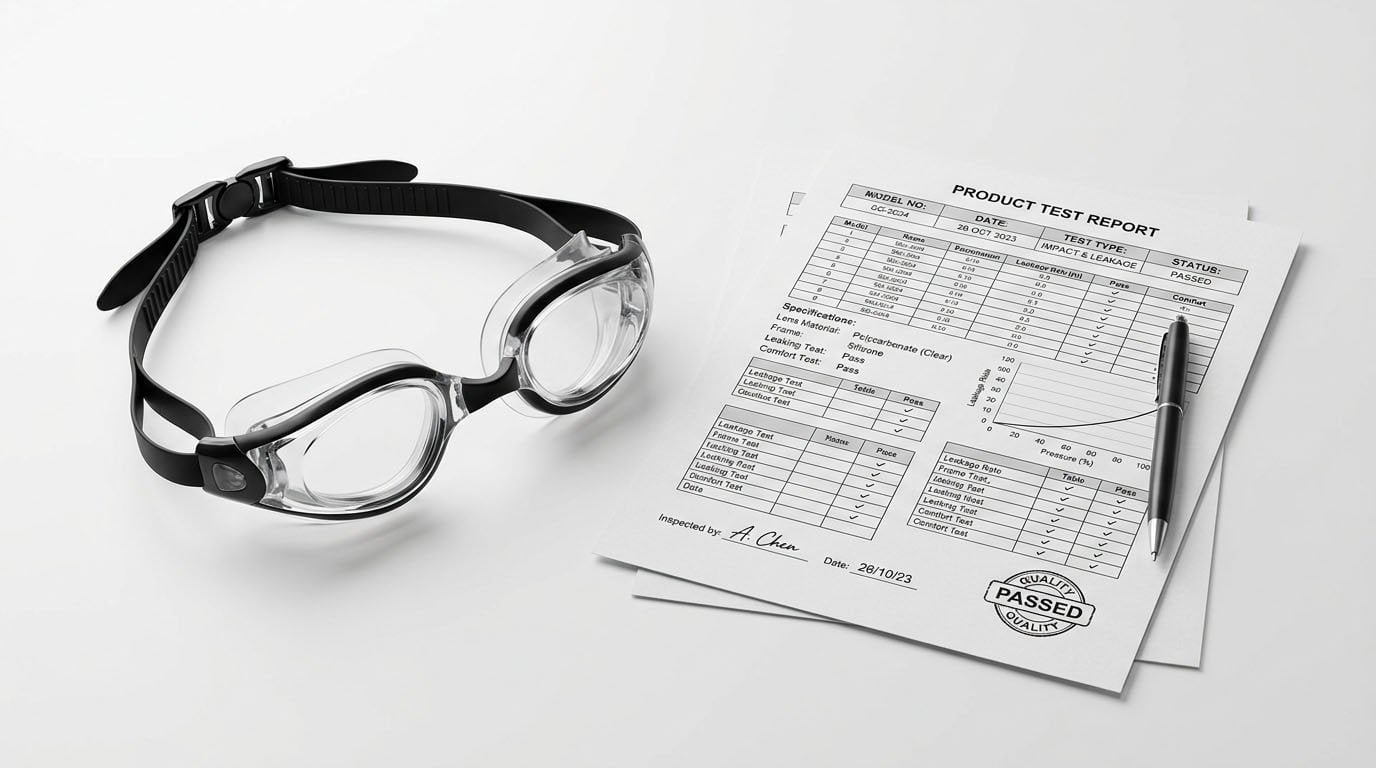
Quick Answers: What Swimming Goggle Test Reports Should Buyers Check?
If you are comparing swimming goggle manufacturers, start with these five questions.
What reports matter most?
Most buyers should review reports related to:
- Material and chemical safety
- Mechanical strength
- Optical performance
- Anti-fog performance
- UV protection
- Leakage and sealing performance
- Product conformity
- Factory quality-control records
The exact combination depends on your market and product.
Is one report valid for every swimming goggle?
No.
A report should be checked against the:
- Product model
- Materials
- Lens type
- Lens color or coating
- Strap and gasket materials
- Product claims
- Target market
A report issued for one model cannot automatically be assumed to cover a different product.
When should new testing be considered?
Re-testing may be necessary when you change:
- Lens materials
- Silicone or TPE compounds
- Pigments or colors
- Anti-fog coatings
- UV treatments
- Product construction
- Molds
- Raw-material suppliers
These decisions should ideally be made during the sampling and prototyping stage rather than after bulk production begins.
How can I check whether a test report is genuine?
Check:
- Report number
- Testing laboratory
- Applicant name
- Product model
- Product photos
- Testing date
- Test methods
- Tested materials
- Scope
- Results
When possible, confirm the report number directly with the laboratory.
Should I only request third-party reports?
No.
Third-party testing and factory QC records solve different problems.
Third-party laboratory reports help confirm that a selected product or sample meets certain requirements.
Factory QC records help show whether your actual production batch remains consistent with the approved product.
You usually want both.
Why Are Test Reports Important When Choosing a Swimming Goggle Manufacturer?
Swimming goggles come into direct contact with the skin around the eyes and are expected to perform reliably in wet environments.

At the same time, brands frequently make performance claims such as:
- Anti-fog
- UV protection
- Leak-resistant
- Impact-resistant
- Optical clarity
- Soft silicone
- Skin-friendly materials
These claims should not depend only on a sales representative’s promise.
Test reports turn product claims into measurable evidence.
They can help buyers:
- Evaluate product safety
- Verify supplier claims
- Reduce sourcing risk
- Meet customer requirements
- Prepare compliance documents
- Reduce marketplace listing problems
- Identify mismatched materials or products before bulk production
But having a large stack of certificates does not necessarily mean a supplier is safer.
The real issue is whether the documentation matches the swimming goggles you intend to purchase.
At Jerry, product documentation should be considered together with the factory’s broader quality assurance process, because laboratory testing and production QC serve different purposes.
Test Reports Are a Risk-Control Tool, Not Just a Checklist
One of the biggest mistakes buyers make is collecting documents without understanding what risk each document addresses.
A more useful way to evaluate reports is to divide them into three major areas.
| Risk Area | Typical Testing Focus | What Buyers Want to Verify |
|---|---|---|
| Material Safety | Silicone, TPE, plastics, coatings, inks | Whether restricted or harmful substances are controlled |
| Mechanical & Optical Performance | Lens, straps, buckles, bridge, optical quality | Whether the product performs safely and consistently |
| Performance Claims | Anti-fog, UV protection, sealing | Whether marketing claims can be supported |
This makes document review much easier.
Instead of asking:
“Can you send all your certificates?”
Ask:
“Which report proves this particular product requirement?”
That question is much more useful during supplier evaluation.
What Material and Chemical Safety Reports Should You Request?
Swimming goggles contain several materials that may come into prolonged contact with the user’s skin.
Typical components include:
- Silicone gasket
- Silicone or TPE strap
- Polycarbonate lens
- Plastic frame
- Buckles
- Nose bridge
- Printed logos
- Surface coatings
- Anti-fog treatment
Depending on the material and target market, buyers may need documentation relating to chemical substances such as:
- Restricted plasticizers
- Heavy metals
- Lead
- Certain hazardous substances
- Material migration
- Other market-specific restricted chemicals
The correct testing scope depends on your destination market and product classification.
Match the Report to the Actual Material
This is particularly important for customized OEM swimming goggles.
Suppose a manufacturer’s standard model uses:
- Clear silicone gasket
- Clear polycarbonate lens
- Blue strap
But your private-label version uses:
- Black silicone gasket
- Mirrored lens
- Custom red strap
- Printed logo
You should not automatically assume that an old test report for the original configuration completely covers your customized version.
Changes in:
- Pigments
- Coatings
- Printing inks
- Material suppliers
- Surface treatments
may affect what should be reviewed or tested.
If you are developing branded retail products, these decisions should be considered as part of the overall private label swimming goggle development process, not treated as an afterthought after packaging has already been finalized.
A good manufacturer should be able to explain which existing reports remain relevant and which customized components may need additional verification.
What Mechanical Test Reports Matter for Swimming Goggles?
Chemical safety is only one part of swimming goggle quality.
The product must also withstand repeated use.
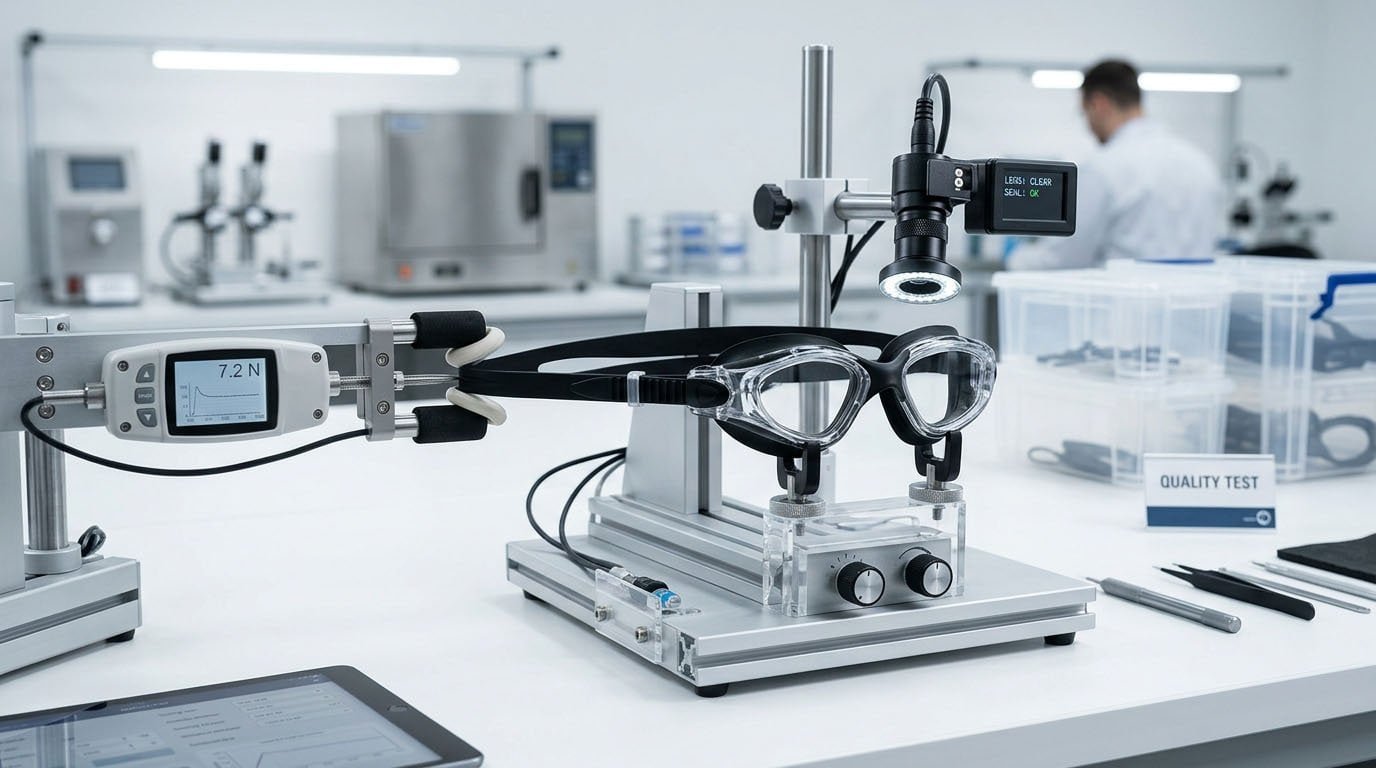
Important areas can include:
Lens Impact Resistance
Swimming goggle lenses should withstand reasonable mechanical impact without creating unsafe breakage.
Buyers should check whether the manufacturer has testing related to the lens material and finished product construction.
Strap Strength
A strap that tears or separates too easily creates both quality complaints and potential safety problems.
Testing may evaluate:
- Strap tensile strength
- Connection strength
- Attachment points
- Strap durability
Buckle and Adjustment System
Adjustment mechanisms should maintain their position during normal use.
Weak buckles can cause:
- Strap slippage
- Poor fit
- Leakage
- Customer complaints
Nose Bridge Strength
For goggles using replaceable or adjustable nose bridges, the bridge should survive repeated fitting and adjustment.
Leakage and Seal Performance
A swimming goggle can have excellent materials and still fail if the gasket does not seal properly.
Leak and sealing tests help evaluate how effectively the lens and gasket assembly maintains contact around the eye area.
What Optical Tests Should Swimming Goggle Manufacturers Provide?
Swimming goggles are not ordinary molded plastic products.
The user looks through the lens continuously while swimming.
That makes optical quality important.
Depending on the product, relevant testing can include:
- Optical clarity
- Refractive power
- Prismatic effects
- Lens distortion
- Light transmission
- UV filtration
- Optical consistency
Poor optical performance may result in:
- Distorted vision
- Eye discomfort
- Poor visibility
- A lower-quality consumer experience
This is particularly important for:
- Competition goggles
- Curved lenses
- Mirrored lenses
- Tinted lenses
- Prescription or diopter swimming goggles
If you are developing a technically advanced model, optical testing should be discussed during product development rather than after mass production.
For custom projects involving new lenses, structures, colors, or functions, an experienced OEM & ODM swimming goggle manufacturer should help identify testing considerations during the development stage.
What Performance Claims Should Be Supported by Test Reports?
Many swimming goggle brands differentiate products through performance claims.
The most common examples are:
- Anti-fog
- UV protection
- Leak resistance
- Impact resistance
- Polarized lenses
- Mirrored lenses
If a claim appears on:
- Packaging
- Product page
- Amazon listing
- Catalogue
- Marketing material
you should be able to explain what evidence supports it.
Anti-Fog Testing
Anti-fog performance depends heavily on:
- Coating chemistry
- Coating thickness
- Application method
- Curing
- Lens material
- Production consistency
An anti-fog report from an older product may not necessarily represent a new lens coating.
If the manufacturer changes its anti-fog formulation or application process, consider whether the product needs to be re-evaluated.
UV Protection Testing
If your packaging says:
UV Protection
or makes a more specific UV-related claim, the relevant lens should be tested.
Do not assume that every polycarbonate swimming goggle lens automatically supports the exact marketing claim you intend to print.
Leak Testing
Leak resistance depends on the complete product:
- Gasket shape
- Silicone hardness
- Frame geometry
- Nose bridge
- Strap tension
- Face fit
That means a leak test should evaluate the assembled swimming goggle rather than only one raw material.
Which Swimming Goggle Standards Should Buyers Discuss With Manufacturers?
Swimming goggle standards and regulatory requirements differ by market.
For surface swimming eyewear, buyers may encounter product standards and testing requirements covering areas such as:
- Materials
- Construction
- Optical performance
- Mechanical performance
- Test methods
- Product marking
- Manufacturer information
One commonly referenced standard for surface swimming eyewear is ISO 18527-3.
However, buyers should avoid assuming that mentioning one standard automatically proves compliance everywhere.
The applicable requirements can depend on:
- Destination country
- Product type
- Age group
- Intended use
- Product claims
- Retailer requirements
- Marketplace rules
A professional swimming goggle manufacturer should therefore ask:
“Where will you sell this product?”
before recommending a testing package.
Third-Party Test Reports vs Factory QC Reports: What Is the Difference?
Buyers often confuse these two document types.
They are both important, but they answer different questions.
Third-Party Laboratory Reports
A third-party lab report usually answers:
Can this tested sample meet a particular requirement?
It may include tests relating to:
- Materials
- Chemicals
- Mechanical properties
- Optical properties
- Anti-fog
- UV protection
- Other product claims
Third-party reports provide independent testing evidence.
Factory QC Records
Factory QC documents answer another question:
Does the mass-produced order remain consistent with the approved product?
Factory records may include:
- Incoming material inspection
- Injection molding inspection
- Lens inspection
- Anti-fog coating inspection
- Assembly inspection
- Strap and buckle checks
- Leak testing
- Appearance inspection
- Final inspection
- Packing inspection
A third-party report may prove that one sample passed.
It does not by itself prove that every piece in a 10,000-piece production order was manufactured consistently.
That is why serious buyers should review the supplier’s quality assurance system as well as third-party laboratory documentation.
How Do You Check Whether a Test Report Matches Your Swimming Goggle?
This is one of the most important parts of supplier evaluation.
A report can be genuine and still be irrelevant to your order.
Before accepting a report, check the following.
1. Match the Model Number
Compare the model number in:
- Test report
- Supplier quotation
- Proforma invoice
- Technical specification
- Approved sample
They should clearly correspond.
If the report shows one model while you are buying another, ask the supplier to explain why the document applies.
2. Check the Product Photos
Many laboratory reports contain photographs of the tested sample.
Compare those photographs with:
- Your approved sample
- Lens shape
- Strap design
- Buckle
- Nose bridge
- Gasket
- Product construction
The tested product should reasonably correspond with what you are purchasing.
3. Check the Materials
Review whether the report identifies the relevant:
- Silicone
- TPE
- Polycarbonate
- Plastic
- Coating
- Ink
- Color
This becomes especially important when you customize colors or materials.
4. Check the Applicant
The applicant should have a clear relationship with the:
- Manufacturer
- Supplier
- Brand owner
- Material supplier
If you do not recognize the applicant’s company name, ask for clarification.
5. Check the Test Date
An old report is not automatically invalid.
However, you should ask whether the following have changed since the report was issued:
- Raw-material supplier
- Formulation
- Pigments
- Lens supplier
- Anti-fog coating
- Mold
- Product construction
- Standard or customer requirement
The issue is not simply:
“How old is the report?”
The better question is:
“Is the tested product still materially the same as what is being produced today?”
6. Check the Testing Laboratory
Professional third-party laboratories normally provide clear information about:
- Laboratory name
- Report number
- Test date
- Test method
- Results
- Product sample
For critical reports, buyers may also check whether the laboratory holds appropriate accreditation for the relevant testing scope.
7. Verify the Report Number
Where available, use the issuing laboratory’s verification system or contact the laboratory directly.
Do not rely only on a PDF supplied through email or WhatsApp.
Why Does SKU Traceability Matter?
Imagine your supplier sends you an excellent test report.
The report is real.
The laboratory is reputable.
The product passed every test.
But the tested model is not your product.
Then the report provides limited value for your actual order.
This is why SKU traceability is important.
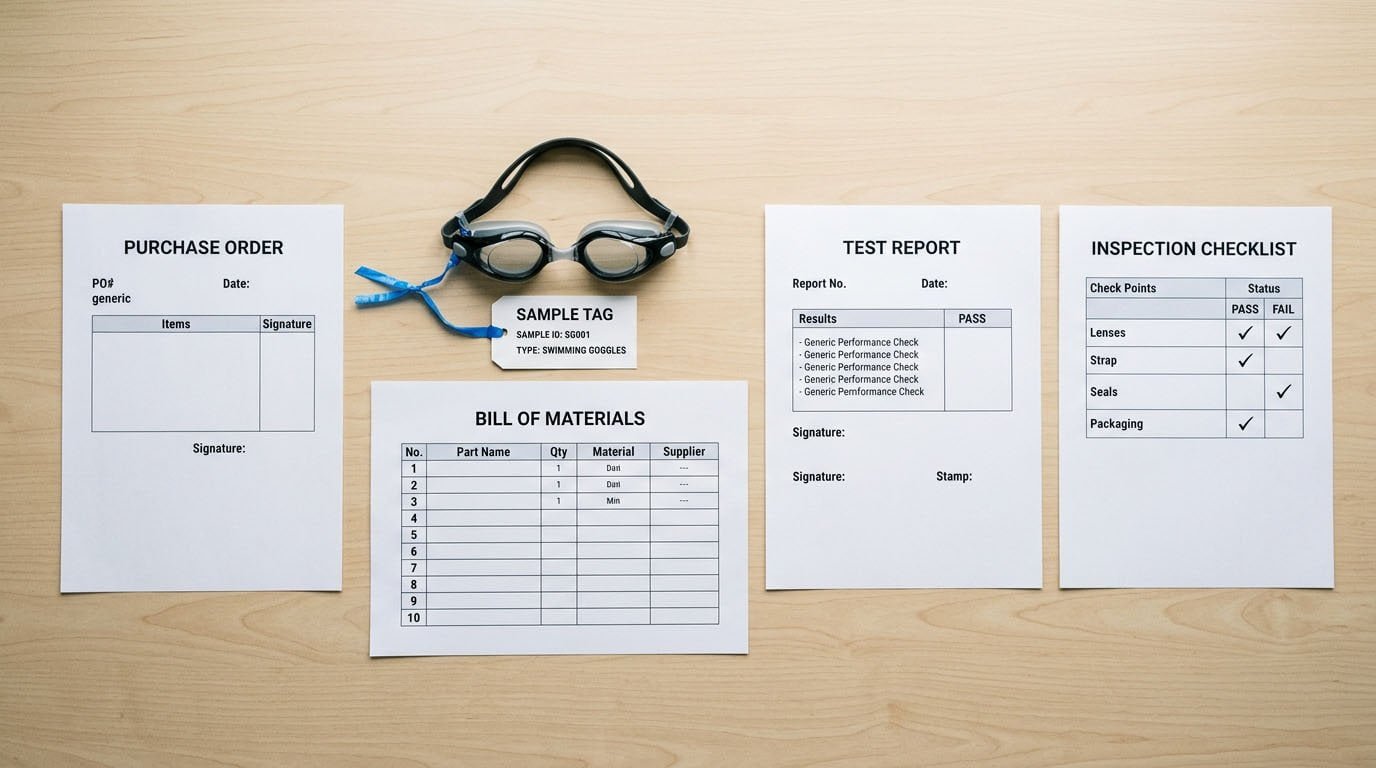
Ideally, you should be able to connect:
Purchase Order
↓
Product SKU / Factory Model
↓
Approved Sample
↓
Bill of Materials
↓
Relevant Test Reports
↓
Bulk Production
↓
Final Inspection
This creates a traceable chain between the paperwork and the physical goods.
Raw Material Reports vs Finished Product Reports
Buyers should also understand the difference between testing a raw material and testing a completed swimming goggle.
Raw Material Report
A material report may cover:
- Silicone
- Plastic resin
- TPE
- Pigments
- Coating chemicals
- Other components
These reports are useful for supplier and material control.
However, they do not necessarily prove that the completed swimming goggle meets every product-level requirement.
Finished Product Report
A finished-product test evaluates the swimming goggle after processes such as:
- Injection molding
- Lens treatment
- Printing
- Anti-fog application
- Assembly
Finished-product testing can therefore provide more direct evidence about the product the buyer will actually sell.
For important product requirements, ask your supplier whether the report applies to:
raw material, component, or finished swimming goggle.
That simple question can prevent a lot of confusion.
What Is a Golden Sample and Why Should Buyers Keep One?
A Golden Sample is the approved physical product that represents the quality and specifications agreed between the buyer and manufacturer.
It can be extremely useful for custom swimming goggle production.
Once the sample is approved, both sides can use it as a reference for:
- Lens color
- Silicone color
- Material feel
- Strap length
- Buckle
- Nose bridge
- Logo placement
- Printing
- Anti-fog performance
- Packaging
- Overall appearance
For larger OEM/ODM orders, it is useful for both the buyer and manufacturer to retain an approved sample.
Then bulk production can be compared against a physical benchmark—not only drawings and email messages.
This is one reason the sampling and prototyping stage is so important in custom swimming goggle manufacturing.
Should Test Samples Come From Real Production?
Whenever possible, critical verification should represent the actual production configuration.
A beautifully prepared prototype may not always represent:
- Bulk materials
- Production molding conditions
- Standard production coating
- Real assembly processes
For important projects, buyers can discuss taking verification samples from:
- Pilot production
- Pre-production runs
- Early mass-production batches
This creates a stronger link between the test result and the goods that will actually be shipped.
What Factory QC Documents Should Buyers Request?
Not every internal production document needs to be sent to every customer.
However, professional manufacturers should have a defined QC system.
Ask how the factory controls:
Incoming Materials
For example:
- Lens raw materials
- Silicone
- Straps
- Pigments
- Printing materials
- Coating materials
Injection Molding
Check for:
- Molding defects
- Deformation
- Surface defects
- Color consistency
- Dimensional consistency
Lens Processing
Check:
- Scratches
- Optical defects
- Coating consistency
- Surface quality
Assembly
Check:
- Strap connection
- Buckle function
- Nose bridge
- Gasket assembly
- Product symmetry
Final Inspection
Final inspection may include:
- Appearance
- Function
- Packaging
- Quantity
- Labeling
- Logo
- Accessories
Ask whether the manufacturer can provide inspection records or shipment inspection evidence when required.
For a clearer overview of how these controls can fit into production, see our Quality Assurance process.
A Pre-Order Swimming Goggle Test Report Checklist
Before placing a bulk order, work through the following steps.
Step 1: Define Your Target Market
Tell the manufacturer where you plan to sell.
For example:
- United States
- European Union
- United Kingdom
- Australia
- Canada
Do this before mass production—not after the goods are finished.
Step 2: Define the Product
Confirm:
- Model
- Materials
- Lens type
- Gasket
- Strap
- Buckle
- Nose bridge
- Colors
- Coatings
- Packaging
For a fully customized project, your technical specification should be aligned with the supplier’s OEM & ODM development process.
Step 3: List Every Product Claim
Write down claims such as:
- Anti-fog
- UV protection
- Impact resistance
- Polarized
- Leak-resistant
Then ask:
“What test evidence supports each claim?”
Step 4: Review Existing Reports
Check:
- Model
- Product photo
- Material
- Applicant
- Date
- Method
- Result
- Laboratory
- Scope
Step 5: Identify Testing Gaps
Separate:
Existing valid evidence
from
new tests needed for your custom product.
Step 6: Agree Who Pays for Additional Testing
Testing responsibility should be discussed before mass production.
Depending on the project, testing costs may be paid by:
- Buyer
- Manufacturer
- Shared agreement
The important point is to clarify responsibility early.
Step 7: Approve a Golden Sample
Keep an approved physical benchmark.
Step 8: Connect Testing With Bulk Production
Where appropriate, take verification samples from representative production goods.
Step 9: Review Final QC Before Shipment
The documentation and actual shipment should correspond.
Swimming Goggle Test Report Buyer Checklist
| Document / Evidence | What to Check | When to Review |
|---|---|---|
| Material safety reports | Material, color, supplier, scope | Before sampling / production |
| Product conformity report | Model, standard, results | Before bulk order |
| Optical test | Lens model, optical requirements | Before production |
| Anti-fog test | Exact lens/coating | Before claim is printed |
| UV test | Exact lens/tint | Before UV claim is printed |
| Mechanical test | Lens, strap, buckle, bridge | During qualification |
| Leak/seal testing | Finished product | Sample / production stage |
| Laboratory information | Lab, report number, scope | Before accepting report |
| Golden Sample | Exact approved specification | Before production |
| Factory QC records | Order/batch/product | Before shipment |
| Final inspection | Quantity, quality, packaging | Before shipment |
Red Flags When Reviewing a Swimming Goggle Manufacturer’s Reports
Be careful if a supplier:
- Sends only a factory audit when you request product testing
- Refuses to show the full report
- Hides the model number
- Provides reports for visibly different products
- Cannot explain which material was tested
- Uses reports from unrelated companies without explanation
- Cannot connect the report to your product
- Claims one certificate covers every country
- Cannot explain its testing process
- Cannot explain what happens when materials change
A good supplier does not necessarily need hundreds of reports.
It should instead be able to explain:
which report applies to which product, material, market, and claim.
Questions to Ask a Swimming Goggle Manufacturer Before Paying a Deposit
Use these questions during supplier qualification.
- Which test reports are available for this exact swimming goggle model?
- Which reports apply to the finished product?
- Which reports only apply to raw materials?
- Which materials were included in the testing?
- Does the report cover my requested color?
- Does it cover my lens type and coating?
- What test supports your anti-fog claim?
- What test supports your UV claim?
- Which laboratory issued the report?
- Can the report number be verified?
- Have any materials changed since the test?
- Have you changed the lens, coating, or mold?
- What tests might be needed for my target market?
- Who pays for additional third-party testing?
- Can testing samples be taken from production?
- Can we approve and retain a Golden Sample?
- What QC records can you provide before shipment?
A supplier that answers these questions clearly is much easier to evaluate than one that simply sends a folder full of PDFs.
If you are evaluating a new project and want to confirm which reports may be relevant to your product specification, you can contact Jerry before sampling or bulk production.
Frequently Asked Questions
Is one swimming goggle test report valid worldwide?
No.
Requirements differ by product, target market, customer, and sales channel.
Always confirm the requirements for your actual destination market.
Does every custom swimming goggle need completely new testing?
Not necessarily.
Existing reports may still be relevant when the product uses previously tested materials and construction.
However, significant changes to:
- Materials
- Pigments
- Lens
- Coating
- Structure
- Mold
may require additional evaluation.
Discuss this with your manufacturer and testing laboratory.
Do I need another test if I only change the lens color?
Possibly.
Different tints, pigments, mirrored treatments, and coatings may affect:
- Chemical composition
- Light transmission
- UV performance
- Optical properties
Ask whether the existing test scope covers your new configuration.
Can I trust a report if the model number is different?
Do not automatically assume it applies.
Ask the manufacturer to explain the relationship between the tested model and your product.
Compare:
- Construction
- Materials
- Lens
- Gasket
- Strap
- Coating
If the products differ significantly, additional testing may be appropriate.
How can I tell whether a laboratory report is genuine?
Check:
- Report number
- Laboratory
- Applicant
- Product photo
- Test date
- Test scope
- Model
When possible, verify the report through the laboratory’s official verification system or contact the laboratory directly.
How often should swimming goggle test reports be renewed?
There is no single renewal interval that applies to every report and every market.
Instead, review whether anything important has changed, including:
- Materials
- Supplier
- Pigment
- Coating
- Lens
- Mold
- Construction
- Applicable requirements
Re-testing decisions should be based on product changes and applicable requirements rather than an arbitrary date alone.
What is the difference between a factory audit and a product test report?
A factory audit evaluates aspects of the manufacturing organization or management system.
A product test report evaluates a specific product or sample against defined test requirements.
They are not interchangeable.
A factory can pass an audit while an individual product still requires separate testing.
Who normally pays for third-party testing?
This depends on the commercial agreement.
For customized OEM/ODM projects, buyers and manufacturers should clarify:
- Required tests
- Laboratory
- Sample preparation
- Testing fees
- Re-testing responsibility
before mass production starts.
Conclusion
Choosing a swimming goggle manufacturer is not only about price, MOQ, tooling, and delivery time.
You also need to understand the evidence behind the product.
The strongest documentation package is not necessarily the one containing the most PDFs.
It is the one where you can clearly connect:
your product
→ your materials
→ your claims
→ your target market
→ the test report
→ the production batch
Before placing a bulk order, check the model number, materials, product photos, laboratory, test date, methods, and scope.
Then connect those reports to a Golden Sample and a real factory QC process.
That is how test reports become more than paperwork.
They become part of a reliable swimming goggle sourcing and quality-control system.
If you are sourcing custom swimming goggles, you can learn more about Jerry Goggles or contact our team to discuss your product specifications, testing requirements, and OEM/ODM project.