Choosing between a swimming goggle manufacturer, supplier, and trading company can affect your product quality, customization options, order costs, and delivery reliability.
But these terms are often confused. A company calling itself a "manufacturer" may outsource part of its production, while an experienced trading company may provide valuable sourcing and quality management services.
The best choice depends on your customization needs, order volume, product range, and the level of manufacturing control your brand requires. A direct manufacturer often suits technically complex swimming goggles, while a trading company can be useful for mixed-product sourcing and smaller purchasing programs.
Quick Answer: Manufacturer vs Supplier vs Trading Company
The three terms describe different business roles.
| Partner Type | What It Means | Main Advantage | Potential Limitation |
|---|---|---|---|
| Manufacturer | A company that manufactures swimming goggles through its own operations, sometimes using external component suppliers | Direct production and engineering communication | May specialize in fewer product categories |
| Trading Company | A business that sources swimming goggles from manufacturers and sells them to buyers | Sourcing flexibility and order coordination | Less direct control over manufacturing |
| Supplier | Any company supplying products under a commercial agreement | Can be a manufacturer, trader, or hybrid business | The term alone does not reveal manufacturing capability |
Important: A supplier is not necessarily a third type of company. Both manufacturers and trading companies can be your suppliers.
Some businesses also operate hybrid models, manufacturing certain products while sourcing others externally.
The objective is not simply to find a company labeled "factory." It is to identify who manufactures your swimming goggles, who controls critical processes, and who is responsible for your order.
Key 1: What Is the Difference Between a Manufacturer, Supplier, and Trading Company?
Swimming Goggle Manufacturer
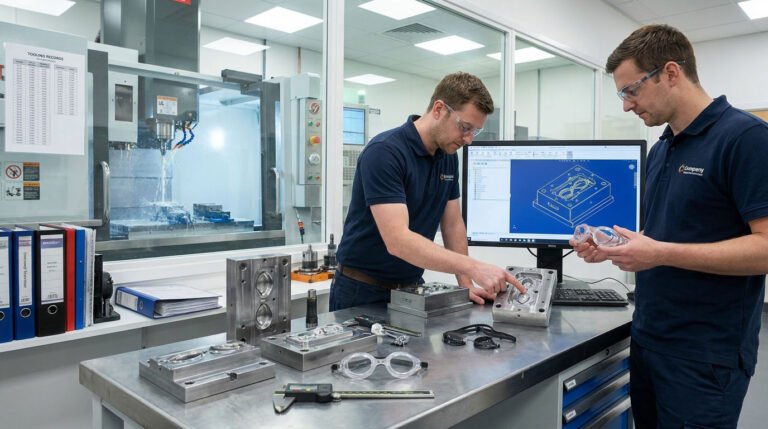
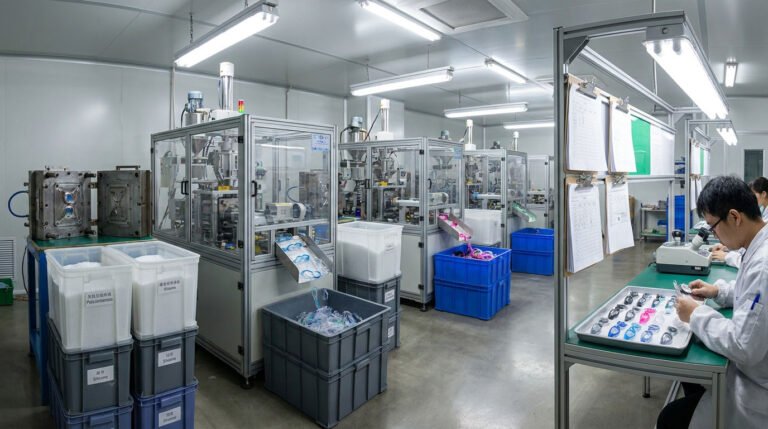
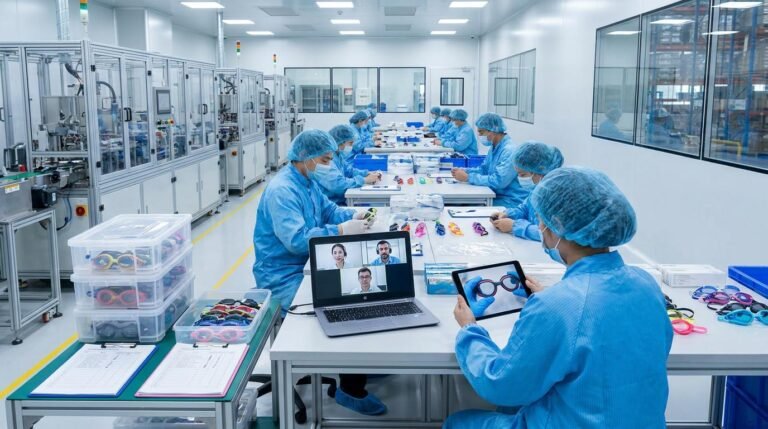
A swimming goggle manufacturer is directly involved in making the product.
Depending on its capabilities, a manufacturer may handle:
- Lens and frame injection molding
- Silicone gasket production
- Anti-fog coating or lens treatment
- Strap and buckle assembly
- Product testing and quality control
- Packaging and finished-goods inspection
Not every manufacturer performs all these processes internally. A legitimate factory may purchase lenses, silicone components, coatings, or packaging from qualified subcontractors.
What matters is whether it has clearly defined manufacturing responsibilities and can demonstrate effective production control.
For brands developing customized lens geometry, gasket structures, or proprietary components, direct communication with manufacturing engineers can reduce technical misunderstandings.
Swimming Goggle Trading Company
A trading company purchases or arranges production through one or more manufacturers and supplies the finished products to buyers.
Its services may include:
- Finding suitable factories
- Comparing product options and quotations
- Coordinating samples and customization
- Managing communication between buyers and factories
- Arranging inspections and shipment consolidation
- Managing orders across multiple product categories
Trading companies can be particularly useful when a buyer needs swimming goggles alongside swim caps, training equipment, or other accessories from different factories.
However, buyers should confirm how the trading company manages product quality and whether technical questions can reach the actual manufacturing team.
Swimming Goggle Supplier
"Supplier" describes a commercial relationship rather than a specific production structure.
For example, your swimming goggle supplier might be:
- A manufacturer selling directly to your brand
- A trading company purchasing products from several factories
- A manufacturer using a separate export or sales company
- A hybrid business that manufactures some products and sources others
This distinction matters because the company issuing your invoice may not be the facility manufacturing your swimming goggles.
Before placing an order, identify both the contracting supplier and the actual manufacturing facility.
Key 2: How Do Manufacturing Capabilities and Responsibilities Compare?
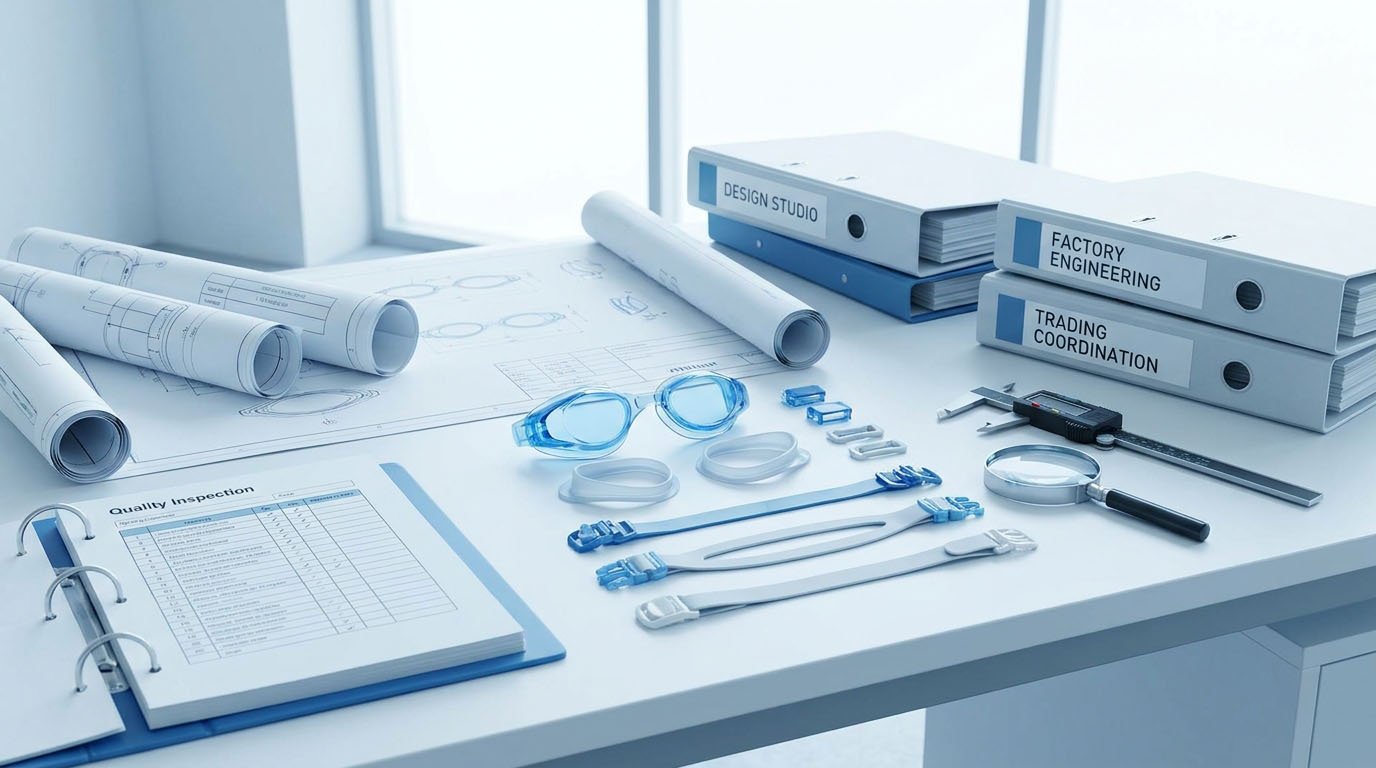
The biggest differences often appear during product development, quality control, and order management.
| Evaluation Factor | Direct Manufacturer | Trading Company |
|---|---|---|
| Product development | Communicates with its engineering or production team | Coordinates with the producing factory |
| Custom molds | May develop or directly manage tooling | Usually coordinates tooling through manufacturers |
| Quality control | Manages its own production QC and relevant subcontractors | Relies on factory QC, its own inspections, or independent inspectors |
| Technical changes | Can communicate directly with production personnel | Must coordinate changes with the factory |
| Product range | Often specializes in selected product categories | May source from multiple product categories |
| Shipment coordination | Manages its products and agreed logistics | May consolidate products from several manufacturers |
| After-sales responsibility | Depends on agreed contract terms | Depends on agreed contract terms |
Why Direct Engineering Communication Matters
Swimming goggles combine optical lenses, flexible sealing components, straps, buckles, and surface treatments.
A design modification can affect several connected parts.
For example, changing gasket geometry may require reviewing fit, lens-to-frame assembly, sealing performance, and manufacturing consistency.
A manufacturer with direct engineering access can usually discuss these interactions without passing every technical question through another company.
A trading company can also manage complex development successfully, provided it has experienced technical staff and clear access to the manufacturing team.
The difference is the communication structure, not an automatic guarantee of product quality.
Who Is Responsible for Quality?
A manufacturer normally manages inspections within its production system.
A trading company may use its partner factory’s QC records, conduct additional inspections, or appoint an independent inspection provider.
Neither arrangement automatically guarantees better products.
For buyers, the essential questions are:
- Who approves the production sample?
- Who controls changes to materials and components?
- Who investigates defects?
- Who authorizes rework or replacement?
- Who provides traceable inspection records?
The answers should be documented before production begins.
Key 3: Which Partner Is Best for Your Swimming Goggle Project?
The appropriate sourcing structure depends more on project requirements than company labels.

Compare Your Options by Project Type
| Your Project | Recommended Starting Option | Main Reason |
|---|---|---|
| Logo customization on an existing goggle | Manufacturer or trading company | Both may offer suitable existing models |
| Custom colors and branded packaging | Manufacturer or capable trading company | Depends on component availability and MOQ |
| New frame, lens, or gasket design | Manufacturer with relevant engineering capability | Direct development and process control |
| Goggles plus several unrelated swim accessories | Trading company or integrated manufacturer | Multi-category sourcing coordination |
| Large, repeated orders of one goggle model | Direct manufacturer is often attractive | Consistency, capacity, and direct communication |
| Small orders across many product categories | Trading company may be suitable | Consolidation and sourcing flexibility |
Scenario A: You Are Launching a Private Label Swimming Goggle Brand
Suppose you want to launch one existing swimming goggle model with your logo and branded packaging.
You may not need a new mold or extensive engineering development.
Both a manufacturer and an experienced trading company could support this project.
For example, Jerry’s Private Label service allows brands to customize suitable existing product models without developing an entirely new goggle structure.
The better partner is the one offering an appropriate product, documented quality, manageable MOQ, and commercially suitable terms.
Scenario B: You Need Custom Swimming Goggle Development
Your brand wants a new lens shape, revised gasket geometry, or distinctive frame construction.
This requires deeper engineering coordination, prototype evaluation, and controlled production changes.
A manufacturer with suitable design, tooling, testing, and production capabilities is often the more practical choice.
For projects involving these changes, Jerry’s OEM & ODM capabilities illustrate how product development can connect engineering, sampling, production, and quality control.
A trading company remains an option if it can provide equivalent technical coordination and transparent access to the producing factory.
Scenario C: You Need a Complete Swimming Equipment Collection
Imagine your brand wants to purchase:
- Adult swimming goggles
- Children’s swimming goggles
- Silicone swim caps
- Kickboards
- Training fins
These products may require different manufacturing processes and factories.
A trading company can potentially simplify supplier communication, purchasing, inspection, and shipment consolidation.
Alternatively, an integrated manufacturer with genuine multi-category capabilities may offer similar convenience.
Compare the actual services offered rather than assuming one company type always provides better consolidation.
Key 4: Is Buying Directly From a Manufacturer Always Cheaper?
No. Direct factory purchasing does not automatically produce the lowest total procurement cost.
A manufacturer may offer a lower unit quotation, but the required order quantity, development expenses, inspections, and logistics can change the final economics.
A trading company may charge more per unit while reducing coordination work or enabling smaller orders across several product categories.
Compare Total Procurement Cost
A practical comparison should consider:
Total Procurement Cost = Product Purchase Cost + Tooling + Testing + Inspection + Logistics + Expected Quality-Related Costs + Internal Coordination Costs
Avoid double-counting services already included in a supplier’s quotation.
| Cost Factor | What Buyers Should Compare |
|---|---|
| Unit price | Same model, specifications, quantity, and trade terms |
| MOQ | Minimum per model, color, or configuration |
| Tooling | Development charges and ownership arrangements |
| Sampling | Prototype costs and revision conditions |
| Testing | Product-specific testing and documentation |
| Inspection | Factory QC and independent inspection expenses |
| Freight | Shipping and consolidation under comparable terms |
| Quality failures | Rework, replacement, returns, and claim procedures |
| Inventory | Cash tied up in minimum order quantities |
Example: Small Private Label Order vs Custom Development
Consider two hypothetical projects.
Project A: A new swim brand
The buyer needs one existing goggle model with a logo and simple packaging. Keeping inventory manageable is more important than owning custom tooling.
A manufacturer or trading company could be suitable, depending on actual MOQ and total costs.
Project B: An established performance brand
The buyer needs a proprietary frame and gasket structure, repeated manufacturing runs, and reliable engineering support.
Direct manufacturing communication may provide greater long-term value, even if initial tooling costs are higher.
Neither case proves that one company type is universally cheaper.
Check MOQ Before Comparing Quotes
At Jerry, suitable logo-customization projects can start from approximately 300 pieces, while custom-color projects can start from around 600 pieces. New mold development is evaluated individually.
These are Jerry project references, not industry-wide MOQ standards.
MOQ may apply per model, per color, or per configuration.
For a detailed explanation of quantity requirements, see our Swimming Goggle MOQ by Customization Type guide.
Key 5: How Can You Verify a Supplier’s Actual Business Role?
A supplier’s website, business license, or company name does not automatically establish which manufacturing processes it operates.
Instead of relying on the label "factory direct," verify the relationship between the commercial supplier and the actual manufacturing operation.
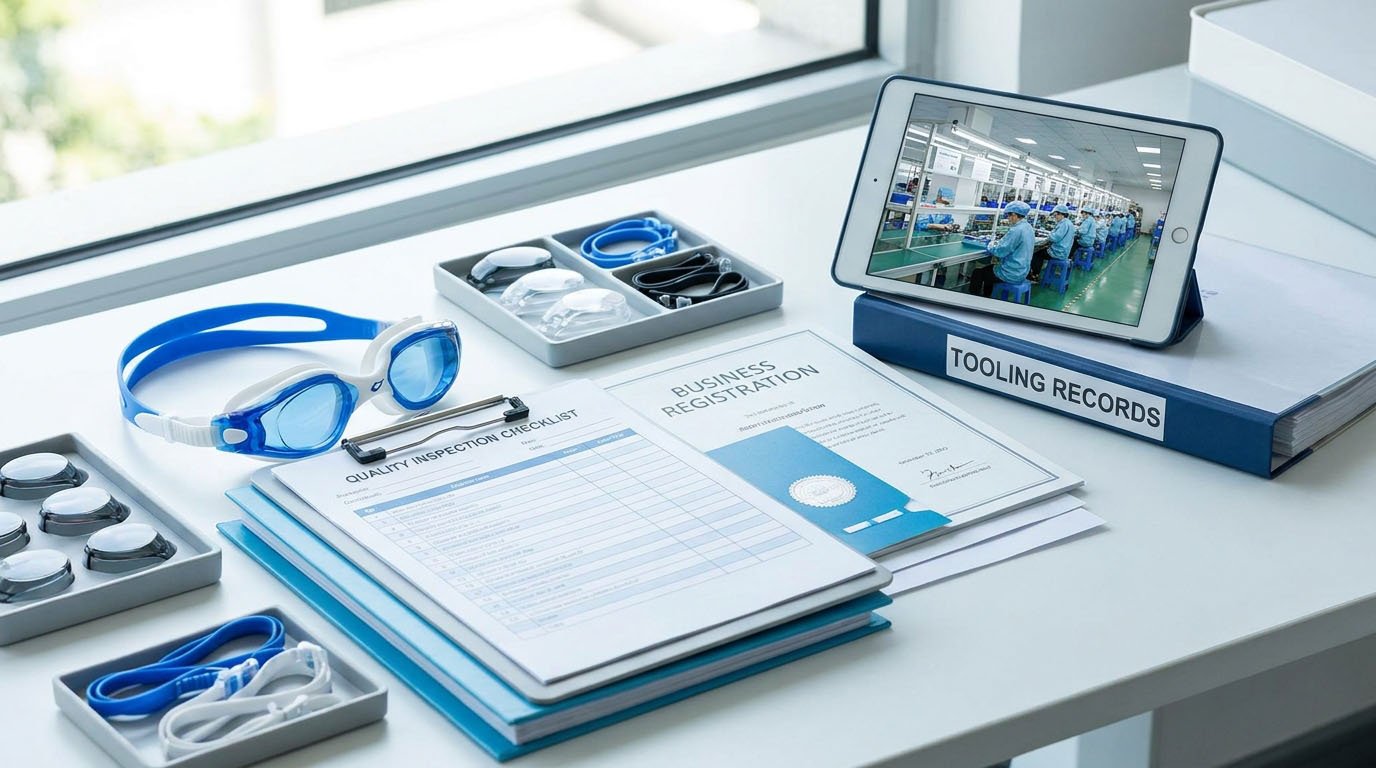
Supplier Verification Matrix
| What to Verify | Evidence to Request | What It Clarifies |
|---|---|---|
| Contracting entity | Business registration and quotation details | Who is selling the products |
| Manufacturing facility | Factory name, address, and relevant production evidence | Where the goggles are made |
| Production responsibilities | List of in-house and outsourced processes | Who performs critical work |
| Tooling control | Tooling agreement and relevant asset records | Who owns or controls molds |
| Quality responsibilities | Inspection plan and sample QC documentation | Who checks product quality |
| Technical communication | Access to responsible engineers or technical contacts | How product changes are handled |
| After-sales responsibility | Written claim and corrective-action terms | Who handles production problems |
Focus on Transparency, Not Just Factory Ownership
Some genuine manufacturers outsource particular production stages.
For example, a factory may produce frames and perform assembly while purchasing specific coated lenses or silicone components from qualified suppliers.
Outsourcing itself is not necessarily a problem.
The issue is whether the supplier can demonstrate:
- Which activities are outsourced.
- Who approves suppliers and specifications.
- How incoming components are inspected.
- How nonconforming parts are handled.
- How approved production configurations are maintained.
Avoid treating a factory photograph or a single video call as definitive proof.
When deeper verification is necessary, Jerry’s Remote Swimming Goggle Factory Audit Checklist explains how to assess factory identity, production controls, traceability, and supporting evidence.
For this initial comparison, you mainly need enough evidence to establish who performs and controls the manufacturing work.
Key 6: What Should You Confirm Before Signing a Supply Agreement?
Once you have identified the right type of partner, the remaining decision is about commercial accountability.
A direct manufacturer and a trading company can both be reliable partners when expectations and responsibilities are clearly defined.
Confirm These Six Agreement Areas
| Agreement Area | What to Clarify |
|---|---|
| Product specification | Approved model, materials, lens treatment, colors, and packaging |
| Manufacturing responsibility | Actual factory, critical subcontractors, and change approval |
| Mold arrangements | Ownership, maintenance, access, and permitted use |
| Quality acceptance | Approved samples, inspection criteria, and defect handling |
| Delivery | Production schedule, shipping terms, and responsibility for delays |
| After-sales claims | Evidence requirements, remedies, and responsible contracting party |
Pay Special Attention to Mold Ownership
Using a manufacturer’s tooling department does not automatically mean the manufacturer owns every mold.
A brand may own custom tooling while the factory stores, maintains, and operates it.
The agreement should distinguish:
- Legal mold ownership
- Physical custody and maintenance
- Rights to use the mold
- Access or transfer arrangements
- Responsibilities if tooling requires repair or replacement
These arrangements matter particularly when a brand plans to develop exclusive swimming goggle designs.
Define Quality Responsibility Clearly
Your agreement should identify who approves the final product specification and what happens if bulk goods do not match the approved reference.
For example, clarify whether the supplying company will arrange corrective action directly or coordinate it with another factory.
A documented quality-management process is more useful than a general promise that products will be defect-free.
Jerry’s Quality Assurance overview explains the role of incoming material checks, production monitoring, functional testing, and final inspection.
Also confirm which party is responsible for applicable product documentation and legal obligations in your destination market. These responsibilities cannot always be determined solely from the supplier’s company type.
Make Your Final Choice
Before committing to a partner, ask yourself three questions:
- Capability: Can this company deliver the specific swimming goggles my brand requires?
- Control: Can it demonstrate sufficient control over development, quality, and manufacturing changes?
- Commercial fit: Does its total cost, MOQ, service model, and accountability match my purchasing program?
If you have already decided to work directly with a factory, our Swimming Goggles Manufacturer Selection Guide provides a more detailed evaluation of production capability, quality, tooling, and lead times.
FAQ: Manufacturer vs Supplier vs Trading Company
Is a Swimming Goggle Supplier the Same as a Manufacturer?
Not necessarily.
A supplier is the company providing products under a commercial agreement. It may be a direct manufacturer, trading company, or hybrid business.
Ask which entity manufactures the goggles and which company is responsible for fulfilling your order.
Can a Trading Company Supply High-Quality Swimming Goggles?
Yes.
An experienced trading company can source high-quality products from capable manufacturers, provided it maintains effective supplier controls, quality inspections, and clear technical communication.
Product quality should be evaluated through evidence rather than company type alone.
Is Buying Swimming Goggles Factory-Direct Always Better?
No.
Direct purchasing can improve technical communication and may reduce certain intermediary costs. However, trading companies can provide useful sourcing flexibility and coordination.
The best approach depends on product complexity, order quantity, and required services.
Can a Genuine Swimming Goggle Manufacturer Outsource Production?
Yes.
Manufacturers may outsource selected components or specialized processes while retaining responsibility for production control and finished-product quality.
Buyers should verify outsourcing transparency, supplier management, and inspection arrangements.
Should New Swimming Goggle Brands Choose a Manufacturer or Trading Company?
For a small private-label launch, either may work.
A manufacturer can provide direct product access and production communication. A trading company may offer more options for mixed products or consolidated orders.
Brands planning technically complex custom designs may benefit more from direct engineering relationships.
Conclusion: Choose Capabilities, Not Company Labels
Choosing between a swimming goggle manufacturer, supplier, and trading company is ultimately about matching the sourcing structure to your business needs.
A direct manufacturer is often attractive for technically complex development, custom tooling, and repeat production. A trading company may be valuable for mixed-product sourcing, purchasing coordination, and flexible commercial services.
A supplier can be either.
Before making your decision, verify the actual manufacturing responsibilities, compare total procurement costs, and define quality and commercial accountability.
At Jerry Goggles, we support private label, OEM, and ODM swimming goggle projects through product development, manufacturing, customization, and quality control.
If you are planning a new swimming goggle collection, contact Jerry Goggles with your product requirements, expected quantity, and customization goals to discuss a suitable manufacturing approach.