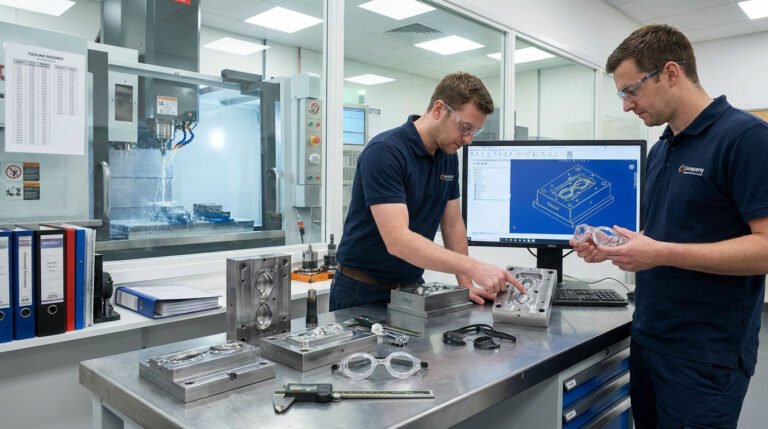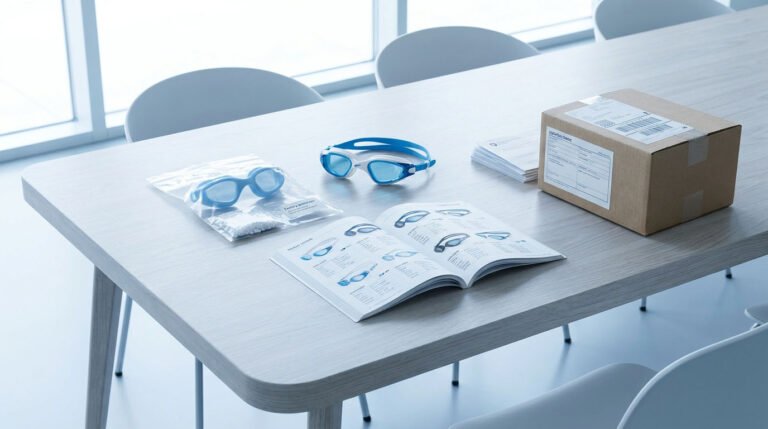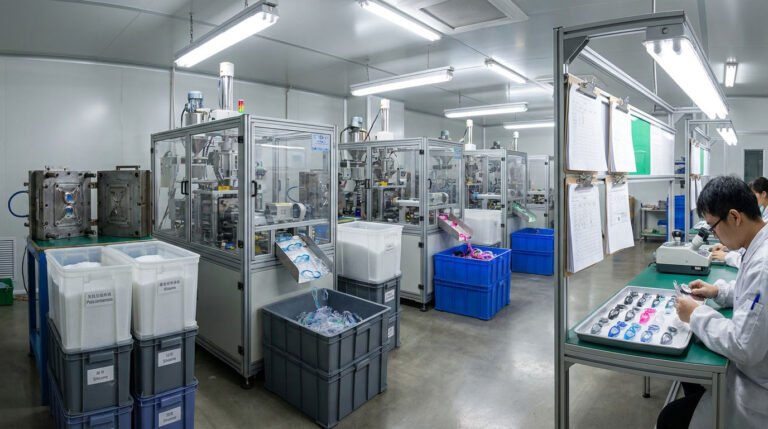
Choosing a swimming goggles manufacturer is more than comparing unit prices. For swimming brands, importers, distributors, and private label businesses, the right manufacturing partner must deliver consistent product quality, suitable customization, reliable lead times, and competitive long-term costs.
A successful development sample does not guarantee reliable mass production. Inconsistent anti-fog coatings, leaking gaskets, weak adjustment components, and unclear tooling arrangements can affect product launches and customer satisfaction.
The best swimming goggles manufacturer is the one that can consistently reproduce your approved product specifications at a cost, quality level, and production scale that fit your business.
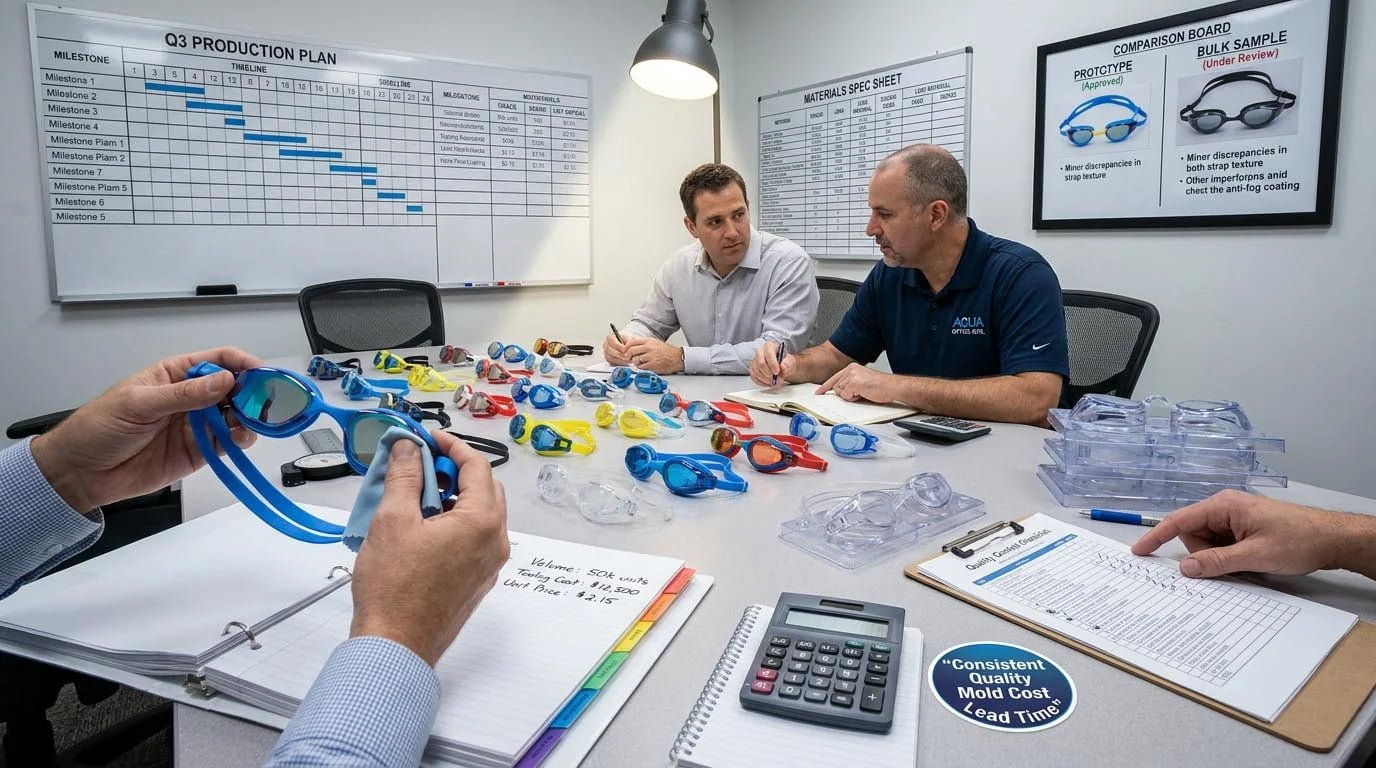
This guide explains how to compare swimming goggle manufacturers using nine practical evaluation steps, covering production capability, materials, quality control, MOQ, tooling, lead times, and supplier selection.
Quick Answer: How Do You Choose a Swimming Goggles Manufacturer?
Evaluate manufacturers based on six essential criteria:
| Evaluation Area | Key Question |
|---|---|
| Product expertise | Can the factory manufacture goggles for your target swimmers? |
| Manufacturing capability | Does it control the critical production processes? |
| Materials and quality | Can it deliver consistent lens, gasket, strap, and anti-fog performance? |
| Testing and compliance | Can it provide relevant product-specific evidence? |
| MOQ, tooling, and lead time | Do its commercial requirements fit your project? |
| Production consistency | Can it reproduce approved samples across bulk and repeat orders? |
For startups, existing swimming goggle models with logo customization are often a practical starting point. Established brands may require proprietary molds, specialized materials, or deeper engineering support.
Before choosing a manufacturer, compare representative samples, written quotations, production capabilities, and quality records.
Most importantly, select a manufacturer based on verifiable performance rather than factory size, attractive pricing, or sales promises alone.
Step 1: Define Your Swimming Goggle Requirements Before Contacting Manufacturers
Before evaluating factories, define what you intend to manufacture and who will use the product.
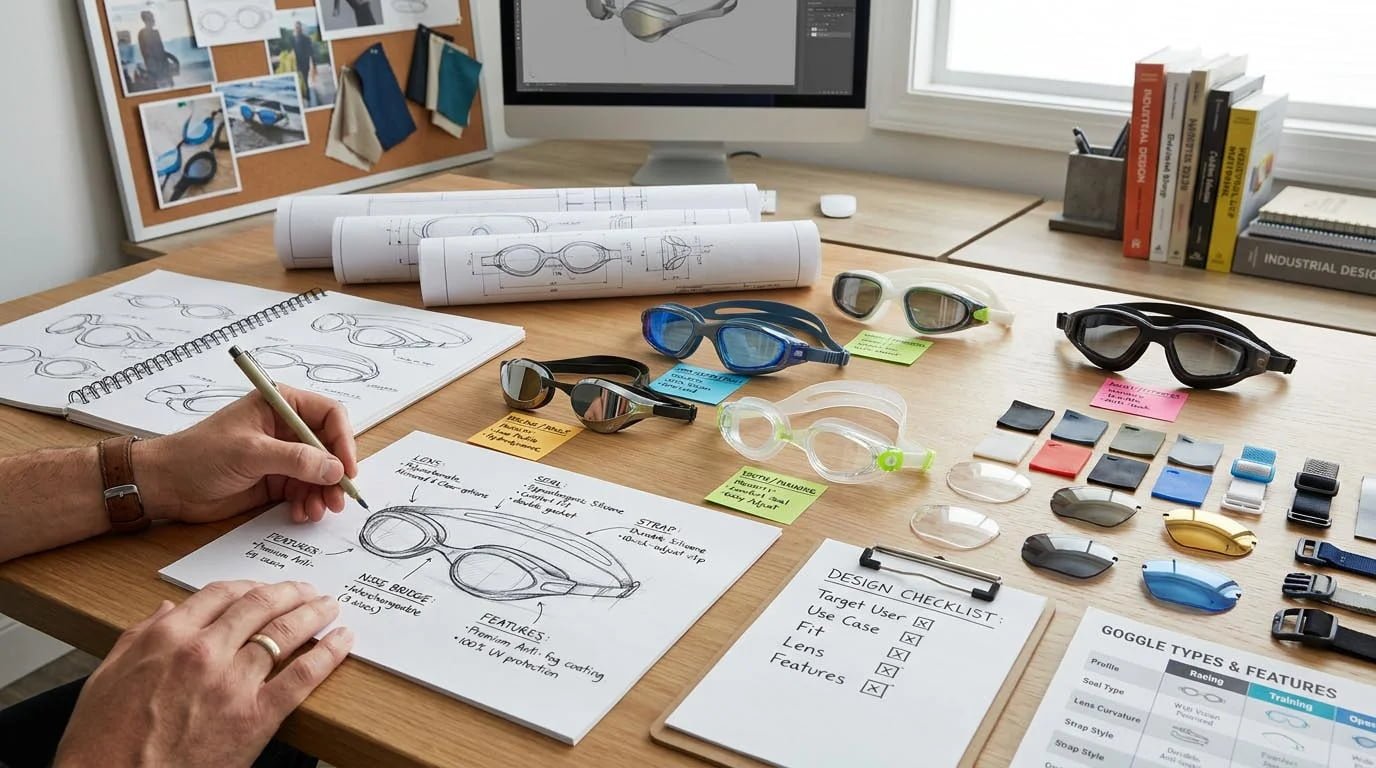
Different swimming goggle designs require different technical capabilities. A manufacturer specializing in racing goggles may approach fit, lens geometry, and sealing differently from a factory focused on recreational or children’s goggles.
Identify Your Target Swimming Goggle Category
| Swimming Goggle Type | Main Product Priorities |
|---|---|
| Racing goggles | Low-profile design, secure fit, reduced drag |
| Training goggles | Comfort, sealing stability, adjustment durability |
| Recreational goggles | Comfortable fit, ease of use, accessible pricing |
| Open-water goggles | Wider field of vision, appropriate lens tint, UV protection |
| Youth goggles | Suitable facial geometry, comfortable seals, adjustable fit |
A manufacturer should understand the intended use rather than recommend the same design for every customer.
Prepare a Product Specification Brief
Provide potential manufacturers with:
- Product type: Racing, training, recreational, or youth goggles
- Lens requirements: Clear, smoke, mirrored, polarized, or other suitable options
- Materials: Lens, frame, gasket, and strap preferences
- Performance: Anti-fog, UV protection, sealing, and durability requirements
- Fit: Nose bridge, gasket geometry, and strap adjustment
- Customization: Logo, colors, packaging, or new structural components
- Commercial requirements: Expected quantity, target price, and destination market
For custom projects, include reference images, drawings, or available technical specifications.
A detailed initial brief helps suppliers determine whether existing molds are suitable or new tooling is necessary.
Buyer tip: Separate essential performance requirements from optional cosmetic features. Unnecessary customization can increase development costs and MOQ without improving the swimming experience.
Step 2: Evaluate the Manufacturer’s Actual Production Capability
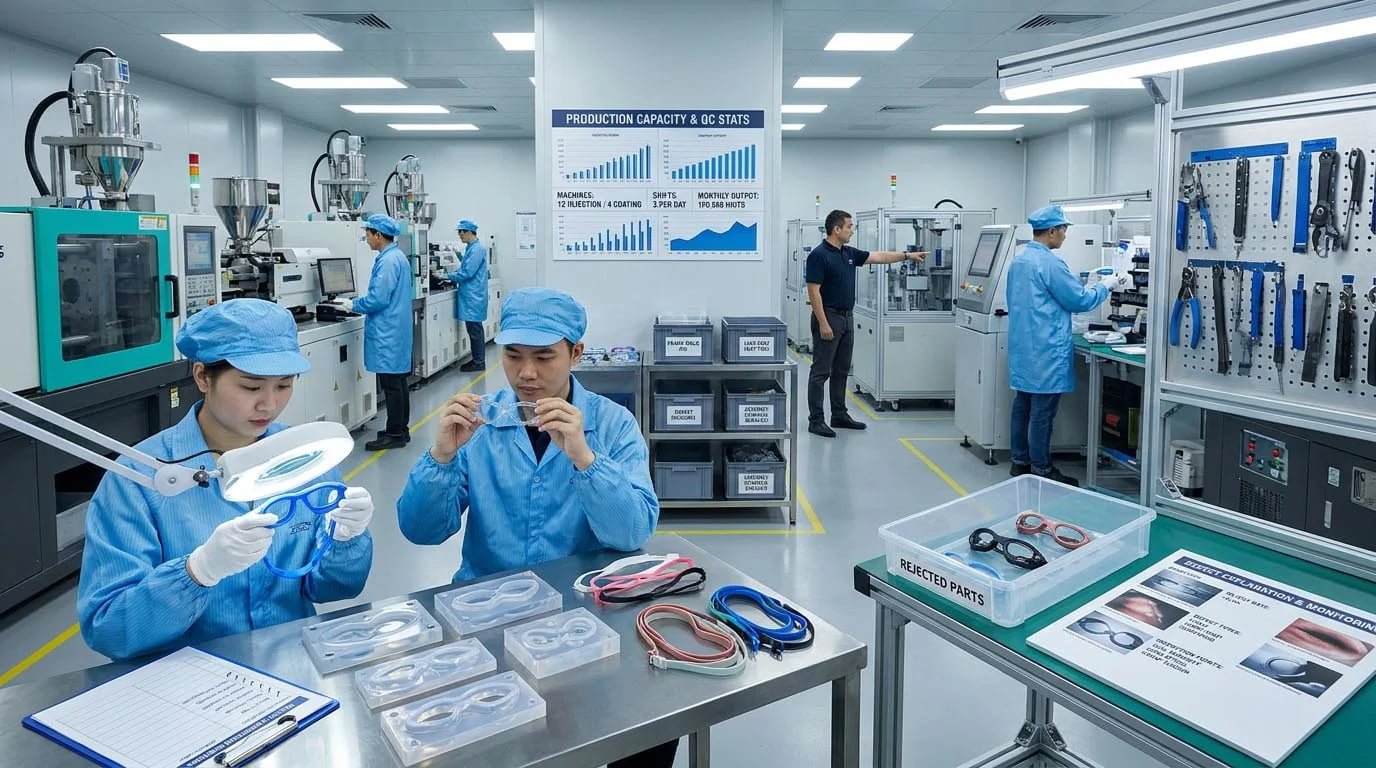
Not every swimming goggle manufacturer controls the same production processes.
Some factories perform molding, silicone processing, coating, assembly, and inspection internally. Others source selected components from specialized partners.
Outsourcing is not automatically a weakness. The important issue is whether the manufacturer can demonstrate reliable control over specifications, suppliers, production changes, and finished-product quality.
Understand the Supplier’s Manufacturing Role
A direct manufacturer performs manufacturing operations, although it may outsource certain components. A trading company typically coordinates production through independent factories.
The distinction matters because technical communication and manufacturing responsibilities may differ.
If you are still comparing sourcing structures, read our Manufacturer vs Supplier vs Trading Company for Swimming Goggles guide.
Once you have identified a potential manufacturer, focus on its actual production capabilities.
Check Critical Swimming Goggle Manufacturing Processes
| Production Process | What Buyers Should Verify |
|---|---|
| Lens and frame molding | Dimensional consistency, optical defects, component precision |
| Silicone or TPE processing | Gasket uniformity, material consistency, sealing performance |
| Lens coating | Optical clarity, coating adhesion, anti-fog process control |
| Strap and buckle production | Connection strength and adjustment reliability |
| Assembly | Component alignment, secure connections, workmanship |
| Quality inspection | Incoming materials, in-process checks, final testing |
Ask whether these processes are performed internally or by approved subcontractors.
For outsourced components, the manufacturer should explain how suppliers are qualified, specifications are controlled, and incoming materials are inspected.
Evaluate Production Capacity and Engineering Support
A large production facility does not automatically make a manufacturer the right partner.
Ask about:
- Experience manufacturing your intended goggle category
- Available equipment and production scheduling
- Prototype development and engineering support
- Experience with comparable order quantities
- Capacity for repeat orders and seasonal demand
- Procedures for engineering changes and defect correction
A factory making millions of standard recreational goggles may not be the best choice for a technically demanding custom racing design.
Inside Jerry’s Manufacturing Operations
Jerry’s published manufacturing information describes an integrated facility in Dongguan, China, supporting product development, mold making, injection molding, silicone processing, assembly, and quality inspection.
Its OEM/ODM overview reports an approximately 8,668 m² facility with 56 production machines.
These capabilities support both existing-model customization and more complex product development.
For buyers, the advantage is not factory size alone, but the ability to coordinate engineering, component specifications, production, and quality requirements throughout the project.
You can learn more about Jerry’s OEM & ODM swimming goggle manufacturing capabilities.
Verify Manufacturing Claims
Request suitable evidence of the factory’s production capabilities, such as process records, production walkthroughs, representative samples, and quality documentation.
For a more detailed identity and capability verification process, consult our Guide to Verifying a Swimming Goggle Factory in China.
The purpose at this stage is to determine whether the manufacturer’s capabilities match your project—not to repeat a complete factory audit.
Step 3: Check Swimming Goggle Materials and Component Quality
Swimming goggle performance depends on how lenses, frames, gaskets, straps, and adjustment components work together.
Even high-quality materials can produce poor results when product geometry, assembly, or manufacturing controls are inadequate.
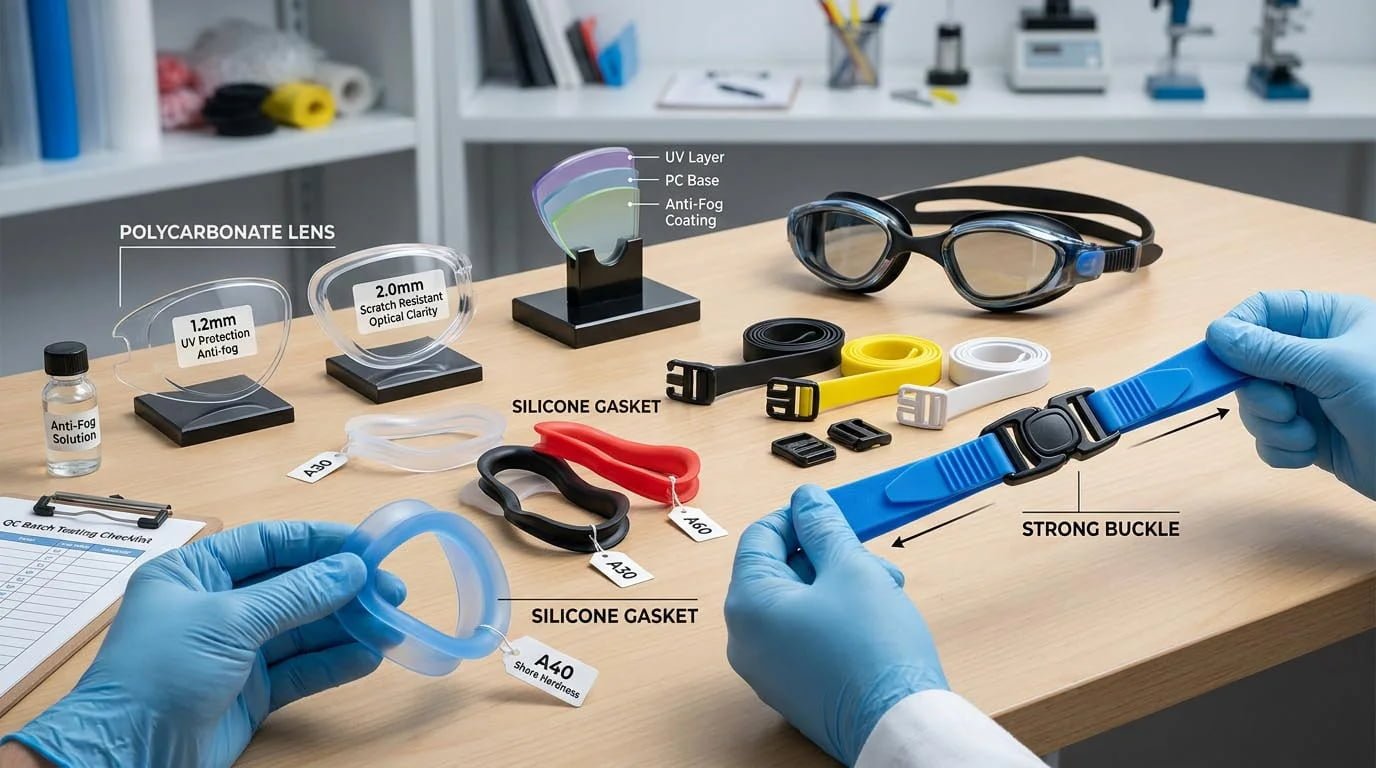
Swimming Goggle Material Evaluation Checklist
| Component | Common Materials | What to Evaluate |
|---|---|---|
| Lens | Polycarbonate (PC) | Optical clarity, impact performance, coating quality |
| Gasket | Silicone, TPE | Softness, rebound, sealing, comfort |
| Strap | Silicone, elastomers | Elasticity, tear resistance, durability |
| Frame | PC, PP, TPU, nylon, or suitable polymers | Strength, flexibility, dimensional stability |
| Buckle | Nylon, PP, engineering plastics | Connection strength, adjustment reliability |
| Nose bridge | Design-dependent plastics or elastomers | Fit, flexibility, secure attachment |
Material selection should reflect the actual product design and intended market.
Evaluate Lens and Coating Quality
Polycarbonate is widely used in swimming goggle lenses because appropriately designed and processed PC offers useful optical and impact-performance characteristics.
When evaluating samples, inspect:
- Optical clarity and visible distortion
- Scratches, molding marks, and surface defects
- Lens tint and mirrored coating consistency
- Anti-fog treatment performance
- UV protection evidence where applicable
A manufacturer should be able to identify the materials, coatings, and inspection requirements used for your approved configuration.
Evaluate Gaskets and Fit
Silicone is frequently used in swimming goggle gaskets because suitable formulations provide flexibility, elastic recovery, and comfort.
TPE can also perform effectively when properly specified and processed.
However, material type alone does not determine whether swimming goggles will leak.
Gasket geometry, facial fit, material hardness, assembly, and strap tension all influence sealing performance.
Ask the manufacturer how gasket designs are evaluated and whether material specifications remain consistent between sampling and production.
Check Strap, Buckle, and Anti-Fog Durability
Straps and buckles should maintain secure adjustment under the intended conditions of use.
Inspect connection points, elasticity, adjustment movement, and signs of premature wear.
For anti-fog performance, request evidence that the manufacturer controls relevant application processes and evaluates durability using agreed methods.
A sample that performs well initially may not reflect repeated-use performance or batch-to-batch consistency.
The key purchasing question is whether the manufacturer can maintain agreed product performance—not whether it claims to use a particular premium material.
Step 4: Verify Product Testing, Certifications, and Quality Control
A reliable swimming goggle manufacturer should demonstrate both effective quality management and relevant product-level testing.
These are different forms of evidence.
A factory audit or quality management certificate does not automatically prove that a specific swimming goggle model satisfies its intended performance or market requirements.
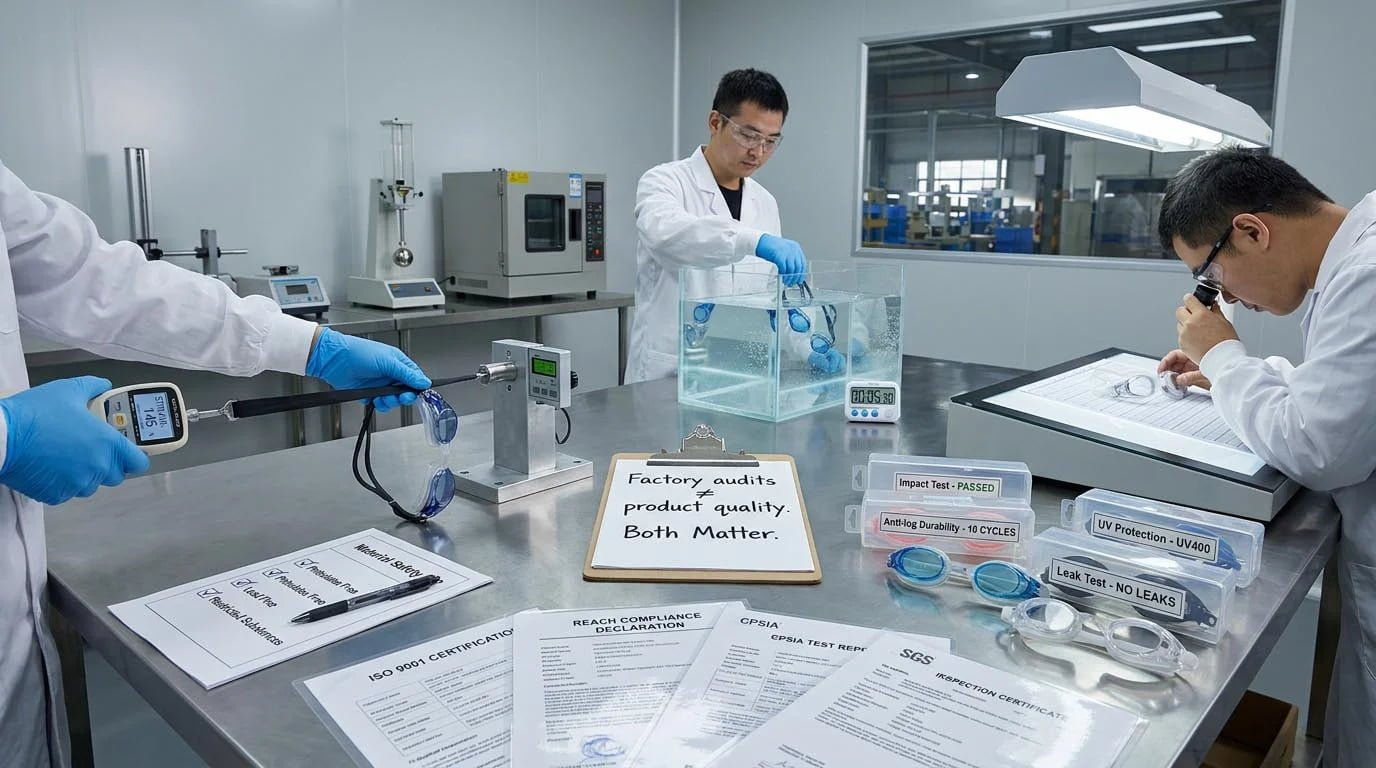
Understand Key Standards and Compliance Documents
| Standard or Document | Purpose | Buyer Consideration |
|---|---|---|
| ISO 9001 | Quality management system | Check certificate validity and scope |
| ISO 18527-3 | Requirements and testing for surface-swimming eyewear | Confirm applicable edition, amendment, and product scope |
| EU PPE / CE requirements | Applicable EU product conformity obligations | Verify classification, assessment, and documentation |
| EU REACH | Chemical substance obligations | Review relevant material and component evidence |
| US CPSIA | Children’s product safety obligations where applicable | Determine relevant rules, testing, and certification |
| BSCI / SMETA | Social responsibility assessment frameworks | Not substitutes for product testing |
| Third-party test reports | Evidence of tested product performance | Check model, method, results, and report relevance |
For surface-swimming eyewear, ISO 18527-3:2020 and its 2025 amendment are important technical references.
Compliance requirements depend on the actual product, intended use, age group, destination market, and applicable legislation.
REACH and CPSIA are regulatory frameworks, not generic product safety certificates. Social compliance assessments also do not establish optical, mechanical, or anti-fog performance.
What Product Tests Should Buyers Evaluate?
Depending on the model and applicable requirements, relevant testing may include:
- Optical quality and lens transmission
- Mechanical and impact-related performance
- Strap and buckle strength
- Water sealing and fit-related performance
- Anti-fog performance and durability
- UV protection where claimed
- Restricted substances and material safety
- Coating and printing durability
Not every test applies to every product.
The manufacturer should explain which tests are required, which are additional buyer specifications, and how results are documented.
Verify Product-Specific Test Evidence
Before accepting a test report, confirm that it:
- Identifies the relevant swimming goggle model.
- States the applicable test method and version.
- Represents the materials and construction you intend to order.
- Shows clear test results and acceptance criteria.
- Comes from a suitable testing facility.
- Remains relevant after any material or design changes.
An attractive test report has limited value if it describes a different model or outdated product configuration.
Check Golden Sample and Bulk Production Consistency
An approved development sample establishes the target product specification.
Before bulk production, confirm the golden sample or approved production reference covering lens tint, coatings, gasket properties, strap construction, branding, packaging, and acceptance criteria.
A practical quality control sequence is:
Approved Sample → Incoming Material Inspection → First Production Check → In-Process QC → Final Inspection → Shipment Approval
Each stage should help identify differences between the approved product and actual production.
Ask the manufacturer how it records deviations, investigates defects, implements corrective actions, and determines whether affected goods can be released.
Jerry’s Quality Assurance process provides further information about production inspections and quality management.
Buyer tip: Strong quality documentation should connect a particular product configuration with its applicable test evidence and production records.
Step 5: Compare MOQ, Tooling Costs, and Production Lead Times
Minimum order quantity, tooling requirements, and production schedules directly affect project feasibility.
However, these factors must be compared against the same product specification and customization level.
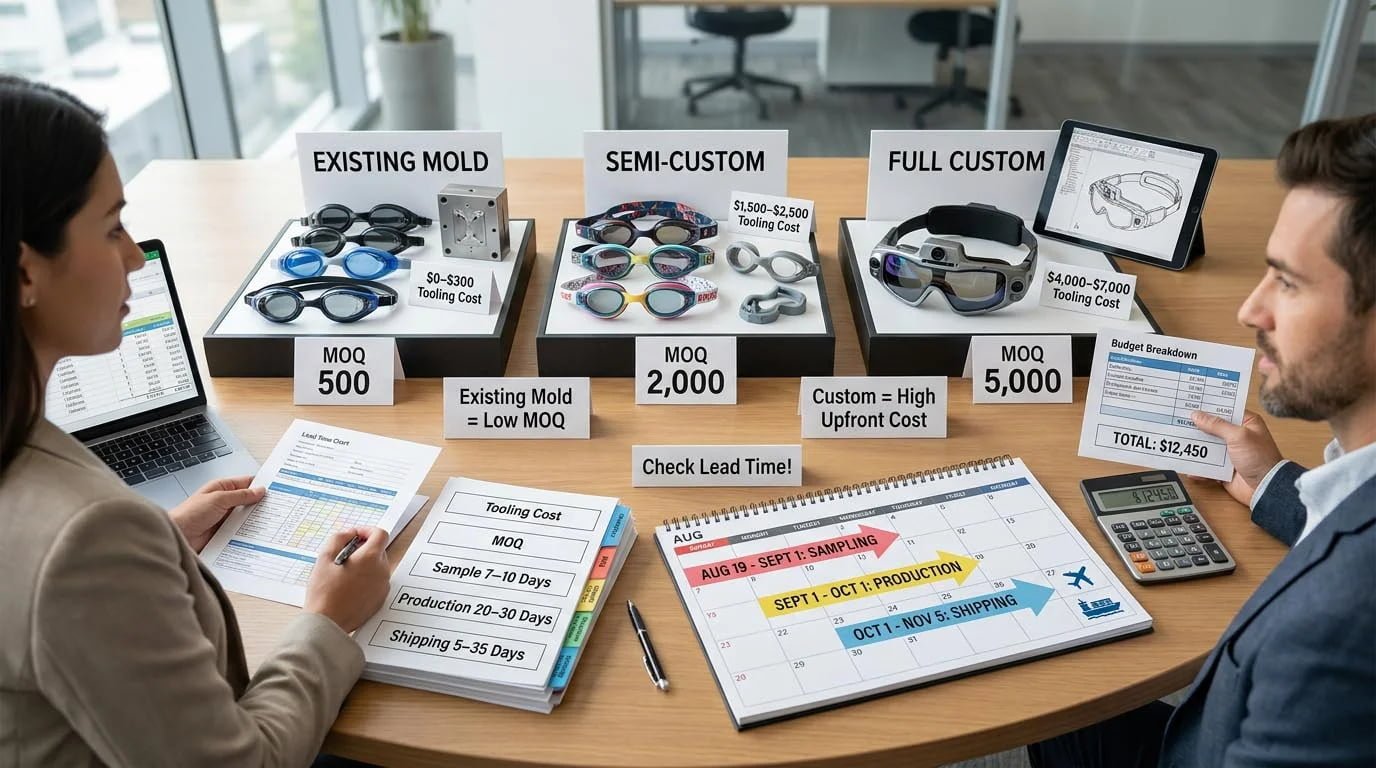
Compare MOQ by Customization Type
Jerry’s minimum order quantities depend on the selected model and customization requirements.
| Customization Route | Jerry MOQ Reference | Main Consideration |
|---|---|---|
| Existing model + logo | From 300 pcs | Eligible models and standard available components |
| Existing model + custom color | From 600 pcs | Color preparation and production requirements |
| Deeper OEM/ODM customization | Project-based | Changes to components, materials, or structure |
| Full new-mold development | Project-based | Tooling, engineering, and production configuration |
These are starting references rather than universal minimums. MOQ may apply per model, per color, or per configuration.
For example, a 300-piece logo order does not necessarily qualify for several custom colors, specialized lenses, and fully customized packaging at the same quantity.
Confirm the exact configuration with the factory before accepting a quotation.
Our Swimming Goggle MOQ Guide explains how customization requirements influence minimum quantities.
Existing Molds vs Custom Tooling
Existing molds are generally appropriate when a brand wants to:
- Reduce initial development costs
- Launch products using proven structures
- Test market demand
- Customize branding, colors, or packaging
- Avoid unnecessary engineering work
Custom tooling becomes more relevant when a project requires a proprietary frame shape, lens geometry, gasket structure, or adjustment mechanism.
A new swimming goggle design may require several molds rather than a single tool.
Before approving tooling investment, ask which components require new molds, what engineering and trial work is included, and how mold ownership will be documented.
Tooling cost and production MOQ should be evaluated as separate decisions.
For a detailed breakdown of mold development and ownership, see the Swimming Goggle Mold Cost Guide.
Compare Realistic Sampling and Production Lead Times
Lead times depend on artwork approval, material availability, tooling complexity, sampling revisions, production capacity, and testing.
| Project Stage | Planning Reference |
|---|---|
| Simple existing-model samples | Approximately 5–7 days where materials and specifications are ready |
| Samples requiring additional preparation | Confirm according to customization and material availability |
| New mold development | Approximately 35–50 days, depending on project complexity |
| Tooling trials and sample revisions | Additional time as required |
| Bulk production after approval | Approximately 20–30 days for suitable projects |
| Shipping | Depends on destination and logistics arrangements |
These are indicative planning references, not guaranteed commitments for every project.
For custom developments, the overall schedule must include engineering approval, tooling, sample evaluation, possible modifications, testing, production, and delivery.
Ask for a Milestone-Based Production Plan
Instead of accepting a single promised delivery date, request milestones covering:
- Design and specification approval
- Tooling completion, where applicable
- Sample production and revision approval
- Material preparation
- Bulk production
- Final inspection
- Shipment
This makes delays easier to identify and helps both parties understand which decisions must be completed before the next stage can begin.
Step 6: Compare Manufacturer Quotations on the Same Basis
A lower quoted unit price does not necessarily indicate a better manufacturing offer.
Two manufacturers may use different materials, coatings, packaging, inspection arrangements, or shipping terms.
Compare quotations only after confirming that they cover equivalent specifications.
Swimming Goggle Manufacturer Quotation Checklist
| Quotation Item | What to Confirm |
|---|---|
| Unit price | Exact model, materials, lens treatments, and components |
| MOQ | Minimum per model, color, or configuration |
| Tooling | Included molds, ownership, trial and revision terms |
| Sampling | Sample charges and approval requirements |
| Branding | Logo methods and setup costs |
| Packaging | Materials, printing, and any separate minimums |
| Testing | Included and additional test expenses |
| Quality | Inspection criteria and defect resolution |
| Delivery | Production schedule, Incoterms, and freight responsibilities |
| Payment | Deposit, balance, and relevant commercial terms |
Compare Total Project Cost
Where applicable, a simplified calculation is:
Total Project Cost = Product Cost + Tooling + Packaging + Testing + Inspection + Freight + Applicable Import Costs
Include only costs not already covered elsewhere in the quotation.
You should also consider the commercial impact of excess inventory, delayed launches, rework, and product claims.
For example, an apparently cheaper offer may require purchasing more units than your brand can reasonably sell during the first launch period.
A different manufacturer may offer a higher unit price but a more suitable quantity, clearer inspection arrangements, or better technical support.
The best quotation clearly identifies what is included, what is excluded, and who is responsible when problems occur.
Step 7: Use a Swimming Goggles Manufacturer Evaluation Scorecard
After reviewing production capabilities, testing evidence, samples, and commercial terms, compare your shortlisted manufacturers systematically.
A weighted scorecard helps you assess different suppliers against the same criteria rather than relying on subjective impressions.
This scorecard is for selecting among manufacturers that have already passed basic identity, capability, and mandatory compliance checks. It does not replace factory verification or product testing.
Manufacturer Selection Scorecard
| Evaluation Area | Suggested Weight | Evidence to Review |
|---|---|---|
| Product quality and testing | 25% | Samples, relevant tests, QC records |
| Manufacturing capability | 20% | Equipment, production control, capacity |
| Materials and compliance evidence | 20% | Specifications, traceability, documentation |
| MOQ, pricing, and lead time | 15% | Quotations and production plans |
| Communication and development support | 10% | Technical responses and sampling support |
| Repeat-order consistency | 10% | Batch records and corrective actions |
| Total | 100% |
These weights are illustrative. Adjust them according to your product category and business priorities.
For example, a technically complex racing goggle program may place greater emphasis on engineering capabilities, while an existing-model private label program may prioritize quality consistency and commercial flexibility.
How to Calculate the Score
Rate each manufacturer from 1 to 5:
| Rating | Interpretation |
|---|---|
| 1 | Major concerns or insufficient evidence |
| 2 | Several significant limitations |
| 3 | Acceptable capability with some limitations |
| 4 | Strong capability supported by evidence |
| 5 | Excellent capability with consistent documentation |
Calculate the weighted result using:
Category Score = (Supplier Rating ÷ 5) × Category Weight
Add the category scores to obtain a total score out of 100.
For example, a manufacturer scoring 4 out of 5 for product quality receives:
(4 ÷ 5) × 25 = 20 points
Apply the same method to the remaining categories.
How to Interpret the Results
A higher score suggests a stronger overall fit based on the selected criteria, but it should not automatically determine the final decision.
Consider whether any weaknesses involve:
- Mandatory safety or regulatory requirements
- Essential technical capabilities
- Unacceptable quality risks
- Unrealistic production commitments
- Unclear tooling or commercial responsibilities
Mandatory legal and safety requirements should be evaluated as pass/fail conditions.
A manufacturer cannot compensate for critical compliance failures simply by offering a lower price or receiving a higher score elsewhere.
The scorecard should support your purchasing decision, not replace professional judgment or required verification.
Step 8: Ask the Right Questions Before Placing an Order
Before selecting your manufacturer, ask each shortlisted supplier the same questions and compare the supporting evidence.
Eight Essential Manufacturer Selection Questions
-
Manufacturing capability: Which critical processes are performed in-house, and how are outsourced operations controlled?
-
Materials: What lens, gasket, frame, and strap materials will be used for our approved model?
-
Quality control: How will you maintain consistency between the approved sample and bulk production?
-
Testing: Which product-specific test reports and inspection records can you provide?
-
Customization: What changes can be made using existing molds, and which require new tooling?
-
MOQ and pricing: What minimum quantities apply per model, color, and configuration, and what costs are included?
-
Lead times: What are the realistic milestones for sampling, tooling, mass production, and shipment?
-
Problem resolution: How will you handle failed inspections, defective goods, or production delays?
A capable manufacturer should answer these questions clearly, acknowledge limitations, and provide relevant documentation where appropriate.
Do not assume that a confident answer is equivalent to verified capability.
Step 9: Identify Red Flags Before Committing to a Manufacturer
Several warning signs may indicate elevated sourcing risk.
Key Manufacturing and Commercial Red Flags
- Unclear production responsibilities: The supplier cannot explain where critical components are manufactured.
- Inconsistent specifications: Sample materials, quotations, and technical requirements do not match.
- Weak testing evidence: Product performance claims lack relevant documentation.
- Vague tooling terms: Mold ownership, scope, revisions, or usage rights are unclear.
- Poor quality transparency: The supplier cannot explain inspection procedures or corrective actions.
- Unrealistic commitments: Prices or delivery schedules appear unusually favorable without supporting production plans.
A single concern may have a reasonable explanation. However, several unresolved issues should prompt additional verification before committing funds.
For high-value tooling or substantial production orders, consider independent inspections or factory audits where appropriate.
The goal is not to eliminate every sourcing risk, but to identify important uncertainties before they become production problems.
FAQ: Choosing a Swimming Goggles Manufacturer
How Do I Know Whether a Swimming Goggles Manufacturer Is Reliable?
Evaluate its manufacturing experience, production capabilities, representative samples, product-specific testing evidence, and quality management procedures.
Compare actual records and performance against your requirements rather than relying solely on company presentations or certifications.
What Is the MOQ for Custom Swimming Goggles?
MOQ depends on the model and customization level.
At Jerry, eligible existing-model logo projects can start from approximately 300 pieces, while suitable custom-color projects can start from approximately 600 pieces.
Deeper OEM/ODM customization and new-mold development are quoted according to project requirements.
Is Silicone Better Than TPE for Swimming Goggle Gaskets?
Not necessarily.
Both materials can provide suitable performance when properly specified and processed.
Gasket geometry, material hardness, comfort, sealing performance, and durability should determine the selection.
What Certifications Should a Swimming Goggle Manufacturer Have?
Buyers should distinguish manufacturing quality management, relevant product testing, social responsibility assessments, and destination-market conformity requirements.
The applicable documentation depends on the swimming goggle model, its intended use, and the target market.
No single factory certificate guarantees that every product meets all regulatory or performance requirements.
Is OEM or ODM Better for a New Swimming Goggle Brand?
Using an existing ODM design or private label model can reduce initial development costs and help brands test market demand.
More extensive OEM development is appropriate when a brand requires proprietary features, detailed technical specifications, or custom product structures.
The decision depends on budget, product differentiation, and projected demand.
What Matters More: Sample Quality or Production Consistency?
Both are essential.
The approved sample defines the required product, while production controls, inspections, and records help ensure that the same quality is maintained during bulk manufacturing and repeat orders.
A strong initial sample alone is not sufficient evidence of manufacturing reliability.
Should I Visit a Swimming Goggle Factory Before Ordering?
A factory visit may be particularly valuable for large orders, custom tooling, or long-term manufacturing partnerships.
If an on-site visit is impractical, live production walkthroughs, independent audits, representative samples, and relevant production records can provide additional evidence.
Conclusion: Choose a Manufacturer That Can Deliver Consistent Quality
Choosing the right swimming goggles manufacturer requires a balanced assessment of manufacturing capability, materials, product testing, quality consistency, MOQ, tooling, lead times, and commercial accountability.
The strongest manufacturing partner is not necessarily the one offering the lowest initial price. It is the one capable of repeatedly delivering your approved product specifications at a sustainable cost.
Before committing to a manufacturer, define your product requirements, verify critical capabilities, compare samples and quotations, and use a consistent evaluation scorecard.
Make sure quality responsibilities, production milestones, tooling arrangements, and after-sales procedures are clearly documented.
At Jerry Goggles, we support swimming brands, importers, distributors, and private label businesses with OEM/ODM development, product customization, sampling, manufacturing, and quality management.
If you are planning a new swimming goggle collection or evaluating a long-term manufacturing partner, contact Jerry Goggles with your product specifications, target market, expected quantity, and customization requirements to discuss suitable production options.