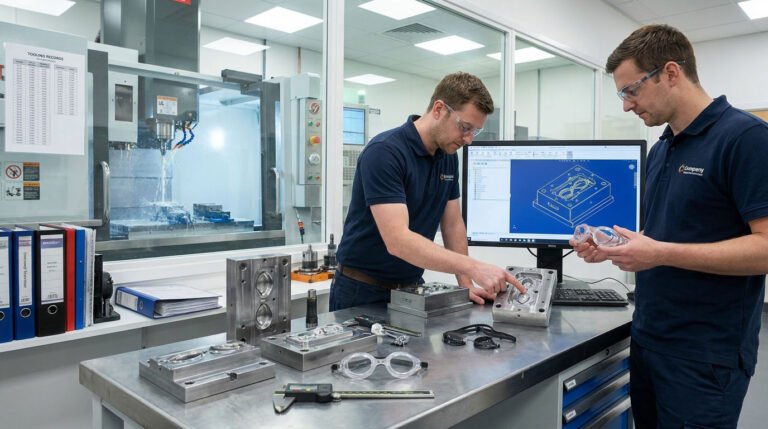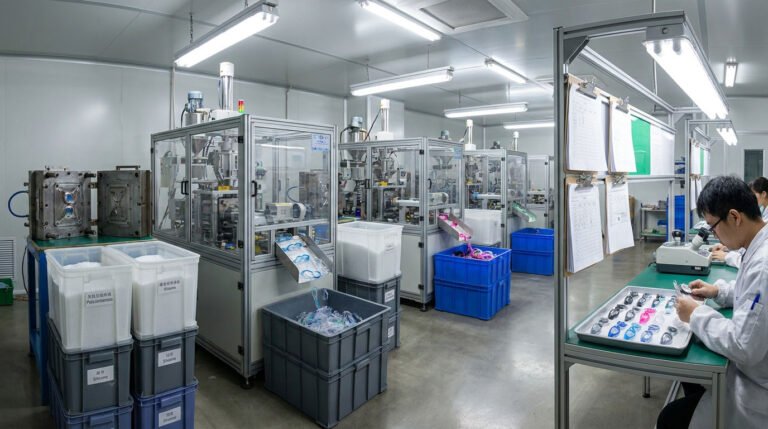
Finding a swimming goggle supplier in China is relatively easy. Verifying whether that supplier can consistently manufacture reliable products at scale is much harder.
A professional website, impressive factory photos, and a perfect sample do not necessarily prove manufacturing capability. The real challenge is confirming whether the factory can maintain anti-fog performance, watertight sealing, optical quality, and material consistency throughout mass production.
To verify a swimming goggle factory in China, buyers should follow seven steps:
- Verify the business license and legal identity.
- Confirm manufacturing capabilities and outsourcing arrangements.
- Conduct a live or on-site factory audit.
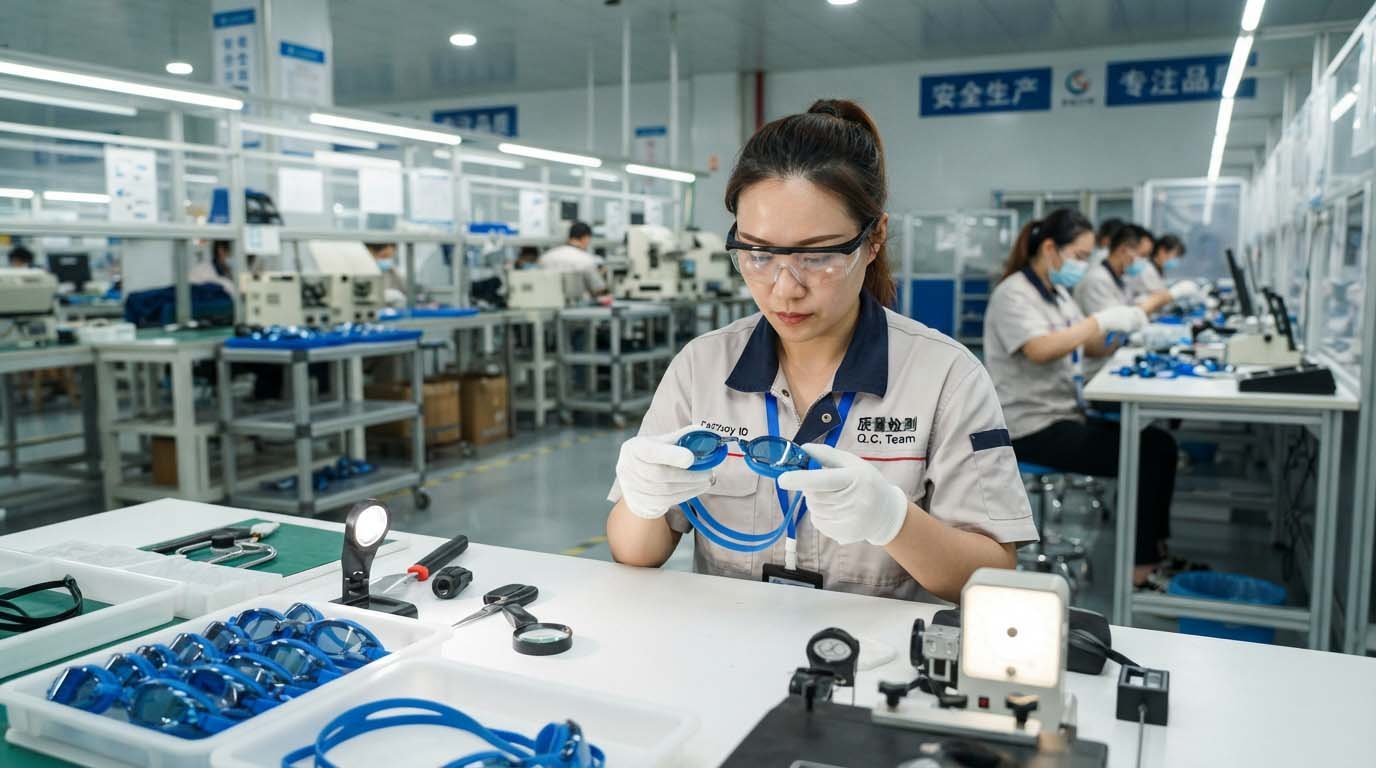
- Evaluate swimming goggle quality control and testing.
- Approve golden samples and technical specifications.
- Validate production consistency through pilot orders.
- Identify supplier red flags before paying a deposit.
This guide provides a practical factory verification framework for importers, OEM buyers, private-label brands, and procurement teams.
Quick Answer: Swimming Goggle Factory Verification Checklist
Before selecting a manufacturer, evaluate the following areas:
| Verification Area | What Buyers Should Check |
|---|---|
| Legal identity | Business license, registration, company details |
| Manufacturing | Equipment, production processes, outsourcing |
| Factory operations | Live video, workers, production records |
| Product quality | Anti-fog, sealing, lens and strap testing |
| Sampling | Golden sample and approved specifications |
| Production | Pilot batch, consistency, change control |
| Shipment | Inspection records, AQL and quality criteria |
Key principle: One successful sample proves that a design can be manufactured. It does not prove that thousands of units can be produced consistently.
For new suppliers or high-value orders, combining remote verification with independent on-site inspection provides stronger evidence than relying on supplier claims alone.
Step 1: Verify the Factory’s Business License and Legal Identity
The first step is confirming that the supplier is legally registered and identifying which company will manufacture your products.
Check the Chinese Business License
Request the supplier’s official Chinese business license and verify:
- Registered company name
- Unified Social Credit Code (USCC)
- Registered address
- Legal representative
- Business scope
- Registration status
Buyers can cross-check company information through China’s National Enterprise Credit Information Publicity System (GSXT).
A manufacturing-related business scope is useful, but registration alone does not prove that the supplier operates the claimed factory.
Match Company, Contract, and Payment Details
Check whether the business license, sales contract, proforma invoice, and bank beneficiary identify the same company or clearly disclosed affiliated entities.
Some Chinese manufacturers use separate export companies. This is not automatically a problem, provided the commercial relationship is transparent.
| Document | What to Verify |
|---|---|
| Business license | Legal company identity |
| Sales contract | Responsible contracting entity |
| Bank details | Authorized payment beneficiary |
| Factory address | Actual manufacturing location |
| Export documents | Exporting entity and shipment history |
Red flag: An unexplained request to transfer money to a personal account or unrelated company.
Validate Certifications and Audit Reports
Request relevant management-system certificates, social audit documentation, and product test reports.
Verify each document according to its purpose:
- ISO certificates: Check the issuer, scope, validity, and covered company.
- amfori BSCI audits: Verify the audited facility, audit date, and relevant findings through authorized records.
- Product test reports: Confirm the tested model, laboratory, applicable standard, and report details.
ISO management-system certification and amfori BSCI social auditing serve different purposes. Neither automatically proves swimming goggle product compliance.
A valid test report should also match the actual swimming goggle model, materials, and intended product claims. Buyers need to review the test scope, methods, results, and acceptance criteria rather than relying only on a “Pass” conclusion. For a detailed review process, see our guide to reading a swimming goggle test report.
Step 2: Confirm Real Manufacturing Capabilities
A supplier with a large product catalog is not necessarily the manufacturer of every product it sells.
Some suppliers operate integrated factories. Others use subcontractors for tooling, molding, anti-fog treatment, or assembly.
The important question is who controls the manufacturing process and product quality.
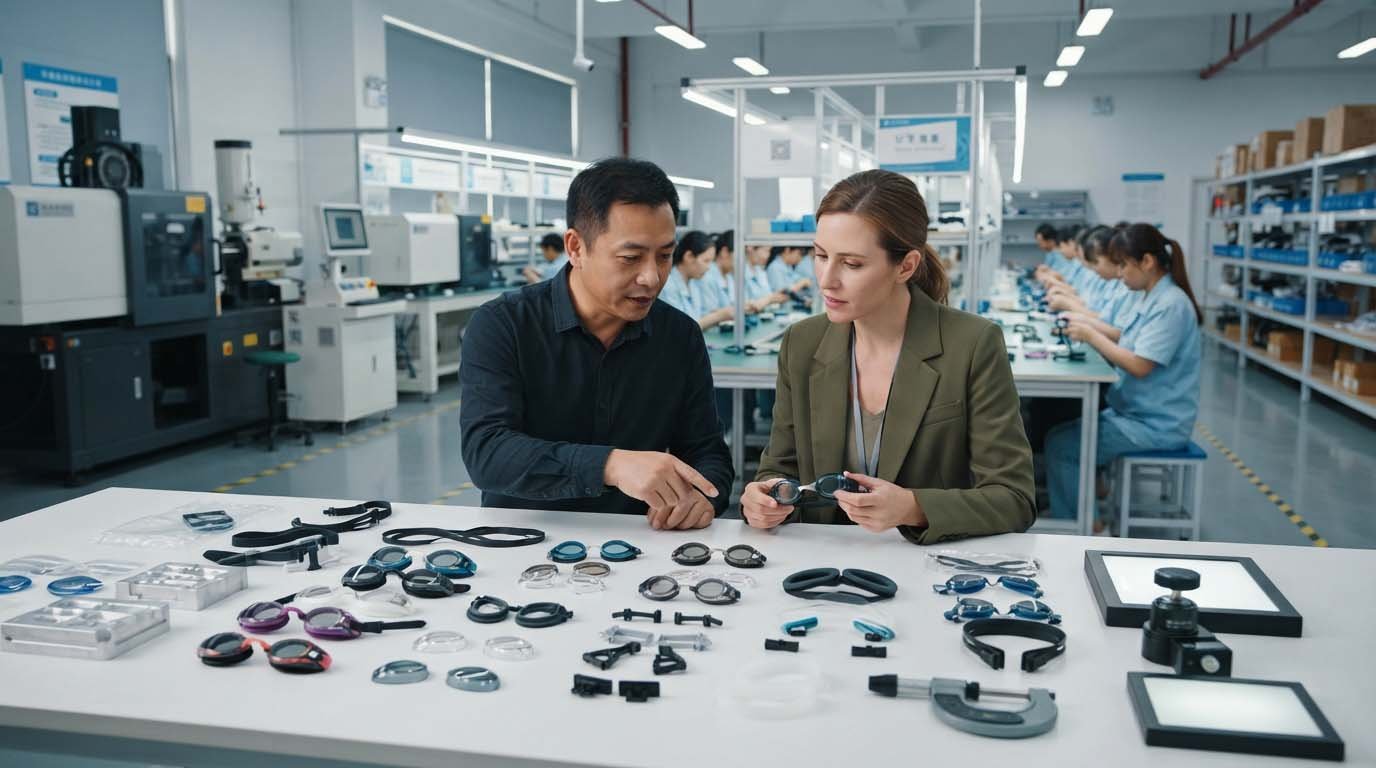
Factory vs. Trading Company: What Is the Difference?
| Evaluation Area | Manufacturer | Trading Company |
|---|---|---|
| Production equipment | Operates relevant manufacturing processes | Relies mainly on partner factories |
| Engineering | May offer direct technical support | Depends on supplier network |
| Production visibility | Usually more direct | Requires partner-factory access |
| Quality control | Manages factory-level processes | Coordinates or outsources inspections |
| Customization | Depends on factory capabilities | Depends on manufacturing partners |
A trading company is not automatically unreliable, and a direct factory is not automatically qualified.
The objective is to verify the manufacturing location, responsible parties, and quality controls.
Factory verification is only one part of choosing the right manufacturing partner. Buyers should also compare product expertise, MOQ, tooling costs, quality requirements, and lead times. See our guide to choosing a swimming goggles manufacturer for the complete supplier selection framework.
Which Swimming Goggle Processes Should You Investigate?
Swimming goggles combine rigid lenses, flexible sealing components, straps, and functional coatings.
Buyers should map the relevant production processes.
| Production Process | Evidence to Request |
|---|---|
| Mold development | Tooling records, maintenance procedures |
| Lens molding | Equipment, material specifications |
| Silicone processing | Material records, molding controls |
| Anti-fog treatment | Application process, testing records |
| Assembly | Production lines, work instructions |
| Final inspection | QC records, defect handling |
A manufacturer may legitimately outsource specialized processes. What matters is whether subcontractors are qualified, monitored, and subject to appropriate quality and change controls.
Ask three questions:
- Which processes are performed in-house?
- Which processes are outsourced?
- Who is responsible when a subcontracted component fails inspection?
For custom designs, these responsibilities should be established before production.
Learn how Jerry supports product engineering, tooling, and manufacturing through our Swimming Goggle OEM & ODM services.
Step 3: Conduct a Live Factory Audit or On-Site Inspection
Factory photos and promotional videos offer limited evidence because they may not reflect current operations.
A structured live video walkthrough can help buyers verify that manufacturing activities are taking place.
For higher-risk projects, an independent on-site audit provides additional assurance.
What Should You Inspect During a Factory Audit?
Follow the production sequence:
Raw Materials → Molding → Component Processing → Anti-Fog Treatment → Assembly → Testing → Packaging
During the walkthrough, verify:
- Active production equipment
- Workers performing relevant operations
- Raw material and component identification
- Work-in-progress tracking
- Quality inspection stations
- Production and testing records
Ask the supplier to explain how defects are detected and handled rather than simply demonstrating machines.
How Can You Check Production Capacity?
Do not rely solely on an advertised monthly or annual capacity figure.
Request supporting information such as:
- Number of relevant machines
- Production shifts and staffing
- Historical production output
- Current production commitments
- Assembly and packaging capacity
- Bottleneck processes
For example, a factory may have sufficient lens-molding capacity but limited anti-fog processing or assembly output.
Buyer tip: Ask the factory to explain its realistic production capacity and lead time for your specific swimming goggle model.
Step 4: Evaluate Swimming Goggle Quality Control and Testing
Quality control is one of the most important differences between a supplier that produces attractive samples and a factory capable of stable mass production.
Swimming goggles must perform consistently across several functional areas.
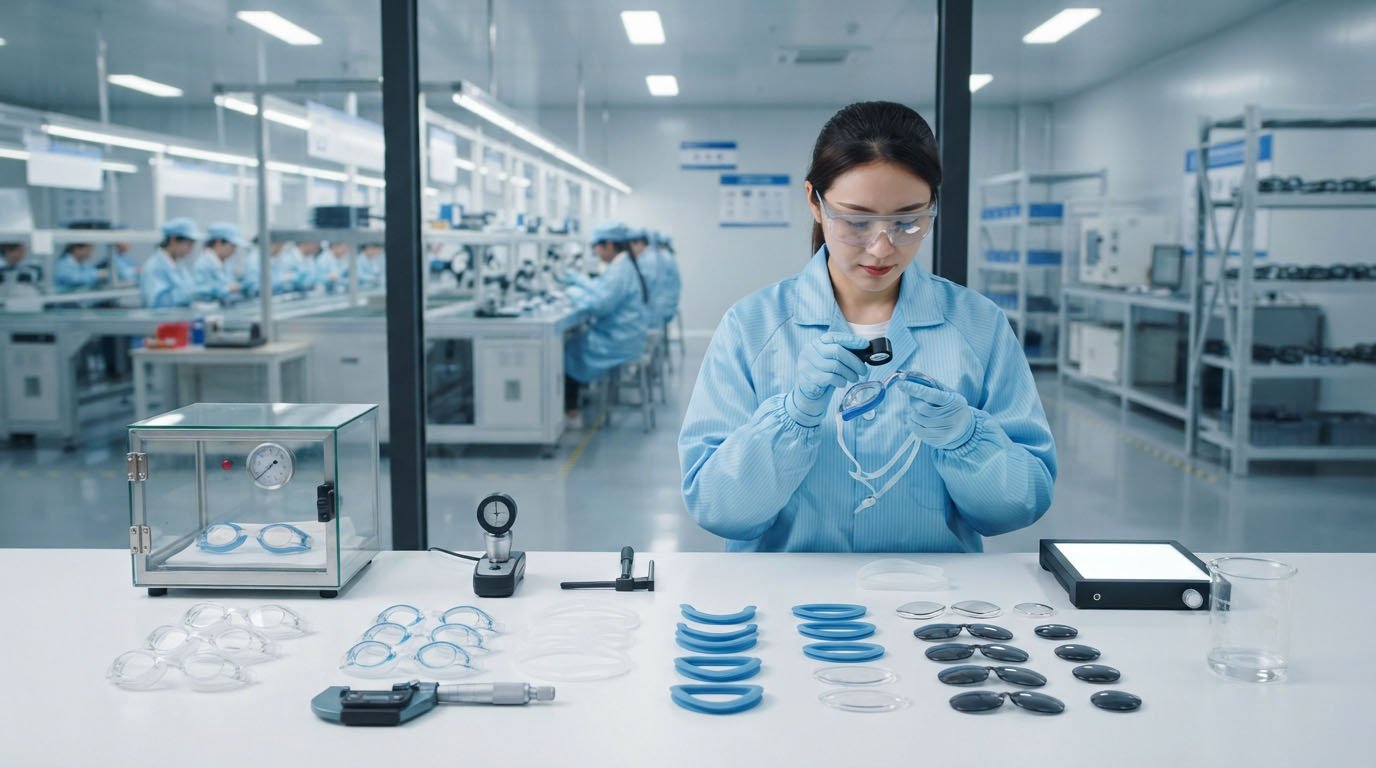
What Quality Tests Should Buyers Verify?
| Quality Area | What to Check |
|---|---|
| Anti-fog | Performance, treatment consistency, durability |
| Watertight sealing | Gasket fit, material properties, leakage evaluation |
| Optical quality | Clarity, distortion, surface defects |
| Straps and buckles | Strength, adjustment, durability |
| Materials | Approved resin and silicone specifications |
| Coatings | Appearance and durability where applicable |
| Assembly | Component fit, alignment, workmanship |
| Packaging | Correct labeling, quantity, carton condition |
Test methods and acceptance criteria should reflect the product design, intended market, and agreed specifications.
Anti-Fog Testing: Verify Consistency, Not Just One Demonstration
A sample that passes a basic fogging demonstration may still perform poorly after repeated use or inconsistent coating application.
Ask the factory:
- How is the anti-fog treatment applied?
- How are contamination and process conditions controlled?
- Which test method is used?
- Is anti-fog durability evaluated?
- Are results recorded across production batches?
A steam demonstration can be a preliminary check, but it is not sufficient evidence of long-term durability.
Representative samples, documented test conditions, and agreed acceptance criteria provide stronger verification.
Watertight Sealing, Lens Quality, and Strap Durability
Sealing performance depends on gasket geometry, material properties, assembly accuracy, and facial fit.
Buyers should also examine:
- Lens scratches or optical distortion
- Silicone material consistency
- Strap strength and adjustment reliability
- Buckle performance after repeated use
- Component alignment during assembly
Testing should use representative production samples rather than only display pieces.
Can the Factory Trace Defects to Production Batches?
A reliable quality system should allow the manufacturer to investigate defects using production records.
Ask the factory to select a finished swimming goggle and demonstrate how it traces the product to relevant material lots, production batches, inspection results, and process records.
For example, if anti-fog performance fails after shipment, the factory should be able to identify affected batches and investigate coating materials, processing conditions, and inspection history.
Effective batch traceability helps manufacturers investigate defects, implement corrective actions, and improve repeat-order consistency.
Which Swimming Goggle Standards Are Relevant?
For surface swimming eyewear, ISO 18527-3:2020, together with its 2025 amendment, provides relevant requirements and test methods covering materials, construction, optical properties, and product information.
Buyers should confirm the applicable standard edition, amendments, and destination-market requirements.
A test report should correspond to the actual product configuration or an appropriately justified representative model.
For additional information about Jerry’s inspection procedures, see our Quality Assurance page.
Step 5: Approve Golden Samples and Technical Specifications
A perfect-looking sample does not guarantee reliable mass production.
Before bulk manufacturing, buyers should approve both a reference sample and the technical specifications that define acceptable production.
What Is a Golden Sample?
A golden sample is an approved reference product used to compare future manufacturing output.
For swimming goggles, the approval file should identify:
- Lens material, color, and optical requirements
- Silicone material and relevant properties
- Strap and buckle specifications
- Anti-fog performance requirements
- Logo placement and appearance
- Packaging and labeling
- Agreed quality acceptance criteria
Buyer and manufacturer should maintain controlled reference samples or equivalent documented approval records.
Why Does Change Control Matter?
Once a sample is approved, the manufacturer should not make material or process changes without appropriate review.
Potential changes include:
- Different silicone or lens materials
- Mold modifications
- Anti-fog coating adjustments
- Replacement straps or buckles
- Changes in critical component suppliers
Depending on the change, additional testing or sample approval may be required.
A structured Sampling & Prototyping process helps establish approved specifications before mass production.
Step 6: Validate Production Through a Pilot Order and Inspection
After document verification, factory auditing, and sample approval, the next challenge is demonstrating repeatability.
A pilot batch or controlled initial production run helps identify issues that may not appear during sample development.
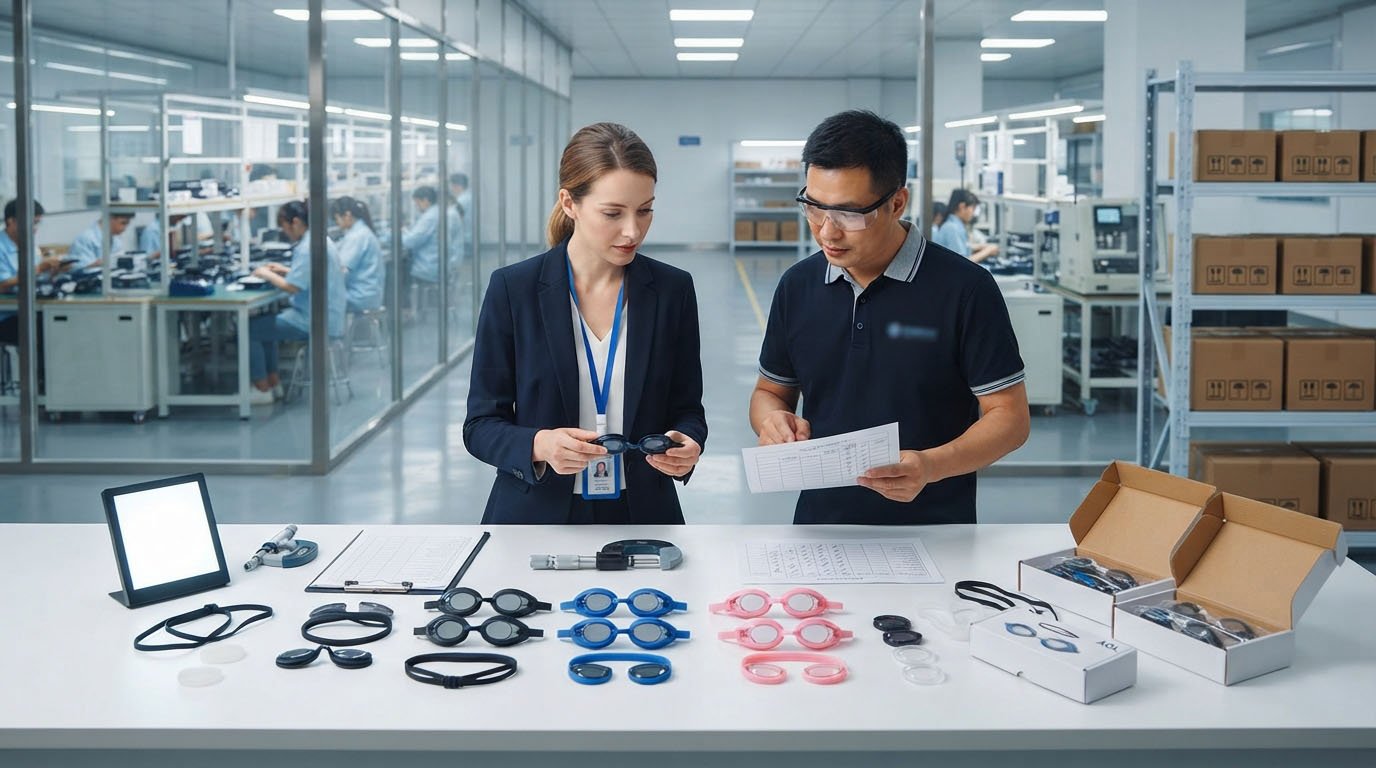
What Should a Pilot Order Confirm?
Evaluate whether production units consistently match the approved specifications.
Review:
- Golden sample consistency
- Anti-fog and sealing test results
- Component and material traceability
- Assembly defects and rework records
- Packaging accuracy
- Corrective actions for identified problems
The appropriate pilot quantity depends on the product, MOQ, process complexity, and buyer risk.
A pilot run may be a separate small order or a controlled stage within the first bulk order.
When Should You Arrange Third-Party Inspection?
Independent inspection is especially useful when working with a new supplier, developing a new mold, or placing a high-value order.
A pre-shipment inspection (PSI) should follow an agreed inspection plan covering product characteristics, defect classifications, sample selection, and acceptance criteria.
Sampling plans may reference ISO 2859-1, which provides AQL-indexed procedures for inspection by attributes. Buyers should confirm the applicable edition.
Important: AQL is a sampling acceptance framework, not a guarantee that every unit in an accepted shipment is defect-free.
Buyers should agree on inspection requirements before production rather than selecting defect limits only after goods are completed.
Step 7: Identify Red Flags Before Paying a Deposit
Supplier verification should uncover potential problems before they become expensive production disputes.
Common warning signs include:
| Red Flag | Recommended Action |
|---|---|
| Inconsistent company information | Request supporting documents |
| Refusal of meaningful factory verification | Arrange independent inspection |
| Unclear manufacturing locations | Confirm the actual production facility |
| Undisclosed subcontracting | Request process and supplier details |
| Invalid or unverifiable certificates | Confirm with the issuer |
| Missing quality records | Request testing and inspection evidence |
| Pressure for immediate payment | Complete due diligence first |
| Samples inconsistent with specifications | Require correction and reapproval |
A single discrepancy does not necessarily indicate fraud.
For example, registered offices and production facilities may have different addresses, and export operations may involve affiliated companies.
However, repeated contradictions, missing evidence, or refusal to cooperate with reasonable verification requests justify additional caution.
Swimming Goggle Factory Verification Checklist
Use this practical checklist before approving a new manufacturing partner.
Business and Factory Verification
- [ ] Business license and legal entity verified
- [ ] Factory location and manufacturer identity confirmed
- [ ] Contracting and payment entities checked
- [ ] In-house and outsourced processes identified
Manufacturing and Quality Verification
- [ ] Live or on-site factory audit completed
- [ ] Relevant certifications and audit records reviewed
- [ ] Swimming goggle functional testing evidence evaluated
- [ ] Golden sample and specifications approved
Production and Commercial Verification
- [ ] Production change-control responsibilities agreed
- [ ] Pilot or initial production performance reviewed
- [ ] Inspection plan and acceptance criteria established
- [ ] Commercial terms and supplier responsibilities confirmed
For higher-risk orders, record the evidence, responsible person, and corrective action for every unresolved item.
How Should Buyers Score a Swimming Goggle Factory?
A supplier scorecard helps procurement teams compare manufacturers consistently.
The following weighting system is an illustrative buyer evaluation framework, not an official audit standard.
| Evaluation Area | Suggested Weight |
|---|---|
| Legal and business verification | 15% |
| Manufacturing capability | 20% |
| Swimming goggle engineering | 20% |
| Quality control and testing | 25% |
| Sampling and change control | 10% |
| Communication and delivery | 10% |
| Total | 100% |
Assign each area a score from 1 to 5 based on verified evidence.
Weighted Score = (Category Score ÷ 5) × Category Weight
A high overall score should not override critical failures involving legal identity, product safety, or manufacturing transparency.
Frequently Asked Questions
1. Can I Verify a Swimming Goggle Factory Without Visiting China?
Yes. Buyers can review business registration, conduct live video audits, request samples, and arrange independent factory inspections. For complex or high-value projects, an on-site audit provides stronger verification.
2. How Do I Know If a Swimming Goggle Supplier Is a Real Factory?
Check the legal entity, manufacturing address, equipment, workforce, production records, and actual manufacturing responsibilities. Confirm which processes are performed internally and which are outsourced.
3. Is One Approved Sample Enough to Trust a Factory?
No. A sample demonstrates that a product can be manufactured, but it does not prove mass-production consistency. Buyers should also evaluate quality controls, technical specifications, and initial production results.
4. How Can I Verify Swimming Goggle Anti-Fog Quality?
Request documented test methods, representative samples, batch records, and agreed performance criteria. Independent laboratory testing may be appropriate when durability or market-specific compliance requires additional evidence.
5. Should I Pay a Deposit Before Factory Verification?
Complete appropriate supplier due diligence before making significant payments. For custom tooling or OEM development, staged payments can be linked to contractual milestones, sample approval, and clearly defined deliverables.
Conclusion: Verify Production Capability, Not Just Supplier Claims
Verifying a swimming goggle factory in China requires more than reviewing business documents or approving one sample.
A reliable supplier should demonstrate transparent manufacturing operations, documented quality controls, approved technical specifications, and consistent production performance.
Before committing to a substantial order, confirm that the manufacturer can provide:
- Verifiable business and factory information
- Clear control over manufacturing and subcontracting
- Swimming goggle-specific testing and quality records
- Approved samples and controlled specifications
- Evidence of repeatable production quality
- Transparent inspection and communication procedures
At Jerry Goggles, we support international brands, importers, and distributors with swimming goggle product development, manufacturing, and quality management.
If you are evaluating a Chinese swimming goggle manufacturer for an OEM, ODM, or private-label project, contact the Jerry team to discuss your requirements, sampling plans, and available factory verification information.