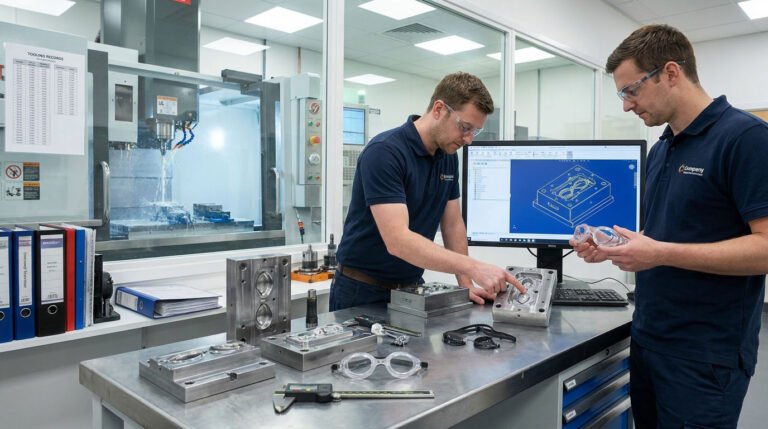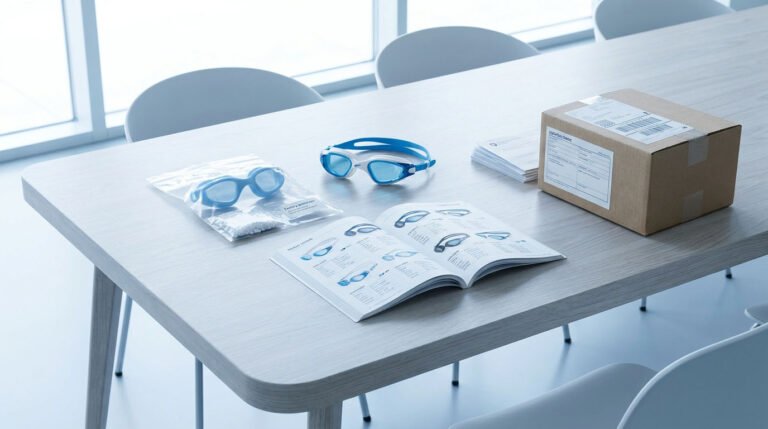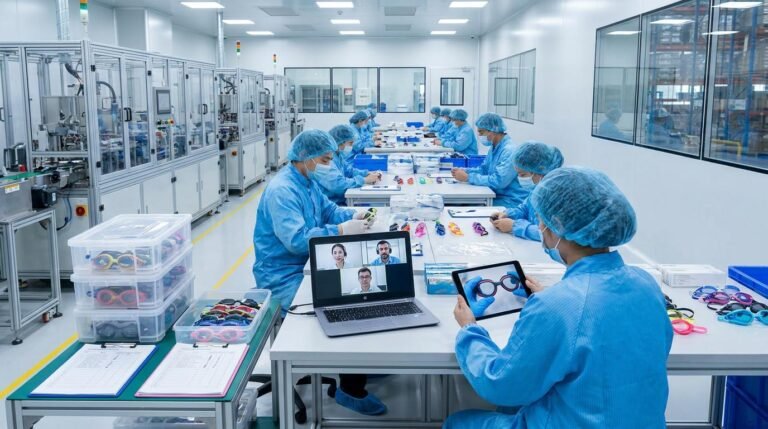
A swimming goggle supplier may claim to have in-house injection molding, but owning injection machines does not prove that your specific goggle components will be produced there.
Some manufacturers mold lenses and frames internally while sourcing silicone gaskets, straps, or other components from specialist suppliers. This is not necessarily a problem. The real concern is whether production responsibilities are transparent and properly controlled.
To verify in-house injection molding, connect five types of evidence: operating machines, matching molds, material records, production work orders, and quality inspection results. Confirm that these records relate to the swimming goggle components you intend to purchase—not simply to unrelated products manufactured at the facility.
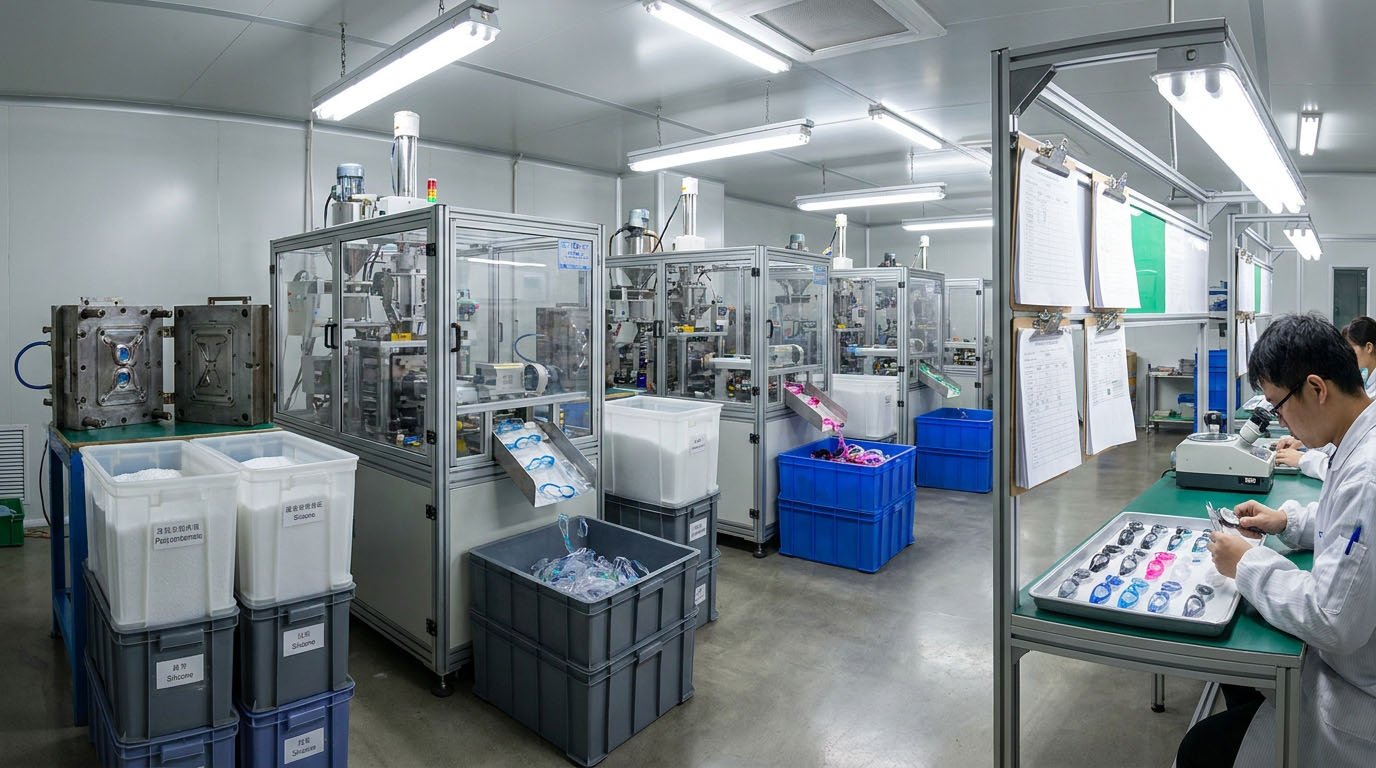
This guide explains six practical verification steps for swimming goggle brands, importers, and OEM/ODM sourcing teams.
Quick Answer: How Do You Verify In-House Injection Molding?
The most reliable approach is to trace an actual molded component from its raw material to its inspection record.
Start with these six checks:
| Verification Area | What Buyers Should Confirm |
|---|---|
| Component production | Which goggle parts are molded at the facility |
| Injection equipment | Machines can physically and technically run the relevant molds |
| Production traceability | Material, work order, mold, and machine records match |
| Available capacity | Suitable equipment and tooling can meet the order schedule |
| Quality control | Molding inspection records demonstrate controlled production |
| Outsourcing transparency | External production stages are identified and managed |
Important: In-house molding means that a facility actually operates and controls the molding process. It does not necessarily mean the factory legally owns every machine or mold. Customer-owned tooling and leased equipment may still be used for genuine in-house production.
No single photograph, machine list, or certificate proves the entire manufacturing arrangement.
Step 1: Identify Which Swimming Goggle Components Are Molded In-House
Before checking the machines, identify what the factory claims to manufacture.
A swimming goggle contains several components, and different materials require different molding technologies.
Check Production Responsibility by Component
| Swimming Goggle Component | Common Materials | What to Verify |
|---|---|---|
| Lens | Polycarbonate (PC) | Lens injection molding and optical inspection capability |
| Frame or eye cup | PC, TPE, or other specified polymers | Suitable molding equipment and tooling |
| Gasket or eye seal | Silicone or TPE | Actual sealing-component production method |
| Nose bridge | TPE, PC, or other plastics | Component mold and production records |
| Buckle or adjustment clip | PP, nylon, or other engineering plastics | Appropriate injection molding capability |
| Strap | Silicone or other elastomers | In-house production or disclosed external sourcing |
Not every silicone component is produced using conventional thermoplastic injection molding. Depending on the design and material, silicone parts may use liquid silicone rubber (LSR) injection molding or other molding processes.
A factory equipped for PC lens injection may not necessarily produce all its silicone components internally.
For a broader explanation of how these parts are manufactured and assembled, see our Swimming Goggles Manufacturing Process Guide.
Ask for a Component Manufacturing Map
Request a simple list showing:
- Components manufactured at the audited factory
- Components produced at other company facilities
- Components purchased from external suppliers
- Processes performed by approved subcontractors
This identifies the production scope before you begin a detailed equipment review.
Buyer takeaway: Verify the molding capability relevant to your product. A working injection department alone does not establish that every component will be manufactured there.
Step 2: Verify Injection Machines and Mold Compatibility
After identifying the relevant components, confirm that suitable molding equipment is actually operating at the factory.
A supplier’s machine inventory may demonstrate available assets, but it does not prove active production or compatibility with your tooling.
Check the Machines During Operation
During an on-site visit or buyer-directed live video inspection, request evidence of:
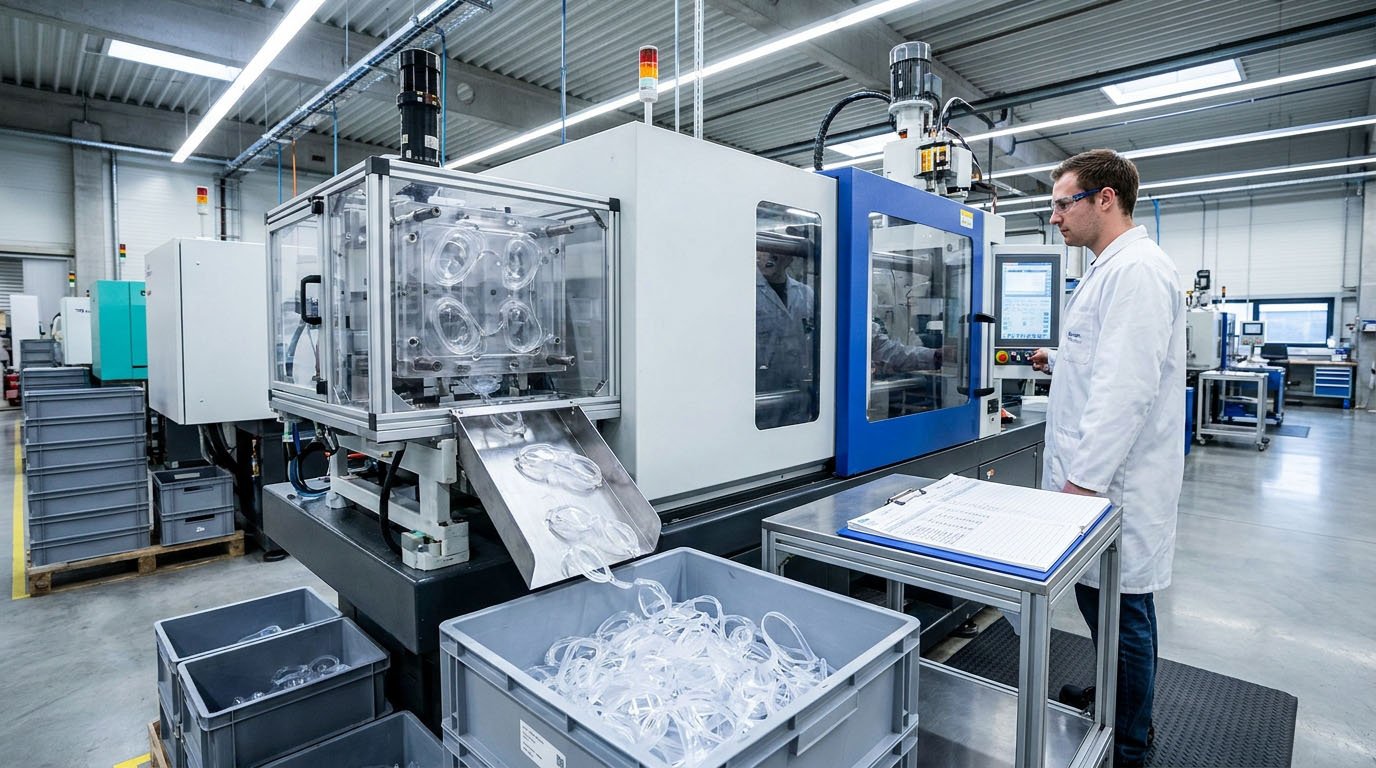
- A clearly identifiable injection molding machine.
- The mold installed on that machine.
- The component being produced.
- The responsible operator or technician.
- A corresponding production order or setup record.
Ideally, the inspector should be able to connect the physical machine to the records for the observed production run.
If your specific product is not yet scheduled, ask to inspect a recent production batch involving a comparable material and molding process.
A live demonstration provides useful evidence, but it should still be supported by production records.
Confirm Machine–Mold Compatibility
For each relevant component, ask whether the machine can safely and consistently operate its assigned mold.
Important considerations include:
- Clamping force appropriate for the mold and material
- Platen dimensions and tie-bar clearance
- Injection capacity and processing requirements
- Tool installation and safety arrangements
- Approved setup and operating parameters
You do not need access to every confidential machine setting. However, the supplier should be able to explain how equipment suitability is established.
Avoid assuming that a specific press tonnage is suitable for every swimming goggle lens, frame, or buckle. Requirements depend on the actual part and mold design.
Verify the Mold Identification
Check whether the mold can be linked to a controlled identifier, such as a mold number or asset code.
Compare that identifier with the production order and available maintenance records.
A mold identification plate helps establish traceability, but it does not independently prove legal ownership.
For a broader remote assessment of a supplier’s facilities, documents, and manufacturing controls, refer to our Remote Swimming Goggle Factory Audit Checklist.
Step 3: Trace a Real Injection Molding Production Batch
This is the most important verification step.
Instead of asking whether the factory owns injection machines, ask it to trace one actual swimming goggle component through production.
A reliable evidence chain connects the material lot, production order, machine, mold, production date, and inspection results.
Follow the Production Evidence Chain
Use the following sequence:
Raw Material Lot → Work Order → Machine & Mold ID → Production Record → Quality Inspection → Molded Component Batch
Each stage should connect to the next through identifiable records.
For example, if a factory is producing polycarbonate swimming goggle lenses, request evidence showing:
| Production Stage | Evidence to Review |
|---|---|
| Material preparation | Approved resin grade and material lot identification |
| Production authorization | Work order identifying the relevant lens component |
| Tooling assignment | Machine ID and mold ID |
| Molding operation | Production date, shift, and process records |
| Output control | Production quantity and rejected-part records |
| Quality inspection | Relevant dimensional, visual, or optical inspection results |
Cross-Check Records Rather Than Collecting Documents
A factory may provide many documents without demonstrating a meaningful connection between them.
The goal is to establish consistency.
For instance, the mold ID on the production sheet should correspond to the mold identified for that component. Material records should correspond to the material used in the production batch.
If records contain discrepancies, request an explanation and supporting evidence.
Electronic systems are useful, but controlled paper records may also provide reliable traceability.
What if Your Order Has Not Started Production?
Before placing an order, the factory may not have records for your exact product.
In this situation:
- Review a recent comparable molding batch.
- Verify that the same manufacturing capability applies to your intended component.
- Confirm the proposed machine and tooling arrangement.
- Arrange production-specific verification during tooling trials, sampling, or the initial manufacturing run.
This separates existing factory capability from verified production of your actual order.
Step 4: Check Available Capacity and Tooling Control
A large injection molding department does not automatically mean your order can be manufactured on schedule.
Equipment may already be assigned to other products, unavailable for maintenance, or unsuitable for your specific mold.
Verify Usable Production Capacity
Ask the factory to explain:
- Which machines can produce your components?
- How many suitable machines are currently available?
- When will the relevant molds enter production?
- What shift arrangements apply?
- How are mold changeovers and maintenance scheduled?
- What happens if a machine becomes unavailable?
Evaluate Capacity Using Production Evidence
| Capacity Factor | Useful Evidence |
|---|---|
| Suitable machines | Equipment specifications and compatibility records |
| Available machine time | Production schedule or capacity allocation |
| Mold availability | Tooling schedule and maintenance status |
| Production efficiency | Relevant historical output and downtime records |
| Delivery feasibility | Proposed production plan with reasonable allowances |
Do not calculate a promised delivery date solely from the number of machines or an assumed molding cycle time.
Actual output depends on part design, tooling, operational efficiency, quality losses, maintenance, and scheduling.
Review Mold Storage and Maintenance
Check whether the factory maintains appropriate control over:
- Mold identification and storage
- Preventive maintenance
- Repair records
- Engineering changes
- Approved production revisions
For customer-owned tools, confirm who is responsible for their custody, maintenance, and use.
If you are developing proprietary swimming goggle tooling, our Swimming Goggle Mold Cost Guide explains the separate commercial considerations of mold ownership, tooling development, and RFQ documentation.
Buyer takeaway: Real manufacturing capacity means having suitable machines, controlled tooling, and available production time for your order—not simply a high machine count.
Step 5: Review Injection Molding Quality Control Records
Verifying in-house production establishes where and how components are manufactured.
It does not automatically establish that those components meet your quality requirements.
For swimming goggles, small variations in component geometry or material processing can affect assembly, optical appearance, and sealing performance.
Check Molding-Specific Quality Controls
A practical review should examine the inspection controls relevant to each part.
| Component | Typical Molding Quality Checks |
|---|---|
| PC lens | Surface defects, optical distortion, dimensions, and molding stress where applicable |
| Frame | Warpage, dimensions, appearance, and assembly interfaces |
| TPE or silicone gasket | Geometry, material condition, dimensional consistency, and visible defects |
| Buckle or nose bridge | Dimensions, molding defects, and functional fit |
Acceptance criteria should come from the approved product specification, drawings, and applicable inspection plan.
Review First-Piece and In-Process Inspection
Ask how the factory confirms that a molding run is ready for production.
Depending on the process, available evidence may include:
- First-piece inspection results
- Approved component samples
- In-process inspection records
- Documented process settings or control ranges
- Nonconforming material records
- Corrective actions for recurring defects
A capable supplier should be able to demonstrate how production changes are reviewed and how unacceptable parts are identified.
Check Material Handling and Regrind Controls
Material preparation matters, particularly for components with demanding optical or appearance requirements.
Ask whether:
- Materials are identified by approved grade and lot.
- Moisture-sensitive resins follow relevant preparation requirements.
- Regrind use is controlled under the approved material specification.
- Rejected materials are properly identified and separated.
Avoid applying a universal regrind percentage or material rule to every product. The correct policy depends on material properties, component requirements, customer specifications, and validation evidence.
Finally, remember that satisfactory molding inspection does not replace assembled-product testing.
Our Quality Assurance Process explains how material checks, in-process monitoring, functional testing, and final inspection work together.
Step 6: Identify Outsourcing Risks and Make a Verification Decision
Not every swimming goggle manufacturer produces every component internally.
Specialized suppliers may manufacture particular silicone parts, coatings, or accessories.
The issue is not outsourcing itself. The issue is whether external production is disclosed, controlled, and consistent with the buyer’s agreement.

Identify Warning Signs
| Warning Sign | What Buyers Should Investigate |
|---|---|
| Machines are shown, but no relevant production can be verified | Request recent comparable production records |
| Mold identification does not match the work order | Investigate tooling and documentation discrepancies |
| No traceable material records | Review batch identification and material control |
| Claimed production capacity conflicts with the schedule | Request an updated capacity allocation |
| Component origin cannot be explained | Confirm internal and external production responsibilities |
| Repeated refusal to provide reasonable supporting evidence | Assess whether independent verification is required |
A single observation should not automatically disqualify a supplier.
For example, a relevant machine may be temporarily idle because its mold is undergoing maintenance. The important question is whether the factory can explain the situation and provide credible evidence.
In-House Injection Molding Verification Checklist
Use this checklist before making a final sourcing decision.
- [ ] The manufacturing location has been identified.
- [ ] In-house and externally sourced components are clearly listed.
- [ ] Relevant injection machines have been verified.
- [ ] Machine and mold compatibility has been reviewed.
- [ ] Material and production records can be connected.
- [ ] Molding quality records are available and relevant.
- [ ] Production capacity has been checked against the proposed schedule.
- [ ] Mold maintenance and custody responsibilities are understood.
- [ ] Critical outsourcing arrangements have been disclosed.
- [ ] Significant verification gaps have been resolved or assigned for follow-up.
Make a Practical Sourcing Decision
Use three possible outcomes:
| Decision | When It Applies |
|---|---|
| Verified for Defined Scope | Relevant molding capability is supported by consistent evidence |
| Additional Evidence Required | Important documents or operating evidence remain incomplete |
| Further Audit Required | Critical discrepancies or outsourcing concerns remain unresolved |
Verification should be limited to the processes and components actually reviewed.
Confirming one PC lens production line does not automatically verify the factory’s entire silicone molding operation.
Frequently Asked Questions
What Is the Best Evidence of In-House Injection Molding?
The strongest evidence combines direct observation of a relevant molding process with matching machine, mold, material, production, and inspection records.
No single photograph or certificate is sufficient.
Can I Verify Injection Molding Without Visiting the Factory?
Yes, a buyer-directed live video review combined with identifiable production records can provide meaningful evidence.
However, independent inspection or an on-site audit may still be appropriate when critical risks cannot be resolved remotely.
Does a Factory Need to Own Every Injection Mold?
No. Customer-owned or leased tooling may be operated at the factory.
The key questions are where the mold is used, who controls production, and whether ownership and custody responsibilities are documented.
Do Swimming Goggle Factories Need Separate Silicone Molding Equipment?
Not necessarily for every product, because manufacturing methods depend on the specified materials and component designs.
However, conventional thermoplastic injection equipment does not automatically establish capability for liquid silicone rubber molding.
Buyers should verify the actual process used for their gasket or other silicone components.
Is In-House Injection Molding Always Better Than Outsourcing?
Not always.
In-house production may provide closer process coordination and easier access to production records, but quality still depends on process control, tooling, materials, and inspection.
Disclosed and properly managed outsourcing can also be suitable.
Conclusion: Verify Production Evidence, Not Factory Claims
In-house injection molding can give swimming goggle brands greater visibility into production, tooling, and quality control.
However, the presence of injection machines is only the beginning of verification.
The most reliable approach is to:
Identify the component → Verify the machine and mold → Trace the production batch → Check capacity and quality records → Confirm production responsibility.
At Jerry Goggles, injection molding, mold development, and quality control form part of our OEM & ODM Manufacturing Capabilities.
We work with swimming goggle brands on component development, manufacturing, and production quality requirements.
If you are evaluating a supplier or planning a custom swimming goggle project, contact Jerry to discuss the relevant production capabilities, tooling requirements, and verification arrangements for your product.