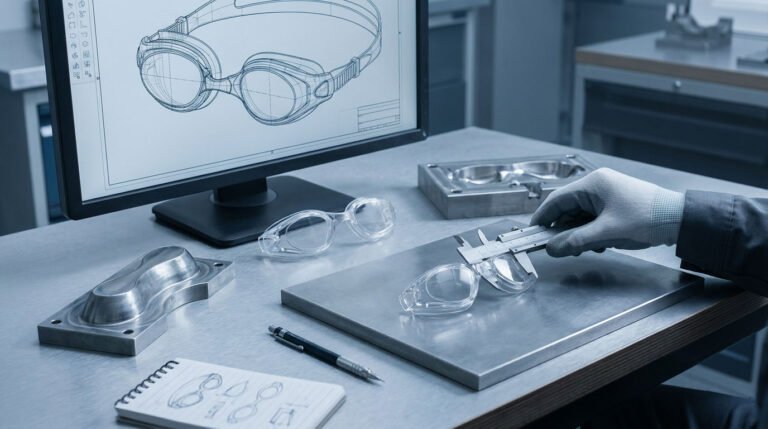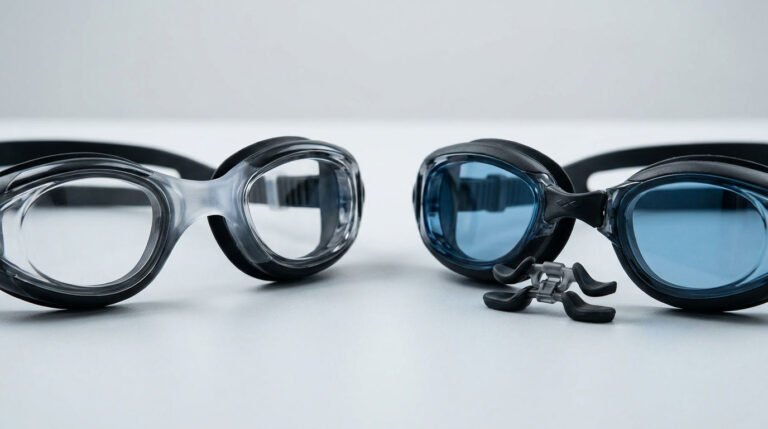
Developing a custom swimming goggle mold is not simply a matter of paying one tooling fee.
A complete pair of swimming goggles contains multiple molded components, and the final tooling cost depends on how many parts need to be developed, the materials used, mold construction, surface requirements, and the number of trial rounds required before approval.
For buyers, the most important questions are not only:
How much does a swimming goggle mold cost?
but also:
What does the tooling quotation include?
How many trial rounds are included?
Who owns the mold after payment?
What happens if revisions are required?
This guide explains how swimming goggle tooling works, what affects mold cost, how the development process moves from design to T1/T2 samples, and what buyers should confirm before paying for tooling.
Quick Answer: What Determines Swimming Goggle Mold Cost?
Swimming goggle mold cost is not one fixed number.
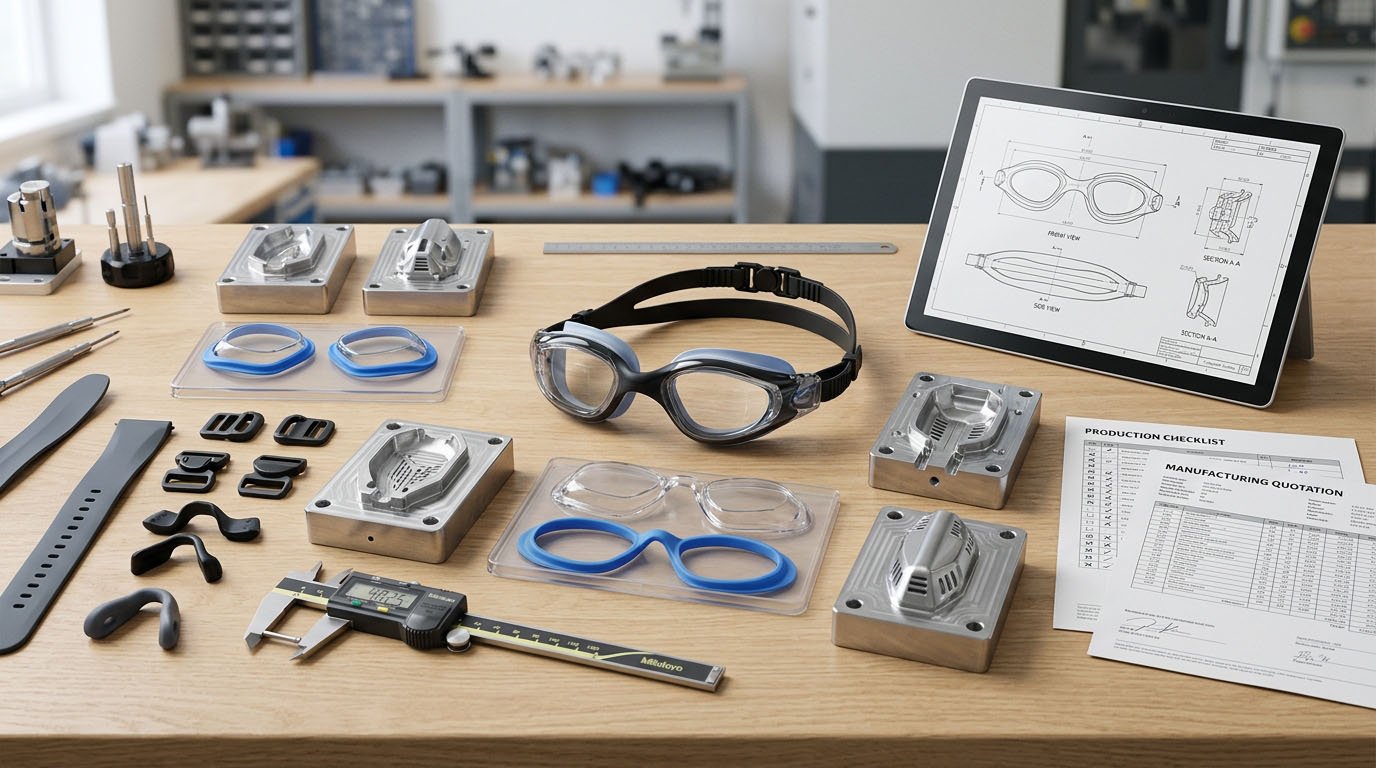
A complete pair of goggles normally requires several molded parts, which may include:
- lens
- frame or eye cup
- gasket
- strap
- buckle
- nose bridge
- adjustment components
The final tooling quotation depends on the number of new components, materials, mold construction, surface requirements, cavity design, expected mold life, and development complexity.
Before comparing quotations, always confirm:
- which components are included
- whether the quote covers one mold or multiple molds
- how many trial rounds are included
- who pays for revisions
- mold ownership
- mold life expectations
- what happens after final approval
A low tooling quotation is not automatically the lowest total development cost.
Tooling is only one part of the total investment in custom swimming goggles. Buyers should also consider recurring production costs, lens specifications, packaging, and setup charges. For the broader manufacturing budget, see our custom swimming goggles cost guide.
Why Does One Pair of Swimming Goggles Need Multiple Molds?
One of the most common misunderstandings in new product development is assuming that one swimming goggle requires one mold.
In reality, a swimming goggle is an assembly of multiple components.
Different parts may use different materials and manufacturing processes, so each component can require its own tooling.
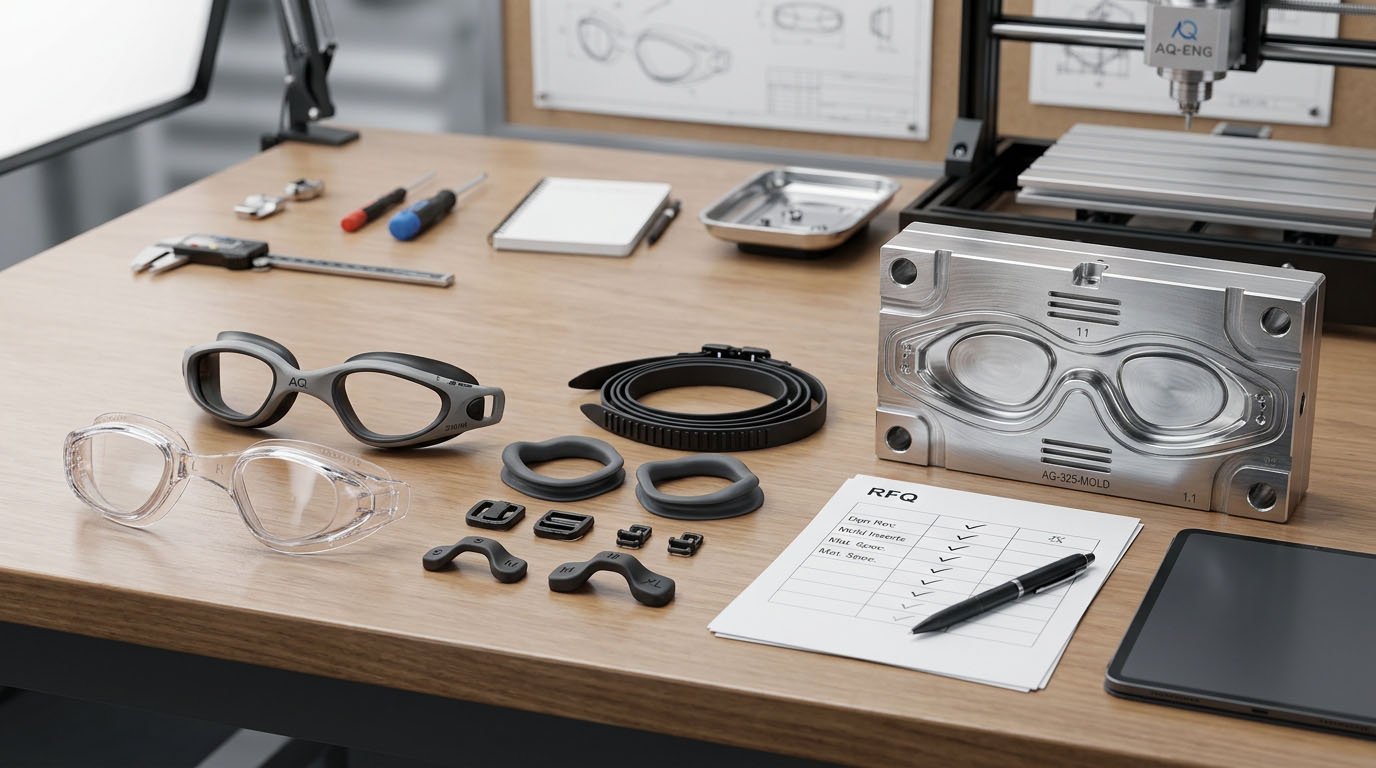
Typical Molded Components
| Component | Common Material | May Require Separate Tooling? |
|---|---|---|
| Lens | Polycarbonate | Yes |
| Frame / Eye Cup | PC, TPE, or related materials | Yes |
| Gasket / Seal | Silicone or TPE | Yes |
| Strap | Silicone or elastomer | Yes |
| Buckle / Clip | Nylon, PP, or engineering plastic | Yes |
| Nose Bridge | Depends on design | Often |
This means buyers should never compare two tooling quotations based only on the headline price.
One supplier may quote only the lens or frame tooling, while another may include the complete component set.
Before comparing prices, ask:
Which exact parts are included in this tooling quotation?
What Factors Affect Swimming Goggle Mold Cost?
Tooling cost depends on the engineering requirements of the project.
The main cost drivers usually include:
Number of New Components
The more components that require new tooling, the higher the overall tooling investment.
A project that changes only the frame may be very different from one that requires a new frame, gasket, buckle, and lens structure.
Material
Different materials require different mold structures, production conditions, and technical considerations.
Hard plastic components and flexible silicone or TPE components may therefore require different tooling approaches.
Mold Construction
Tooling specifications can vary according to:
- expected production life
- material
- cavity design
- maintenance requirements
- production efficiency
A mold designed for long-term commercial production may require a different investment from a simpler development tool.
Surface and Cosmetic Requirements
Additional tooling work may be required for:
- polished surfaces
- textured finishes
- visible cosmetic areas
- optical components
- branding details
Product Complexity
Complex curves, sealing surfaces, adjustment systems, or multi-component interfaces can increase engineering and trial requirements.
The more parts that must fit and function together, the more important the development and testing stages become.
Existing Mold vs Modified Mold vs Private Mold: Cost and Development Differences
Not every swimming goggle project requires completely new tooling.
Buyers generally have three development routes:
| Development Route | Tooling Investment | Development Time | Design Control | Best For |
|---|---|---|---|---|
| Existing Mold | Low or none | Short | Limited | Private label and market testing |
| Modified Existing Platform | Medium | Moderate | Partial | Brands needing selected structural changes |
| Full Private Mold | Highest | Longest | Full | Proprietary product development |
Existing Mold
An existing mold uses a product platform that has already been developed.
The buyer may customize:
- logo
- colors
- lens options
- packaging
without changing the basic product structure.
This is normally the fastest development route.
Modified Existing Platform
A modified platform starts with an existing design but changes selected features.
Depending on the modification, the project may require new tooling for only some components.
This route can provide more differentiation without developing every component from zero.
Full Private Mold
A full private-mold project is appropriate when the buyer requires a proprietary product structure.
This may include:
- unique lens geometry
- new gasket profile
- different frame shape
- proprietary buckle
- custom adjustment system
- new fit concept
The buyer gains greater design control, but the project also requires more engineering, tooling, sampling, and validation.
Tooling cost and production MOQ are separate decisions. For quantity requirements across logo branding, custom colors, lens options, and new-mold projects, see our Swimming Goggle MOQ Guide.
What Is the Swimming Goggle Mold Development Process?
Once the design direction is confirmed, the project moves through several development stages.
A typical flow looks like this:
Design / 3D File → Mold Making → T1 Trial → Sample Review → T2/T3 Revisions → Golden Sample Approval → Production Handoff
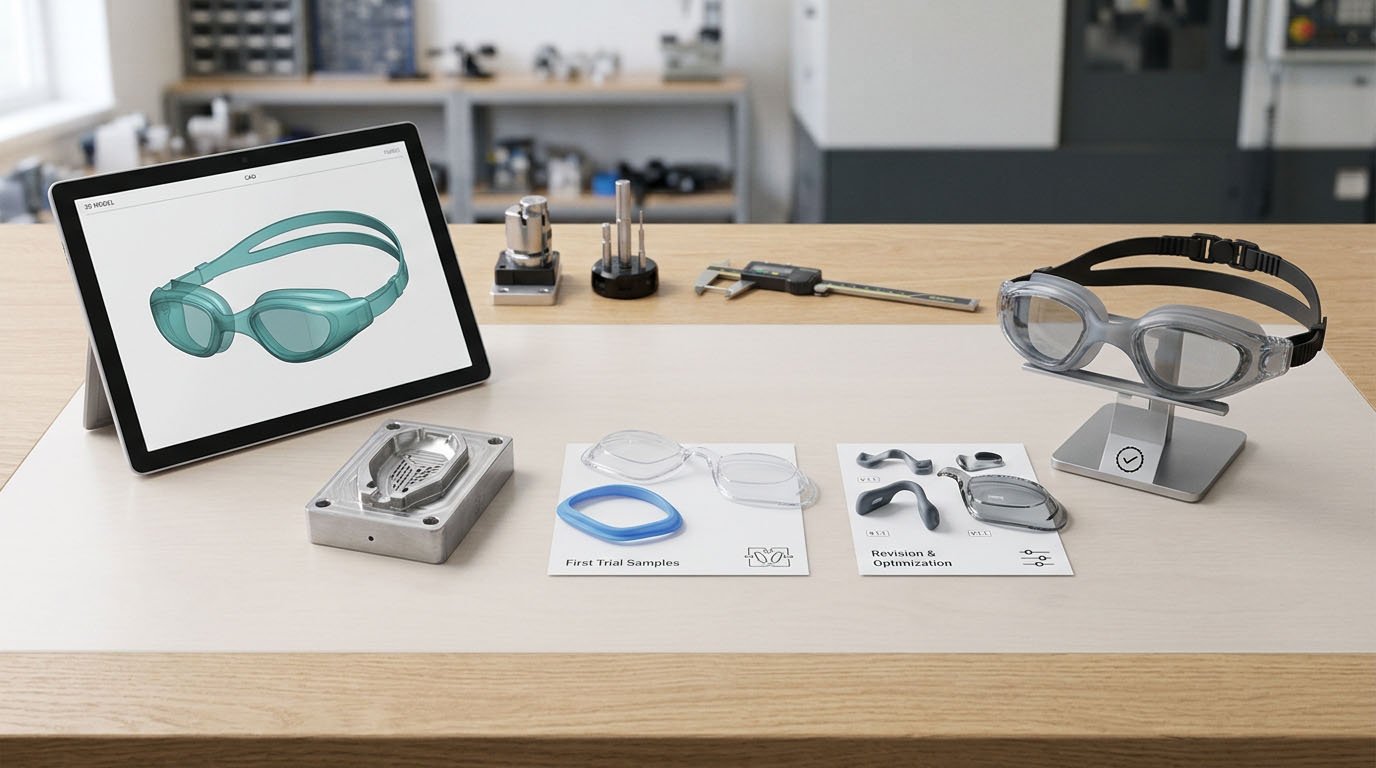
Step 1: Confirm the Product Design
Before tooling begins, the buyer and manufacturer should confirm the product structure.
This may include:
- 3D drawings
- component dimensions
- material choices
- lens geometry
- gasket profile
- strap system
- buckle design
- assembly relationships
Changes become more expensive after the tool has already been cut, so design confirmation is critical.
Step 2: Mold Making
Once the design is approved, the tooling is manufactured according to the confirmed product structure.
The exact tooling scope depends on which components are new.
Step 3: T1 Trial
T1 is the first trial run from the new tooling.
The purpose is not simply to produce a finished-looking sample.
The team uses T1 to check issues such as:
- dimensions
- fit between components
- sealing surfaces
- assembly
- cosmetic quality
- basic function
T1 samples may reveal areas that need adjustment.
Step 4: Sample Review
The buyer and manufacturer review the trial samples against the agreed requirements.
For swimming goggles, the review may include:
- fit
- seal
- comfort
- lens alignment
- assembly
- adjustment function
- appearance
Step 5: T2 / T3 Revisions
If the first trial does not meet the approval criteria, the tooling may require adjustment.
Additional trial rounds may follow until the product reaches the required standard.
This is why buyers should confirm how many trial rounds are included in the tooling quotation before payment.
Step 6: Golden Sample Approval
Once the product meets the agreed requirements, the approved sample becomes the reference for production.
The golden sample should represent the expected:
- dimensions
- fit
- appearance
- materials
- assembly
- function
Step 7: Production Handoff
After final approval, the project moves from tooling development into production preparation.
At this point, the buyer should confirm that the approved tooling, technical requirements, and golden sample are all clearly documented.
Jerry’s Sampling & Prototyping process provides more detail on how prototypes and samples move toward production approval.
Why Are T1, T2, and T3 Trial Rounds Important?
The first tooling trial is not always the final approved version.
New components may require adjustment after the first sample run.
Possible issues can include:
- dimensions outside target
- poor component fit
- seal problems
- cosmetic defects
- assembly difficulty
- buckle or strap interaction
- unexpected material behavior
That does not automatically mean the tooling project has failed.
Tooling development is an iterative engineering process.
The important commercial question is:
How are revisions handled?
Before paying for the mold, confirm:
- how many trial rounds are included
- which revisions are included in the tooling fee
- what counts as a buyer-requested design change
- what happens if the tool does not meet the agreed specification
- who pays for additional modifications
This prevents disputes after T1 samples are produced.
Who Owns the Swimming Goggle Mold?
Mold ownership should be confirmed in writing before tooling begins.
Paying for tooling does not automatically clarify:
- who legally owns the mold
- where the mold will be stored
- whether the supplier can use it for another customer
- whether the mold can be transferred
- who pays for future maintenance
A tooling agreement should clearly state the ownership and usage terms.
Questions Buyers Should Ask
Ask the supplier:
- Who owns the mold after the tooling fee is paid?
- Is the mold exclusive to my company?
- Can the supplier use the mold for another buyer?
- Where will the tooling be stored?
- Who is responsible for maintenance?
- Can the tooling be transferred if the supplier relationship ends?
- What documentation is available for the tooling?
For proprietary swimming goggle development, these points can be as important as the initial tooling price.
What Should Be Included in a Swimming Goggle Tooling RFQ?
A strong tooling RFQ makes supplier quotations easier to compare.
Instead of asking:
"How much is a swimming goggle mold?"
send enough information for the supplier to define the actual project scope.
Product Information
Include:
- product concept
- reference images
- 2D or 3D files if available
- target user
- training, racing, recreational, kids, or other application
Components
Confirm which parts require new tooling:
- lens
- frame
- gasket
- strap
- buckle
- nose bridge
- other components
Materials
Specify intended materials where known.
If materials are not finalized, ask the supplier to recommend suitable options.
Design Requirements
Include requirements such as:
- dimensions
- fit
- surface finish
- lens shape
- adjustment system
- branding
- color direction
Testing and Approval
Define how the project will be reviewed before final approval.
Jerry’s Quality Assurance process can be used as a reference when considering product and production validation.
Swimming Goggle Mold RFQ Checklist
Before paying a tooling deposit, confirm the following:
- Which molds are included?
- Which components are new?
- What material will each component use?
- How many trial rounds are included?
- Who pays for tooling revisions?
- What are the sample approval criteria?
- What is the expected mold life?
- Who owns the mold after payment?
- Is the tooling exclusive?
- Where will the mold be stored?
- Who handles mold maintenance?
- What happens after golden sample approval?
- What is included in the handoff to production?
A tooling quotation should be treated as a development scope, not just a single price.
Two quotations are not truly comparable unless they cover the same components, trial rounds, ownership terms, and revision responsibilities.
How Can Buyers Reduce Swimming Goggle Tooling Risk?
Most tooling problems come from unclear scope rather than the mold price itself.
Buyers can reduce risk by confirming several items before tooling begins.
Define the Component Scope
List every component that requires new tooling.
Do not rely on a quotation that simply says:
"Goggle mold."
Approve the Design Before Cutting Tooling
Major geometry changes after tooling begins can create additional cost and delays.
Confirm the design first.
Define Trial and Revision Terms
Make sure T1, T2, and any additional revisions are clearly addressed in the quotation.
Confirm Mold Ownership
Ownership, exclusivity, storage, maintenance, and transfer rights should be documented.
Use a Golden Sample
The final approved sample should become the production reference.
This gives both buyer and manufacturer a clear acceptance standard.
Frequently Asked Questions About Swimming Goggle Mold Cost
Does One Pair of Swimming Goggles Need Only One Mold?
Usually no.
A complete product contains multiple molded components, and several parts may require separate tooling.
What Is the Difference Between an Existing Mold and a Private Mold?
An existing mold uses a previously developed product platform.
A private mold is developed specifically for a new product structure or proprietary component design.
Why Can Two Tooling Quotations Be Very Different?
The quotations may include different components, mold specifications, trial rounds, surface requirements, ownership terms, or revision responsibilities.
Always compare the full tooling scope rather than only the total price.
How Many Tooling Trial Rounds Are Needed?
There is no fixed number that applies to every project.
The important point is to confirm how many trial rounds are included and how additional revisions will be handled.
Who Should Own the Mold?
Ownership should be defined in the tooling agreement.
Buyers funding proprietary tooling should clarify ownership, exclusivity, storage, maintenance, and transfer conditions before payment.
Does Paying for Tooling Remove Production MOQ?
No.
Tooling investment and production quantity are separate commercial considerations.
For quantity guidance across private label, custom color, and new-mold projects, see our Swimming Goggle MOQ Guide.
Conclusion: Evaluate the Full Tooling Scope, Not Just the Mold Price
Swimming goggle mold cost should not be judged by one headline number.
A complete tooling project may involve multiple component molds, several trial rounds, revisions, ownership terms, and a final production handoff.
Before paying for tooling, buyers should confirm:
Component Scope → Tooling Specification → T1/T2/T3 Terms → Approval Criteria → Mold Ownership → Production Handoff
A lower quotation is not necessarily the better quotation if it excludes important components, trial rounds, or revision responsibilities.
For buyers developing a completely new swimming goggle, Jerry can support the process through OEM & ODM, Sampling & Prototyping, and Quality Assurance.
If you already have a product concept, drawing, or reference sample, contact Jerry with your project requirements for a tooling and development review.