Choosing the right swimming goggles MOQ is not simply about getting the lowest factory price. For swimwear brands, e-commerce sellers, and distributors, the real challenge is balancing order quantity, inventory risk, and available cash.
Order too few, and your unit cost may be higher. Order too many, and unsold swimming goggles can tie up working capital that could support marketing or product development.
The best choice between 300, 500, and 1,000 swimming goggles depends on your sales demand, budget, product configuration, and inventory turnover—not just the supplier’s minimum order quantity.
This guide helps you compare the three quantities and choose a practical starting point for your brand.
Quick Answer: Should You Order 300, 500, or 1,000 Swimming Goggles?
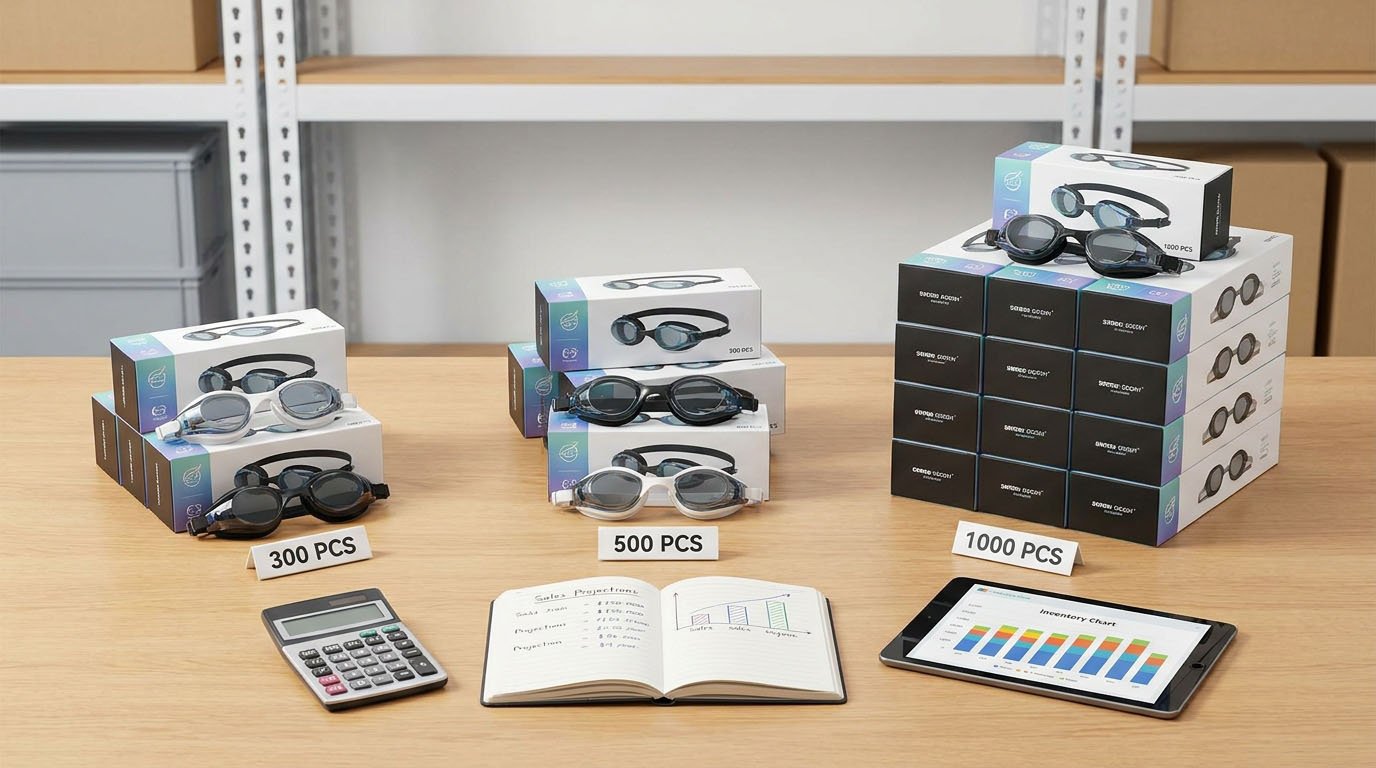
For most buyers, the three quantities represent different levels of inventory commitment.
| Order Quantity | Best Suited For | Main Advantage | Main Risk |
|---|---|---|---|
| 300 pieces | Startups and first product tests | Lower initial inventory commitment | Higher unit cost |
| 500 pieces | Growing brands testing demand or replenishment | Moderate stock investment | May not meet certain customization MOQs |
| 1,000 pieces | Established sellers with proven demand | Potential volume pricing benefits | Higher cash exposure and overstock risk |
These quantities are purchasing scenarios, not universal customization thresholds.
At Jerry, the practical starting points for eligible projects are:
- Logo / Private Label: From 300 pieces on selected existing models.
- Custom Color: Generally from 600 pieces, subject to specifications.
- New Mold Development: MOQ quoted by project.
A 500-piece order does not automatically qualify for a custom color, and ordering 1,000 pieces does not automatically include new mold development.
The key is to match a feasible factory quantity with your business’s ability to sell and replenish stock.
Key 1: Understand What MOQ Means Before Comparing Quantities
Before deciding whether 300, 500, or 1,000 pieces is appropriate, confirm what the factory’s MOQ actually covers.
MOQ may apply to the total order, each goggle model, each color, or each product configuration.
For example, ordering 500 pieces of one existing model is not the same as requesting 500 pieces divided across five different colors.
| MOQ Definition | What Buyers Should Confirm |
|---|---|
| Per order | Can multiple models be combined? |
| Per model | Does every goggle style require its own minimum? |
| Per color | Must each custom color meet a separate MOQ? |
| Per configuration | Do different lens or component combinations have separate minimums? |
| Per packaging type | Does custom packaging require an additional minimum? |
A buyer requesting 1,000 swimming goggles across four colors may face different production conditions from a buyer ordering 1,000 pieces in one standard configuration.
For detailed manufacturing thresholds, see our Swimming Goggle MOQ Guide: Logo vs Color vs New Mold.
Once the factory confirms the acceptable configuration, you can make a meaningful comparison between order quantities.
Key 2: When Should You Order 300 Swimming Goggles?
A 300-piece order is often a practical starting point for brands introducing a new swimming goggle product.
It allows buyers to test demand without making a larger inventory commitment before reliable sales data becomes available.
Why 300 Pieces Can Work for Market Testing
A smaller first order can help you:
- Evaluate customer demand for a selected model.
- Test product listings and retail pricing.
- Gather initial customer feedback.
- Identify which features customers prefer.
- Reduce the amount of capital tied up in an unproven product.
For example, a new online swimwear brand may want to introduce one training goggle model with its logo.
Instead of ordering several variations immediately, the brand can start with a suitable existing design and focus on measuring actual sales performance.
Jerry’s Private Label Swimming Goggles service supports branding on selected existing models, with eligible logo projects starting from 300 pieces.
What Are the Limitations?
Ordering 300 pieces can involve trade-offs:
- Unit prices may be higher than larger volume quotations.
- Custom colors may require a higher minimum.
- Special packaging may add setup charges.
- Shipping costs may represent a larger percentage of the order value.
A smaller order is not automatically cheaper per unit. Its advantage is limiting the amount of inventory you must commit to before proving demand.
Best choice: Consider 300 pieces when you are testing a new market, launching your first SKU, or introducing an unfamiliar product.
Key 3: Is 500 Pieces the Right Middle Ground?
A 500-piece order can be useful for brands that have some sales confidence but are not ready to commit to 1,000 units.
It provides more inventory than a minimum launch order without doubling or tripling the purchasing commitment.
However, 500 pieces is a purchasing decision, not a separate customization category.
When Does 500 Pieces Make Sense?
Consider 500 pieces when:
- Your first product has received positive customer feedback.
- Sales are becoming more predictable.
- You want additional stock before a planned promotion.
- Your working capital supports a larger inventory position.
- Your supplier confirms that the requested model and configuration can be produced at this quantity.
For instance, a swim accessories retailer may have successfully sold an initial batch and now expects stronger demand during the next swimming season.
Ordering 500 pieces could provide more stock while avoiding the commitment of a much larger purchase.
Does 500 Pieces Unlock More Customization?
Not necessarily.
At Jerry, custom-color projects generally start from 600 pieces, depending on the components and configuration.
Therefore, a 500-piece order may be feasible for an existing model with a logo, while a newly specified custom color could require a different quantity.
The same principle applies to lens options and packaging.
For a closer look at smaller production runs, read our Low MOQ Swimming Goggles Customization Guide.
Best choice: Consider 500 pieces when demand is improving, your supplier accepts the configuration, and you want a moderate increase in inventory.
Key 4: When Does Ordering 1,000 Swimming Goggles Make Sense?
A 1,000-piece order becomes more attractive when you have reliable sales data and sufficient distribution capacity.
Larger orders may offer manufacturing efficiencies because certain setup and handling costs can be spread across more units.
However, the potential savings must justify the additional inventory investment.
Signs Your Brand May Be Ready for 1,000 Pieces
Before increasing your order, consider whether:
- You have consistent monthly sales rather than a one-time promotion.
- Your customer return rates and product feedback are acceptable.
- Your distribution channels can handle more stock.
- Your business can finance the purchase without restricting other operations.
- You have a realistic forecast for selling the inventory.
For an established brand selling through several retail accounts, a 1,000-piece purchase may support predictable replenishment.
For a startup without consistent orders, the same quantity could create unnecessary inventory exposure.
Does 1,000 Pieces Guarantee Lower Prices or More Options?
Not always.
The factory may offer better unit pricing, but the result depends on the model, materials, configuration, and quotation.
Likewise, 1,000 pieces do not automatically allow any number of colors.
If a particular custom color has a 600-piece minimum, dividing 1,000 pieces into two new colors of 500 each may not meet the requirement.
Always confirm the approved SKU allocation before committing.
Best choice: Consider 1,000 pieces when demand is established and the expected cost benefits outweigh the higher inventory commitment.
Key 5: How Do 300, 500, and 1,000 Pieces Affect Inventory and Cash Flow?
Inventory planning is one of the most important considerations when choosing a swimming goggles order quantity.
A lower factory price does not necessarily mean a better purchasing decision if the products remain unsold.
Calculate Your Inventory Coverage
A simple starting formula is:
Inventory Coverage (Months) = Order Quantity ÷ Expected Monthly Sales
Assume your brand expects to sell 100 swimming goggles per month.
| Order Quantity | Expected Monthly Sales | Theoretical Inventory Coverage |
|---|---|---|
| 300 pieces | 100 pieces | 3 months |
| 500 pieces | 100 pieces | 5 months |
| 1,000 pieces | 100 pieces | 10 months |
Illustrative scenario only. These are not actual Jerry customer sales figures. The calculation assumes consistent sales, with no opening stock, returns, or demand changes.
In this example, 1,000 pieces represent approximately ten months of expected sales.
That may be reasonable for a brand with stable demand and sufficient storage capacity. It may be excessive for a business still testing its product.
Account for Sales Fluctuations
Expected monthly sales should not be treated as guaranteed demand.
Swimming goggles sales can vary because of:
- Swimming seasons and school schedules.
- Retail promotions and advertising campaigns.
- Changes in product preferences.
- Competition and pricing.
- Retailer restocking patterns.
When sales data is limited, test a conservative forecast rather than relying only on your most optimistic projection.
Also calculate demand separately for each SKU. A strong-selling clear-lens model does not necessarily offset unsold inventory in a slower-moving mirrored version.
Plan Your Reorder Point
Ordering too little can create stockouts if replenishment takes longer than expected.
A basic planning formula is:
Reorder Point = Expected Demand During Replenishment Lead Time + Safety Stock
For example, suppose your business sells approximately 100 pairs per month.
If the total replenishment lead time is 30 days and you maintain 25 pairs as safety stock, the approximate reorder point is:
100 + 25 = 125 pairs
This means you would normally begin replenishment planning when available inventory approaches 125 pairs, assuming the demand and lead-time estimates remain valid.
Your actual reorder point should reflect confirmed production scheduling, shipping time, inventory already on order, and demand uncertainty.
The goal is not simply to order fewer goggles. It is to maintain enough stock without holding unnecessary inventory.
Key 6: How Should You Compare Factory Quotes at Different Quantities?
Once your product specification is confirmed, request comparable quotations for 300, 500, and 1,000 pieces where those quantities are feasible.
Do not compare unit prices from different product specifications.
Compare Total Landed Cost, Not Just Factory Price
A more useful purchasing calculation is:
Total Landed Cost = Product Cost + Setup Charges + Freight + Applicable Duties and Other Import Costs
Depending on your commercial arrangements, storage and fulfillment costs should also be considered when evaluating the overall inventory commitment.
For a meaningful comparison, confirm that each quotation uses the same product specification, packaging, shipping terms, and destination.
| Quotation Factor | 300 Pieces | 500 Pieces | 1,000 Pieces |
|---|---|---|---|
| Unit price | Request quote | Request quote | Request quote |
| Total product cost | Calculate | Calculate | Calculate |
| Setup charges | Confirm | Confirm | Confirm |
| Packaging specification | Confirm | Confirm | Confirm |
| Freight and import costs | Estimate | Estimate | Estimate |
| Expected inventory coverage | Calculate | Calculate | Calculate |
| MOQ and SKU allocation | Verify | Verify | Verify |
This comparison reveals whether a larger order produces meaningful savings or simply increases your inventory commitment.
For a detailed breakdown of manufacturing expenses, see our Custom Swimming Goggles Cost Guide.
Consider the Cost of Unsold Inventory
Suppose a supplier offers a lower unit price at 1,000 pieces.
The larger order is only financially attractive if the expected savings justify the extra stock.
Unsold inventory can create additional costs through storage, handling, markdowns, or obsolete packaging and designs.
Before increasing your order, ask:
Will the expected savings compensate for the extra cash tied up in inventory?
If the answer is uncertain, a smaller order may be the more practical commercial choice.
Final Decision Checklist: Which Quantity Fits Your Brand?
Use the following checklist before confirming your swimming goggles order.
| Your Business Situation | Practical Starting Point |
|---|---|
| First product launch with limited sales data | Evaluate 300 pieces |
| Existing product with improving demand | Compare 300 and 500 pieces |
| Stable sales with a manageable inventory forecast | Compare 500 and 1,000 pieces |
| Strong distribution and predictable reorders | Evaluate 1,000 pieces |
| Need a custom color or special configuration | Confirm project-specific MOQ first |
| Need a new mold or proprietary structure | Request a separate OEM/ODM assessment |
The quantity should be supported by both manufacturing feasibility and your commercial forecast.
Avoid ordering 1,000 pieces solely because the unit price looks more attractive.
Similarly, avoid choosing 300 pieces automatically if the quantity creates frequent stockouts or disproportionately high replenishment costs.
The right order size balances production efficiency, inventory coverage, and your ability to sell the product.
Frequently Asked Questions
Is 300 Pieces Enough to Start a Private Label Swimming Goggle Brand?
It can be. Jerry supports eligible logo and private-label projects starting from 300 pieces on selected existing models. Additional color, lens, or packaging requirements may change the minimum.
Can I Order 500 Swimming Goggles in Two Different Colors?
It depends on whether the colors are existing options or require custom production.
Jerry’s custom-color projects generally start from 600 pieces, and the minimum may apply per color or configuration. A 500-piece order divided into two new custom colors should not be assumed feasible without factory confirmation.
Is Ordering 1,000 Swimming Goggles Always More Profitable?
No. A lower unit cost can improve potential margins, but profitability also depends on retail pricing, sales velocity, shipping, storage, and unsold inventory. Larger orders make sense when the commercial benefits justify the additional commitment.
Should I Order More Swimming Goggles to Reduce Shipping Costs?
Not automatically. Larger shipments may lower freight cost per unit, but they increase the total inventory investment. Compare the delivered cost of each quantity alongside expected sales and cash-flow requirements.
Can I Start With 300 Pieces and Increase My Reorder Later?
Yes, this can be a practical strategy for eligible existing-model projects. Confirm reorder MOQ, lead time, availability of components, and any price differences before your first purchase.
If a future order requires custom colors or other changes, different production minimums may apply.
Conclusion: Choose Your Swimming Goggles MOQ Based on Demand, Not Price Alone
There is no universally correct swimming goggles MOQ for every brand.
300 pieces can be a practical starting point for market testing.
500 pieces may suit brands with improving demand that want a moderate inventory commitment.
1,000 pieces may offer purchasing efficiencies for businesses with established sales and reliable forecasts.
Before selecting a quantity, confirm the factory’s MOQ requirements, review expected inventory coverage, and compare the total cost of each feasible option.
At Jerry Goggles, we work with brands, distributors, and retailers to evaluate swimming goggle production requirements and suitable order quantities.
If you are planning a new order, contact Jerry Goggles with your preferred model, customization requirements, estimated sales demand, and target quantity. Our team can help review the available manufacturing options before you commit to bulk production.