Custom swimming goggles can have very different prices, even when two products look similar. One supplier may quote a basic existing model with a printed logo, while another includes upgraded lenses, custom colors, retail packaging, and additional testing.
The cost of custom swimming goggles depends on the base model, customization level, order quantity, lens features, packaging, and one-time development charges. Private-label projects using existing molds generally require less upfront investment than products developed with entirely new tooling.
This guide explains what affects custom swimming goggle pricing, how to estimate your first-order budget, and how to compare manufacturer quotations without overlooking important costs.
Quick Answer: How Much Do Custom Swimming Goggles Cost?
There is no universal factory price for custom swimming goggles because different specifications create different production costs.
The most useful starting point is to compare the level of customization.
| Customization Type | Typical Scope | Upfront Cost | Unit Cost Impact |
|---|---|---|---|
| Private Label | Existing model with custom logo | Lowest | Low |
| Custom Color | Existing model with specified colors | Low–Medium | Low–Medium |
| Performance Upgrade | Mirrored or polarized lenses, upgraded coatings | Varies | Medium–High |
| New Mold OEM/ODM | New frame, gasket, lens geometry, or components | Highest | Project-dependent |
For most new brands, customizing an existing swimming goggle model is the most cost-effective way to start. It avoids the larger tooling investment associated with developing a proprietary product.
At Jerry, the starting MOQ guidance is:
- Logo / Private Label: From 300 pcs
- Custom Color: From 600 pcs
- Deeper OEM/ODM: Quoted by project
- New Mold Development: Quoted by project
MOQ may apply per model, color, or configuration rather than the combined quantity across different products.
For a detailed explanation of quantity requirements, see our Swimming Goggle MOQ Guide.
Key 1: What Factors Affect Custom Swimming Goggle Pricing?
Five major factors determine how manufacturers calculate the price of custom swimming goggles.
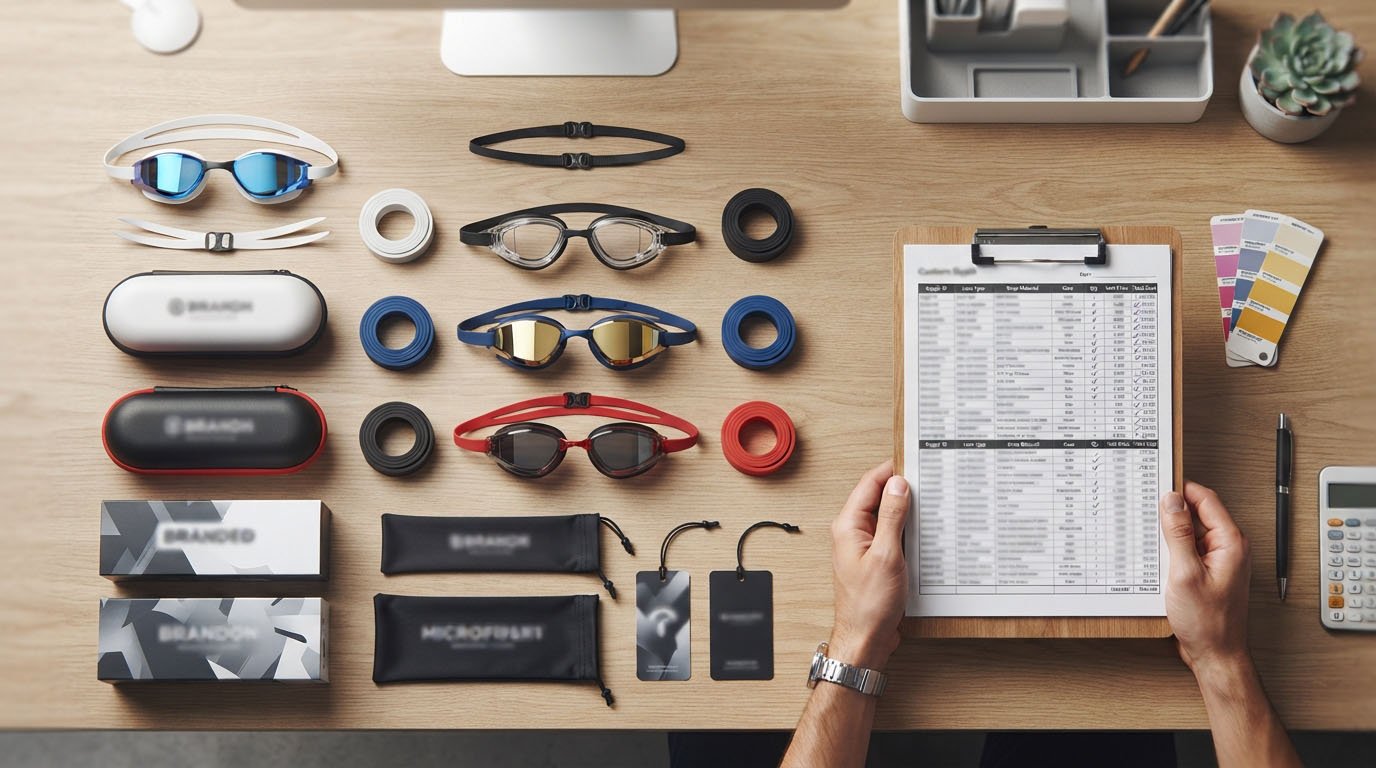
1. Base Model and Product Design
The starting model establishes much of the manufacturing cost.
For example:
- Recreational goggles: Generally simpler construction and standard lens configurations.
- Training goggles: Designed for repeated use, comfort, and reliable sealing.
- Racing goggles: May require specialized low-profile geometry and adjustment components.
- Open-water goggles: May include larger viewing areas, mirrored lenses, or polarized options.
A complex product is not automatically better. The appropriate design depends on the target customer, intended use, and retail positioning.
2. Customization Depth
Logo printing on an existing model usually requires less investment than modifying its structure.
Custom colors may introduce material preparation and production changeover costs. Creating a new frame or gasket may require dedicated tooling.
The more components that change, the more development and production expenses may be involved.
3. Order Quantity
Order volume affects how production setup expenses are distributed.
Smaller orders spread fixed preparation costs across fewer units. Larger production runs can improve manufacturing efficiency, although the savings depend on materials, configuration, and factory capacity.
4. Lens and Material Specifications
Lens technology, anti-fog treatment, silicone components, and finishing requirements affect the final price.
Upgraded components may cost more because of additional material, processing, or inspection requirements.
5. Packaging and Quality Requirements
Simple protective packaging generally costs less than customized retail boxes or premium storage cases.
Testing and inspection requirements can also affect the project budget, especially when third-party laboratory verification is required.
Key 2: What Is Included in the Custom Swimming Goggle Cost Breakdown?
A manufacturer quotation should separate recurring production costs from one-time charges.
| Cost Component | Cost Type | What Buyers Should Check |
|---|---|---|
| Lens, frame, gasket, strap | Per unit | Materials and specifications |
| Logo application | Per unit + possible setup | Method, placement, number of colors |
| Anti-fog and lens finishes | Per unit | Performance requirements |
| Packaging | Per unit + possible setup | Box, case, labels, artwork |
| Mold development | Usually one-time | Components requiring new tooling |
| Sampling | Project-dependent | Sample rounds and freight |
| Testing and inspection | Per project or batch | Scope and acceptance criteria |
| Shipping | Per shipment | Incoterms and destination |
Materials and Components
Most swimming goggles include lenses, sealing components, straps, buckles, and nose-bridge or frame structures.
Polycarbonate lenses, silicone gaskets, and adjustable straps are common options, but material selection varies by product design.
Material quality and manufacturing consistency matter because the components must work together to achieve the intended comfort, fit, and sealing performance.
Logo and Packaging
Printed logos on existing components are often relatively economical.
More complex branding, such as molded details or specialized decoration, may require additional preparation or tooling.
Custom retail packaging also affects total cost through printing, packaging materials, setup charges, and shipping volume.
For brands testing a new market, simple packaging may help control initial investment.
Testing and Quality Control
Testing should be planned according to product design, customer requirements, and destination-market obligations.
Buyers may need to evaluate:
- Lens optical quality
- Anti-fog performance
- Water-sealing performance
- Strap and component durability
- Relevant chemical and material requirements
Testing fees are not necessarily charged on every individual goggle. Depending on the project, they may apply to sample submissions, production batches, or third-party laboratory programs.
Key 3: How Does Customization Level Change the Price?
Customization depth is often the most important decision when preparing a new swimming goggle budget.
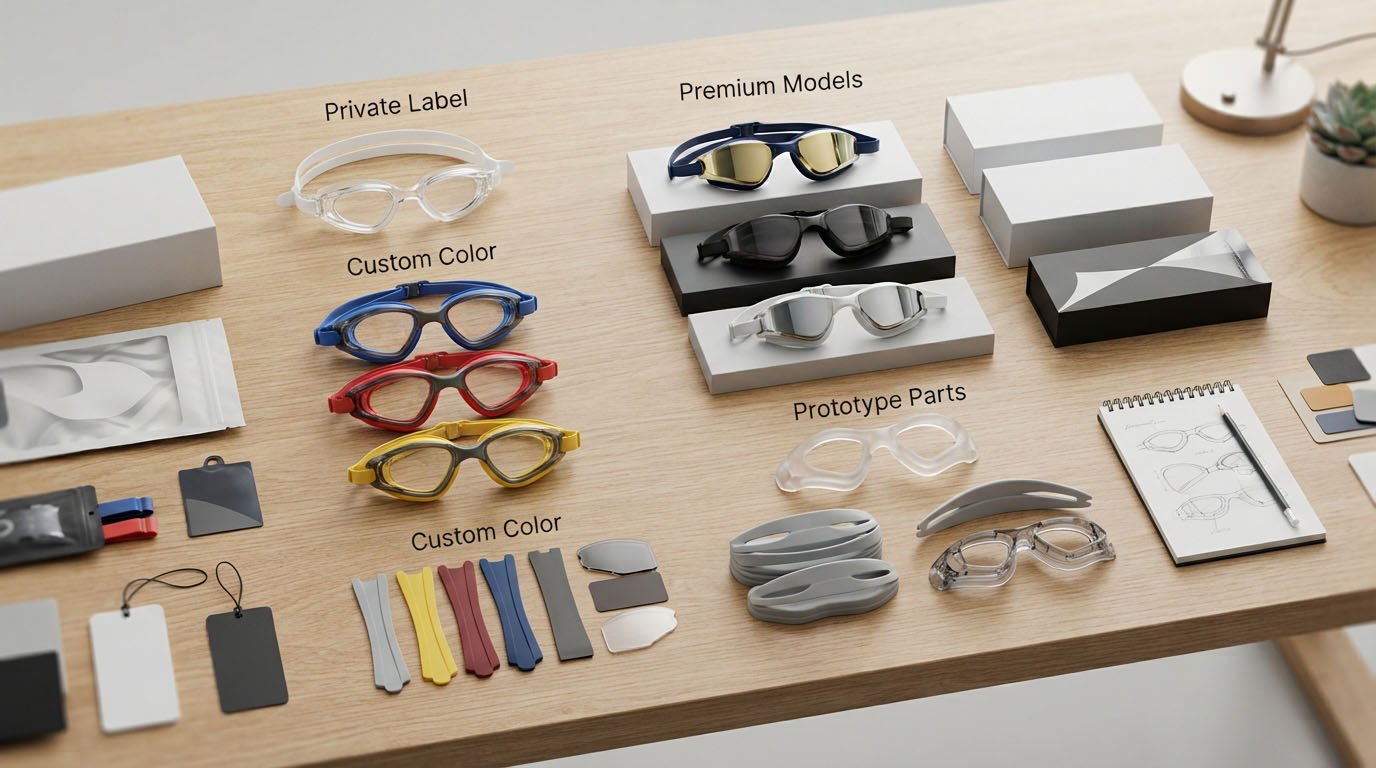
Private Label: The Lowest Upfront Investment
Private-label production uses an existing manufacturer-developed model.
Buyers may customize the logo, select available product configurations, and choose suitable packaging.
Because the main product tooling already exists, the project can avoid new structural mold-development expenses.
This approach is suitable for:
- New swimming brands
- E-commerce retailers
- Swim clubs and training programs
- Distributors testing a new product range
Jerry supports Private Label Swimming Goggles using selected existing models, with logo customization starting from 300 pieces.
Custom Color: Additional Production Preparation
Custom colors allow brands to create a more distinctive appearance without necessarily changing the product structure.
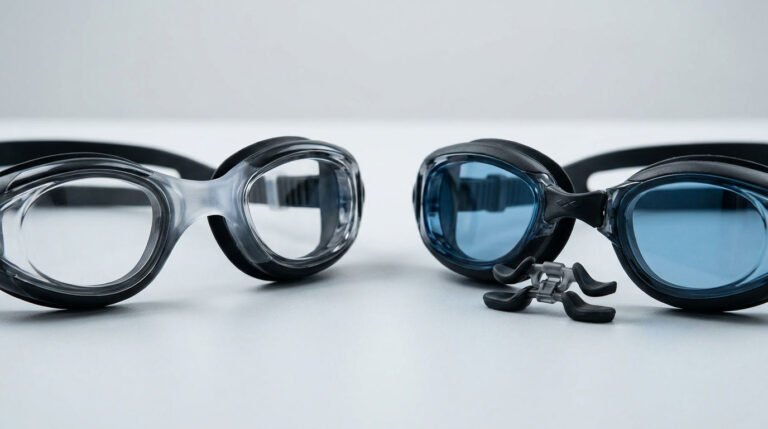
Depending on the design, customization may involve frame colors, silicone gaskets, straps, or other components.
The quotation should identify whether color-matching fees, material minimums, or dedicated production runs apply.
Jerry’s custom-color MOQ starts from 600 pieces on eligible existing models.
Performance Upgrade: Higher Component Cost
Brands targeting premium training, racing, or open-water applications may request upgraded lens features.
These can include:
- Mirrored lens finishes
- Polarized lens options
- Enhanced anti-fog treatments
- Specified UV protection
- Specialized lens tints
Not every option is available on every existing model.
Before requesting a price, confirm compatibility with the selected lens and frame design.
New Mold OEM/ODM: Higher Initial Development Investment
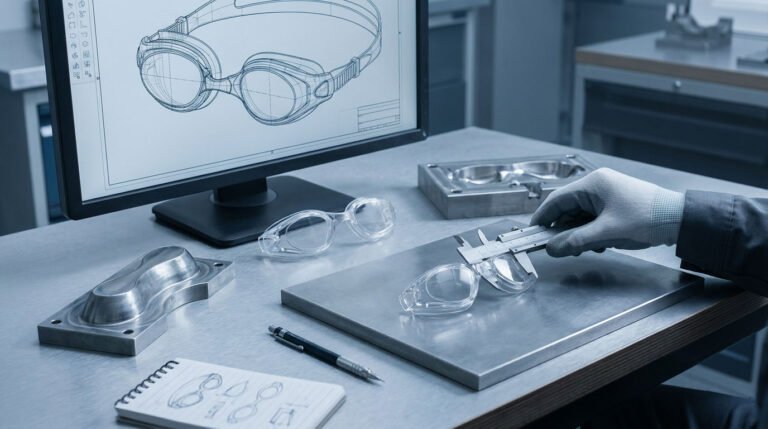
A completely new swimming goggle design may require dedicated molds for the lens, frame, gasket, or other components.
Tooling costs depend on the actual engineering scope rather than one standard fee.
Buyers should distinguish the price of manufacturing the finished goggles from the one-time cost of developing the tooling.
For component scope, mold ownership, tooling specifications, and development steps, see our Swimming Goggle Mold Cost Guide.
Key 4: How Do MOQ and Order Volume Affect Unit Price?
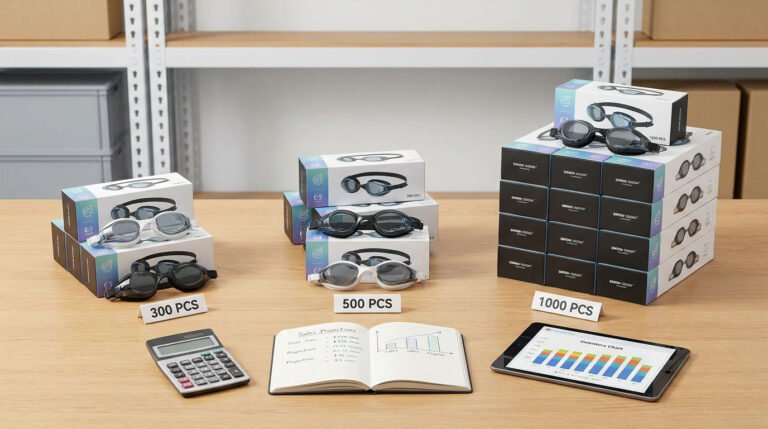
Order quantity influences manufacturing efficiency and inventory investment.
A smaller order may be easier for a new brand to finance, but the fixed setup costs are distributed across fewer pieces.
A larger order may achieve a lower unit cost, although it also increases the total inventory commitment.
| Order Strategy | Unit Cost Trend | Inventory Commitment | Suitable For |
|---|---|---|---|
| Small first order | Generally higher | Lower | Market testing |
| Moderate volume | More balanced | Medium | Established initial demand |
| Larger repeat order | Potentially lower | Higher | Stable sales and replenishment |
An Illustrative Setup-Cost Calculation
Assume a hypothetical swimming goggle project has:
- Base production cost: $4.00 per pair
- One-time setup cost: $300
- Order quantity: 300, 600, or 1,200 pairs
The effective first-order unit cost can be estimated as:
Effective Unit Cost = Production Unit Cost + (Fixed Setup Cost ÷ Order Quantity)
| Order Quantity | Fixed Setup Cost per Pair | Effective Unit Cost |
|---|---|---|
| 300 pcs | $1.00 | $5.00 |
| 600 pcs | $0.50 | $4.50 |
| 1,200 pcs | $0.25 | $4.25 |
Important: These figures are hypothetical calculation examples, not Jerry factory quotations or guaranteed volume discounts. Actual prices depend on the project specifications and supplier quotation.
The calculation demonstrates why increasing order quantity can reduce the share of fixed setup expenses allocated to each product.
However, the best quantity is not always the largest.
For a new product launch, unsold inventory can cost more than the potential savings from a lower unit price.
Key 5: What Is the Difference Between First-Order Cost and Reorder Cost?
Buyers should evaluate the complete initial investment rather than focusing only on the quoted price per pair.
First-order investment = Production cost + One-time setup charges + Sampling/testing costs + Packaging setup + Freight and applicable import costs.
Not every project incurs every category, and some charges may already be included in the supplier’s unit price.
First-Order Expenses
Depending on the customization route, initial charges may include:
- Artwork and logo setup
- Color matching
- Packaging design or printing preparation
- Sample development and delivery
- Tooling, when new structural components are required
- Product verification
Reorder Expenses
For repeat production using unchanged, approved specifications, certain setup charges may not need to be paid again.
However, recurring expenses remain, including materials, manufacturing, applicable testing, packaging, and shipping.
Reorder pricing may also change if material costs, quantities, exchange rates, or product specifications change.
Buyer Tip: Request separate quotations for the first order and an identical repeat order. This makes the long-term economics easier to compare.
Key 6: How Can You Reduce Custom Swimming Goggle Costs Without Sacrificing Quality?
The goal should be to eliminate unnecessary development expenses, not remove product features essential to performance.
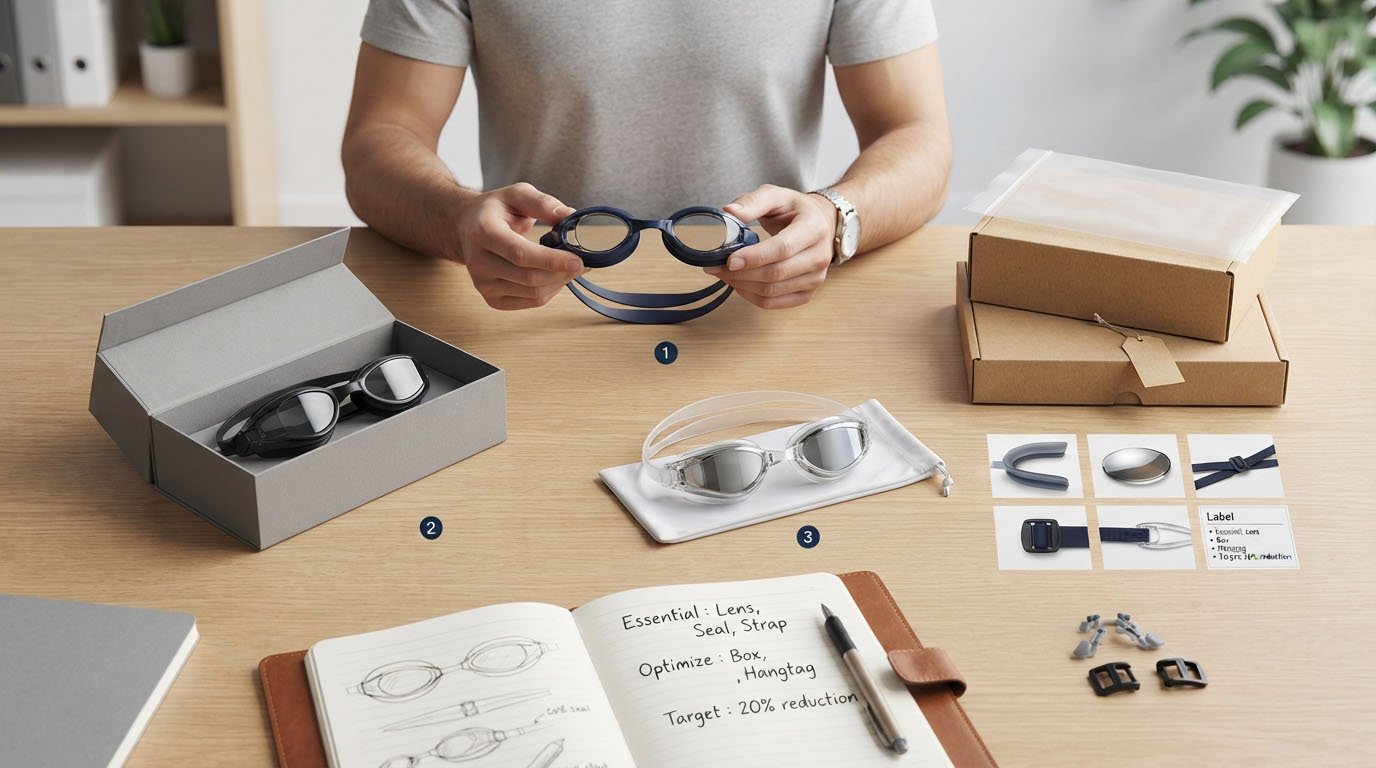
Use an Existing Product Platform
Selecting a proven existing model can avoid major tooling costs and reduce development complexity.
For many startup brands, private-label customization offers enough differentiation for an initial launch.
Keep the First Collection Focused
Launching too many models, colors, or packaging variations can increase setup complexity and fragment order quantities.
A smaller collection with a clear target audience is often easier to manage.
Match Lens Features to Your Market
Premium lens features should support a genuine customer need.
For example, an open-water product may justify different lens options from a basic indoor training goggle.
Avoid specifying expensive upgrades only because they are available.
Simplify Packaging
Use packaging appropriate for the sales channel.
An e-commerce product may not need the same presentation as a premium product displayed in retail stores.
Protect Essential Product Quality
Cost reductions should not undermine:
- Lens clarity and required optical performance
- Anti-fog performance specifications
- Gasket fit and sealing
- Strap durability
- Applicable testing and compliance requirements
- Approved production consistency
A cheaper initial quotation can become more expensive if product defects create returns, replacements, or customer complaints.
Key 7: What Should You Include When Requesting a Manufacturer Quote?
An effective RFQ (Request for Quotation) allows manufacturers to calculate pricing against the same requirements.
Before contacting a supplier, prepare the following information.
| RFQ Item | Information to Provide |
|---|---|
| Product Type | Training, racing, recreational, kids, or open-water |
| Base Model | Existing model reference or new design |
| Quantity | Total order and breakdown by model/color |
| Customization | Logo, colors, lens features, structural changes |
| Packaging | Standard case, retail box, custom packaging |
| Quality Requirements | Testing, inspection, destination market |
| Delivery Terms | Destination, Incoterms, target delivery date |
Questions to Ask Before Accepting a Quote
- What is included in the quoted unit price?
- Are logo, packaging, and sampling fees included?
- Does the project require new tooling?
- Is the MOQ calculated per model, color, or configuration?
- Which testing and inspection activities are included?
- What costs will change for an identical reorder?
A low quotation is not necessarily the best quotation if it excludes important specifications.
Frequently Asked Questions About Custom Swimming Goggles Cost
How much does it cost to put my logo on swimming goggles?
Logo customization on an existing goggle model is generally one of the least expensive customization routes.
The final cost depends on the logo method, placement, number of colors, base model, and order quantity.
A quotation should clarify any setup fees and per-unit branding charges.
What is the MOQ for private-label swimming goggles?
Jerry offers logo and private-label customization starting from 300 pcs on eligible existing models.
The exact MOQ depends on the selected product and configuration.
Are custom-colored swimming goggles more expensive?
They may be.
Custom colors can require additional material preparation, color matching, or dedicated production arrangements.
Jerry’s starting MOQ for custom-color projects is 600 pcs, subject to model and configuration.
How much does a new swimming goggle mold cost?
There is no single tooling price applicable to every design.
The cost depends on the number of new components, material requirements, mold specifications, and development complexity.
Tooling should be quoted separately from mass-production unit pricing.
Are mirrored or polarized swimming goggles more expensive?
Generally, upgraded lens technologies can increase component costs.
The exact difference depends on the lens construction, coating process, manufacturing quantity, and inspection requirements.
Is a larger order always cheaper?
Larger orders may reduce unit costs, but they also increase the amount of capital committed to inventory.
Buyers should compare the unit-price savings against expected demand, inventory risk, and cash flow.
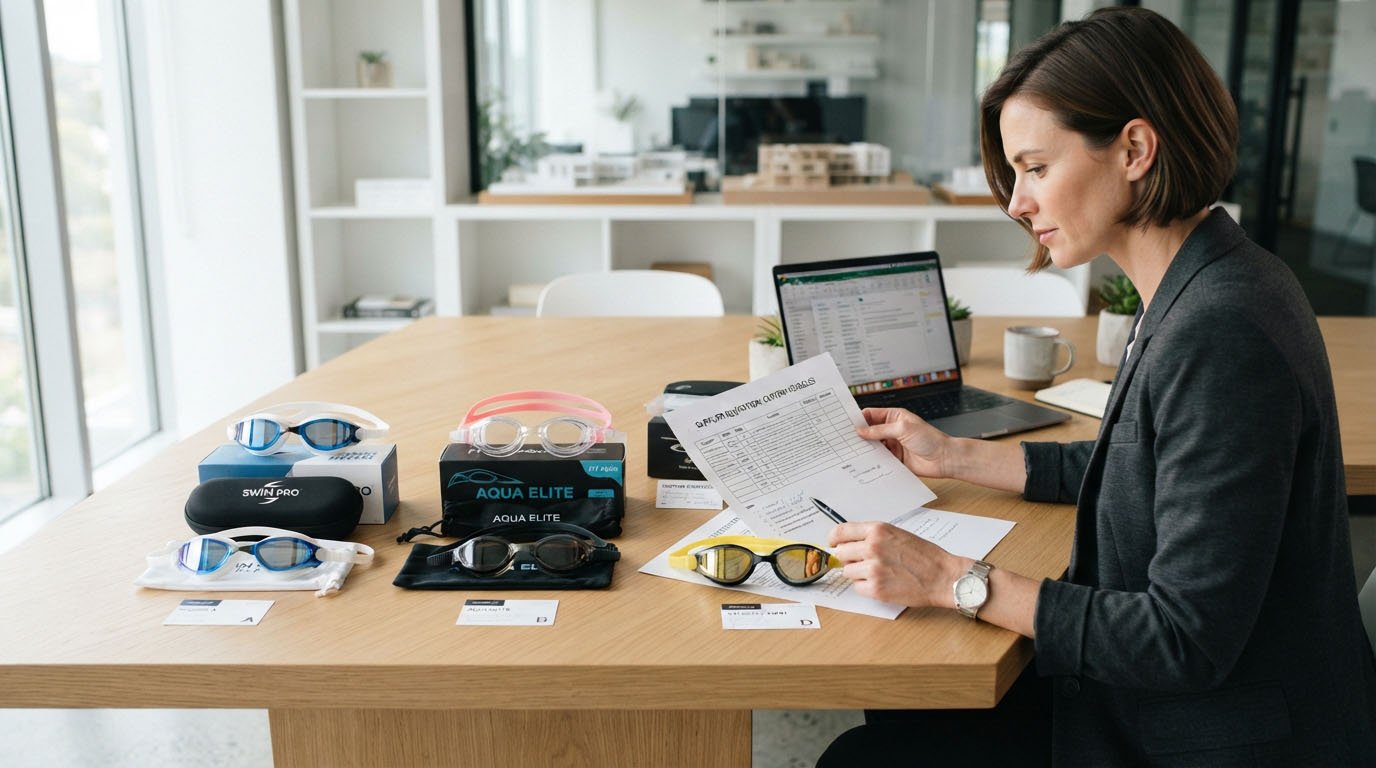
How can I compare quotes from different swimming goggle factories?
Send the same product specifications to each manufacturer and request an itemized quotation.
Confirm whether production, packaging, setup, sampling, testing, freight, and applicable tooling expenses are included.
Conclusion: Choose the Right Customization Route Before Comparing Prices
The cost of custom swimming goggles is determined by more than the factory unit price.
Customization depth, lens features, material selection, order quantity, packaging, and one-time charges all contribute to the total project investment.
For brands entering the market, private-label production using existing models is often the most economical starting point. Custom colors and performance upgrades provide additional differentiation, while new-mold OEM/ODM development offers greater design control at a higher upfront investment.
Before placing an order, compare manufacturers using consistent specifications and separate recurring production expenses from one-time development costs.
Looking for a custom swimming goggle manufacturer?
Jerry supports private-label, OEM, and ODM swimming goggle projects for brands, distributors, and retailers. Our team can help evaluate suitable product configurations, customization requirements, and manufacturing considerations.
Contact Jerry with your target quantity, product requirements, and customization details to request a project-specific quotation.