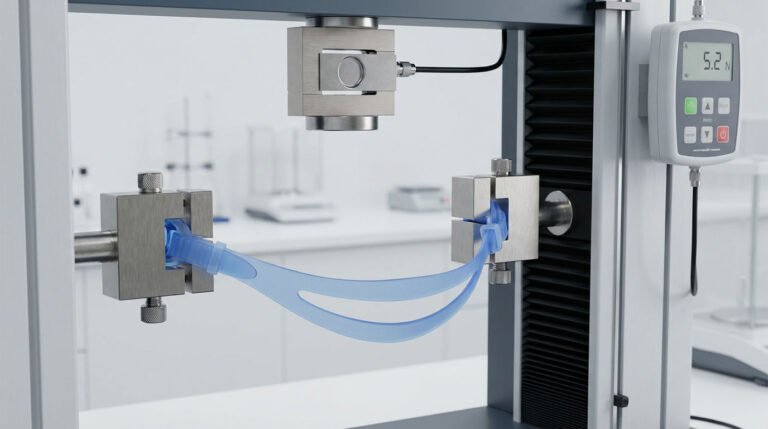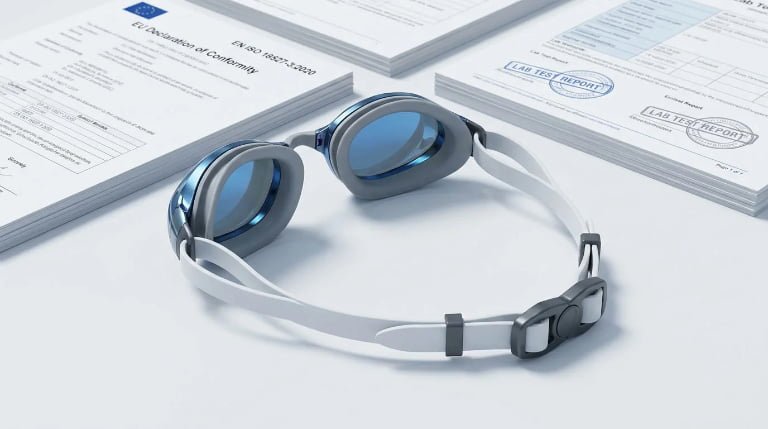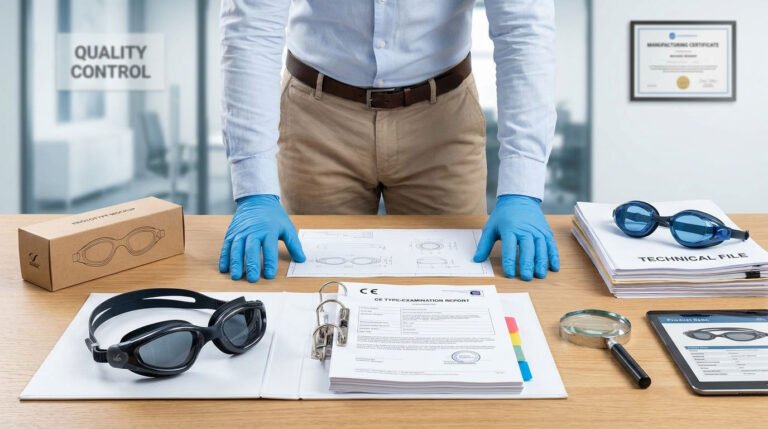
Launching swimming goggles into a new market can become expensive when compliance requirements are unclear. A product may perform well in the pool but still face delayed customs clearance, retailer rejection, additional laboratory testing, or packaging changes if the wrong regulatory path was followed.
There is no single certificate that makes swimming goggles compliant worldwide. Your compliance path depends mainly on four factors: where the goggles will be sold, whether they are intended for adults or children, their intended use, and the sales channel.
ISO 18527-3, CE marking, REACH, CPSIA, and the EU General Product Safety Regulation (GPSR) serve different purposes. They should not be treated as interchangeable certificates.
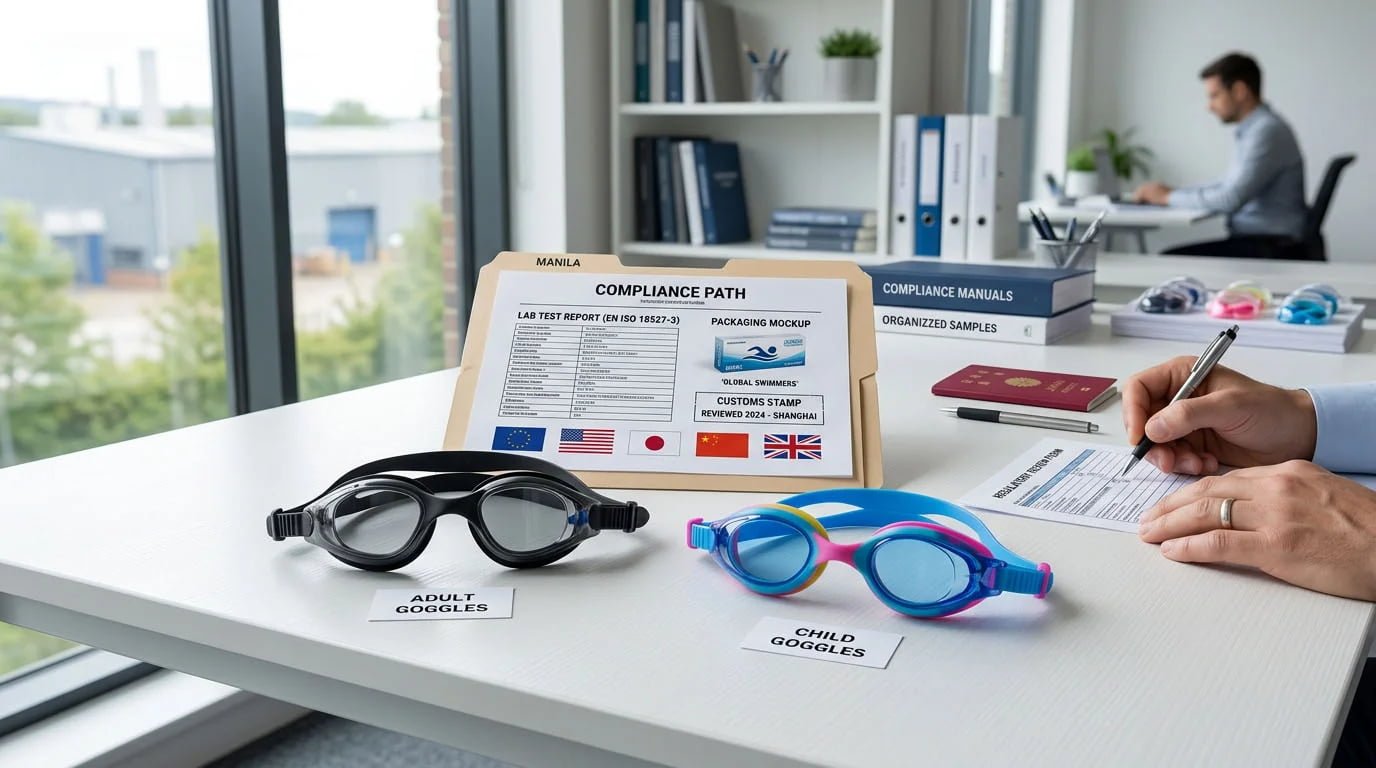
For brands developing custom products, compliance should therefore begin during product development—not after bulk production.
At Jerry, our OEM & ODM swimming goggles development process considers materials, product construction, target market, testing requirements, labeling, and production consistency before mass manufacturing.
Important: This guide is intended to explain the manufacturing and product-development side of swimming goggles compliance. Final legal requirements should always be confirmed with an accredited laboratory, qualified compliance specialist, or the relevant authority for your target market.
Quick Answer to Swimming Goggles Compliance
Swimming goggles compliance is a combination of technical standards, market-access rules, chemical restrictions, product-safety obligations, and documentation requirements.
The most important frameworks commonly encountered by international swimming-goggle buyers include:
| Standard / Regulation | Main Purpose | Typical Market |
|---|---|---|
| ISO 18527-3 | Technical requirements and test methods for surface-swimming eyewear | International |
| CE / EU PPE Regulation | EU conformity and market access where applicable | EU / EEA |
| REACH | Chemical restrictions and substance control | European Union |
| CPSIA | Children’s product safety requirements where applicable | United States |
| GPSR | General product safety, traceability and economic-operator obligations | European Union |
The key is not to collect every certificate available.
The key is to determine:
Product → User → Market → Applicable Rules → Testing → Documentation
before bulk manufacturing starts.
Why Should Compliance Start With Four Questions?
One of the most common sourcing mistakes is asking:
“What certificates do your swimming goggles have?”
before defining the actual product.
A better approach is to answer four questions first.
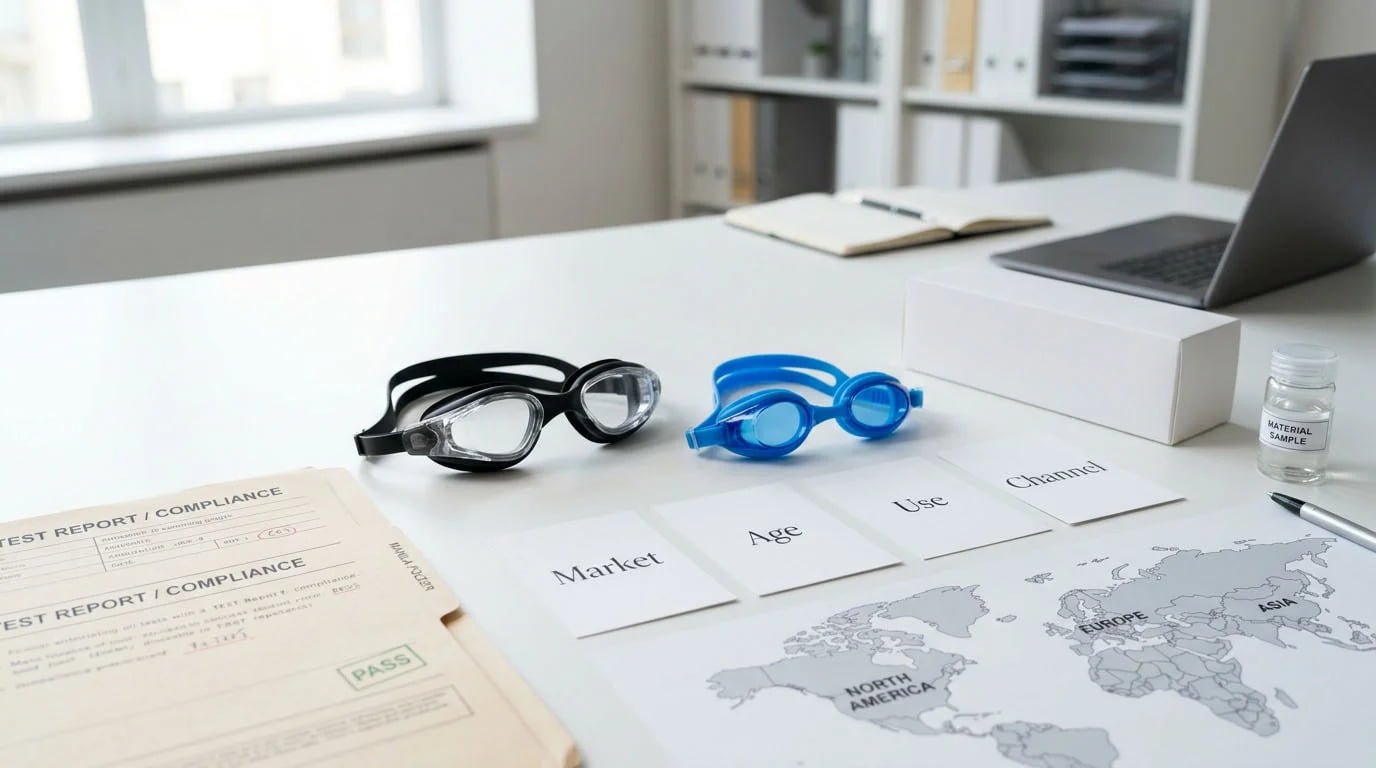
1. Where Will the Swimming Goggles Be Sold?
Your destination market determines which legal framework applies.
A pair of swimming goggles intended for Germany may follow a different compliance route from an equivalent product sold in the United States.
For example:
- EU sales may involve PPE conformity, CE marking, REACH and GPSR obligations.
- US children’s products may trigger applicable CPSC/CPSIA requirements.
- Great Britain has its own product-safety and conformity framework.
- Other markets such as Australia, Canada or Japan should be assessed separately.
Do not assume that a report prepared for one country automatically provides market access everywhere.
2. Are the Goggles Intended for Adults or Children?
Age classification can materially change the test plan.
Children’s products can face additional requirements relating to:
- accessible materials
- lead
- applicable chemical restrictions
- small parts
- warnings
- tracking information
- third-party testing
- certification
The exact requirements depend on both the jurisdiction and how the product is designed, marketed and classified.
This is one reason brands should decide their intended age group during development rather than after production.
3. What Is the Intended Use?
Not every product that looks like swimming eyewear should automatically follow the same pathway.
Consider whether the product is intended for:
- recreational pool swimming
- competitive swimming
- open-water swimming
- triathlon
- children’s recreational use
- prescription or corrective use
- diving or underwater activities
ISO 18527-3 specifically concerns eyewear intended for surface swimming. Products intended for diving or other activities may fall under different technical or regulatory frameworks.
This classification should therefore be confirmed before laboratory testing begins.
4. Where and How Will the Product Be Sold?
A product may need to satisfy more than statutory requirements.
Retailers, distributors and major e-commerce platforms can request additional documentation, such as:
- laboratory reports
- declarations
- product specifications
- traceability information
- packaging artwork
- factory audit information
- chemical declarations
- batch identification
For private-label brands, these requirements should be incorporated into the initial RFQ and sampling and prototyping process.
What Is ISO 18527-3 for Swimming Goggles?
ISO 18527-3 is the international standard covering requirements and test methods for eyewear intended for surface swimming.
It applies to both recreational and specialist competitive swimming eyewear and addresses areas including materials, construction and optical properties.
It is important to understand one distinction:
ISO 18527-3 is a technical standard. It is not, by itself, a universal market-access certificate.

What Does ISO 18527-3 Evaluate?
Depending on the product and test plan, laboratories may evaluate factors associated with:
- optical quality
- field of vision
- product construction
- mechanical performance
- lens performance
- headstrap and adjustment systems
- materials
- markings and information supplied by the manufacturer
Instead of guessing numerical limits from secondary online sources, brands should have their testing laboratory work from the applicable current version of the standard.
That becomes especially important when modifying:
- lenses
- gaskets
- headstraps
- buckles
- frame materials
- coatings
- color masterbatches
- tooling
A visually small product change can affect the validity or relevance of previous testing.
Is ISO 18527-3:2020 Still Current in 2026?
Yes.
ISO 18527-3:2020 was reviewed and confirmed in 2026 and remains current. ISO also published ISO 18527-3:2020/Amd 1:2025.
For brands preparing new testing programs, the practical lesson is simple:
Do not merely ask whether a factory has “an ISO test.”
Ask which edition and amendments were used, which SKU was tested, which materials and components were covered, and whether the report corresponds to the product you are purchasing.
Does ISO 18527-3 Mean the Goggles Can Be Sold Everywhere?
No.
Passing tests associated with ISO 18527-3 can provide important technical evidence, but legal market access depends on the destination country’s regulatory framework.
This is where buyers often confuse:
Standard
with:
Regulation
A standard describes technical requirements or testing methods.
A regulation creates legal obligations.
For an EU-bound product, for example, ISO testing may help support the conformity assessment, but the brand still needs to determine applicable EU legislation, technical documentation, declarations, markings and other obligations.
How Does CE Marking Apply to Swimming Goggles in the EU?
Swimming goggles marketed in the European Union should be assessed against the applicable EU product legislation, including the rules governing personal protective equipment where applicable.
CE marking is therefore not simply a laboratory certificate.
It represents a manufacturer’s declaration that the product conforms to the applicable EU requirements.

A compliance file may involve elements such as:
- product description
- design information
- applicable standards
- risk assessment
- laboratory evidence
- manufacturing information
- labeling
- instructions
- Declaration of Conformity
The exact conformity-assessment route depends on how the product is classified.
Brands should therefore avoid asking suppliers only:
“Can you provide CE?”
A better question is:
“Which EU legislation applies to this specific model, which standards support conformity, and what documentation is available for this exact product?”
For conventional swimming goggles, Regulation (EU) 2016/425 generally establishes the Category I PPE route. For specific Annex III documentation requirements, manufacturer obligations, and importer responsibilities, read our EU PPE Regulation 2016/425 guide for swimming goggles.
Is CE a Worldwide Swimming Goggles Certificate?
No.
A CE mark concerns applicable European Union legislation.
It does not automatically establish compliance in:
- the United States
- Canada
- Australia
- Japan
- other non-EU markets
Great Britain should also be assessed under its current product-marking framework rather than assuming that either CE or UKCA always applies in exactly the same way.
For buyers selling into multiple markets, the safer approach is to prepare a market-by-market compliance map before product testing.
How Does REACH Apply to Swimming Goggles?
Swimming goggles contain multiple materials that remain in prolonged contact with skin, including:
- silicone
- TPE
- rubber
- polycarbonate
- plastic buckles
- coatings
- inks
- elastic components
For products sold in the European Union, REACH chemical compliance should therefore be considered during material selection, rather than after bulk goods have already been produced.
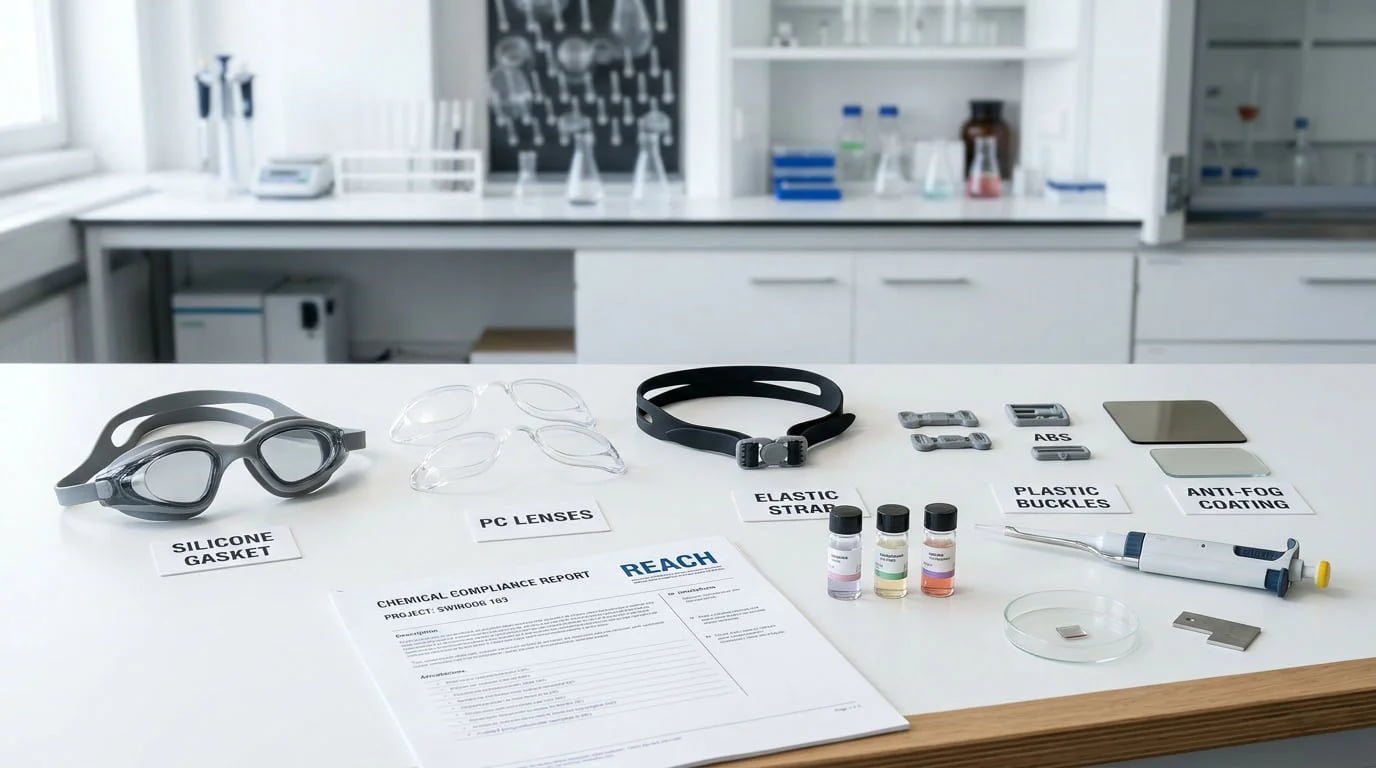
Relevant concerns may include restricted substances in particular materials, such as:
- certain phthalates
- PAHs
- heavy metals
- restricted substances in coatings or plastics
- Substances of Very High Concern where applicable
The actual test scope should be determined according to:
material + component + product + intended market
rather than using a generic “REACH certificate” for every model.
This is why material control matters.
If a brand changes a gasket compound, colored resin, strap material or printed decoration after approval, the new component may need to be reassessed.
Jerry’s Quality Assurance process is designed around incoming-material control, in-process inspection and finished-product verification so approved specifications are carried through production.
How Does CPSIA Apply to Children’s Swimming Goggles in the United States?
The United States requires special attention when swimming goggles are marketed as children’s products.
CPSIA and CPSC requirements can involve issues such as:
- lead limits in accessible components
- third-party testing for applicable children’s product safety rules
- Children’s Product Certificates where required
- tracking-label requirements
- applicable product-specific safety requirements
However, one important distinction is often missed:
CPSIA phthalate restrictions do not automatically apply to every product merely because it is intended for children.
The federal phthalate prohibitions specifically apply to children’s toys and child-care articles as defined under the applicable rules.
Therefore, a children’s swimming-goggle product should first be correctly classified.
Brands should not simply copy a generic toy-testing checklist without confirming whether the relevant rule applies.
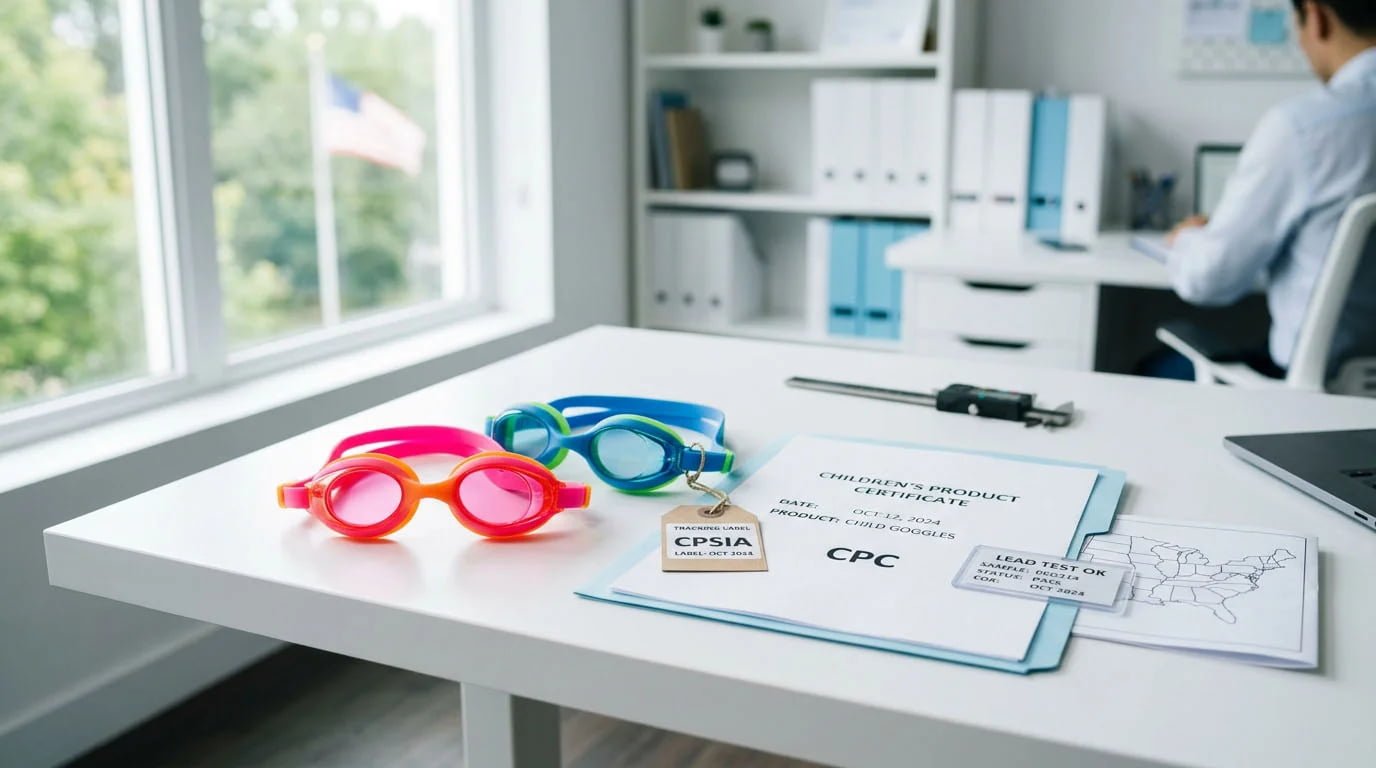
What About Lead and Tracking Labels for Children’s Products?
For applicable children’s products, accessible components are generally subject to federal lead-content requirements, although exclusions and material-specific rules may apply.
Tracking information is another important requirement.
Children’s products should carry permanent identifying marks on the product and its packaging, to the extent practicable.
Information should allow identification of factors such as:
- manufacturer or private labeler
- production location
- production date
- batch or run
This means brands should plan traceability before packaging artwork and mold details are finalized.
Waiting until goods are already packed can create unnecessary relabeling work.
What Does GPSR Mean for Swimming Goggles Sold in the EU?
The EU General Product Safety Regulation—Regulation (EU) 2023/988—has applied since 13 December 2024.
GPSR should not be thought of as another laboratory certificate.
It is a wider product-safety framework involving obligations such as:
- product safety
- traceability
- product identification
- economic-operator information
- warnings and safety information
- corrective actions
- obligations affecting online and distance sales
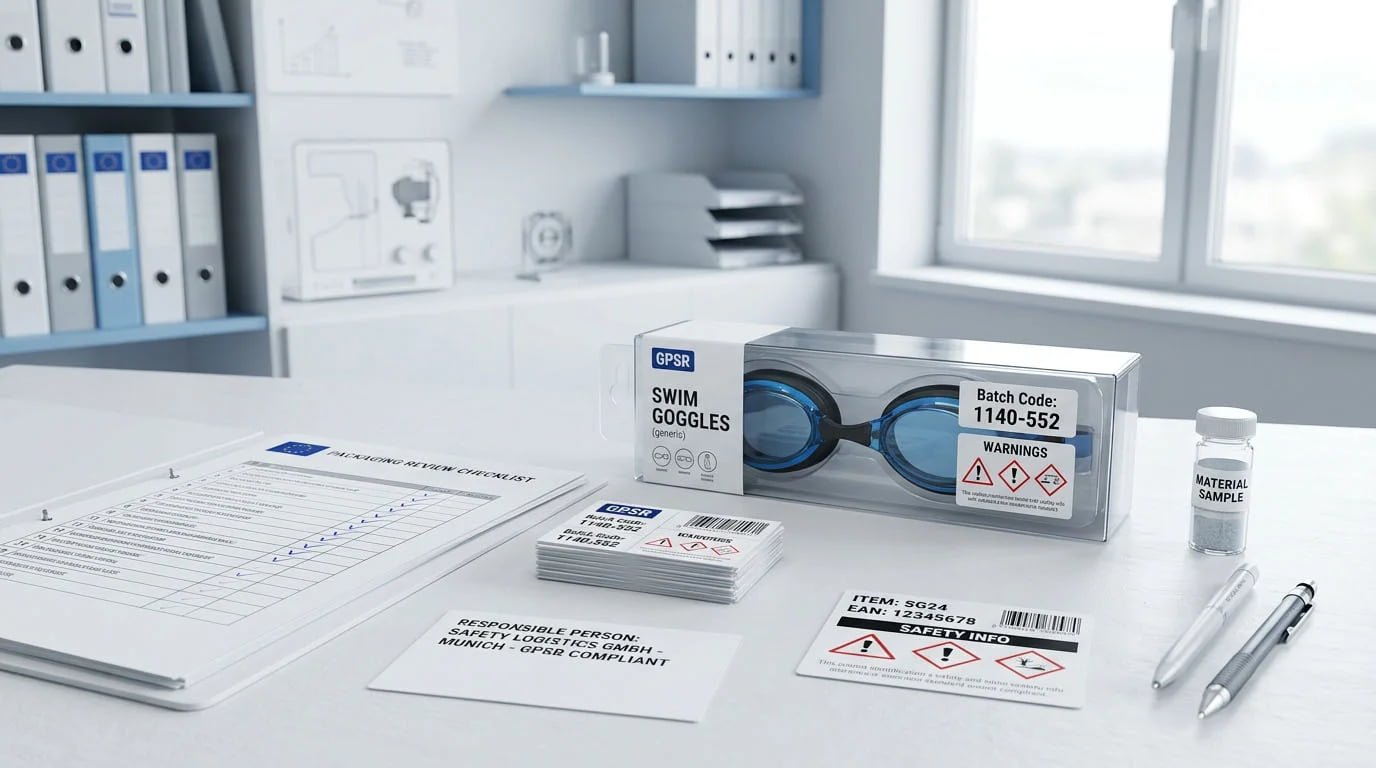
For products already subject to specific EU harmonisation legislation, GPSR interacts with that sector-specific framework rather than simply replacing it.
For a swimming-goggle brand, this means the compliance project should consider not only laboratory testing but also:
Who is responsible for the product in the EU?
Can each batch be traced?
Does the packaging contain the necessary identification?
Are required warnings and instructions available for the target market?
Do the online listing and physical product information align?
This is why GPSR needs to be addressed before shipment—not when an EU marketplace asks for documentation.
ISO vs CE vs REACH vs CPSIA vs GPSR: What Is the Difference?
The easiest way to understand the system is to separate the roles.
| Requirement | What It Mainly Does | What It Is Not |
|---|---|---|
| ISO 18527-3 | Defines technical requirements and test methods for surface-swimming eyewear | Universal sales license |
| CE | Demonstrates conformity with applicable EU legislation | Worldwide certificate |
| REACH | Controls chemical substances in the EU | Mechanical-performance test |
| CPSIA | Establishes applicable US children’s product safety requirements | EU regulation |
| GPSR | Provides EU general product-safety and traceability obligations | Single lab test |
So:
ISO tests the product. Regulations determine legal responsibilities. Documentation connects the two.
EU vs US Swimming Goggles Compliance: What Changes?
A simplified planning comparison looks like this:
| Compliance Area | European Union | United States |
|---|---|---|
| Technical eyewear testing | ISO 18527-3 may be relevant | Product/risk-dependent |
| Market conformity | Applicable EU PPE / CE route | No CE requirement |
| Chemical safety | REACH | Applicable federal/state rules |
| Children’s products | EU product rules + applicable safety requirements | CPSIA / CPSC rules where applicable |
| General consumer safety | GPSR | US consumer-product framework |
| Traceability | EU product/GPSR requirements | Children’s product tracking requirements where applicable |
This table should be treated as a planning tool rather than a substitute for a product-specific compliance assessment.
When Should Swimming Goggles Be Retested?
There is no universal rule saying every swimming-goggle model must automatically undergo complete retesting every fixed number of months.
The more important question is:
Has anything changed that can affect compliance?
Reassessment may be appropriate after changes involving:
- lens material
- lens coating
- silicone formulation
- TPE formulation
- headstrap material
- buckles
- pigments
- printed inks
- adhesives
- mold dimensions
- component supplier
- manufacturing process
- intended age grading
- product claims
- target market
A previous test report is most valuable when the production model still matches the tested sample.
This is where specification control becomes critical.
What Documents Should You Request From a Swimming Goggles Manufacturer?
This is one of the most useful procurement checks a brand can perform.
Before bulk manufacturing, ask your supplier which documents are available for the specific product you plan to buy.
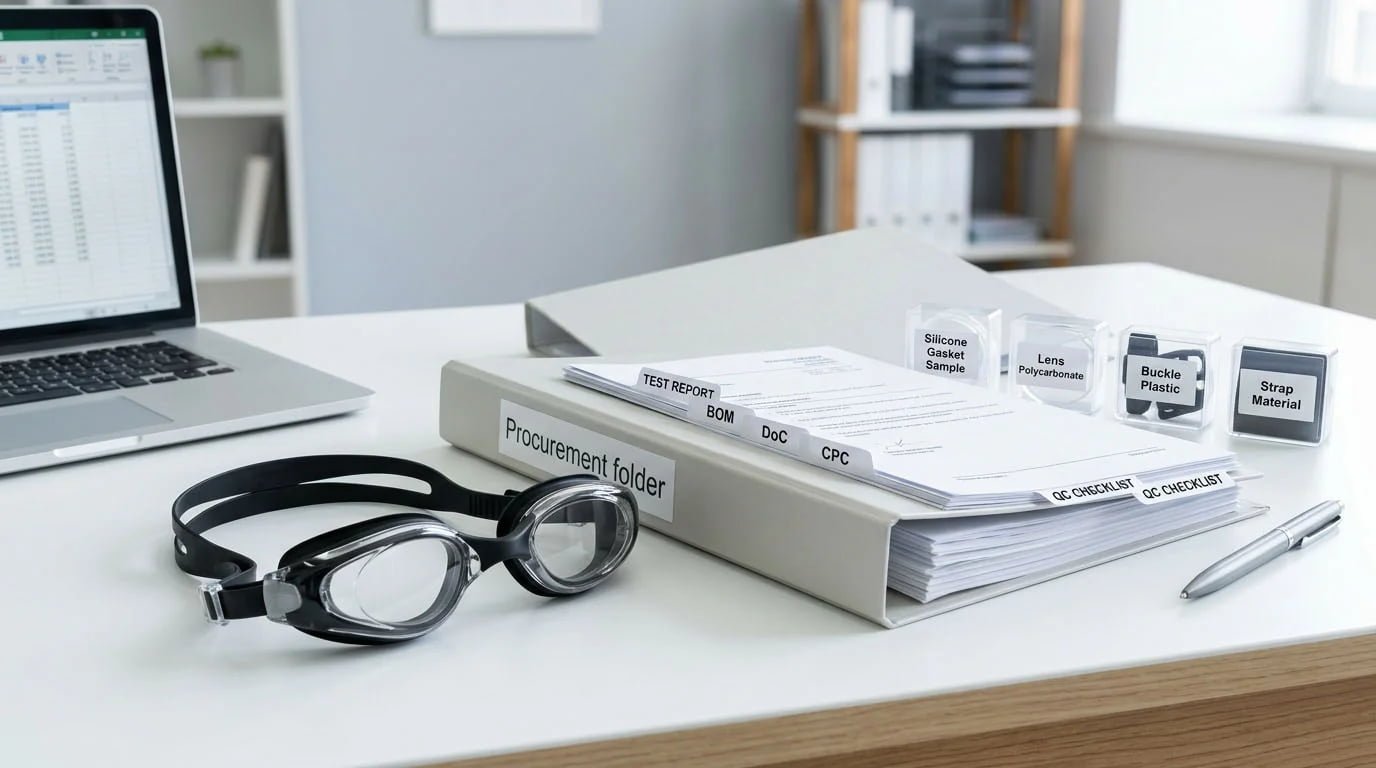
Depending on the market and product, your file may include:
Product and Technical Information
- product specification sheet
- material specification
- bill of materials where appropriate
- drawings or approved dimensions
- approved color and component standards
Laboratory Documentation
- applicable ISO testing reports
- chemical test reports
- material test reports
- other market-specific laboratory reports
Compliance Documentation
Where applicable:
- Declaration of Conformity
- Children’s Product Certificate
- supplier declarations
- responsible economic-operator information
- traceability records
Production Documentation
- approved golden sample
- batch number
- incoming inspection records
- in-process QC records
- final inspection report
- component-change records
Packaging Documentation
- approved artwork
- warnings
- model identification
- batch information
- market-specific labels
- importer or responsible-party details where required
The goal is not to collect a folder of unrelated certificates.
The goal is to build a traceable link between:
Approved Product → Tested Product → Bulk Product → Compliance Documents
That is much more valuable to a brand than receiving an old laboratory report for a vaguely similar goggle.
Why Should Testing Be Planned Before Bulk Production?
Compliance testing becomes significantly more expensive when it begins after production.
Imagine approving a custom swimming goggles model, ordering packaging and producing the full quantity before discovering that one material needs changing.
A single component replacement can affect:
- fit
- appearance
- chemical compliance
- previous testing
- labeling
- production schedule
The more efficient path is:
Target Market
↓
Product Classification
↓
Materials & Specifications
↓
Prototype
↓
Compliance Testing
↓
Packaging / Documentation
↓
Pre-Production Approval
↓
Bulk Production
This is why Jerry integrates compliance planning with sampling and prototyping rather than treating testing as a final shipping step.
How Can Private-Label Brands Reduce Compliance Risk?
Private-label brands should make compliance part of supplier selection.
Before placing an order, ask:
- Which markets has this exact product been tested for?
- Which standard edition appears on the report?
- Does the report match the current material specification?
- Which laboratory performed the testing?
- Which SKU or model was actually tested?
- Have any materials or suppliers changed since testing?
- Can the factory support additional testing if required?
- How are production batches traced?
- How are approved materials controlled?
- Who reviews packaging and labeling before production?
For brands building a new collection, Jerry’s Private Label service can integrate product customization with sampling, material selection, manufacturing and packaging development.
Swimming Goggles Compliance Checklist Before Mass Production
Before releasing a PO for mass manufacturing, confirm:
- [ ] Target market is defined
- [ ] Intended age group is defined
- [ ] Intended use is defined
- [ ] Product classification has been reviewed
- [ ] Applicable standards/regulations are identified
- [ ] Materials are locked
- [ ] Components are approved
- [ ] Prototype is finalized
- [ ] Required laboratory testing is completed or scheduled
- [ ] Test reports match the production specification
- [ ] Packaging artwork has been reviewed
- [ ] Required warnings and instructions are included
- [ ] Traceability method is established
- [ ] Required declarations/certificates are prepared
- [ ] Bulk QC plan is confirmed
This checklist should be completed before, not after, mass production begins.
Frequently Asked Questions
Do Swimming Goggles Need ISO 18527-3 Certification?
ISO 18527-3 provides requirements and test methods for eyewear intended for surface swimming.
Whether and how it should be used for your product depends on the destination market and applicable legal framework.
A laboratory report against the standard should not be confused with a worldwide sales certificate.
Do I Need ISO, CE, REACH, CPSIA and GPSR for Every Pair of Swimming Goggles?
No.
You need the requirements that apply to your:
market + product classification + user group + materials + sales method.
An adult swimming goggle sold in Europe does not automatically follow the same compliance path as a children’s product sold in the United States.
Does CE Cover the United States?
No.
CE marking relates to applicable European Union legislation and does not replace US product-safety requirements.
Does CPSIA Apply to Every Swimming Goggle?
Not in the same way.
CPSIA is particularly important for products classified as children’s products, but individual requirements still need to be evaluated.
For example, federal phthalate restrictions specifically apply to children’s toys and child-care articles rather than automatically to every children’s product.
Does GPSR Replace CE?
No.
GPSR and sector-specific EU product legislation serve different functions.
GPSR strengthens the EU’s overall consumer-product safety, traceability and economic-operator framework; it does not simply replace applicable PPE conformity obligations.
Can We Use One Swimming Goggles Test Report for Multiple Colors?
Possibly, but it depends on what changes between variants.
Different pigments, inks, coatings or materials may affect chemical or technical testing requirements.
Confirm the scope with the laboratory rather than assuming every colorway is automatically covered.
Can a Manufacturer Guarantee Regulatory Approval?
A manufacturer can support product development, material control, testing coordination, production documentation and QC.
However, final legal responsibility and applicable compliance routes depend on the product, market and economic operator involved.
Final requirements should be confirmed with the relevant laboratory or compliance professional.
Conclusion
Swimming goggles compliance is not about collecting as many certificates as possible.
It is about correctly matching:
the product
to:
the market
and then building the right combination of:
technical testing + chemical control + documentation + labeling + traceability + production consistency.
For most brands, the best starting point is to answer four questions:
- Where will the goggles be sold?
- Are they intended for adults or children?
- What is their intended use?
- Which channel will sell them?
Once those questions are clear, ISO 18527-3, CE, REACH, CPSIA and GPSR become much easier to map correctly.
Jerry supports global brands, distributors and private-label buyers with in-house product development, mold development, injection molding, silicone manufacturing, anti-fog processing, assembly and multi-stage quality control.
If you are developing a new swimming-goggle collection, define the target market and compliance path during sampling—not after the production line starts.
Contact Jerry to discuss your swimming-goggle specifications, target market, testing plan and production requirements.