
You can choose a globally recognized testing company and still end up with the wrong report.
The problem is rarely the logo on the laboratory report. The real questions are whether the specific laboratory facility can test your required scope, whether it uses the correct standard and revision, and whether your buyer or target market will accept the final documentation.
Choosing between SGS, Intertek, TÜV, and Bureau Veritas for swim goggle testing is therefore not a simple brand-ranking exercise. The right laboratory depends on your destination market, product type, required test scope, applicable standards, buyer requirements, and the capabilities of the specific facility performing the work.
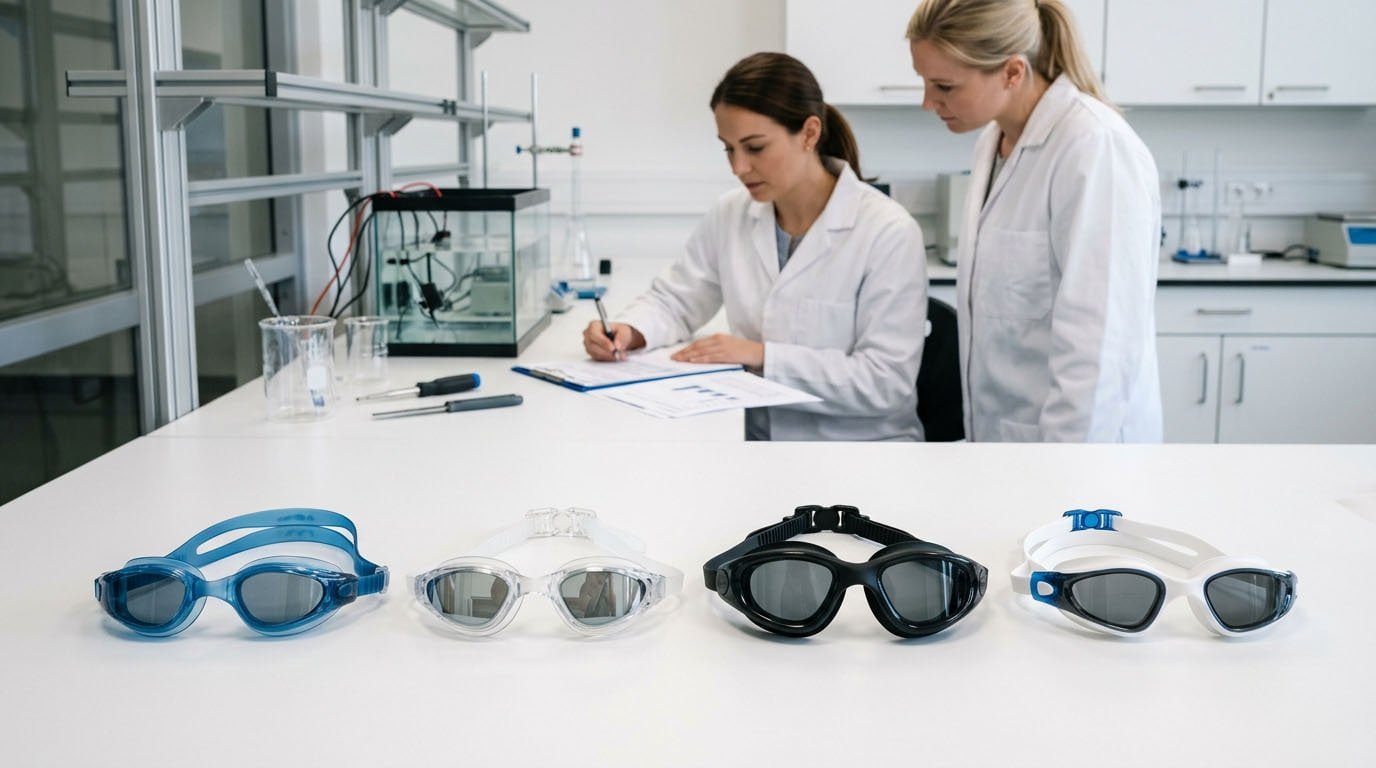
If you are developing custom swimming goggles, private-label products, or an OEM & ODM swim goggle program, this guide explains how to compare these major testing organizations without choosing a laboratory based on reputation alone.
Quick Answer: SGS vs Intertek vs TÜV vs Bureau Veritas — Which Is Best for Swim Goggles?
There is no universal best laboratory for every swim goggle project.
SGS, Intertek, TÜV organizations, and Bureau Veritas all operate large international testing networks. What matters is whether the specific branch or facility you intend to use can perform your required tests under the correct standards and whether its report meets the requirements of your buyer, retailer, marketplace, or destination market.
Before choosing a laboratory, confirm:
- Which market will the goggles be sold in?
- What standard or buyer protocol applies?
- Which version or amendment of the standard is required?
- Does the named laboratory facility have the relevant accredited scope?
- Which tests are performed in-house?
- Will any test items be subcontracted?
- What samples and material information are required?
- Will the buyer or other accepting party recognize the resulting report?
- What happens if one test item fails and needs to be repeated?
The best choice is therefore not necessarily SGS, Intertek, TÜV, or Bureau Veritas as a group.
It is the specific laboratory facility that best matches your project.
Why Does the Laboratory Matter So Much for Swim Goggle Compliance?
A swim goggle test report is useful only when it answers the right compliance question.
A globally recognized testing company may have hundreds of facilities, but each facility can have different:
- equipment;
- accredited scopes;
- technical teams;
- test methods;
- standard coverage;
- subcontracting arrangements;
- scheduling capacity.
That means a laboratory that works perfectly for one swim goggle project may not be the right choice for another.
The Real Risk Is Not Choosing the “Wrong Brand”
The bigger risk is choosing a facility before confirming the test scope.
For example, a project can run into problems when:
- the requested standard revision is not covered;
- some tests need to be transferred to another facility;
- the quotation does not include every required test;
- the buyer expects a different protocol;
- material testing is added only after physical testing begins;
- the submitted samples are insufficient;
- the final report format does not meet the accepting party’s requirements.
Any of these issues can lead to additional samples, repeat quotations, retesting, or launch delays.
That is why laboratory selection should be treated as risk management, not a contest between famous testing brands.
SGS vs Intertek vs TÜV vs Bureau Veritas: What Are the Real Differences?
It is tempting to build a comparison table that says:
- SGS is best for one market;
- Intertek is best for another;
- TÜV is stronger for a certain test;
- Bureau Veritas is better for another region.
That type of comparison is often too simplistic.
The service that matters to you is delivered by a specific laboratory location, not by the corporate logo alone.
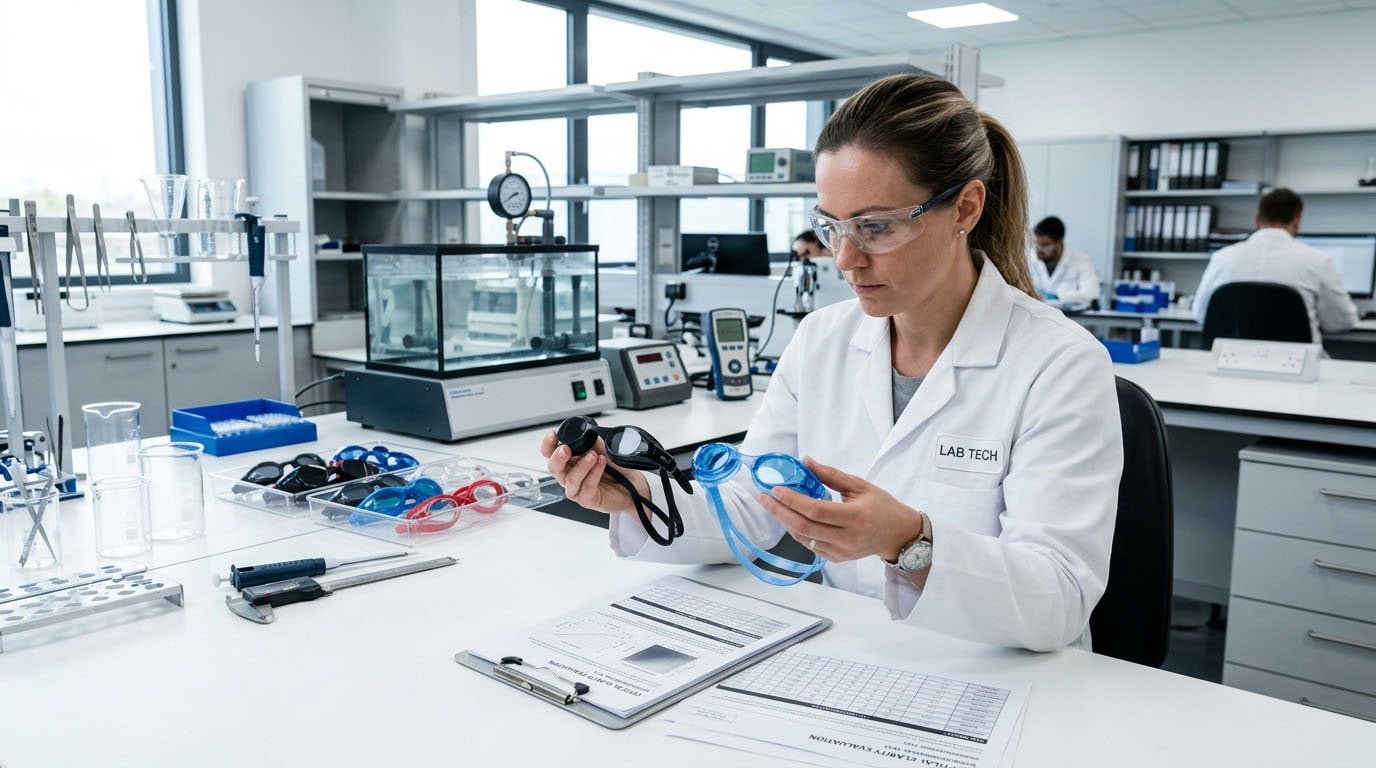
Compare the Facility, Not Just the Logo
When comparing SGS, Intertek, TÜV, and Bureau Veritas, ask for the exact facility that will conduct the work.
Then compare:
| Factor | What You Need to Confirm | Why It Matters |
|---|---|---|
| Laboratory location | Exact testing facility | Capabilities can vary between branches |
| Standard coverage | Standard and current revision | Prevents testing against the wrong specification |
| Accredited scope | Relevant test methods within the facility’s scope | Helps verify technical competence for the required work |
| In-house capability | Which tests are performed at that facility | Reduces unexpected transfers and coordination |
| Subcontracting | Which tests, if any, go elsewhere | Can affect communication and timing |
| Sample requirements | Number, configuration, colors and materials | Prevents incomplete submissions |
| Report purpose | Compliance, buyer approval, development testing, etc. | Determines what documentation is actually needed |
| Buyer acceptance | Whether the final accepting party approves the lab/report | Avoids paying for an unusable report |
| Retest process | What happens if one clause fails | Helps manage cost and schedule risk |
This comparison method is much more useful than trying to declare one global testing organization the winner.
Why Is ISO/IEC 17025 Important When Choosing a Swim Goggle Laboratory?
One term you will frequently see when discussing third-party testing is ISO/IEC 17025.
ISO/IEC 17025 specifies general requirements for the competence of testing and calibration laboratories.
However, simply asking:
“Is your laboratory ISO/IEC 17025 accredited?”
is not always enough.
A more useful question is:
“Does this specific facility’s accredited scope cover the test method or standard relevant to my swim goggle project?”
Accreditation Should Be Checked at Facility and Scope Level
The existence of ISO/IEC 17025 accreditation does not mean every laboratory within an international group can perform every type of test.
For your project, request information such as:
- the exact laboratory name and address;
- its accreditation information;
- the relevant scope of accreditation;
- the applicable test standard;
- whether your requested test method is included;
- whether any part of the project will be subcontracted.
This gives your compliance or sourcing team something concrete to verify before samples are shipped.
For brands working with a manufacturer, this laboratory verification should sit alongside the factory’s own quality assurance process. Third-party testing and factory QC serve different purposes, but both are important for reducing avoidable compliance problems.
What Standard Is Relevant to Surface Swimming Goggles?
One important international standard for swimming eyewear is:
ISO 18527-3:2020 — Eye and face protection for sports use — Part 3: Requirements and test methods for eyewear intended to be used for surface swimming.
The standard covers eyewear intended for surface swimming and addresses areas including materials, construction, optical properties, test methods, marking, and information supplied by the manufacturer.
An amendment, ISO 18527-3:2020/Amd 1:2025, has also been published.
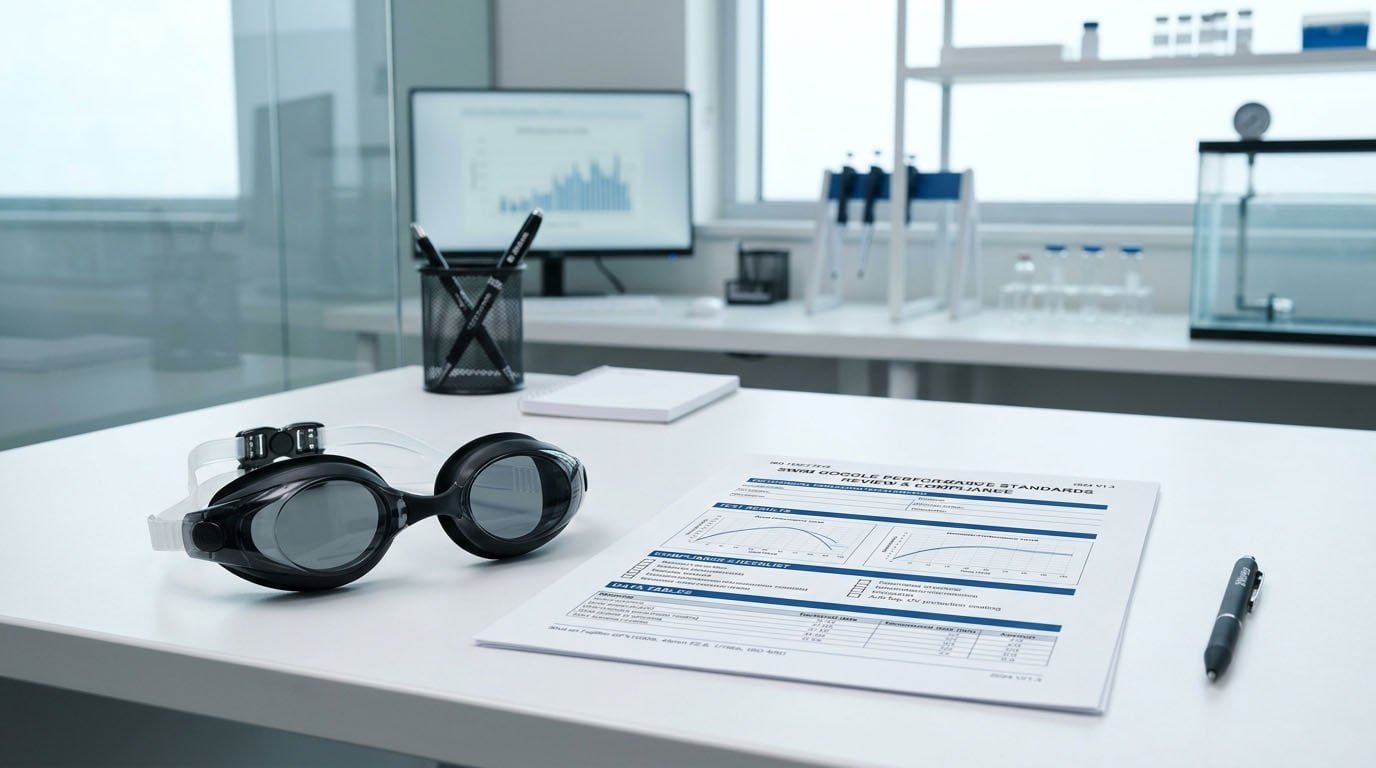
Do Not Put Only the Standard Number on Your RFQ
A stronger testing request identifies:
- the full standard;
- applicable amendment or revision;
- destination market;
- product type;
- intended user;
- product claims;
- buyer-specific requirements;
- additional chemical or material requirements where applicable.
Standards and commercial requirements can change.
Before submitting production samples, confirm the required version with your laboratory and the party that will ultimately accept the report.
What Swim Goggle Tests Should You Discuss With the Laboratory?
The exact test program depends on the product, target market, intended user, materials, claims, and buyer requirements.
Instead of assuming every swim goggle project needs exactly the same package, divide the discussion into several test categories.
1. Construction and Mechanical Performance
Depending on the applicable standard or buyer protocol, areas may include:
- lens and frame construction;
- strap and adjustment system performance;
- bridge construction;
- durability;
- mechanical strength;
- resistance to expected stresses;
- component security.
The purpose is not simply to determine whether a goggle “feels strong.”
The test must follow the applicable method and acceptance criteria.
2. Optical Performance
For swimming eyewear, optical performance can be just as important as mechanical construction.
Relevant requirements may involve areas such as:
- optical properties;
- lens quality;
- field of vision;
- distortion or optical effects;
- transmission characteristics where applicable.
The exact scope should come from the applicable standard and product claims rather than from a generic eyewear checklist.
3. Water and Use-Related Performance
Swimming goggles operate in a very different environment from ordinary fashion eyewear.
Depending on the protocol, evaluation may consider product characteristics related to use in water, construction, sealing, or durability.
If your buyer has additional performance requirements beyond regulatory or standard-based testing, identify them separately.
Do not assume that a standard compliance test automatically covers every marketing or performance claim your brand wants to make.
4. Materials and Chemical Testing
Physical performance and chemical compliance are not the same thing.
A project may also require evaluation of materials or restricted substances depending on:
- destination market;
- age group;
- material composition;
- skin-contact components;
- buyer requirements;
- retailer protocols;
- applicable chemical regulations.
Possible areas can include restricted substances relevant to plastics, elastomers, coatings, pigments, or other components.
The correct panel should be determined from the actual bill of materials and compliance requirements, rather than by automatically ordering the largest possible chemical package.
A Better Approach: Share the BOM Early
Before requesting a quotation, prepare information such as:
| Component | Typical Information to Provide |
|---|---|
| Lens | Material, color/tint, coating |
| Gasket / seal | Material and color |
| Strap | Material and color |
| Buckles / adjusters | Material |
| Nose bridge | Material and construction |
| Printed logo | Ink or printing process |
| Coating | Anti-fog or other functional treatment |
| Packaging | If packaging testing is required |
Providing accurate material information helps the laboratory define a more appropriate testing scope.
It also helps during sampling and prototyping, when material, lens, gasket, strap, and coating decisions can still be adjusted before final production samples are submitted for third-party testing.
In-House vs Subcontracted Testing: Why Should Buyers Ask?
One of the most useful questions to ask any laboratory is:
“Will every test in this quotation be performed at the named facility?”
If the answer is no, ask:
“Which items will be subcontracted or transferred to another laboratory?”
Subcontracting is not automatically a problem.
International testing organizations routinely operate networks of specialized laboratories.
The problem is not knowing about it before the project starts.
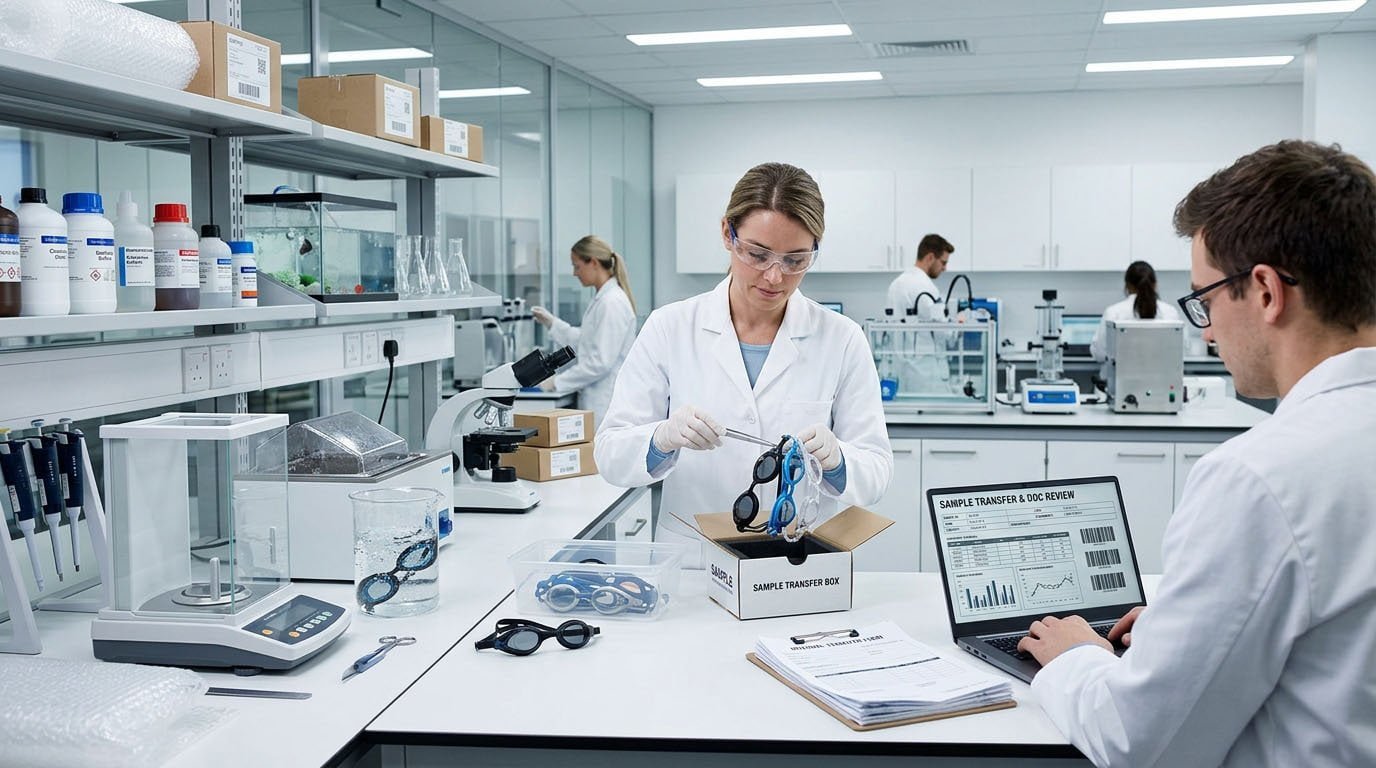
Why In-House Capability Can Simplify a Project
When more of the required scope is available within the same facility or coordinated laboratory system, it may simplify:
- sample handling;
- technical communication;
- quotation clarification;
- failed-item investigation;
- retest coordination;
- report consolidation.
If part of the testing is transferred elsewhere, simply build that into your planning.
Ask:
- Where will the test actually be performed?
- Is the receiving laboratory accredited for the relevant scope?
- Do additional samples need to be sent?
- Will the transfer change the quoted turnaround?
- Will the result appear within one consolidated report?
- Who is responsible for technical communication?
These questions help remove uncertainty before testing begins.
How Should You Compare SGS, Intertek, TÜV, and Bureau Veritas Quotations?
Do not compare the final price at the bottom of four quotations until you know the quotations cover the same work.
A lower quotation may simply contain fewer test items.
Compare Apples to Apples
Before comparing prices, normalize the quotations.
| Quotation Item | SGS | Intertek | TÜV | Bureau Veritas |
|---|---|---|---|---|
| Named testing facility | Confirm | Confirm | Confirm | Confirm |
| Standard | Confirm | Confirm | Confirm | Confirm |
| Standard revision/amendment | Confirm | Confirm | Confirm | Confirm |
| Accredited scope | Confirm | Confirm | Confirm | Confirm |
| Physical/mechanical scope | Confirm | Confirm | Confirm | Confirm |
| Optical scope | Confirm | Confirm | Confirm | Confirm |
| Chemical/material scope | Confirm | Confirm | Confirm | Confirm |
| Tests performed in-house | Confirm | Confirm | Confirm | Confirm |
| Subcontracted tests | Confirm | Confirm | Confirm | Confirm |
| Samples required | Confirm | Confirm | Confirm | Confirm |
| Estimated turnaround | Confirm | Confirm | Confirm | Confirm |
| Retest policy | Confirm | Confirm | Confirm | Confirm |
| Final report format | Confirm | Confirm | Confirm | Confirm |
| Buyer acceptance | Confirm | Confirm | Confirm | Confirm |
Only after these rows match does the total quotation become useful for comparison.
Why Is the Cheapest Swim Goggle Testing Quote Not Always the Lowest-Cost Option?
Testing cost is only one part of compliance cost.
The real project cost can also include:
- additional samples;
- sample preparation;
- international shipping;
- repeat testing;
- engineering changes;
- new molds or components;
- material replacement;
- production delays;
- delayed customer approval.
Suppose Laboratory A appears cheaper, but part of the required scope was not included.
Laboratory B may look more expensive because the quotation includes the complete scope.
The first quotation is not necessarily cheaper.
It may simply be incomplete.
Compare Total Project Risk
A stronger purchasing question is therefore:
Which quotation gives us the clearest path to an acceptable final report with the lowest reasonable risk of repeat work?
That question is much more useful than:
“Which laboratory has the lowest testing fee?”
What Information Should You Send When Requesting a Swim Goggle Testing Quote?
A vague RFQ produces a vague quotation.
Instead of emailing:
“Please quote swim goggle testing.”
send a structured project brief.
Swim Goggle Laboratory RFQ Checklist
Include:
Product
- Product name
- Model/style number
- Adult or children’s product
- Recreational, training, racing, or other intended use
- Prescription or non-prescription where relevant
Market
- Destination country or region
- Retailer or buyer
- Sales channel if it creates additional requirements
Standards
- Known applicable standard
- Required revision/amendment
- Buyer testing protocol if available
Materials
- Bill of materials
- Lens material
- Gasket material
- Strap material
- Buckle/bridge materials
- Coatings
- Printing
- Color variations
Testing
- Requested physical tests
- Optical tests
- Chemical tests
- Product claims requiring verification
Commercial Questions
- Sample quantity
- Testing location
- In-house vs subcontracted scope
- Estimated turnaround
- Retest policy
- Report format
- Quote validity
The more complete your RFQ is, the easier it becomes to compare laboratories fairly.
Brands starting a new product can also coordinate these requirements during the manufacturer’s OEM & ODM development process instead of waiting until bulk production is already underway.
How Should You Choose the Right Laboratory Step by Step?
You do not need to guess which global laboratory brand is “best.”
Use a repeatable decision process.
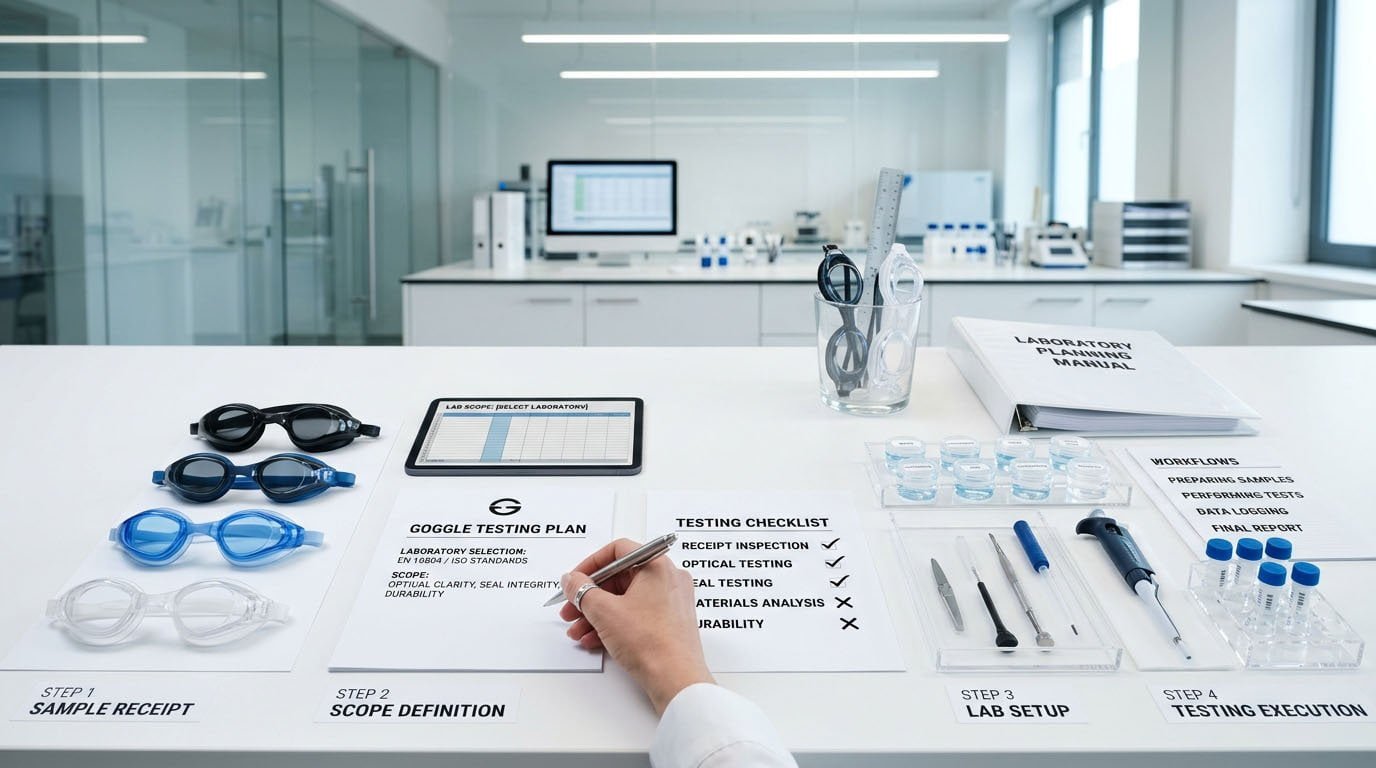
Step 1: Define the Destination Market
Start with where the goggles will actually be sold.
Do not start by asking laboratories for generic “international certification.”
Step 2: Identify the Final Accepting Party
Who needs the report?
It might be:
- your customer;
- a retailer;
- an importer;
- a marketplace;
- a distributor;
- another compliance stakeholder.
Ask whether they have specific laboratory, accreditation, report, or protocol requirements.
Step 3: Define the Applicable Standard and Revision
Write down the exact standard and, where relevant, amendments.
Do not rely on an old report from a previous product without verifying whether the requirements remain current.
Step 4: Define the Full Test Scope
Separate the project into:
- physical/mechanical;
- optical;
- material/chemical;
- claim-specific;
- buyer-specific testing.
This prevents missing items in the initial quotation.
Step 5: Check the Named Laboratory Facility
For each option, confirm:
- facility location;
- accreditation;
- relevant accredited scope;
- available test methods;
- in-house capability;
- subcontracting.
Step 6: Compare Equivalent Quotations
Normalize all quotations before comparing cost.
A quotation covering 12 requirements cannot be compared directly with one covering only eight.
Step 7: Prepare Samples and Documentation
Confirm:
- quantity;
- colors;
- variants;
- material information;
- packaging requirements;
- labeling;
- technical documentation.
Do this before production samples are shipped.
For a newly developed design, completing these decisions during sampling and prototyping helps ensure that the samples sent to the laboratory are representative of the intended production product.
Step 8: Pre-Screen High-Risk Areas
Where practical, manufacturers can conduct internal checks during development and pre-production.
Factory pre-testing does not replace accredited third-party testing.
Its value is different: it can identify obvious design, material, construction, or process problems before final samples reach the external laboratory.
At Jerry, we view compliance as something that should be considered during product development—not only after finished goggles have been packed for shipment. Our quality assurance process is designed to control materials, components, assembly, and finished-product consistency before products move to the next stage.
7 Common Mistakes When Choosing a Swim Goggle Testing Laboratory
1. Choosing by Brand Name Alone
SGS, Intertek, TÜV, and Bureau Veritas are large organizations.
But the relevant question is:
Can this specific facility perform my exact scope?
2. Not Confirming the Standard Revision
A standard number alone may not be enough.
Confirm the version and applicable amendment before testing.
3. Assuming Every Branch Has the Same Capabilities
Testing capability can vary by facility.
Always identify the actual laboratory location.
4. Comparing Quotes Without Comparing Scope
A cheaper quotation may simply exclude tests included in another quote.
Normalize the scope first.
5. Ignoring Subcontracted Testing
Ask where each test will physically be performed.
Subcontracting can be perfectly acceptable, but it should not surprise you after sample submission.
6. Sending Samples Before Confirming Requirements
Do not ship samples until you have confirmed:
- scope;
- standard;
- laboratory;
- sample quantity;
- variants;
- material information.
7. Treating a Test Report as the Same Thing as Certification
A laboratory test report documents test results for the submitted samples and specified test scope.
That does not automatically mean the product has received every certification, approval, registration, or conformity assessment that may apply to its market.
Always confirm exactly what documentation your project requires.
SGS vs Intertek vs TÜV vs Bureau Veritas: A Practical Decision Matrix
Instead of ranking the four companies from first to fourth, use a project-specific decision matrix.
| Decision Question | What a Strong Laboratory Option Looks Like |
|---|---|
| Does the buyer accept the report? | Written confirmation where possible |
| Does the facility cover the required standard? | Correct standard and revision confirmed |
| Is the relevant scope accredited? | Scope can be verified |
| Are key tests performed in-house? | Clear testing location |
| Is subcontracting transparent? | Subcontracted items identified before booking |
| Is the quote complete? | Physical, optical, chemical and buyer-specific items clearly separated |
| Are sample requirements clear? | Quantity and variants defined |
| Is technical communication responsive? | Questions receive specific answers |
| Is the retest process clear? | Failure and retest procedure explained |
| Is the report suitable for its intended purpose? | Final accepting party agrees |
The laboratory that best satisfies these conditions for your project is usually the stronger choice.
It may be SGS on one project and Intertek, TÜV, or Bureau Veritas on another.
Let the project requirements choose the laboratory.
What Should Swim Goggle Brands Ask Their Manufacturer Before Third-Party Testing?
Laboratory selection is only half of the compliance process.
The product must also be ready.
Before final testing, ask your swim goggle manufacturer:
Have the materials been finalized?
Changing lens, silicone, strap, pigment, coating, or printing materials after testing can create unnecessary compliance questions.
Is the tested sample representative of production?
A beautifully prepared prototype is not useful if bulk production will use different materials or construction.
Are colors and material variations documented?
Different formulations may matter for material testing.
Have high-risk components been checked internally?
Pay particular attention to:
- lenses;
- straps;
- adjusters;
- bridges;
- seals/gaskets;
- coatings;
- printed areas.
Can the factory provide supporting material information?
Good documentation makes laboratory communication easier.
If you are evaluating manufacturers for a new private-label swim goggle project, these questions are worth discussing before tooling, sampling, and testing begin—not after the product is ready for shipment.
How Can a Swim Goggle Manufacturer Reduce Testing Risk?
A manufacturer cannot guarantee that a product will pass every external test.
Nor should internal factory testing be presented as a replacement for independent laboratory testing.
However, strong product development and quality control can reduce preventable problems.
At Jerry, the manufacturing-side approach focuses on:
- Defining requirements before tooling and sampling
- Selecting appropriate materials
- Controlling component specifications
- Reviewing construction during development
- Keeping material and color information organized
- Checking production consistency
- Preparing representative samples
- Coordinating clearly with the selected third-party laboratory
Compliance should not begin on the day the courier collects the samples.
It should be considered from the product-development stage onward.
For buyers who want to understand more about our manufacturing background, facilities, and experience, you can also learn more about Jerry.
FAQ: SGS vs Intertek vs TÜV vs Bureau Veritas for Swim Goggle Testing
Which laboratory is best for swim goggle testing?
There is no single laboratory that is best for every project. Choose the specific facility whose technical scope, accreditation, standard coverage, testing location, and report acceptance best match your product and market.
Is SGS better than Intertek for swim goggles?
Not universally. One SGS facility may fit a project better, while an Intertek facility may be more appropriate for another. Compare the named facilities rather than the brands alone.
Is TÜV suitable for swim goggle testing?
A TÜV laboratory may be suitable when the specific facility can cover the required standard and test scope. Confirm the precise TÜV organization, facility, accreditation scope, and test capability before booking.
Can Bureau Veritas test swimming goggles?
Bureau Veritas operates testing and inspection services internationally, but capabilities should be confirmed with the specific laboratory facility handling your project.
What is ISO 18527-3?
ISO 18527-3 is an international standard covering requirements and test methods for eyewear intended for surface swimming. The current base edition is ISO 18527-3:2020, with Amendment 1 published in 2025. Always confirm the applicable version for your project.
Why is ISO/IEC 17025 important?
ISO/IEC 17025 specifies competence requirements for testing and calibration laboratories. For a swim goggle project, it is useful to confirm not only laboratory accreditation but whether the specific required test method falls within the relevant facility’s accredited scope.
Does every SGS, Intertek, TÜV, or Bureau Veritas branch offer the same tests?
No. Laboratory capabilities and accredited scopes can differ between facilities. Always confirm the exact location performing your tests.
Should I choose the cheapest laboratory quotation?
Not before comparing the scope. Make sure each quotation covers the same standards, test items, materials, samples, report requirements, and retesting assumptions.
Is a test report the same as product certification?
No. A test report records results against specified test requirements for submitted samples. Certification or other market-access documentation may involve additional requirements depending on the product and market.
Should my factory pre-test swim goggles before sending them to a third-party laboratory?
Internal checks can help identify obvious design or production problems before external testing, but they do not replace accredited third-party testing where independent testing is required.
Conclusion
SGS, Intertek, TÜV, and Bureau Veritas are all major international testing organizations, but choosing a swim goggle testing partner should not begin with a corporate logo.
Begin with your project.
Define:
- destination market;
- buyer requirements;
- applicable standard and amendment;
- required test scope;
- materials and product variations;
- final report purpose.
Then compare the actual laboratory facilities.
The most important question is not “Which testing company is best?”
It is:
“Which specific laboratory can complete the right testing scope, under the right standard, and provide documentation that the final accepting party will recognize?”
If you are developing a new swim goggle range and need support with product development, materials, sampling, OEM/ODM manufacturing, or production quality control, contact Jerry to discuss your project requirements.