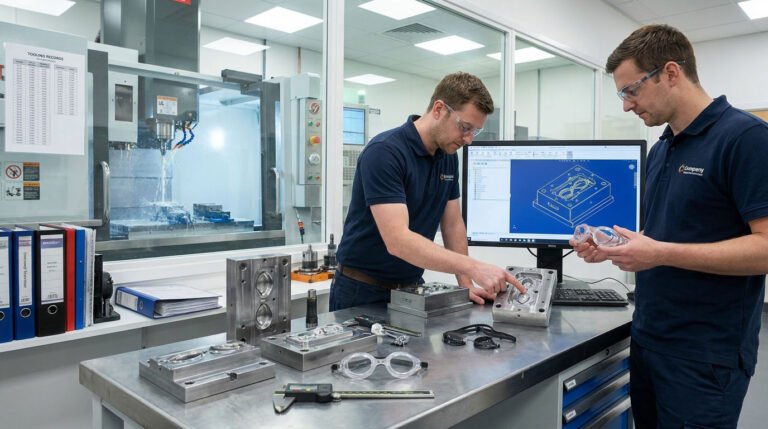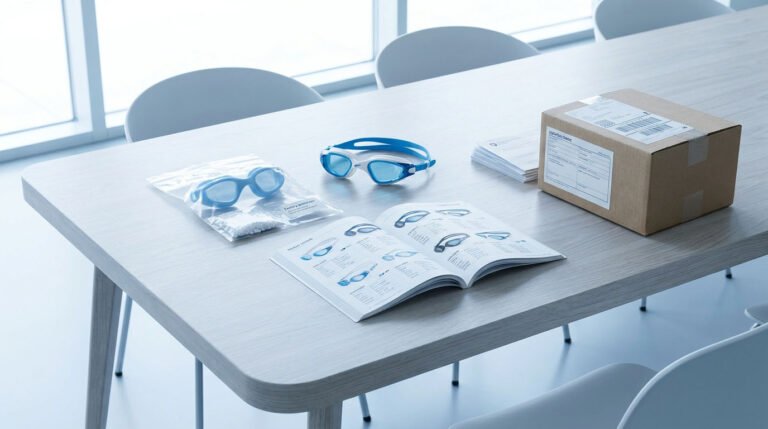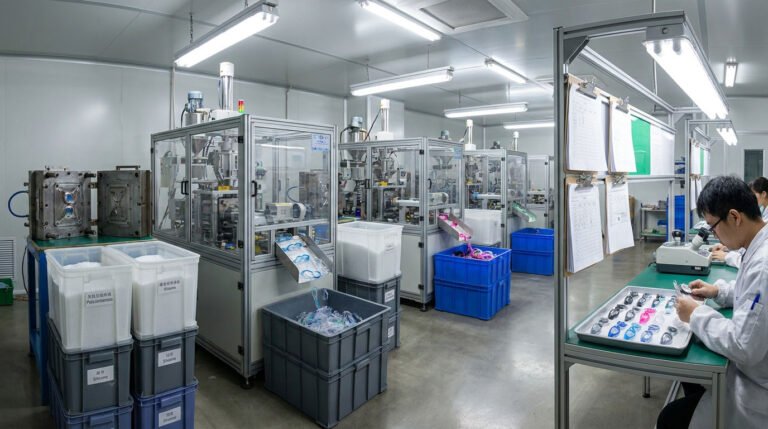
You found a swim goggle factory that looks impressive on paper.
The quotation is competitive. The sample looks good. The sales team replies quickly. The factory has certificates, machines, and a professional showroom.
But none of those things alone prove that the supplier can consistently deliver your order.
A factory can produce one perfect sample and still fail during mass production. A large factory can have strong capacity but give your smaller order very little priority. A supplier can show you certificates while daily quality-control records are weak or outdated.
That is why a factory audit should not be treated as a formality.
A swim goggle factory audit should confirm whether the manufacturer can consistently reproduce your approved product, control quality, support your order size, communicate clearly, manage delays, and take responsibility when problems happen.
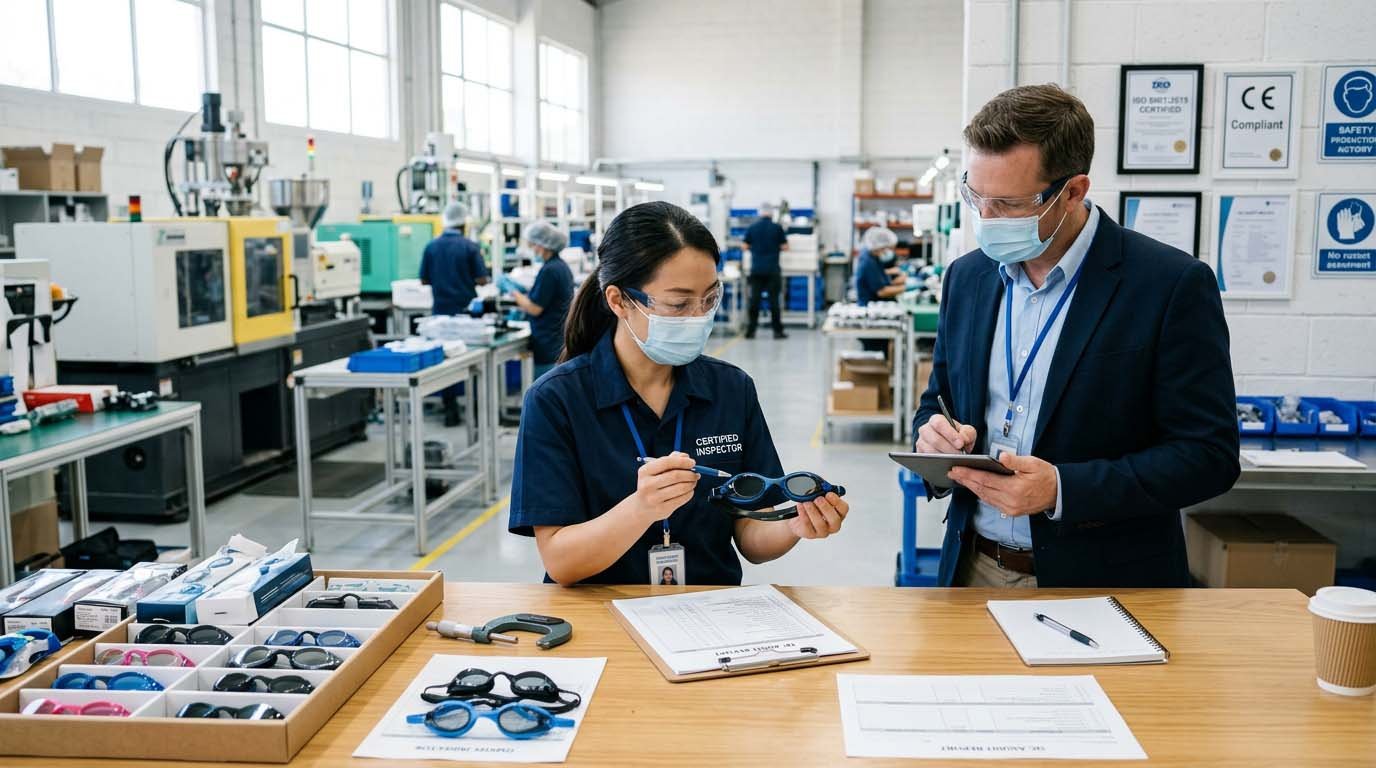
The goal is not to find the biggest factory.
It is not to collect the most certificates.
The goal is to find a manufacturing partner whose capabilities, systems, order priorities, and service model match your business.
Before signing a manufacturing agreement or paying a production deposit, ask these ten questions.
Quick Answers: What Should You Check Before Signing a Swim Goggle Factory?
| Audit Area | What You Need to Confirm |
|---|---|
| Manufacturer status | Is this the real factory or an intermediary? |
| Product experience | Have they made goggles similar to yours? |
| Order priority | Will your order receive realistic attention and capacity? |
| Sample transfer | Can they reproduce the approved sample in mass production? |
| Material control | Are incoming materials inspected and documented? |
| Product testing | Are critical swim goggle functions tested during production? |
| Traceability | Can defects be traced back to a batch or process? |
| Commercial terms | Are MOQ, tooling, pricing, and lead time clear in writing? |
| Problem response | What happens if quality or delivery fails? |
| After-sales ownership | Who takes responsibility after shipment? |
The common theme is simple:
Ask for evidence, not promises.
Why Does a Swim Goggle Factory Audit Matter?
You are not only buying swimming goggles.
You are trusting another company with:
- Your product quality
- Your inventory
- Your launch schedule
- Your cash flow
- Your customer experience
- Your brand reputation
One weak production batch can create problems far beyond the factory floor.
Fogging lenses, leaking seals, scratched lenses, broken straps, inconsistent colors, delayed shipments, or poor packaging can all turn into refunds, negative reviews, and lost retailer trust.
The real purpose of an audit is to turn claims into evidence.
A factory may say:
We have strict quality control.
The audit should answer:
What exactly do you check, when do you check it, who records it, and what happens when something fails?
A factory may say:
We have strong capacity.
The audit should answer:
Will my actual order receive a production slot when the factory is busy?
A factory may say:
We can support small brands.
The audit should answer:
How do you handle smaller orders during peak production periods?
An audit is not a beauty contest.
It is a risk check.
Question 1: Are You the Actual Manufacturer?
This should be one of the first questions.
Some suppliers present themselves as manufacturers but outsource most or all production to other factories.
That does not automatically mean they are bad suppliers, but buyers should know who actually controls the production process.
Why It Matters
If important production stages are outsourced, you may have less visibility into:
- Production scheduling
- Quality control
- Tooling
- Material changes
- Corrective actions
- Delivery problems
For a custom product, this can become especially important.
Ask to See
During a factory visit or live video audit, ask to see relevant areas such as:
- Injection molding
- Mold development
- Silicone processing
- Lens treatment
- Anti-fog processing
- Assembly
- Quality inspection
- Packaging
You do not need every process to be in the same room.
But the supplier should be able to clearly explain:
which processes are in-house and which are outsourced.
For projects that require deeper customization, it is also worth checking whether the supplier has genuine OEM and ODM development capabilities rather than only basic sourcing or logo application.
Good Evidence
Look for:
- Active production lines
- Machines running real orders
- Production records
- Operators who can explain the process
- Tooling or molds
- Work-in-progress products
Red Flag
Be cautious if the supplier:
- Avoids showing production areas
- Cannot explain who owns the machines
- Gives vague answers about subcontractors
- Only shows a showroom or sample room
Question 2: Have You Manufactured Swim Goggles Similar to Ours?
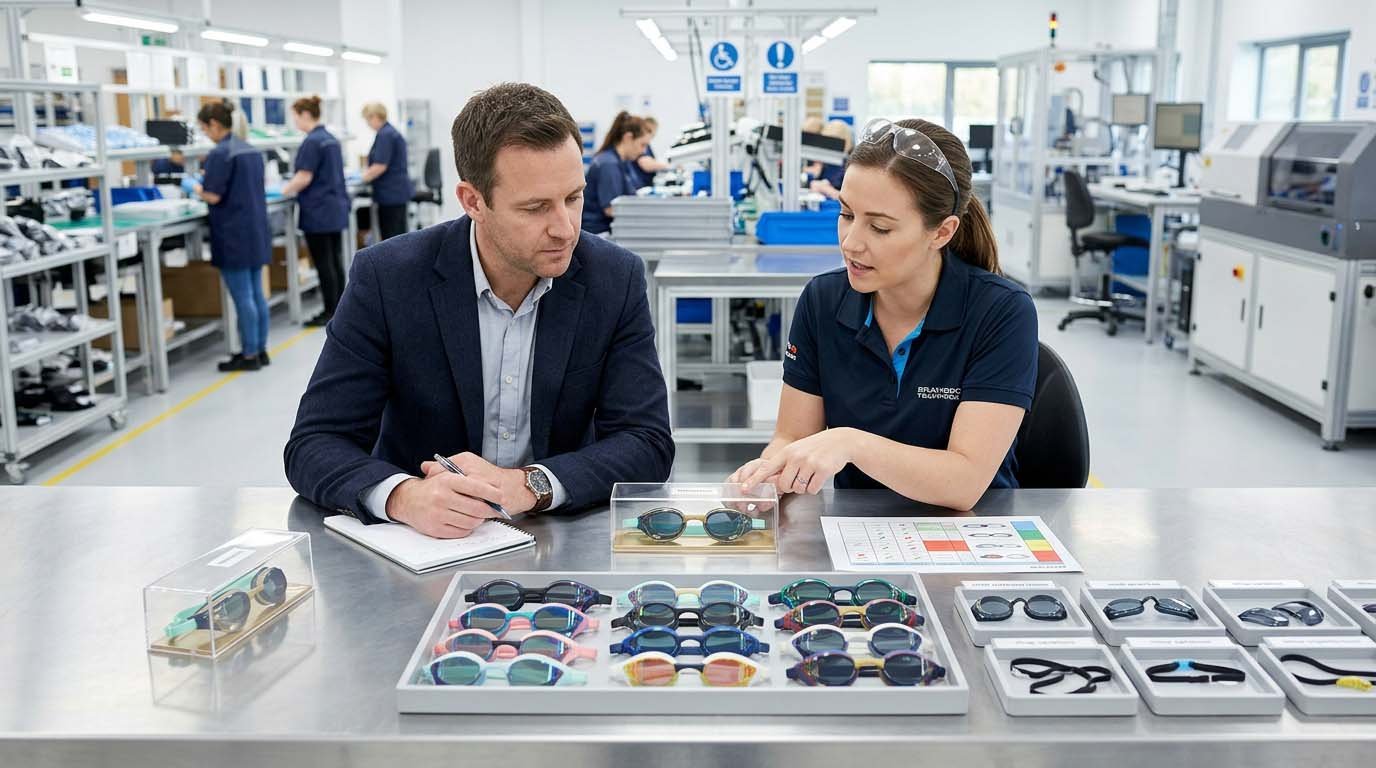
A factory may have years of manufacturing experience but still have limited experience with your specific product category.
Racing goggles, children’s goggles, open-water goggles, training goggles, and specialty lens products can involve different requirements.
Why It Matters
Relevant product experience reduces learning risk.
A factory familiar with similar custom swimming goggles is more likely to understand:
- Fit
- Lens requirements
- Gasket structure
- Strap systems
- Anti-fog expectations
- Packaging
- Quality risks
Ask
- Have you produced goggles similar to our design?
- Have you handled similar customization?
- Have you produced similar order volumes?
- Which markets were those products intended for?
- Can you show non-confidential examples?
Good Evidence
Ask to see:
- Finished samples
- Retained production samples
- Relevant molds
- Similar packaging
- Test records
- Product development records
Red Flag
Be careful when a supplier says:
We can make anything.
but cannot show evidence of comparable work.
Question 3: Will Our Order Size Receive Real Production Priority?
This is one of the most overlooked questions in supplier evaluation.
A huge factory can look extremely impressive.
But size alone does not guarantee that your order will be important to them.
Why It Matters
A factory may have excellent total capacity but prioritize its largest customers first.
If your order is relatively small compared with the factory’s normal production runs, your schedule may be pushed back when larger orders arrive.
The real question is not:
How big is your factory?
It is:
Where will my order sit in your production system?
Ask
- What order sizes do you normally handle?
- Is our volume typical for your factory?
- How will our order be scheduled?
- What happens during peak season?
- Will our order run on a dedicated line or flexible production cell?
- How do you prevent smaller orders from being delayed?
For startup brands and smaller launches, it is also worth asking whether the factory has a private-label program that better matches lower-risk market-entry projects.
Good Evidence
Ask to review:
- Current production schedule
- Similar order sizes
- Realistic lead-time planning
- Production-slot allocation
Red Flag
A factory may not be a good fit if your order is accepted by sales but treated as low priority by production.
Factory fit matters more than factory size.
Question 4: How Do You Transfer an Approved Sample Into Mass Production?
A good sample does not prove a good batch.
This is one of the most important ideas in factory auditing.
A sample may receive special attention from experienced technicians. Mass production requires the same result to be repeated hundreds or thousands of times.
Why It Matters
The approved sample should become a clear production standard.
Without that transfer process, production workers may interpret requirements differently.
Ask
- How is the approved sample stored?
- What written criteria accompany it?
- Who approves the first production output?
- How are appearance and functional defects defined?
- How are changes controlled after approval?
A structured sampling and prototyping process can also help buyers confirm product details before the project moves into larger-scale production.
Good Evidence
Look for:
- Controlled reference or golden samples
- Written acceptance criteria
- First-article approval
- Defect examples
- Production instructions
- Sign-off records
Red Flag
Be cautious if the factory relies only on:
"The workers already know what to do."
A repeatable production system should not depend on memory.
Question 5: How Do You Control Incoming Materials?
Finished product quality begins before assembly.
If raw materials vary, finished goggles can vary.
Why It Matters
Incoming materials may affect:
- Lens clarity
- Color
- Gasket softness
- Strap durability
- Anti-fog compatibility
- Packaging quality
Poor material control can create problems that are difficult to fix later.
Ask
- Which materials are inspected when they arrive?
- Are material batches recorded?
- What happens when incoming materials fail inspection?
- Are approved suppliers used?
- Are materials separated by batch?
Good Evidence
Ask to see:
- Incoming inspection records
- Material labels
- Batch identification
- Rejected-material records
- Approved supplier information
Red Flag
Be cautious if raw materials are stored without clear identification or if the factory cannot show how rejected materials are handled.
Question 6: How Do You Test Swim Goggles During Production?
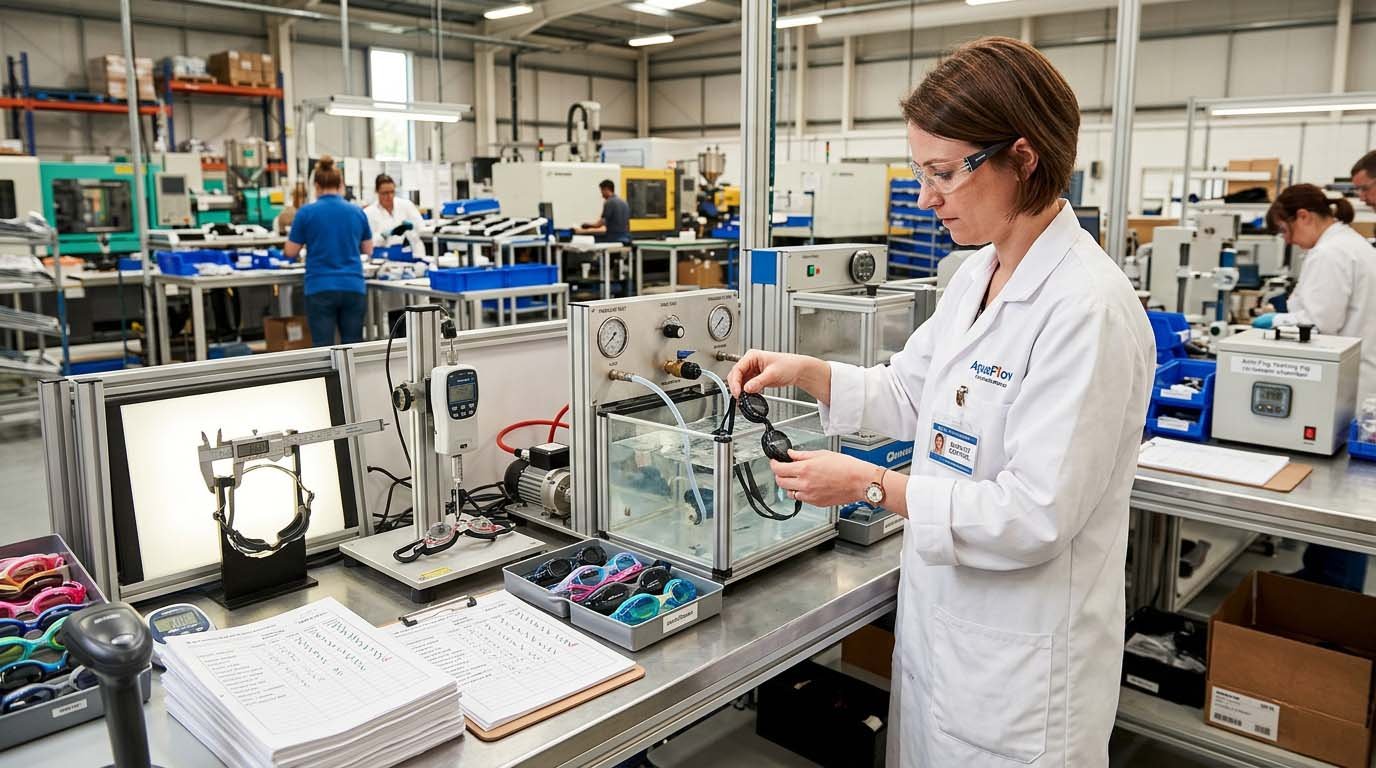
Visual inspection alone is not enough for swimming goggles.
Many important defects are functional.
A goggle can look perfect and still leak, fog early, or fail under strap tension.
Why It Matters
Critical product functions may include:
- Lens clarity
- Seal performance
- Leakage resistance
- Strap durability
- Buckle function
- Anti-fog performance
- Assembly consistency
Ask
- What tests are performed during production?
- Which tests are performed on every batch?
- Who performs them?
- How are results recorded?
- What happens when a test fails?
A documented quality assurance process should explain how incoming inspection, in-process checks, functional testing, and final QC work together.
Ask for a Live Demonstration
If possible, ask the factory to demonstrate relevant tests during the audit.
This is often more useful than seeing a testing machine that is not actively used.
Good Evidence
Look for:
- Active testing stations
- Test records
- Operators who understand the procedure
- Clear pass/fail criteria
- Failed-product handling
Red Flag
A test fixture covered in dust is not strong evidence of a working quality system.
Question 7: Can You Trace a Defect Back to the Production Batch?
Traceability becomes important when something goes wrong after shipment.
Imagine customers report a problem with one batch of goggles.
Can the factory identify where the issue came from?
Why It Matters
Without traceability, the factory may not know whether a problem came from:
- A material batch
- A machine
- A production shift
- A coating process
- An assembly line
- A supplier
That makes root-cause correction much harder.
Ask
- How are finished batches identified?
- Can a finished carton be linked to production records?
- Can material lots be traced?
- Are production dates recorded?
- Are retention samples kept?
- How are complaints linked back to production?
Good Evidence
Look for:
- Batch codes
- Lot records
- Production dates
- Material records
- Retained samples
- Inspection records
Red Flag
If the factory can only say:
We will check.
but cannot explain how it would trace the problem, its traceability system may be weak.
Question 8: What Are the Real MOQ, Tooling, Pricing, and Lead-Time Terms?
Commercial surprises can damage a sourcing project even when the product quality is good.
You should clarify these terms before signing.
Why It Matters
Buyers can run into problems such as:
- MOQ increasing after customization is confirmed
- Packaging having a separate MOQ
- Unexpected tooling fees
- Sample charges not included
- Lead time starting later than expected
- Freight terms being misunderstood
Ask About MOQ
- Is MOQ per model or per color?
- Does custom color affect MOQ?
- Does logo method affect MOQ?
- Does packaging have a separate MOQ?
Ask About Tooling
- Is tooling charged separately?
- Who owns the mold?
- Are modification costs included?
- What happens if tooling needs revision?
Ask About Pricing
- What exactly is included in the unit price?
- Is packaging included?
- Are testing or inspection costs included?
- Which trade term is being quoted?
Ask About Lead Time
- When does the lead-time clock begin?
- Is sampling included?
- Is packaging included?
- What happens if materials arrive late?
- What happens if the buyer delays approval?
Good Evidence
Get commercial terms in writing.
A verbal promise is difficult to rely on when a dispute appears later.
Question 9: What Happens If Production Is Delayed or Quality Fails?
Every factory can experience problems.
What matters is how the factory responds.
Why It Matters
A supplier may perform well when everything is normal.
The real test comes when:
- Materials fail
- A mold needs repair
- Quality drops
- Packaging is late
- Production falls behind schedule
You want to understand the response before the problem happens.
Ask
- Who informs the buyer when a delay appears?
- How quickly is the problem escalated?
- Who creates the recovery plan?
- Can production be rescheduled?
- What happens if finished goods fail inspection?
- How are rework and replacement handled?
For orders where launch timing is critical, ask the supplier to explain its shipping and delivery process as well as its production lead time. A product that leaves production on time can still miss the launch if freight planning is unclear.
Good Evidence
Look for:
- Written escalation procedures
- Corrective-action records
- Clear responsible persons
- Rework controls
- Updated production schedules
Red Flag
Be careful if every answer sounds like:
Don’t worry. We will solve it.
You need to know how.
Question 10: Who Owns the Problem After Shipment?
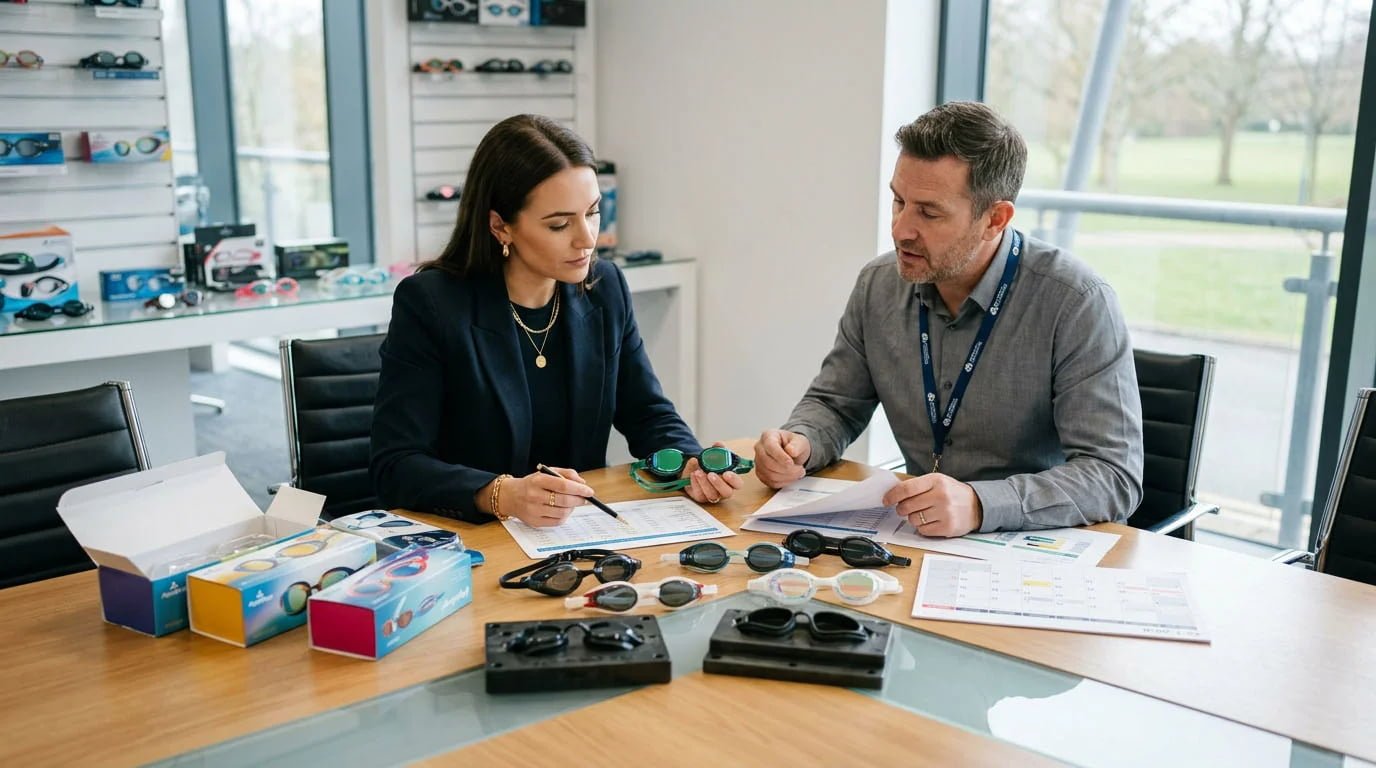
Many buyers focus heavily on pre-shipment quality and forget after-sales responsibility.
But problems can still appear after products reach the market.
Why It Matters
You need to know what happens if customers or retailers report:
- Leakage
- Fogging
- Strap breakage
- Lens defects
- Packaging problems
- Batch inconsistencies
Ask
- Who handles customer complaints?
- Who investigates the root cause?
- How are defective units documented?
- What corrective action is taken?
- How is recurrence prevented?
- How are replacement or compensation situations handled?
Corrective Action Matters
A strong factory should do more than replace a defective product.
It should ask:
Why did this happen?
and then:
How do we stop it happening again?
Good Evidence
Look for:
- Complaint records
- Root-cause reports
- Corrective-action records
- Responsible QA personnel
- Follow-up verification
Red Flag
A supplier that becomes difficult to contact after shipment is a major commercial risk.
Swim Goggle Factory Audit Scorecard
Use this table during an on-site or remote supplier audit.
| Audit Question | Evidence to Request | Pass / Review / Fail |
|---|---|---|
| 1. Real manufacturer? | Production floor, machines, records | □ |
| 2. Similar product experience? | Samples, molds, records | □ |
| 3. Order priority? | Schedule, similar order sizes | □ |
| 4. Sample-to-production system? | Golden sample, criteria, first article | □ |
| 5. Incoming material control? | IQC and batch records | □ |
| 6. Product testing? | Test demonstration and records | □ |
| 7. Traceability? | Lot numbers and production records | □ |
| 8. Commercial terms clear? | Written MOQ, tooling, price, lead time | □ |
| 9. Delay/defect response? | Escalation and corrective procedures | □ |
| 10. After-sales ownership? | Complaint and corrective-action records | □ |
A factory does not need to be perfect in every area.
But weaknesses should be visible before you sign—not discovered after your production deposit is paid.
What Should Buyers Physically Check During a Factory Visit?
Documents are useful.
But the factory floor often tells you more.
During the audit, pay attention to:
- Are production lines active?
- Are materials labeled?
- Are rejected goods separated?
- Are operators following written instructions?
- Are test stations actually being used?
- Are molds and tools maintained?
- Are batch records visible?
- Are work areas organized?
- Can workers and supervisors explain the process consistently?
You are not looking for a perfect-looking factory.
You are looking for evidence that the operating system works every day.
Certificates: Useful, but Not Enough
Factory certificates can be important.
They can indicate that a factory has passed specific audits or management requirements.
But certificates should not replace operational verification.
Ask:
- Is the certificate current?
- What exactly does it cover?
- Does it apply to this facility?
- Can the supplier show the original document?
- Are daily records consistent with the claimed system?
A certificate tells you something about the factory.
Production records tell you what is happening now.
You need both.
Can You Audit a Swim Goggle Factory Remotely?
Yes.
A remote audit is not identical to visiting the factory, but it can still reveal useful information.
Ask for a live video walkthrough rather than only edited factory videos.
During the call, ask the supplier to show:
- Factory entrance
- Production floor
- Injection molding
- Silicone processing
- Lens treatment
- Assembly
- Quality-control area
- Testing equipment
- Material warehouse
- Finished goods
- Rejected-product area
- Relevant records
A live walkthrough reduces the chance that you are only seeing selected marketing footage.
For larger or more sensitive programs, buyers may also consider an independent third-party factory audit.
Common Red Flags During a Swim Goggle Factory Audit
Several signs deserve closer investigation.
Red Flag 1: The Factory Avoids Showing Production Areas
A supplier should have a reasonable explanation if some areas are confidential or restricted.
But persistent avoidance is different.
Red Flag 2: Nobody Can Explain the Quality Process Clearly
Sales, production, and QA may use different language, but the underlying process should be consistent.
Red Flag 3: Testing Equipment Exists but Is Not Used
Ask for a live demonstration.
Red Flag 4: Approved Samples Are Not Controlled
If the reference sample is missing or poorly stored, production consistency becomes harder to manage.
Red Flag 5: Rejected Goods Are Mixed With Good Goods
Nonconforming materials and products should be clearly controlled.
Red Flag 6: Lead Times Sound Too Perfect
A realistic production plan is better than a promise designed only to win the order.
Red Flag 7: Commercial Terms Keep Changing
MOQ, tooling, packaging, and pricing assumptions should become clearer as the project develops—not more confusing.
Red Flag 8: Nobody Owns Problems
A strong supplier should know who is responsible for quality, production, and corrective action.
Factory Size vs Factory Fit: Which Matters More?
This is an important question.
Many buyers automatically assume that the largest factory is the safest choice.
That is not always true.
A very large factory may offer:
- High capacity
- More equipment
- More automation
- Large-retailer experience
But a smaller or more flexible factory may offer:
- Faster communication
- More order attention
- Greater flexibility
- Better support for developing brands
The right question is:
Does this factory fit our current order and our future growth?
The best supplier is not necessarily the biggest.
It is the supplier whose capabilities and commercial model align with your business.
Frequently Asked Questions
Is an ISO certificate enough to approve a swim goggle factory?
No.
Certificates can provide useful evidence, but buyers should also review current production records, testing, material control, traceability, and actual shop-floor execution.
Does a good sample prove the factory is reliable?
No.
A good sample proves the factory can make one good sample.
Mass production requires consistent systems, production standards, testing, and quality control.
Should I always visit the factory before ordering?
Not always.
A remote live-video audit or third-party audit may be practical when travel is difficult.
For large, highly customized, or strategically important projects, an on-site audit may provide additional confidence.
What is the most important question to ask during a factory audit?
There is no single question that replaces a full audit.
However, one especially useful question is:
Show me the evidence.
Ask for records, samples, production lines, testing, and responsible personnel rather than relying only on verbal assurances.
Is the largest swim goggle factory always the safest choice?
No.
The factory should match your order volume, quality requirements, customization needs, communication expectations, and growth stage.
What should I check if I am a small private-label brand?
Pay special attention to:
- MOQ
- Order priority
- Communication
- Sample support
- Customization flexibility
- Lead times
- After-sales support
For these projects, a structured private-label program may be more relevant than a fully custom development route.
What should I check for custom OEM/ODM swimming goggles?
In addition to standard factory-audit items, review:
- R&D capability
- Prototype development
- Mold ownership
- Tooling capability
- Engineering communication
- Design revisions
- Mold trials
- Product validation
A factory’s OEM and ODM capabilities should be supported by actual development, tooling, sampling, and production evidence.
Conclusion
A good swim goggle factory audit is not about finding the cleanest showroom or the thickest certificate folder.
It is about finding evidence that the factory can deliver your product consistently.
Before signing, ask ten questions:
- Are you the actual manufacturer?
- Have you made products similar to ours?
- Will our order receive real production priority?
- How do you transfer an approved sample into mass production?
- How do you control incoming materials?
- How do you test swim goggles during production?
- Can you trace defects back to the production batch?
- Are MOQ, tooling, pricing, and lead time clear?
- What happens if production is delayed or quality fails?
- Who owns the problem after shipment?
The strongest supplier is not necessarily the biggest or the cheapest.
It is the one that can show you:
clear processes, reliable records, realistic planning, consistent quality, and accountable people.
That is what protects your inventory, your timeline, and your brand.
If you are evaluating a swim goggle supplier and want to review manufacturing capability, quality systems, customization options, or production fit, contact our team with your product requirements and planned order volume.