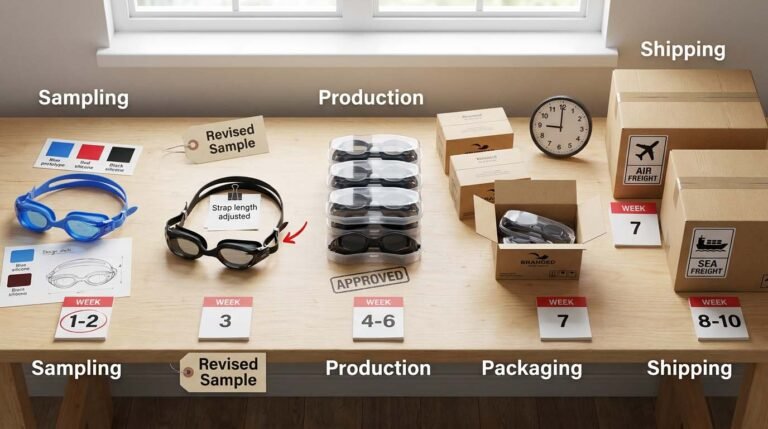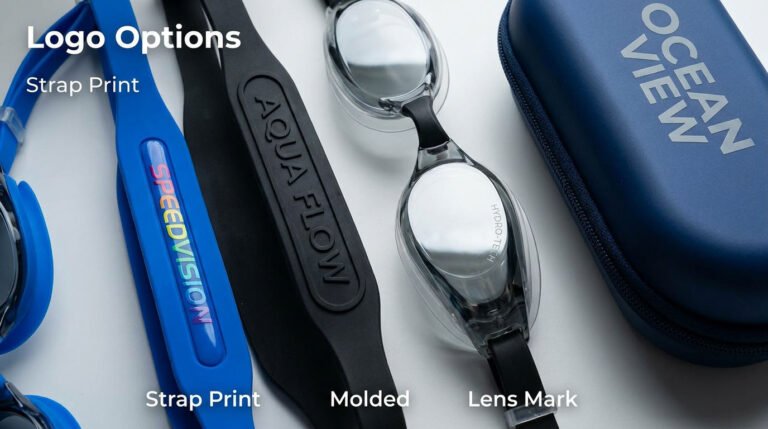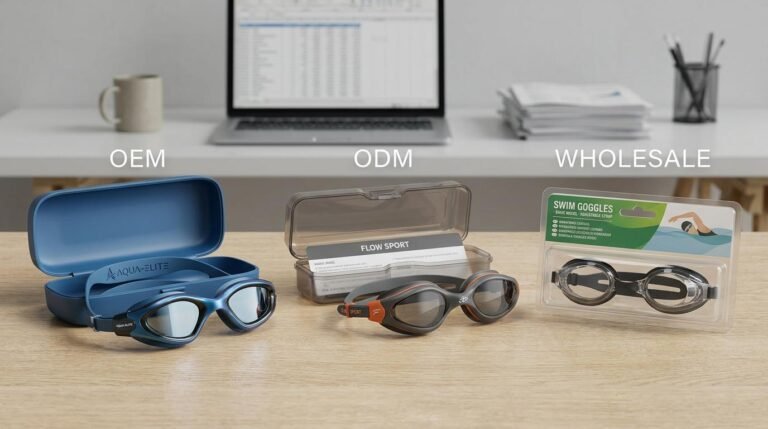
The OEM swimming goggles process usually includes concept development, technical design, tooling, sampling, trial production, mass production, and final quality control. For most brands, the biggest risks are not in the initial idea but in tooling revisions, compliance requirements, pilot production, and the gap between approved samples and stable bulk production.
Many first-time buyers assume OEM swim goggle development is a simple sequence: send a concept, confirm samples, place an order, and wait for shipment. In practice, the process is more complex. Product feasibility, mold design, material selection, trial validation, and production consistency all affect whether a project stays on budget and on schedule.
This guide explains how OEM swimming goggles are made, including concept approval, design for manufacturability, tooling cost, prototyping, quality planning, pilot runs, packaging, and shipping.
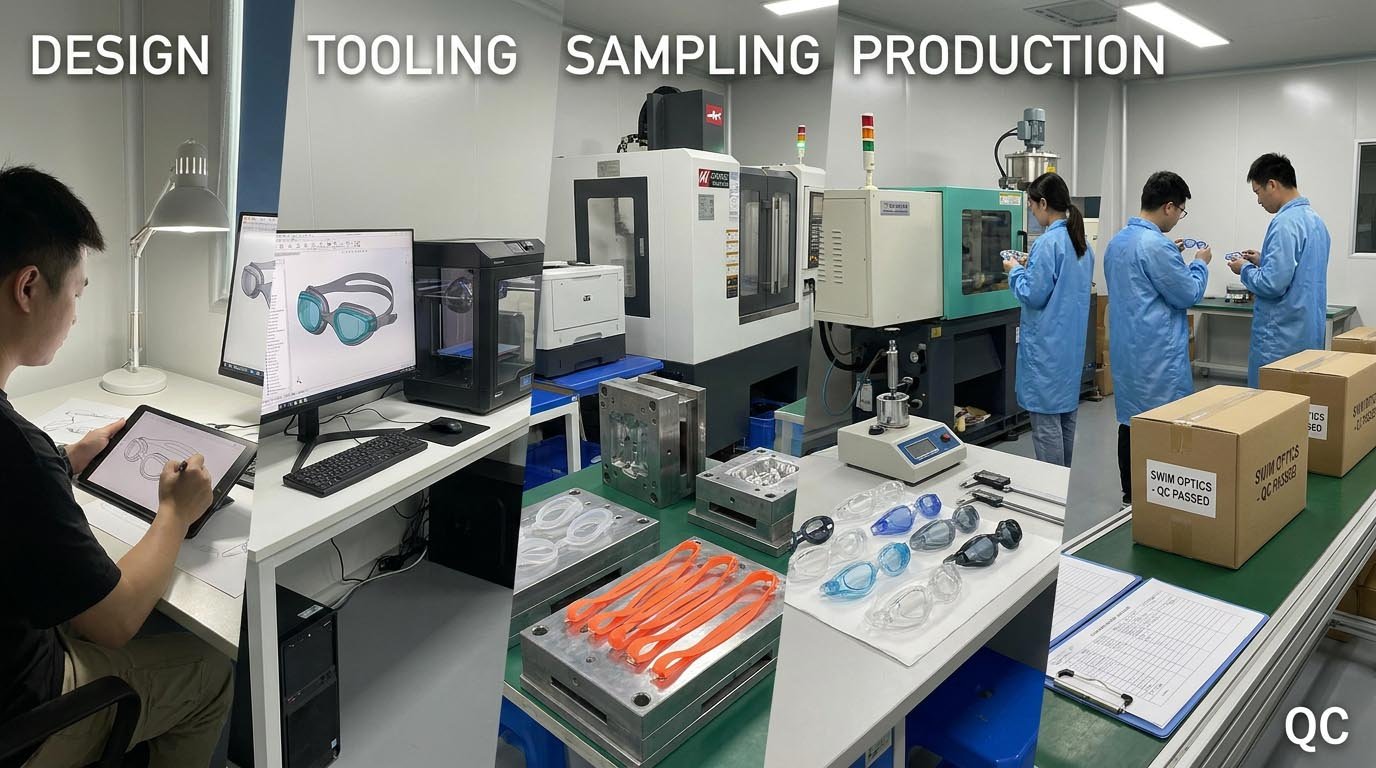
Quick Answers: OEM Swimming Goggles Process
How long does the OEM swimming goggles process take?
For a first-time OEM project, the full process often includes concept review, design engineering, tooling, sample approval, trial production, mass production, and shipment preparation. Lead time depends on product complexity, testing requirements, and revision rounds.
What is the tooling cost for custom swimming goggles?
Tooling cost depends on mold complexity, material structure, number of cavities, and whether the design needs special features such as overmolding or custom assembly components.
Can a brand go straight from samples to mass production?
It is possible, but risky. Trial production helps confirm that the approved sample can be reproduced consistently under real manufacturing conditions.
What causes delays in OEM swim goggle projects?
The most common causes are incomplete specifications, design changes after tooling begins, unexpected mold adjustments, material testing issues, and packaging decisions made too late.
What should buyers confirm before starting an OEM project?
Before moving forward, buyers should confirm target market, product requirements, certification needs, budget, MOQ expectations, and whether the project is better suited to OEM or ODM.
OEM Swimming Goggles Process at a Glance
The table below summarizes the main stages of a typical OEM swimming goggles project.
| Stage | Main Focus | Why It Matters |
|---|---|---|
| Concept and Brief | Target market, specs, budget, compliance | Prevents unrealistic development plans |
| Design Engineering | Product structure, DFM, tolerances, component design | Improves manufacturability and cost control |
| Material Selection | Lens, gasket, strap, coatings | Affects comfort, clarity, durability, and compliance |
| Prototyping | Fit, appearance, usability | Reveals ergonomic issues before tooling |
| Tooling | Mold fabrication and trials | Determines production quality and repeatability |
| Validation | First articles, testing, quality plan | Confirms design can be produced reliably |
| Pilot Production | Small-scale production run | Reduces mass production risk |
| Mass Production | Full-volume manufacturing | Requires process control and inspection discipline |
| Packaging and Shipping | Retail packaging, labeling, freight | Affects delivery timing and market readiness |
What Is the OEM Swimming Goggles Process?
OEM swimming goggles production means a brand develops a custom product with a manufacturer based on its own design requirements, specifications, branding, and target market.
OEM vs ODM for swimming goggles
Before starting, it helps to distinguish between OEM and ODM:
- OEM swimming goggles: Custom product development based on the buyer’s concept, design changes, material requirements, and private mold or structural modifications.
- ODM swimming goggles: Existing factory product adapted with logo, color, packaging, or minor changes.
OEM is more suitable when a brand wants:
- A unique fit or structural design
- Custom lens shape or gasket geometry
- Specific performance positioning
- Exclusive branding and long-term product control
ODM is often better when a buyer needs:
- Lower development cost
- Faster launch timing
- Lower project risk
- Standardized product architecture
For many first-time brands, deciding between OEM and ODM is one of the most important early decisions.
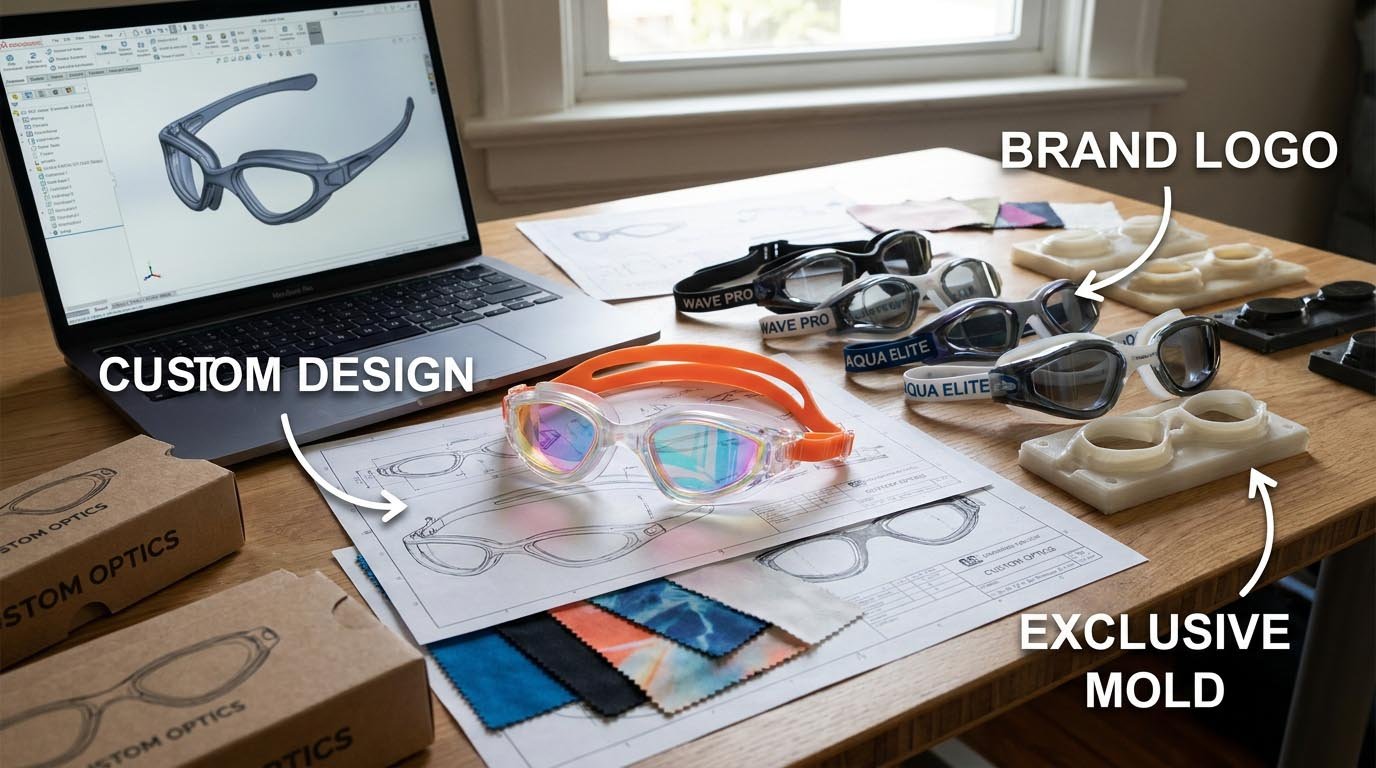
Step 1: Concept, Product Brief and Market Requirements
A successful OEM project starts with a clear brief. Factories cannot quote accurately or develop the right product from a vague request such as “premium racing goggles” or “high-end anti-fog swim goggles.”
What buyers should define first
At minimum, the product brief should clarify:
- Target market
- Intended user group
- Product positioning
- Price target
- Expected order volume
- Required certifications
- Core performance priorities
Why market requirements matter
Different markets may require different testing, documentation, or compliance standards. Certification and material compliance should be considered early, because they affect:
- Lens material choices
- Coating selection
- Silicone or TPR material options
- Labeling claims
- Packaging language and documentation
What performance specs should be defined
For OEM swimming goggles, the factory usually needs clearer technical direction on:
- Lens type and optical clarity expectations
- UV protection claims
- Anti-fog durability target
- Gasket softness and fit profile
- Strap adjustment design
- Nose bridge style
- Comfort expectations for training, racing, or recreational use
Why budget must be discussed early
OEM projects include more than unit price. A realistic budget should account for:
- Tooling
- Prototypes
- Sample revisions
- Material testing
- Pilot production
- Packaging development
- Bulk production
If the budget, MOQ, and customization level do not align, the concept often needs to be simplified before design engineering begins.
Step 2: Design Engineering and DFM for Swimming Goggles
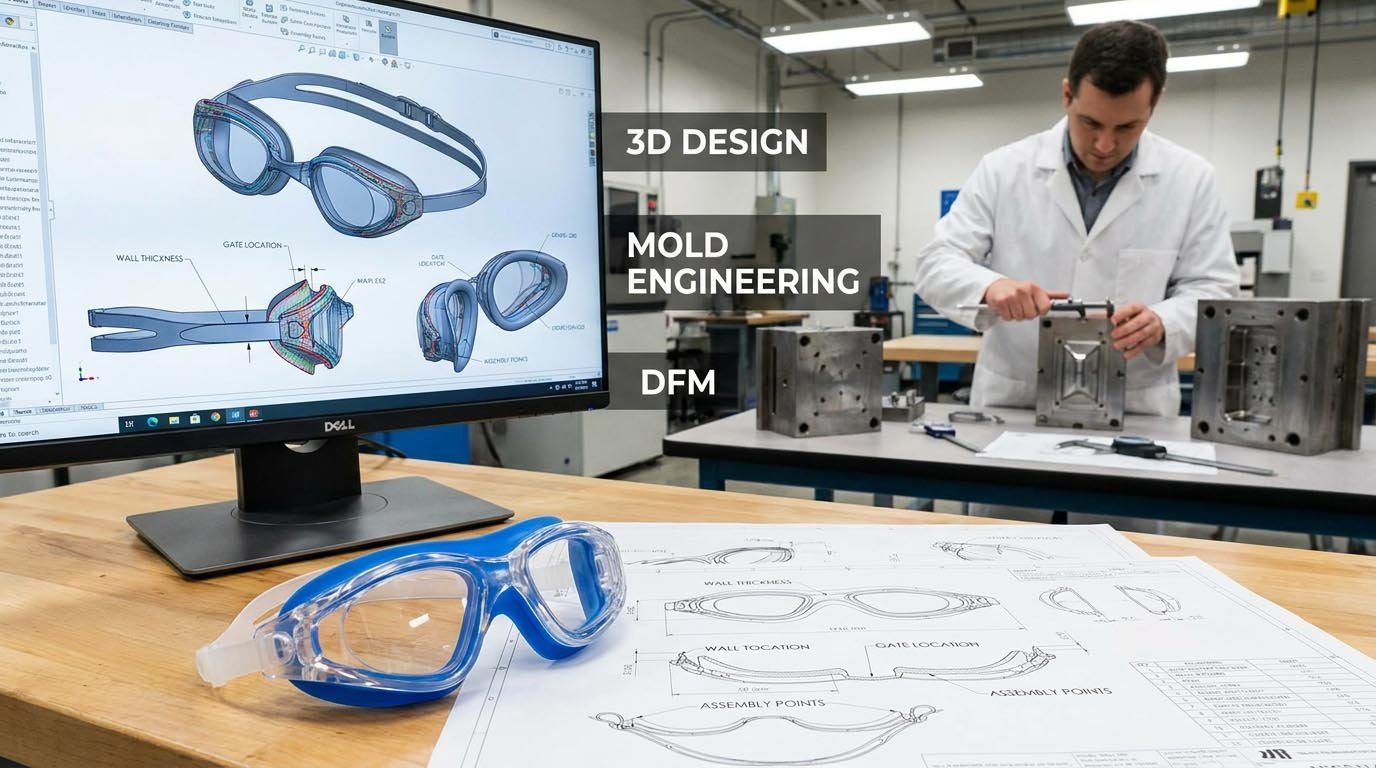
Once the concept is approved, the next step is design engineering. This is where the initial idea is converted into a structure that can actually be manufactured.
What DFM means in swim goggle manufacturing
Design for manufacturability (DFM) means adjusting the product design so it can be produced consistently, efficiently, and at the target cost.
For swimming goggles, DFM usually includes review of:
- Part geometry
- Wall thickness
- Draft angles
- Gate locations
- Mold opening direction
- Assembly feasibility
- Dimensional tolerances
Common DFM issues in swimming goggles
Typical manufacturability problems include:
- Features that require complicated mold actions
- Tight tolerances on non-critical dimensions
- Uneven wall thickness that causes sink marks or warping
- Complex structures that slow cycle time
- Visual design requests that conflict with mold release requirements
Why design revisions happen here
This is often the stage where brands learn that some requested features are possible but not efficient, while others require significantly higher tooling cost. For example, changes to gasket structure, lens thickness, or strap attachment style may affect:
- Mold complexity
- Production yield
- Assembly speed
- Final unit cost
A strong OEM supplier should explain which design elements are essential and which can be simplified without damaging the product concept.
Step 3: Material Selection for Lenses, Gaskets, Straps and Coatings
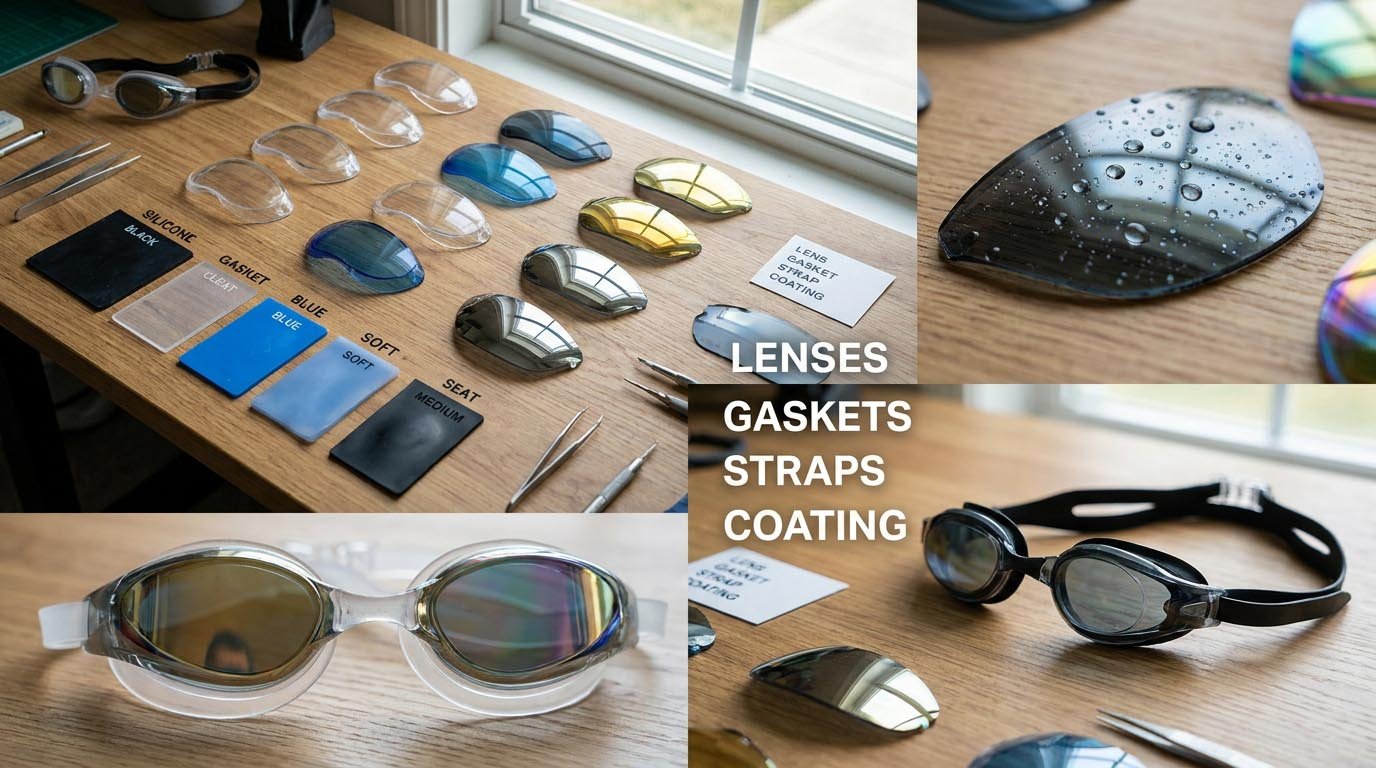
Material choice directly affects comfort, optical performance, durability, compliance, and retail positioning.
Main components in swimming goggles
Most OEM swim goggles include several core material decisions:
- Lenses
- Gaskets
- Straps
- Nose bridge
- Anti-fog treatment
- UV or mirror coating if applicable
Lens material considerations
Swimming goggle lenses are commonly made from polycarbonate, but different grades may be selected depending on:
- Optical clarity requirements
- Impact performance
- Cost target
- Surface treatment compatibility
- Tint or mirror application
Gasket and strap material considerations
The softness and durability of the gasket and strap affect both comfort and product lifespan. Buyers should compare:
- Seal comfort
- Material hardness
- Skin compatibility
- Shape retention
- Durability under repeated use
Anti-fog coating choices
Anti-fog performance is one of the most important and misunderstood parts of swimming goggle development. Different anti-fog methods vary in:
- Cost
- Durability
- Coating consistency
- Production complexity
- Retail claim potential
If anti-fog performance is a key selling point, buyers should ask how the coating is applied, how it is tested, and what realistic durability can be expected.
Step 4: Prototype Development and Sample Evaluation
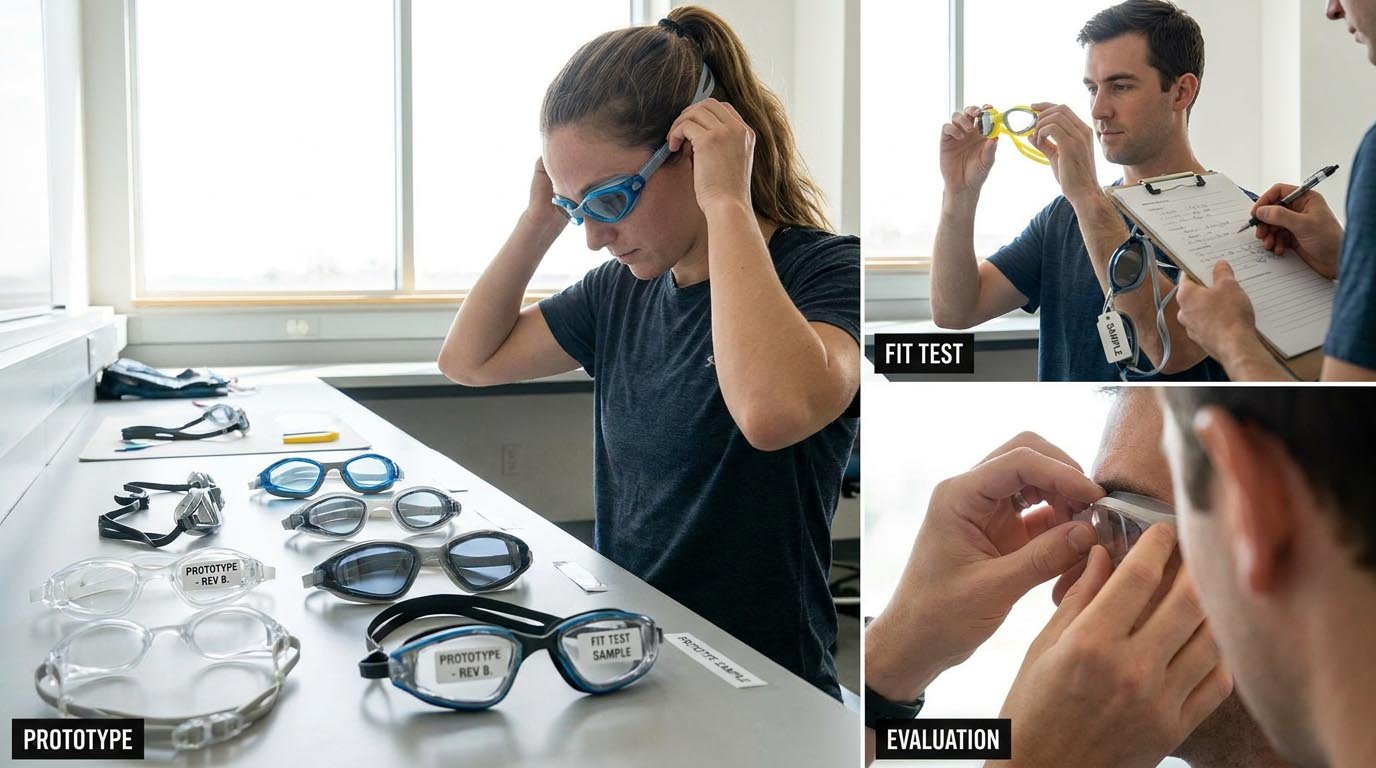
Prototypes help confirm whether the design works in real use before expensive tooling decisions are locked in.
What prototypes are used for
Prototype samples are useful for checking:
- Face fit
- Lens shape
- Strap adjustment
- Product proportions
- Brand appearance
- Comfort feedback
- Preliminary usability
What prototypes cannot fully prove
Early prototypes may not perfectly reflect final production because they are often made by CNC, soft tooling, or 3D printing methods. They can help validate shape and concept, but they do not fully replace molded production samples.
What brands should evaluate during sampling
When reviewing prototypes and first samples, buyers should check:
- Fit on different face types
- Seal quality
- Lens clarity
- Finish consistency
- Coating performance
- Ease of adjustment
- Packaging compatibility
This stage is also the best time to catch ergonomic problems before steel molds are cut.
Step 5: Tooling for OEM Swimming Goggles
Tooling is one of the most important and expensive parts of the OEM swimming goggles process.
What tooling includes
For swim goggles, tooling may include molds for:
- Lenses
- Gaskets
- Frames
- Nose bridge components
- Strap parts
- Packaging inserts in some cases
Why tooling rarely works perfectly on the first shot
Even with solid engineering, first mold trials often reveal issues such as:
- Flash
- Short shots
- Warping
- Ejection marks
- Surface defects
- Dimensional drift
This is normal in OEM development. Mold adjustment rounds are often needed before stable production is possible.
What affects tooling cost
Tooling cost may increase when the product includes:
- Multiple cavities
- Complex geometry
- Overmolding or two-shot structures
- Tight cosmetic requirements
- Special coatings or assembly interfaces
- High-volume production planning
Why design changes after tooling are expensive
Once mold fabrication begins, even small structural changes may trigger:
- Mold rework
- Additional machining
- Delayed trials
- New sample rounds
- Extended lead time
For this reason, design approval before tooling should be treated as a major project checkpoint.
Step 6: Validation, First Articles and Quality Planning
After the first molds are ready, the next step is validation. This is where the project moves from design theory to manufacturing reality.
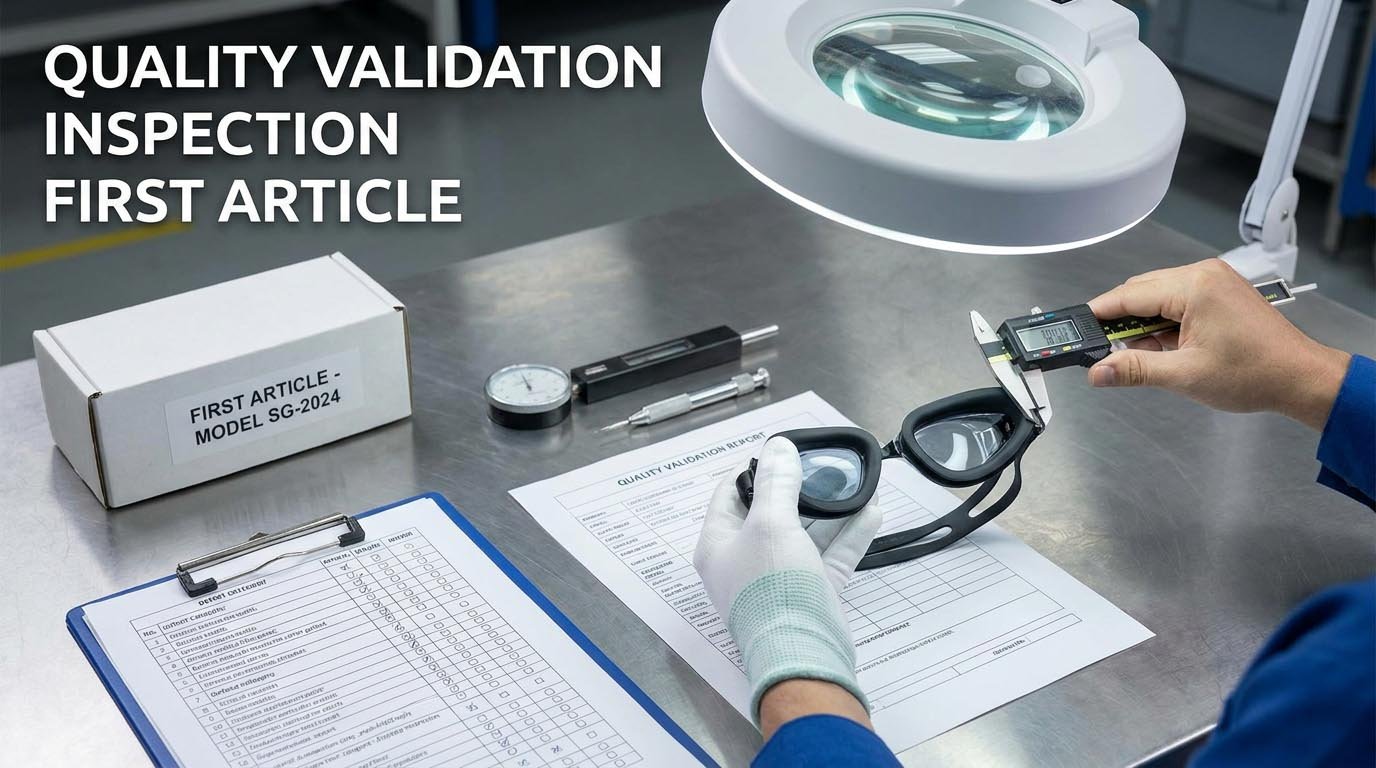
What first article validation checks
First article samples are used to verify:
- Dimensional accuracy
- Lens clarity
- Fit and seal
- Surface appearance
- Assembly quality
- Material behavior
- Coating results
Why quality planning should happen before mass production
A quality plan helps reduce disputes and production surprises. Before bulk production begins, both sides should align on:
- Inspection criteria
- Defect definitions
- Test methods
- AQL standard
- Acceptance rules
- Rework policy
AQL and inspection standards
For OEM swimming goggles, the inspection plan often separates defects into:
- Critical defects
- Major defects
- Minor defects
This creates a measurable standard for final shipment approval and helps avoid vague quality arguments after production is complete.
When PPAP or extra documentation may be needed
Some retail or regulated channels may require more formal documentation, such as:
- Material certifications
- Dimensional reports
- Process flow documents
- Control plans
- Initial sample approval records
Buyers supplying large retailers should ask about this requirement early, because documentation can affect both timeline and cost.
Step 7: Pilot Production Before Full Mass Production
Pilot production is one of the most valuable but often overlooked stages in OEM projects.
What pilot production does
A pilot run tests the full process using a limited quantity before launching full-volume manufacturing. It helps validate:
- Process stability
- Assembly speed
- Real defect rate
- Shift consistency
- Packaging workflow
- Production capacity assumptions
Why pilot production matters
A product that performs well in first articles may still encounter problems during continuous production. Pilot runs often reveal issues such as:
- Higher defect rates than expected
- Coating inconsistency
- Assembly bottlenecks
- Packaging damage risk
- Labor-intensive steps that slow delivery
Can pilot production be skipped?
It can be skipped, but the risk usually shifts into the first bulk order. For projects with custom structures, coatings, packaging, or strict retailer requirements, pilot production is usually a better decision than rushing directly into full mass production.
Step 8: Mass Production, Packaging and Shipping
After pilot approval, the project moves into full production.
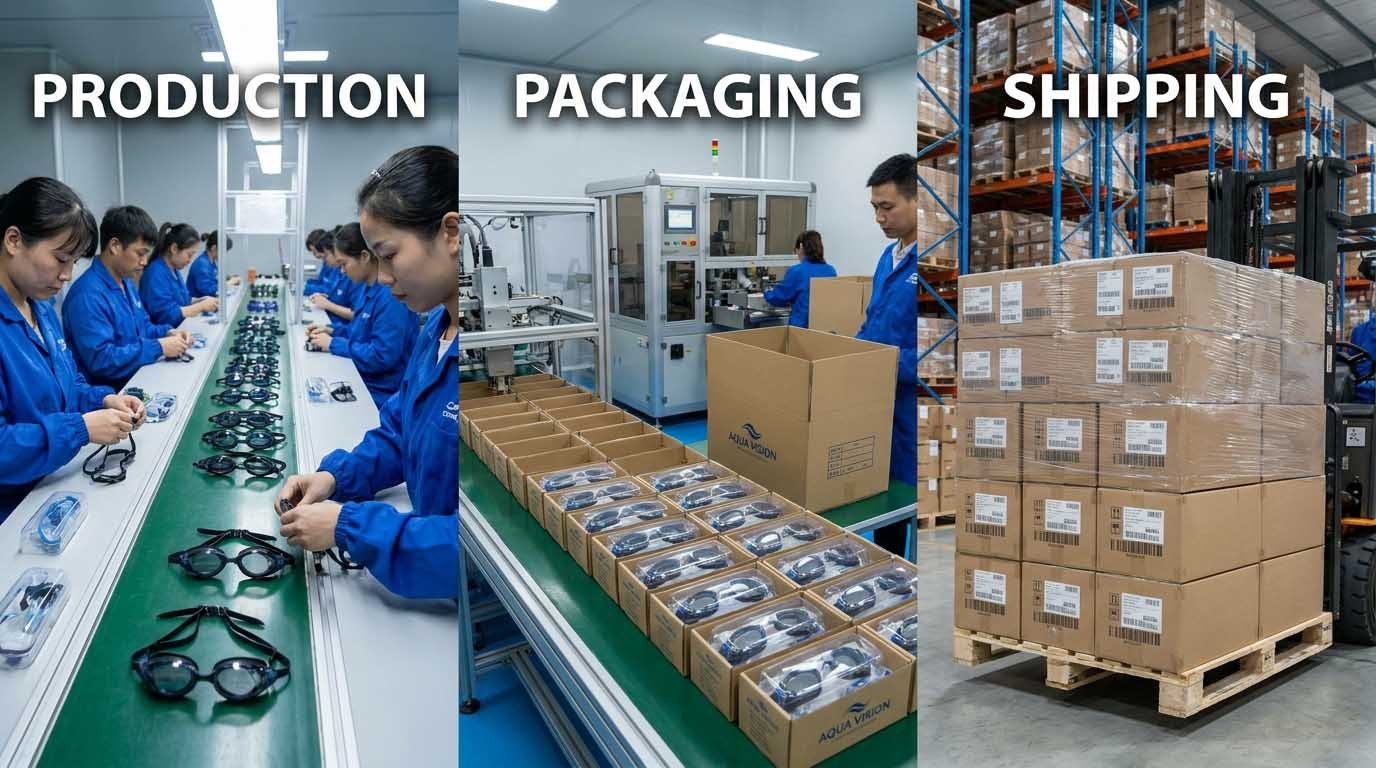
What happens during mass production
Mass production generally includes:
- Injection molding
- Trimming and finishing
- Lens coating or treatment
- Assembly
- In-process inspection
- Final inspection
- Packaging
- Carton packing
- Shipment preparation
Why packaging should not be left to the end
Packaging is often treated as an afterthought, but it affects:
- Production timing
- Retail readiness
- Product protection
- Label compliance
- Freight efficiency
If packaging artwork, dimensions, inserts, or barcode requirements are delayed, finished goods may sit in the warehouse waiting for boxes or labels.
Shipping options for OEM swim goggles
Common shipping methods include:
- Sea freight for lower cost and planned orders
- Air freight for urgent deliveries or smaller high-value shipments
The right option depends on delivery schedule, packaging volume, destination market, and budget.
Common Mistakes in OEM Swimming Goggles Projects
Many OEM delays and cost overruns come from preventable mistakes.
1. Starting with vague specifications
Broad ideas such as “premium,” “professional,” or “better anti-fog” are not enough for engineering and quoting.
2. Ignoring compliance at the concept stage
Certifications and material restrictions should be considered before design and tooling begin.
3. Underbudgeting tooling revisions
The initial mold quote is not always the final development cost.
4. Making design changes after tooling starts
Late changes usually create expensive delays.
5. Assuming approved samples guarantee stable production
Sample approval and bulk production consistency are not the same thing.
6. Skipping pilot production
This often shifts risk into the first large batch.
7. Finalizing packaging too late
Packaging delays can hold up shipment even when the goggles are finished.
8. Not clarifying mold ownership
Tooling ownership should be clear in the OEM agreement from the beginning.
Final Thoughts
The OEM swimming goggles process is not just a production checklist. It is a structured development process that moves through concept definition, DFM review, material selection, tooling, validation, pilot runs, and controlled mass production.
Brands that succeed usually do three things well:
- Define product requirements clearly
- Align customization with realistic budget and MOQ
- Treat sampling and pilot production as risk-control steps, not optional delays
For buyers comparing suppliers, the best manufacturing partner is not simply the one with the lowest quote. It is the factory that can explain technical trade-offs clearly, identify risks early, support validation properly, and deliver stable quality in mass production.
OEM Swimming Goggles Supplier Checklist
Before starting an OEM swim goggle project, ask the manufacturer:
- Can you support OEM swimming goggles or only ODM/private label?
- What information do you need before quoting?
- What certifications or compliance standards should be considered for my target market?
- What parts of the design require custom tooling?
- How many sample and tooling adjustment rounds are typical?
- Do you recommend pilot production before mass production?
- What AQL standard do you use for final inspection?
- Who owns the mold after payment?
- Can you provide documentation for materials, testing, and inspections?
- What is your realistic lead time from concept approval to shipment?
A clear answer to these questions will usually reveal whether the supplier understands the full swimming goggles manufacturing process and can support long-term OEM development.