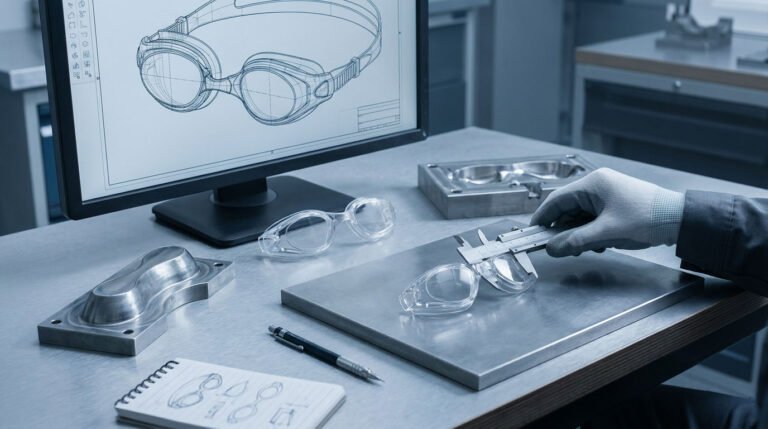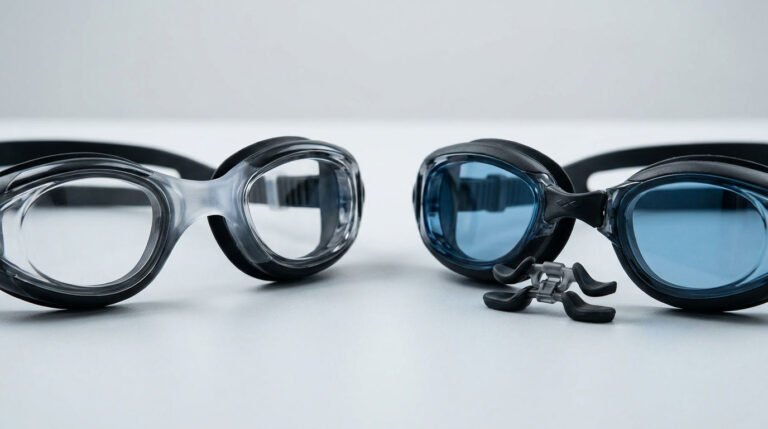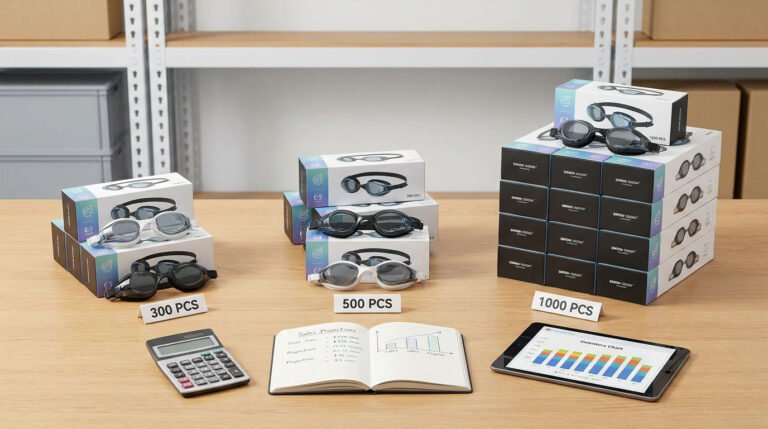
You pay for a custom swimming goggle mold. The factory develops it, stores it, and uses it for production.
So who actually owns it?
In an OEM swimming goggle project, mold ownership should be defined by the written agreement—not assumed from who paid the tooling fee or who physically holds the mold.
A well-structured tooling agreement should separate:
- legal ownership,
- physical custody,
- production usage rights,
- exclusivity,
- maintenance responsibility,
- and mold transfer rights.
For swimming goggle brands developing custom frames, lenses, gaskets, or other molded components, these terms can directly affect product exclusivity, supplier flexibility, and long-term supply continuity.
Quick Answer: Who Owns the Mold?
The simplest answer is:
The party named as the owner in the tooling or manufacturing agreement owns the mold. Paying the tooling invoice alone should not be treated as proof of ownership.
At the same time, ownership is only one part of the issue.
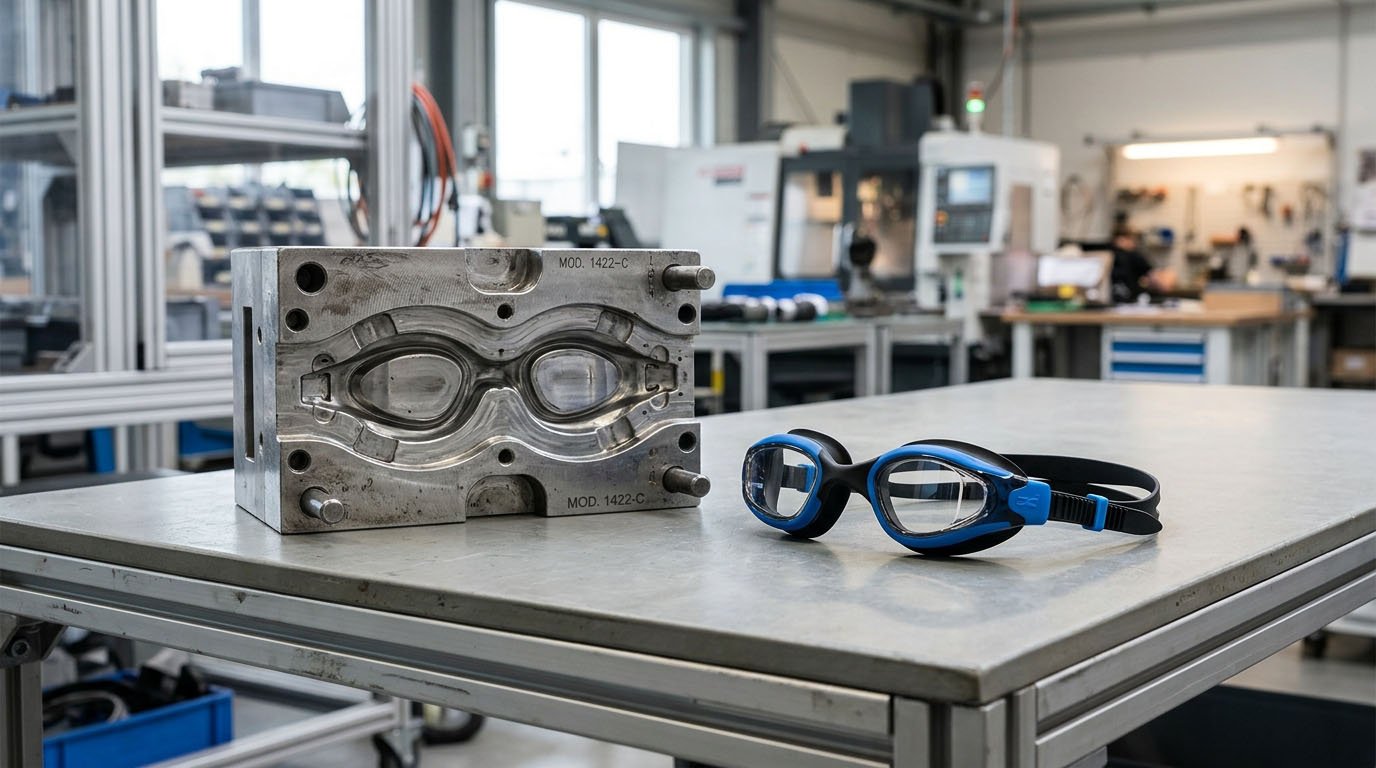
A brand may legally own a mold while the OEM factory physically stores and maintains it. The factory may have permission to use it only for the brand’s confirmed production orders.
That is why buyers should separate the following rights.
| Question | What Should Be Defined? |
|---|---|
| Who owns the mold? | Legal ownership |
| Who stores the mold? | Physical custody |
| Who may use it? | Production usage rights |
| Can it be used for other customers? | Exclusivity |
| Who maintains it? | Maintenance responsibility |
| Can it be moved? | Transfer and release rights |
These terms should ideally be agreed before mold development begins, not after production has already started.
What Is the Difference Between Mold Ownership, Custody, Usage and Transfer Rights?
One of the biggest mistakes in OEM product development is treating all tooling rights as the same thing.
They are not.

Legal Ownership
Legal ownership identifies who owns the physical tooling asset under the agreement.
For a buyer-funded custom project, the brand may negotiate ownership of the completed mold.
However, this should be stated clearly in writing.
Physical Custody
Custody refers to who physically keeps the mold.
In most OEM swimming goggle projects, the mold remains at the manufacturing factory because that is where production takes place.
This means:
The brand can own the mold while the factory holds it.
Ownership and physical possession are therefore separate questions.
Production Usage Rights
Usage rights define who is permitted to run the mold.
For a customer-owned custom mold, the factory should normally use the tooling only for authorized production associated with that customer’s orders.
Exclusivity
Exclusivity determines whether the same mold—or customer-specific tooling components—may be used to manufacture products for other buyers.
If exclusivity matters to your brand, do not rely on assumptions.
Define it in writing.
Transfer Rights
Transfer rights determine whether the buyer can request the mold to be released or transferred to another qualified factory.
This becomes especially important if:
- the supplier relationship ends,
- production performance changes,
- the brand changes sourcing strategy,
- or the buyer needs a secondary manufacturing option.
If You Pay for the Mold, Do You Automatically Own It?
No. Paying the tooling fee does not automatically settle every ownership and usage question.
The tooling fee generally covers the cost of developing the mold. But payment and contractual ownership should still be treated separately.
For example, a buyer may pay for:
- mold engineering,
- tooling development,
- prototyping,
- sample adjustments,
- or other development work.
That invoice alone may not explain:
- who legally owns the finished mold,
- whether the factory can use it elsewhere,
- whether the mold can be transferred,
- who maintains it,
- or what happens when the manufacturing relationship ends.
This is why mold ownership should be discussed during the development stage of an OEM & ODM swimming goggle project, rather than after the tooling has already been completed.
Payment, Ownership and Portability Are Different
A useful way to think about the issue is:
Payment ≠ Ownership ≠ Custody ≠ Portability
Even when a contract identifies the customer as the mold owner, moving the tooling to another factory may still require technical preparation.
That is a separate operational issue from legal ownership.
Why Does Mold Ownership Matter for a Swimming Goggle Brand?
Custom swimming goggle tooling can represent far more than a physical mold.
It may determine how easily your brand can control:
- product differentiation,
- future production,
- factory switching,
- design confidentiality,
- and supply continuity.
Product Exclusivity
If your custom mold creates a distinctive frame, gasket, lens geometry, or other unique product feature, unclear usage rights may weaken your control over that design.
Clear exclusivity terms help define whether the tooling may be used for other customers.
Supply Continuity
If your production depends entirely on tooling stored at one supplier, unclear release terms may make changing factories difficult.
A strong tooling agreement creates a clearer exit path.
Supplier Flexibility
Brands often focus heavily on today’s supplier relationship.
But product development decisions can affect the business several years later.
A buyer should therefore ask:
If our sourcing strategy changes later, what happens to the tooling?
Protection of Development Investment
Mold development requires engineering work, prototyping, testing and production validation.
Your agreement should protect that investment by clearly defining what rights you receive in return.
For custom projects, it is also important to coordinate tooling terms with the sampling and prototyping process so that ownership, sample approval and production responsibilities remain clear.
Who Usually Owns the Mold: Brand, Factory or Both?
There is no single ownership model for every OEM swimming goggle project.
Three structures are common.
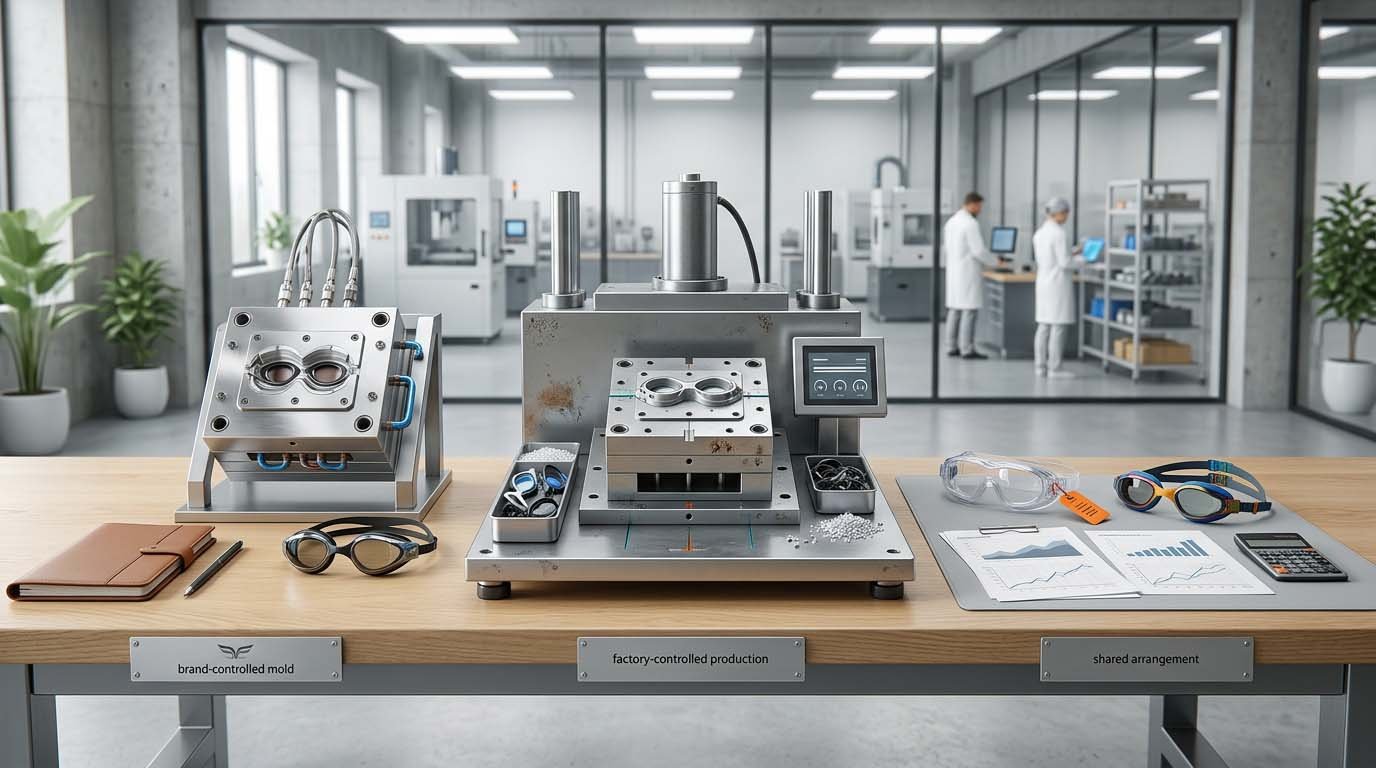
Brand-Owned Tooling
Under this model, the agreement identifies the customer or brand as the tooling owner.
The factory may continue storing and operating the mold for production.
This model can provide stronger long-term control, provided usage, custody and transfer terms are also clearly defined.
Factory-Owned Tooling
In some projects, the manufacturer owns the tooling.
The customer purchases finished products rather than ownership of the production asset itself.
This arrangement may work for certain existing-platform or supplier-funded development models, but the buyer generally has less flexibility to relocate production.
Shared or Conditional Tooling Arrangements
Some agreements use shared, subsidized, amortized or conditional tooling structures.
For example, part of the tooling investment may be supported by the manufacturer and recovered through later production.
In these cases, ownership and transfer rights can become more complicated.
The agreement should therefore explain:
- who owns the tooling during the cooperation period,
- whether ownership changes later,
- what conditions apply,
- and whether the mold can eventually be released.
| Tooling Model | Typical Control | Main Buyer Consideration |
|---|---|---|
| Brand-owned | Higher buyer control | Confirm custody and transfer terms |
| Factory-owned | Higher supplier control | Understand long-term dependency |
| Shared / conditional | Depends on agreement | Define ownership milestones clearly |
What Should Be Written Into a Swimming Goggle Mold Agreement?
The agreement does not need unnecessary complexity, but it should answer the questions that could create a dispute later.
At minimum, buyers should review the following areas.
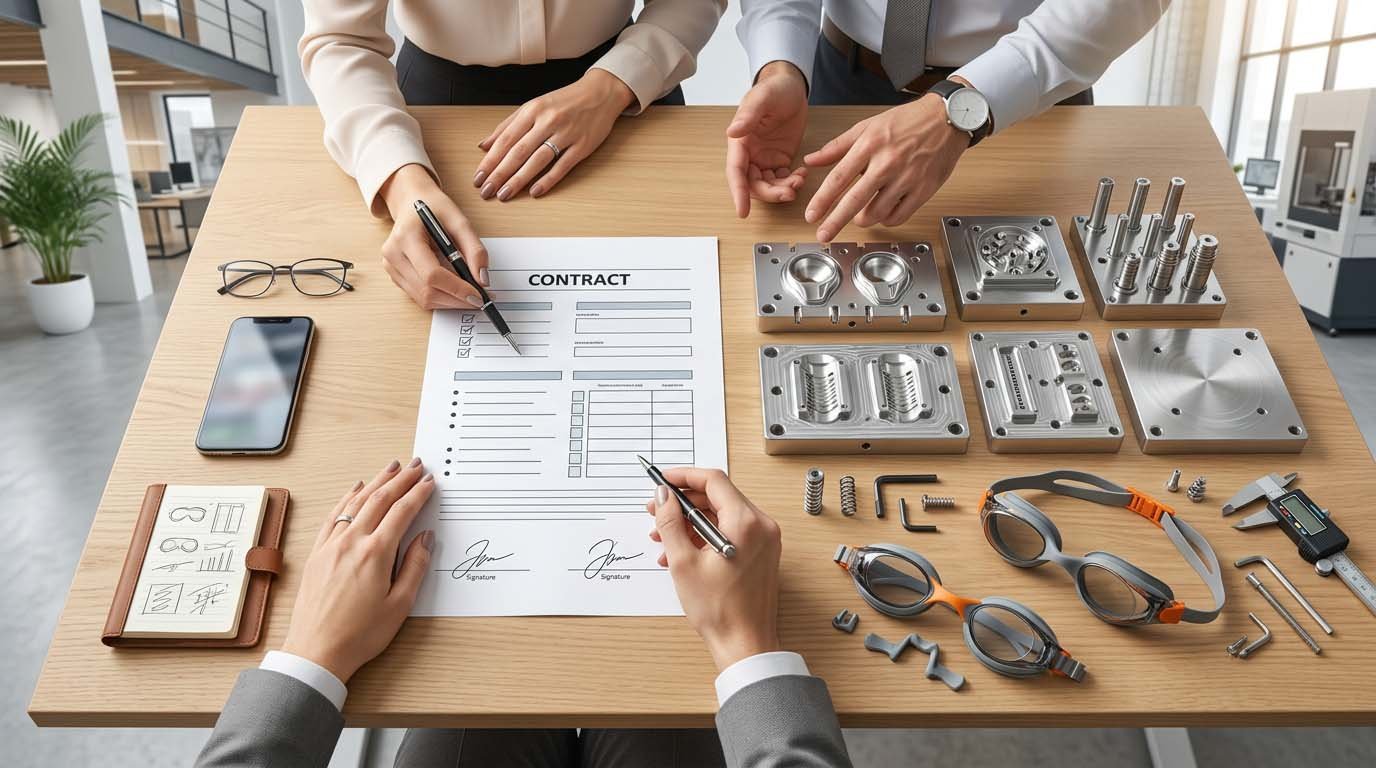
1. Mold Ownership
State clearly who owns the completed mold.
Avoid vague wording such as:
"Tooling provided for customer production."
Instead, the agreement should make the ownership structure unmistakable.
2. Physical Custody
Define where the mold will normally be stored and who is responsible for protecting it while it remains at the factory.
3. Authorized Usage
Specify when the manufacturer may use the mold.
For customer-specific tooling, production should normally be linked to authorized purchase orders or agreed manufacturing activity.
4. Exclusivity
If the mold is exclusive to the buyer, state that clearly.
The agreement should address whether the factory may:
- produce for another customer,
- reproduce the design,
- reuse tooling inserts,
- or commercialize similar customer-specific tooling.
5. Maintenance Responsibility
Molds require routine care during their working life.
The agreement should explain who is responsible for normal maintenance and how significant repair or modification costs will be handled.
Avoid relying on one universal mold-life figure because actual tooling life depends on factors such as:
- mold material,
- component design,
- production conditions,
- maintenance,
- molding material,
- and manufacturing volume.
6. Transfer and Release Conditions
The contract should explain what happens if the customer requests the tooling to be transferred.
Questions should include:
- What conditions trigger release?
- Are outstanding tooling-related costs required to be settled?
- Who prepares the tooling for transport?
- What supporting technical files are provided?
- Who pays transportation costs?
- What happens to customer-owned inserts, fixtures or accessories?
Should the Mold Be Marked With the Buyer’s Name or Tooling ID?
For customer-owned tooling, physical identification can make asset management clearer.
A buyer can ask the OEM factory to identify the mold using information such as:
- customer or project name,
- internal tooling number,
- product model,
- tooling version,
- or asset identification code.
This can help both parties distinguish customer-specific tooling from the factory’s other production assets.
For more complex projects, brands may also keep their own tooling register showing:
| Item | Example Record |
|---|---|
| Tooling ID | Internal project number |
| Product | Swimming goggle model |
| Component | Frame / gasket / lens / other part |
| Ownership | Buyer / factory / conditional |
| Storage location | OEM factory |
| Revision | Current tooling version |
| Status | Active / maintenance / retired |
This type of documentation is especially useful when one swimming goggle model involves several separate tooling components.
Can You Move Your Swimming Goggle Mold to Another Factory?
Potentially—but ownership does not automatically mean the mold is instantly portable.
This is an important distinction.
A receiving factory may need to review whether the tooling is compatible with its:
- manufacturing equipment,
- mold mounting system,
- material process,
- temperature-control setup,
- supporting fixtures,
- and production parameters.
The new factory may also need supporting documentation such as:
- tooling drawings,
- relevant CAD data,
- processing information,
- maintenance records,
- revision records,
- and approved production samples.
This is why mold transfer should be planned as both a contract issue and an engineering issue.
However, the detailed engineering of mold development and transfer should not be confused with ownership itself.
For buyers, the key question here is simple:
Does your agreement give you a practical path to retrieve the tooling and the information needed to use it elsewhere?
How Can Buyers Protect Their Mold Before Development Starts?
The strongest protection starts before tooling begins.
Use the following checklist before releasing a tooling deposit.
Pre-Tooling Ownership Checklist
- [ ] Who legally owns the mold?
- [ ] Who will physically store it?
- [ ] Who may operate it?
- [ ] Is the tooling exclusive to our project?
- [ ] Can the factory use the design for another customer?
- [ ] Who handles routine mold maintenance?
- [ ] How are major repairs handled?
- [ ] Is the tooling physically identified?
- [ ] What happens if the cooperation ends?
- [ ] Can the mold be transferred?
- [ ] What technical files accompany a transfer?
- [ ] Are customer IP and confidentiality obligations separately defined?
These questions should be discussed alongside product specifications, sample approvals and manufacturing requirements—not left until after tooling has already been completed.
Jerry’s Quality Assurance process can also be used alongside tooling and sample approval requirements to define how the finished product will be verified before bulk production.
What Are the Most Common Mold Ownership Mistakes?
Several mistakes repeatedly create unnecessary risk.
Assuming Payment Automatically Equals Ownership
A tooling invoice shows that money was paid.
It does not replace a clear tooling agreement.
Confusing Ownership With Physical Possession
Your supplier may store a mold that your company owns.
These two concepts can coexist.
Forgetting Usage Rights
Even when ownership is clear, unauthorized production can become a separate issue.
Usage restrictions should therefore be written separately.
Ignoring Transfer Until Problems Occur
The worst time to negotiate mold release is after the buyer and supplier relationship has already broken down.
Discuss transfer terms at the beginning.
Treating IP Rights and Mold Ownership as the Same Thing
The physical mold and the intellectual property behind the product are related, but they are not automatically identical rights.
Your agreement should address each separately.
FAQ About OEM Swimming Goggle Mold Ownership
Does Paying 100% of the Mold Fee Mean the Mold Is Mine?
Not automatically.
If you want customer-owned tooling, the agreement should explicitly state that the buyer owns the completed mold and explain custody, usage and transfer rights.
Can the Factory Keep My Mold Even If I Own It?
The factory may physically store customer-owned tooling during normal production.
The important issue is whether the contract explains its custody responsibilities and the conditions under which the tooling must be released.
Can the Factory Use My Mold for Other Customers?
Not if your agreement gives you exclusive usage rights and prohibits unauthorized production.
Do not rely on verbal assumptions. Put exclusivity in writing.
Who Should Pay for Mold Maintenance?
The agreement should define responsibility for routine maintenance, repair and significant tooling modifications.
There is no need to rely on one universal rule for every project.
Can I Move the Mold to Another Swimming Goggle Manufacturer?
Potentially, if your agreement permits transfer.
However, the receiving factory must also confirm that the tooling and associated production process are technically compatible with its equipment.
Is Mold Ownership the Same as Owning the Product Design?
No.
Physical tooling ownership, design/IP ownership, confidentiality, usage rights and exclusivity should be treated as separate contractual issues.
When Should Mold Ownership Be Negotiated?
Ideally before tooling development starts and before the initial tooling deposit is released.
At that point both sides can establish the rules before significant development investment has been made.
Final Takeaway
The most important principle is simple:
Paying for a swimming goggle mold does not automatically define every right associated with that mold.
A professional OEM project should clearly separate:
Ownership → Custody → Usage → Exclusivity → Maintenance → Transfer
Before development begins, ask your manufacturer to define each point in writing.
That gives your brand clearer control over its tooling investment, reduces future supplier disputes, and creates a more practical path if your sourcing strategy changes.
If you are planning a new frame, gasket, lens or other custom swimming goggle component, Jerry can support the project from OEM & ODM development and sampling and prototyping through quality control and bulk production.
For a custom project review, contact Jerry with your design concept, target market and customization requirements.