Your swimming goggle sample arrives with excellent anti-fog performance. You approve it, release the order, and then discover that some units in the bulk shipment fog much faster than the original sample.
Why?
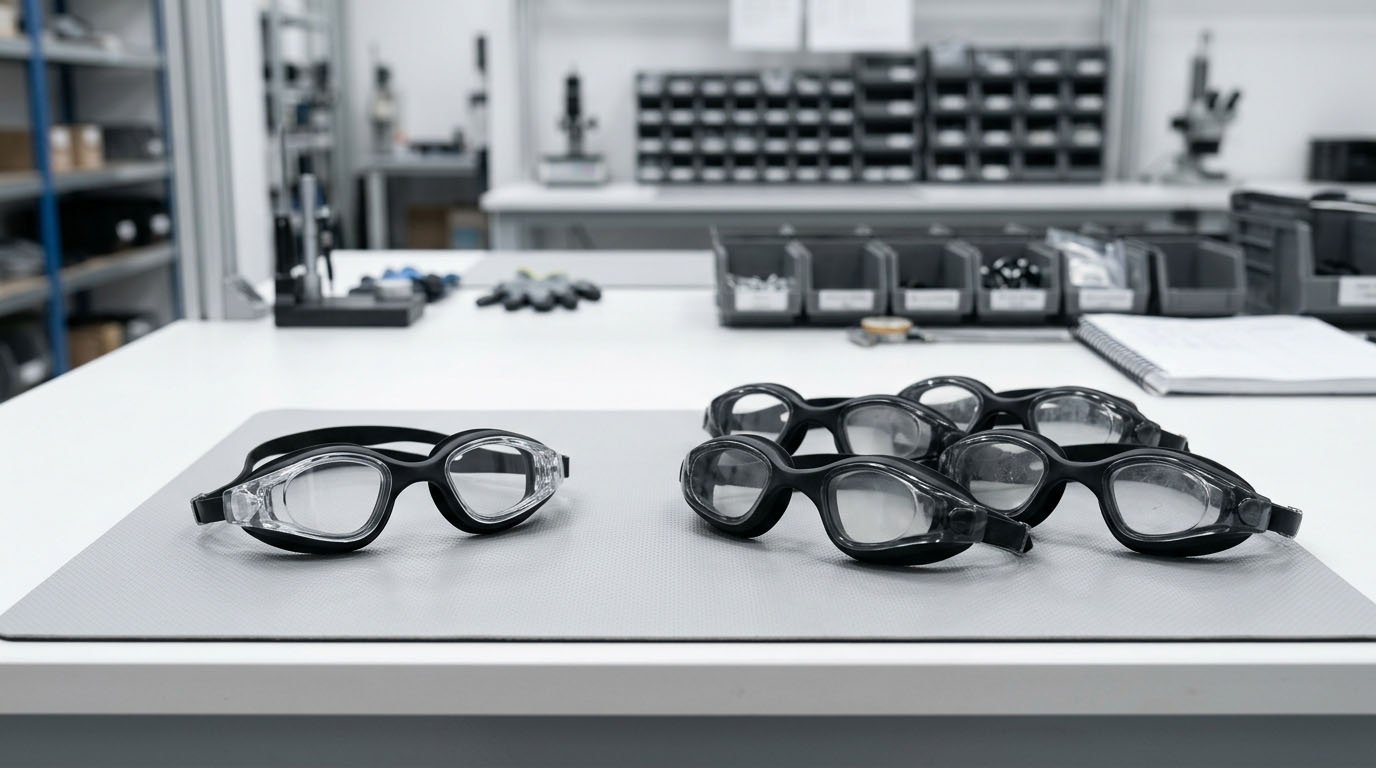
Samples often pass anti-fog tests because they are produced and checked under carefully controlled conditions. Bulk production introduces much more variation across coating application, curing, production time, equipment conditions, handling, and inspection. A passing sample proves the target performance can be achieved; it does not prove the factory can reproduce it consistently across thousands of units.
For buyers, the real question is not:
Did the approved sample pass?
It is:
Can the manufacturer reproduce that anti-fog performance consistently across the production run?
Quick Answer: Why Do Samples Pass but Bulk Orders Fail?
The most common causes are:
- uneven anti-fog coating application,
- curing variation,
- process drift during long production runs,
- changes between production windows,
- weak sampling coverage,
- different test methods between supplier and buyer,
- and poor traceability between the approved sample and bulk production.
The simplest way to think about it is:
Sample approval proves possibility. Bulk production requires repeatability.
Why Can Anti-Fog Performance Change From Sample to Bulk?
A development sample and a mass-production unit may look identical, but the manufacturing conditions can be very different.
A sample is often:
- produced in a small quantity,
- handled more carefully,
- checked closely,
- and made under direct engineering supervision.
Bulk production must repeat the same result across a much larger quantity and over a longer period.
Sample Stage vs Bulk Stage
| Factor | Sample Stage | Bulk Production |
|---|---|---|
| Attention per unit | High | Spread across large quantities |
| Process monitoring | Closely watched | Must remain stable over time |
| Coating application | Small-batch control | Continuous production |
| Curing | Easier to control | More variables |
| Sampling | Few units reviewed closely | Needs representative coverage |
| Variation risk | Lower | Higher if process drifts |
The key point is:
A golden sample is an output. Process control is the system that determines whether that output can be repeated.
Cause 1: Anti-Fog Coating Application Changes During Bulk Production
Anti-fog performance depends heavily on coating consistency.
If the coating is:
- too thin,
- uneven,
- contaminated,
- or applied inconsistently,
some lenses may perform well while others fog quickly.
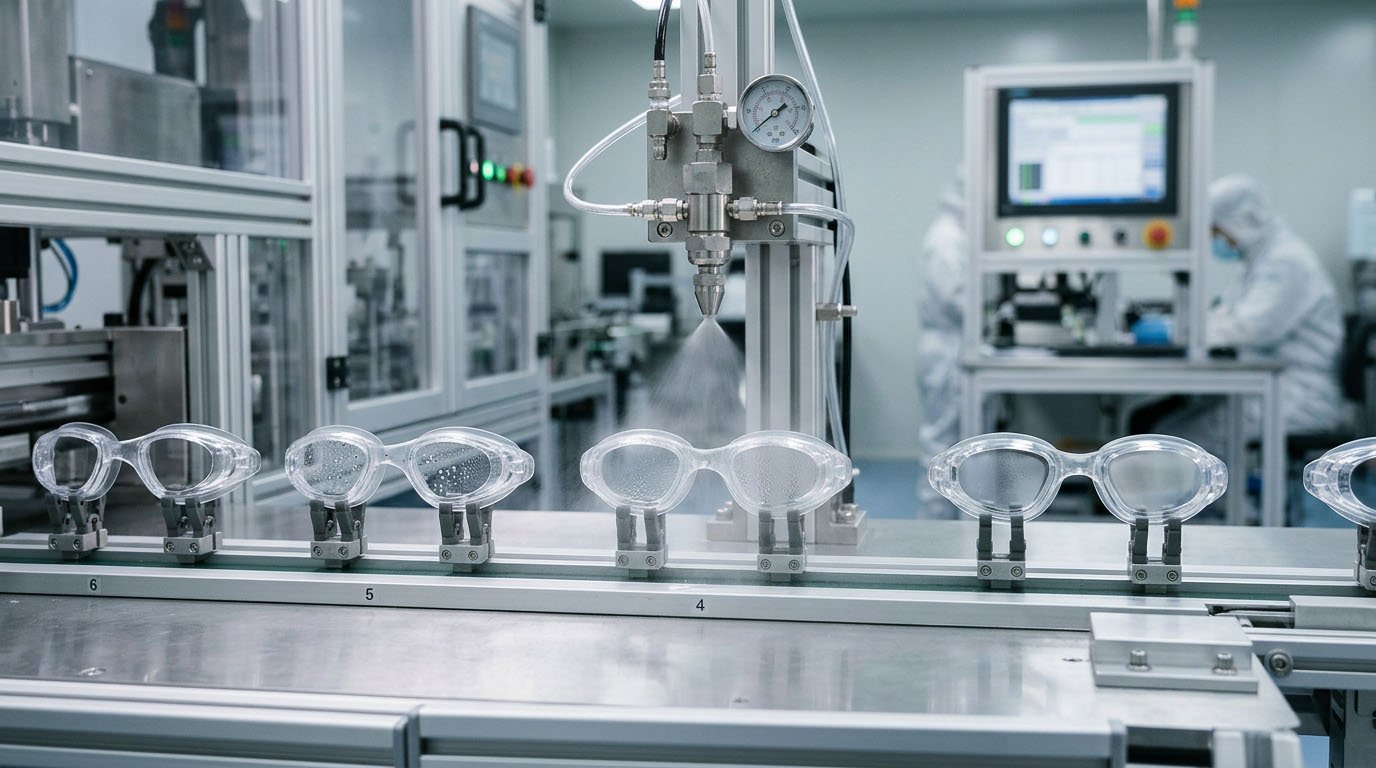
Why Can Bulk Coating Vary?
During a long production run, factors may change, including:
- coating condition,
- application equipment,
- spray or dipping consistency,
- lens surface preparation,
- production speed,
- and environmental conditions.
These changes may not be visible during normal inspection.
A lens can look perfectly clear and still have weaker anti-fog performance.
Cause 2: Curing Conditions Can Drift
Applying the anti-fog treatment is only part of the process.
The coating must also be dried or cured according to the required process.
If curing conditions change, performance can become inconsistent.
Potential risks include:
- unstable curing time,
- temperature variation,
- airflow differences,
- equipment loading,
- and production speed.
A development sample may receive ideal curing conditions.
Bulk production must maintain comparable conditions continuously.
So buyers should ask not only:
What coating is used?
but also:
How is coating application and curing controlled during volume production?
Cause 3: Process Drift Builds Up During Long Production Runs
One of the biggest differences between sample production and bulk production is time.
A development sample may be made during one short session.
A bulk order may run across:
- many hours,
- multiple shifts,
- different equipment cycles,
- and several production windows.
What Is Process Drift?
Process drift means manufacturing conditions gradually move away from the approved setup.
For example:
Early Production → Stable Result → Mid Production → Small Variation → Late Production → Larger Variation
Possible causes include:
- coating condition,
- equipment settings,
- curing stability,
- operator handling,
- contamination,
- or environmental changes.
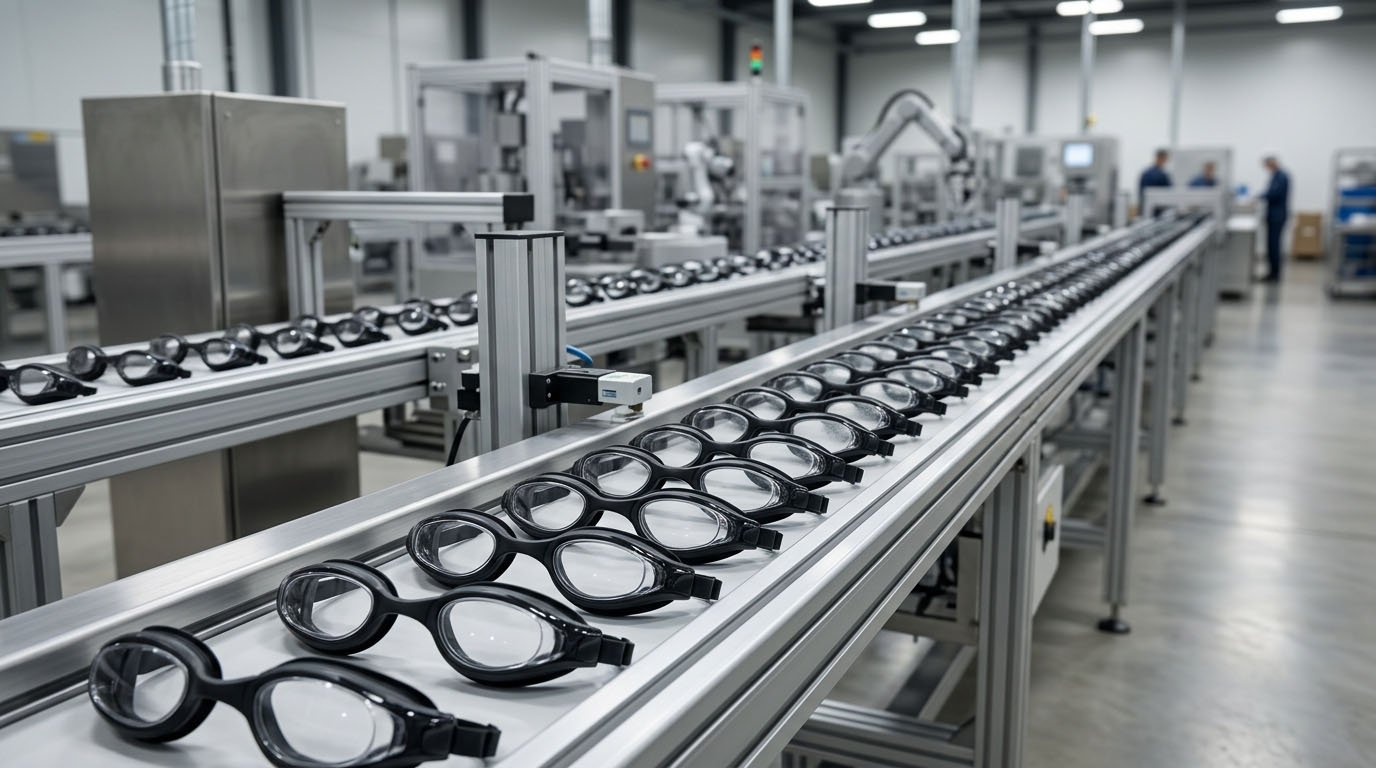
This is why one passing sample or one passing carton may not represent the whole order.
Cause 4: Sampling From One Production Window Can Hide Problems
This is one of the most important reasons anti-fog defects reach customers.
Imagine a production run where:
- early units are good,
- middle units begin to vary,
- later units perform worse.
If the inspector tests only units from the early production window, the inspection may still pass.
Why Representative Sampling Matters
Functional coating defects may sometimes be linked to:
- production time,
- equipment conditions,
- coating changes,
- or shift changes.
That means samples should represent different parts of the production run.
A practical approach is:
Early Production + Middle Production + Late Production
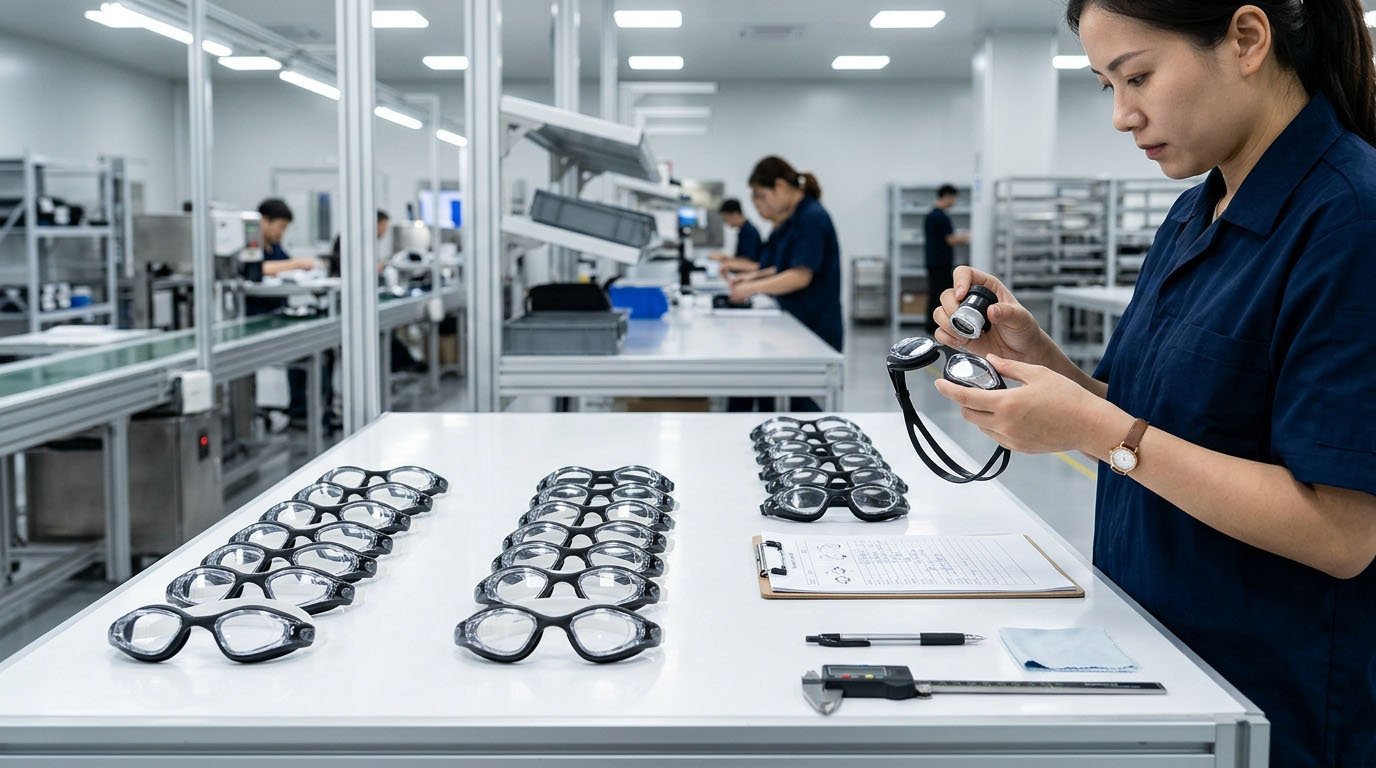
This helps reveal:
- time-based variation,
- process drift,
- inconsistent coating,
- and curing instability.
Cause 5: Factory and Buyer Test Methods May Not Match
Sometimes the problem is not only production quality.
The supplier and buyer may be using different test methods.
Factory Test
May use:
- a quick steam check,
- short exposure,
- internal pass/fail criteria.
Buyer or Third-Party Test
May use:
- different sample preparation,
- different exposure conditions,
- different observation time,
- or different clarity criteria.
The result can be:
Factory: PASS
Buyer: FAIL
even when both sides believe they tested correctly.
Align the Test Before Production
Both parties should agree on:
- sample preparation,
- test method,
- test conditions,
- observation method,
- pass/fail criteria,
- and documentation.
The goal is:
the same definition of “PASS.”
For the detailed testing process, see How to Test Anti-Fog Performance on Swimming Goggles.
For the detailed testing process, see How to Test Anti-Fog Performance on Swimming Goggles.
Why Pilot Production Matters
A golden sample defines the approved target.
A pilot run checks whether the real production process can reproduce it.
That makes pilot production much more useful for scale-up risk than relying only on one perfect development sample.
A Practical Approval Flow
Development Sample → Golden Sample → Pilot Production → Production Verification → Bulk Release
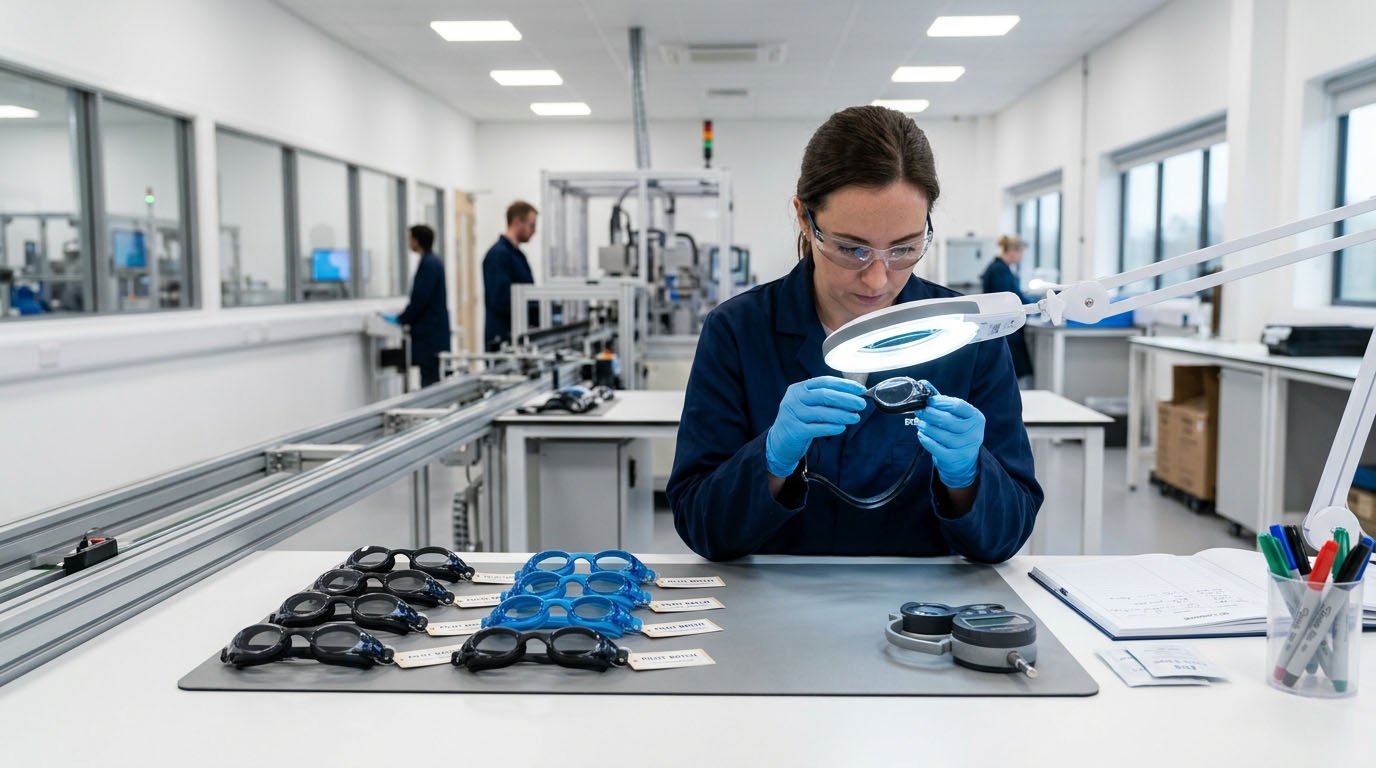
During a pilot run, buyers can evaluate:
- coating consistency,
- curing stability,
- sample variation,
- real line conditions,
- and test repeatability.
For custom projects, this fits naturally into Jerry’s sampling and prototyping process.
Can Storage, Packaging, and Shipping Affect Anti-Fog Performance?
Yes.
The product still needs to survive:
Packing → Storage → Shipping → Warehousing → Retail
Potential risks include:
- heat or humidity,
- prolonged storage,
- surface contamination,
- packaging contact,
- and rubbing.
Packaging should protect the coated inner lens from unnecessary contact.
Where anti-fog performance is commercially important, buyers should consider the full product journey—not only factory testing immediately after production.
How Can Buyers Prevent Sample-to-Bulk Anti-Fog Failure?
A stronger control system should focus on repeatability rather than one-off approval.
1. Define the Test Method Before Bulk Production
Agree on:
- sample preparation,
- test conditions,
- observation method,
- acceptance criteria,
- and documentation.
2. Sample Across Different Production Windows
Do not test only one convenient carton.
Use production-representative sampling across:
Early → Middle → Late
3. Verify Coating and Curing Process Control
Ask how the supplier controls and records critical production steps.
4. Keep Traceable Retained Samples
Retained samples should link back to:
- production batch,
- model,
- lens configuration,
- coating configuration,
- test date,
- and approval status.
5. Verify Durability Separately
Initial anti-fog performance and durability are different questions.
For repeated stress cycles and production-level durability validation, see How Is Anti-Fog Durability Testing Conducted Before Mass Production?
What Should Buyers Compare Between the Approved Sample and Bulk Order?
| Check | Approved Sample | Bulk Verification |
|---|---|---|
| Lens configuration | Approved | Same configuration |
| Anti-fog system | Approved | Same specification |
| Test method | Defined | Same method |
| Initial performance | Recorded | Compare |
| Optical clarity | Approved | Compare |
| Production stage | Development / pilot | Bulk production |
| Traceability | Sample ID | Batch / production window |
| Result | Reference | Within agreed acceptance |
The objective is not to make every unit mathematically identical.
It is to keep production within the agreed quality range.
Anti-Fog Sample-to-Bulk Verification Checklist
| Check | What to Verify |
|---|---|
| Golden sample | Approved reference retained |
| Test protocol | Supplier and buyer aligned |
| Coating process | Controlled during production |
| Curing process | Stable and documented |
| Production sampling | Covers different production windows |
| Anti-fog testing | Same evaluation method used |
| Traceability | Samples linked to batch |
| Retained sample | Available for comparison |
| Packaging | Coated surface protected |
| Durability | Verified separately where needed |
This is much stronger than assuming:
“The original sample passed, so the order should be fine.”
Common Mistakes Buyers Should Avoid
Approving Bulk Production From One Development Sample
A development sample shows what is possible.
It does not prove production repeatability.
Testing Only One Production Window
This can miss time-based variation or process drift.
Using Different Test Methods
If the supplier and buyer define “PASS” differently, disputes become much more likely.
Ignoring Process and Traceability Records
A good sample is useful.
A controlled, traceable manufacturing process is more important.
FAQ: Why Do Anti-Fog Samples Pass but Bulk Orders Fail?
Does a Passing Sample Guarantee Bulk Quality?
No.
It proves one sample achieved the required result under specific conditions.
Bulk quality depends on whether that result can be repeated consistently.
What Is the Biggest Hidden Risk?
Process variation across the production run.
Conditions may change between early, middle, and later production.
Should Anti-Fog Testing Use the Same Method for Sample and Bulk?
Ideally, yes.
Using aligned preparation, test conditions, and acceptance criteria makes comparison much more meaningful.
How Jerry Approaches Sample-to-Bulk Quality Control
For OEM and ODM swimming goggles, the goal is not simply to create one perfect sample.
The goal is to reproduce the approved specification reliably during production.
That requires coordination between:
- product development,
- sampling,
- coating process control,
- curing,
- in-process inspection,
- production sampling,
- final QC,
- and traceability.
Jerry supports projects through OEM and ODM development, sampling and prototyping, and production-level quality assurance.
You can also review Jerry’s swimming goggles manufacturing capabilities when evaluating lens, gasket, anti-fog, color, and packaging configurations.
Conclusion
A passing anti-fog sample proves one important thing:
The target performance can be achieved.
It does not prove the same performance will automatically appear across the entire bulk order.
Bulk failures are more often linked to:
- coating variation,
- curing instability,
- process drift,
- weak sampling,
- mismatched test protocols,
- and poor traceability.
A stronger approval strategy is:
Golden Sample → Pilot Run → Process Control → Representative Sampling → Aligned Testing → Bulk Approval
For buyers, the most important question is:
Can this manufacturer reproduce the approved result consistently at scale?
That is what separates a successful sample from reliable mass production.
If you are developing an OEM, ODM, or private label swimming goggle and want to review sample approval, anti-fog performance, or production verification requirements, contact Jerry to discuss your project.