If you plan to sell swimming goggles in the European Union, one of the first compliance questions is:
Do swimming goggles need CE certification?
The short answer is yes—standard swimming goggles for surface swimming are generally treated as Category I Personal Protective Equipment (PPE) in the EU and therefore require CE marking under Regulation (EU) 2016/425.
However, Category I follows a simpler conformity route than higher-risk PPE. Manufacturers generally use Module A — Internal Production Control, rather than the EU type-examination required for Category II PPE. EU Regulation 2016/425 includes prolonged contact with water among Category I minimal risks, and Tukes specifically lists swimming goggles as an example of Category I PPE.
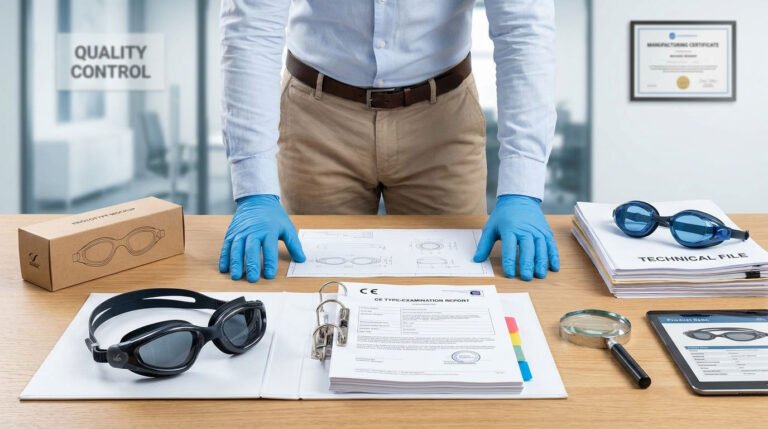
For importers and private-label brands, compliance involves more than printing a CE logo. You should verify the product classification, testing evidence, technical documentation, EU Declaration of Conformity, marking and consistency between the tested model and bulk production.
Quick Answer: Do Swimming Goggles Need a CE Mark in the EU?
Yes. Conventional swimming goggles intended for surface swimming are generally Category I PPE and require CE marking before being placed on the EU market.
The typical route is:
Swimming Goggles → Category I PPE → Module A Internal Production Control → Technical Documentation → EU Declaration of Conformity → CE Marking
Under Regulation (EU) 2016/425, Category I follows internal production control. The manufacturer establishes technical documentation, controls manufacturing conformity, issues the EU Declaration of Conformity and affixes the CE mark.
| Requirement | Standard Swimming Goggles |
|---|---|
| PPE classification | Category I |
| Main EU regulation | Regulation (EU) 2016/425 |
| CE marking | Yes |
| Conformity route | Module A |
| Notified Body normally required? | No |
| Technical documentation | Yes |
| EU Declaration of Conformity | Yes |
| Common technical standard | ISO 18527-3 |
This is why asking only:
“Do you have a CE certificate?”
is often the wrong question.
For Category I swimming goggles, buyers should verify the complete conformity evidence instead.
Why Are Swimming Goggles Category I PPE?
EU PPE rules divide products into three risk categories.
For normal swimming goggles, the important category is Category I, which covers minimal risks including prolonged contact with water. The Finnish Safety and Chemicals Agency, Tukes, specifically includes swimming goggles among Category I PPE examples.
Category I does not mean the product is exempt from CE requirements.
It means the conformity procedure is simpler.
For conventional surface swimming goggles, the manufacturer generally does not need a Notified Body to carry out EU type-examination. Instead, the manufacturer takes responsibility for demonstrating conformity through Module A.
Products intended to protect against substantially different or higher risks may require a separate classification assessment.
What Does Module A Mean for Swimming Goggles?
Under Module A — Internal Production Control, the manufacturer is responsible for ensuring that the product satisfies the applicable PPE requirements.
That normally involves:
- preparing technical documentation,
- ensuring production matches the approved specification,
- maintaining relevant test and verification evidence,
- drawing up the EU Declaration of Conformity,
- and affixing the CE marking.
The regulation specifically requires Category I PPE to use Module A and requires manufacturers to control production so manufactured products remain consistent with the technical documentation.
Does “Self-Certification” Mean No Testing Is Needed?
No.
Self-certification does not mean:
Print the CE logo and sell the product.
It means the manufacturer assumes responsibility for proving conformity.
Testing, risk assessment, product specifications and manufacturing-control records can all form part of the supporting evidence.
What Is ISO 18527-3 for Swimming Goggles?
An important technical reference is:
ISO 18527-3:2020 — Eye and face protection for sports use — Part 3: Requirements and test methods for eyewear intended to be used for surface swimming.
The standard covers both:
- recreational swimming eyewear, and
- specialist competitive swimming eyewear.
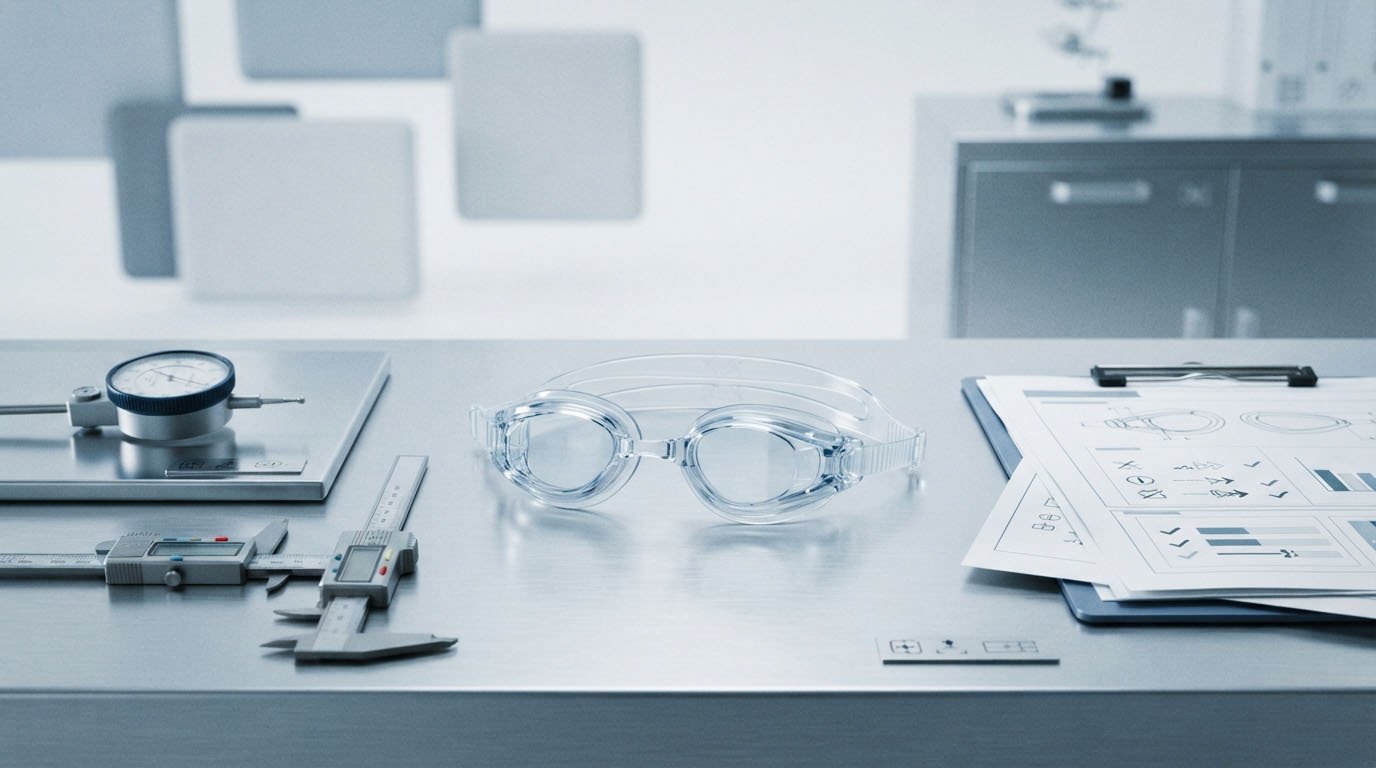
It addresses areas including materials, construction, optical properties, testing, marking and information supplied by the manufacturer.
Is ISO 18527-3:2020 Still Current in 2026?
Yes.
ISO reviewed and confirmed ISO 18527-3:2020 in 2026, so the edition remains current. ISO also published:
ISO 18527-3:2020/Amd 1:2025
in August 2025.
When reviewing a supplier report, buyers should therefore check:
- which edition was used,
- whether the applicable amendment was considered,
- which model was tested,
- and whether the tested specification matches the product being ordered.
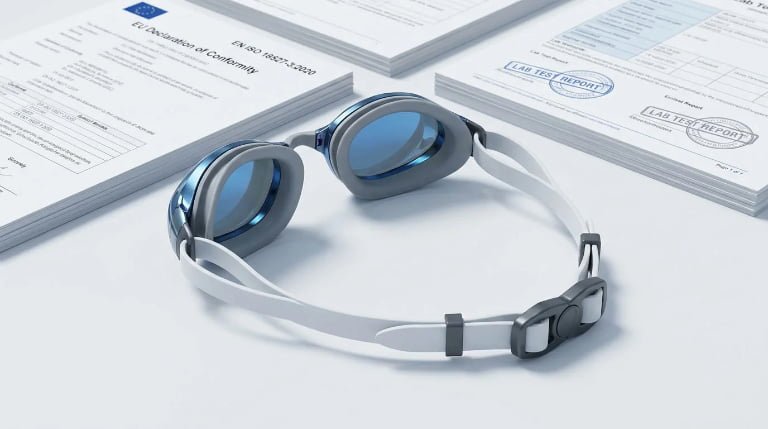
Is an ISO 18527-3 Test Report the Same as CE Certification?
No.
This distinction is important.
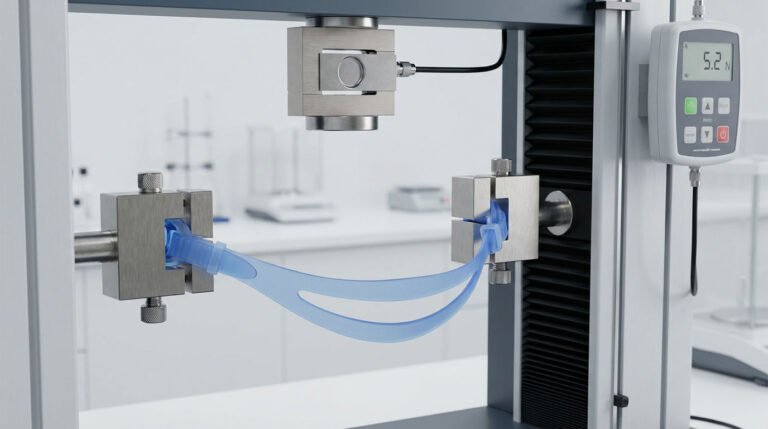
A test report shows how a specific sample performed against defined technical requirements.
CE marking represents the manufacturer’s declaration that the product complies with the applicable EU legislation.
A simplified evidence chain looks like this:
Product Specification → Risk Assessment → Testing Evidence → Technical Documentation → EU Declaration of Conformity → CE Marking
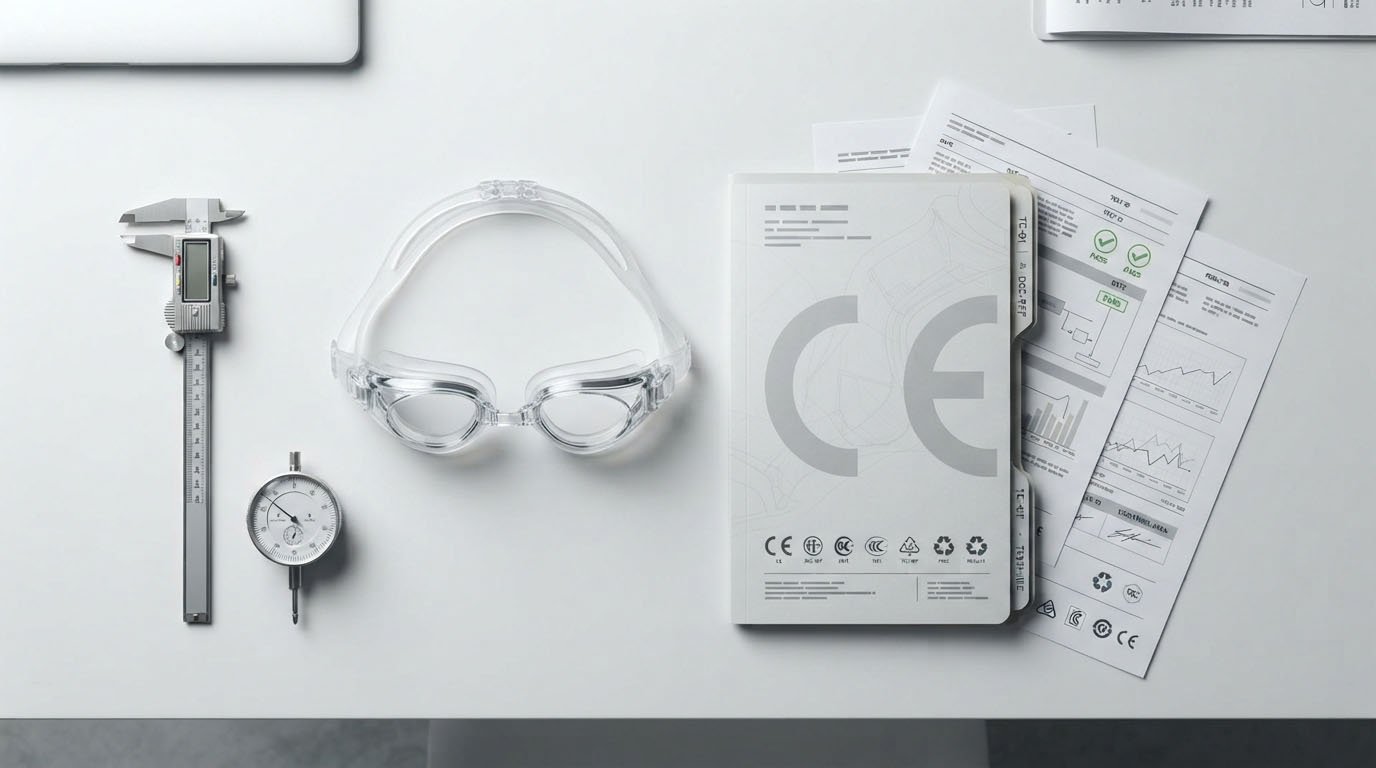
A laboratory report for one model therefore does not automatically prove that every swimming goggle produced by the same factory is compliant.
Buyers should confirm that the report matches the actual:
- model,
- materials,
- construction,
- lens configuration,
- and commercial specification.
What Should the Technical Documentation Cover?
Under the PPE Regulation, manufacturers must establish technical documentation supporting conformity.
For swimming goggles, a practical documentation package may cover:
Product Identification and Design
Include relevant information such as:
- model number,
- product drawings or photographs,
- intended use,
- lens construction,
- gasket,
- strap,
- buckle,
- coatings,
- and key materials.
Buyers developing private-label products can review Jerry’s Swimming Goggles capabilities when defining the commercial specification.
Risk and Testing Evidence
The documentation should identify relevant product risks and explain how the product addresses them.
Testing evidence should correspond to the final product rather than an unrelated factory model.
Production Control
The manufacturer also needs to ensure that bulk products continue to match the documented design.
Material substitutions, lens changes, coatings or component changes after testing should therefore be controlled carefully.
For a more detailed breakdown of Annex III technical documentation and the legal responsibilities of manufacturers and importers, see our EU PPE Regulation 2016/425 for Swimming Goggles guide.
What Is an EU Declaration of Conformity?
The EU Declaration of Conformity, or EU DoC, is a key CE compliance document.
By issuing the declaration, the manufacturer takes responsibility for the product’s conformity with the applicable legislation.
For Category I PPE, Regulation (EU) 2016/425 requires the manufacturer to draw up a written Declaration of Conformity and retain it together with the technical documentation for 10 years after the PPE has been placed on the market.
The declaration normally identifies the:
- PPE model,
- manufacturer,
- applicable legislation,
- relevant standards or technical specifications,
- and responsible signatory.
For conventional Category I swimming goggles, buyers should normally focus on the DoC + technical evidence, rather than expecting a Category II-style EU type-examination certificate.
Does a Notified Body Need to Certify Swimming Goggles?
For conventional Category I swimming goggles, normally no.
The PPE Regulation establishes different conformity routes:
- Category I: Module A — Internal Production Control
- Category II: Module B EU Type-Examination + Module C
- Category III: Module B plus additional supervised production procedures
This means a supplier saying:
“Our goggles have a CE certificate.”
does not provide enough information.
A better question is:
Can you show the conformity documents and test evidence for this exact model?
What Should EU Importers Check Before Production?
Compliance should be reviewed before mass production, not when finished goods are waiting for shipment.
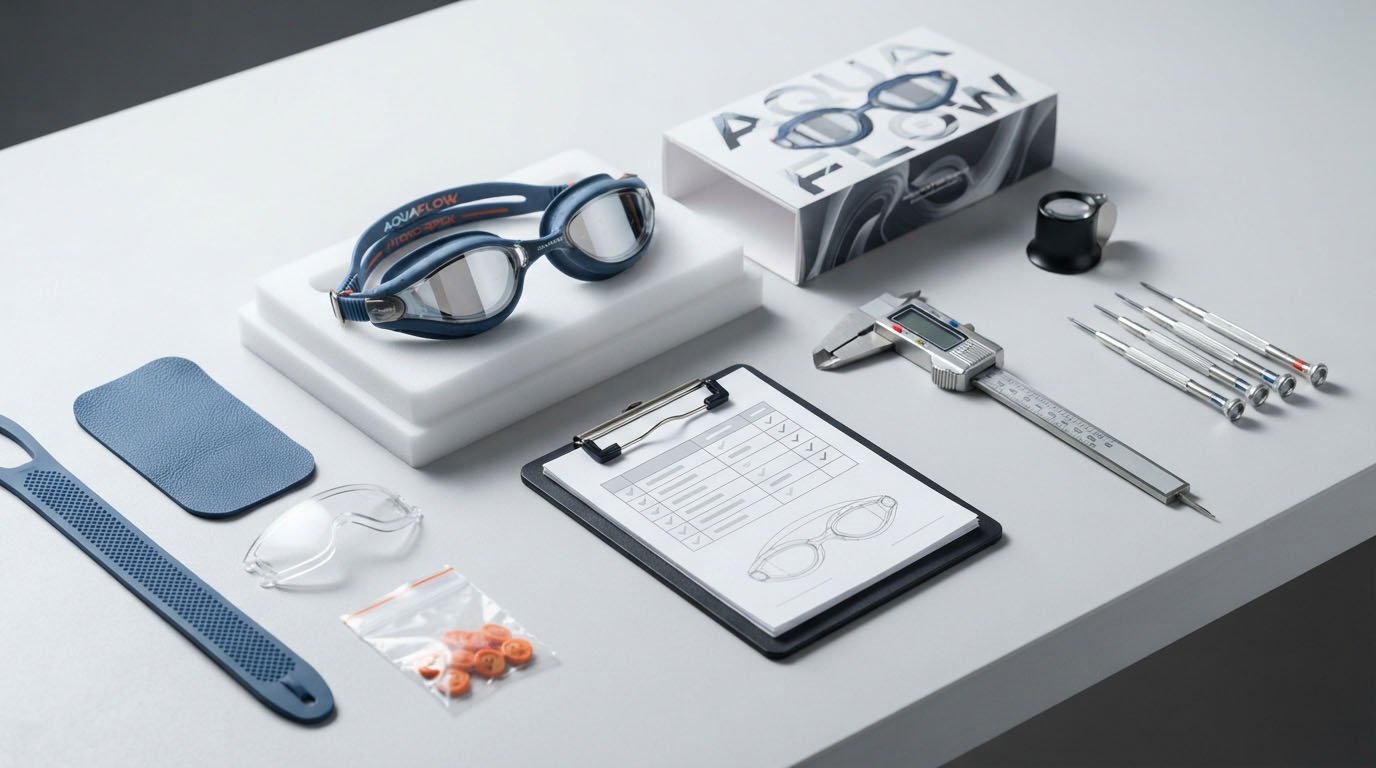
Step 1: Lock the Product Specification
Confirm the:
- model,
- lens,
- gasket,
- strap,
- buckle,
- coating,
- materials,
- intended use,
- and packaging.
If the product changes after testing, existing evidence may no longer accurately represent the commercial product.
Step 2: Confirm the PPE Route
For conventional surface swimming goggles, verify the Category I PPE route under Regulation (EU) 2016/425.
Unusual products or claims should receive a separate classification review.
Step 3: Confirm the Testing Plan
Determine which technical requirements and version of ISO 18527-3 should apply before production specifications are finalized.
Step 4: Match Reports to the Product
Do not accept a report only because the supplier name matches.
Verify the:
- model number,
- materials,
- lens configuration,
- product description,
- and test scope.
Step 5: Review the DoC and Technical Evidence
Ensure the documentation corresponds to the exact product being imported.
Step 6: Check CE Marking and Traceability
Confirm required markings, product identification and accompanying information before packaging artwork is approved.
Step 7: Control Bulk Production
The approved sample, tested sample and production specification should remain aligned.
Jerry’s Quality Assurance process can support consistency between sampling and mass production.
What Are the Most Common CE Compliance Mistakes?
Mistake 1: Assuming Swimming Goggles Do Not Need CE Marking
Conventional surface swimming goggles are generally Category I PPE rather than ordinary non-CE consumer accessories.
Mistake 2: Treating Category I as “No Compliance Required”
Category I simplifies the conformity route but still requires the applicable technical documentation, Declaration of Conformity and CE marking.
Mistake 3: Treating a Test Report as CE Approval
A test report is supporting technical evidence, not the complete CE conformity process.
Mistake 4: Using a Report From a Different Model
Changes to lenses, gaskets, materials, coatings or construction may affect whether previous evidence remains applicable.
Mistake 5: Testing Before the Specification Is Final
Testing an early prototype and then changing the bulk specification creates unnecessary compliance gaps.
Use Sampling & Prototyping to finalize key specifications before the final verification stage.
What Should You Ask a Swimming Goggle Manufacturer?
Before placing an EU order, ask:
- Is this exact model treated as Category I PPE?
- Which version of ISO 18527-3 was used?
- Does the test report match my exact model and materials?
- Can you provide the relevant test reports?
- Is an EU Declaration of Conformity available?
- What technical documentation supports the declaration?
- Where will the CE mark and traceability information appear?
- How are changes after testing controlled?
- How do you ensure bulk production matches the approved sample?
These questions provide far more useful information than simply asking whether the factory “has CE.”
For projects involving deeper product development, materials or tooling, clarify compliance responsibilities during the OEM & ODM stage.
CE Marking vs ISO Testing vs Quality Control
These three concepts should not be confused.
| Area | Main Purpose |
|---|---|
| CE Marking | Demonstrates conformity with applicable EU legal requirements |
| ISO 18527-3 Testing | Evaluates technical requirements for surface swimming eyewear |
| Factory Quality Control | Helps keep bulk production consistent with the approved specification |
A goggle can pass laboratory testing while later production changes.
A factory can have good QC but incomplete CE documentation.
And a CE logo alone does not demonstrate that the correct conformity process was followed.
For the broader relationship between CE, ISO, REACH, CPSIA and GPSR, see our Swimming Goggles Compliance Guide. This article focuses specifically on the EU CE pathway.
FAQ About CE Certification for Swimming Goggles
Do standard swimming goggles sold in the EU need CE marking?
Yes. Conventional swimming goggles for surface swimming are generally Category I PPE and require CE marking under Regulation (EU) 2016/425. Tukes specifically lists swimming goggles as Category I PPE.
Are swimming goggles Category I or Category II PPE?
Standard swimming goggles are generally Category I. Products designed for different or higher risks may need a separate classification assessment.
Do Category I swimming goggles need a Notified Body?
Normally no. Category I uses Module A internal production control.
Is ISO 18527-3 still current?
Yes. ISO confirmed ISO 18527-3:2020 in 2026, and Amendment 1 was published in 2025.
Does an ISO 18527-3 test report equal CE certification?
No. Testing supports the technical evidence, while CE conformity also involves product classification, technical documentation, production control, an EU Declaration of Conformity and CE marking.
Conclusion
So, do swimming goggles need CE certification?
For conventional swimming goggles placed on the EU market:
Yes. Swimming goggles are generally Category I PPE under Regulation (EU) 2016/425 and require CE marking.
The typical compliance path is:
Category I PPE → Testing Evidence → Technical Documentation → Module A Internal Production Control → EU Declaration of Conformity → CE Marking
For buyers, the key is not simply checking whether a CE logo appears on the product.
Verify that the tested sample, technical documentation, Declaration of Conformity and bulk production specification all refer to the same product.
If you are developing private-label or OEM swimming goggles for Europe, Jerry can support product development, sampling and production quality control. Contact our team to discuss your project requirements.
This article provides general manufacturing and compliance information and does not constitute legal advice. Requirements should be confirmed for the exact product and target market.