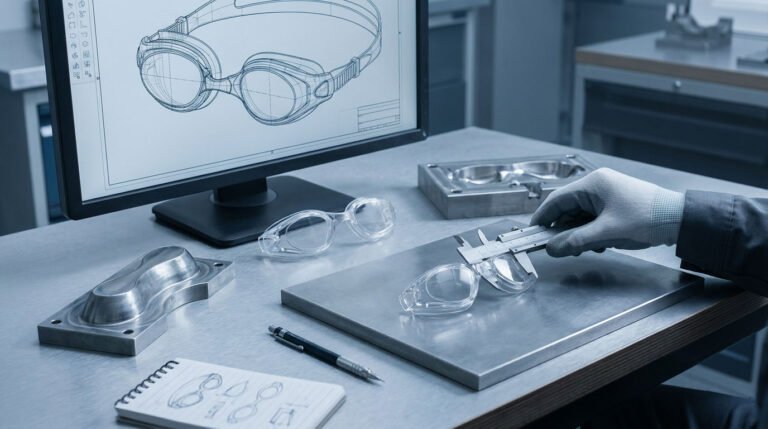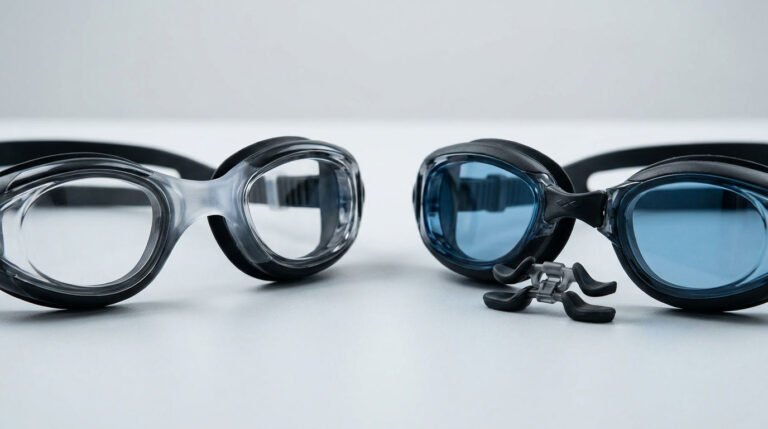
Developing a new swimming goggle involves more than designing a frame, choosing colors, and opening a mold.
A product may look excellent in a 3D rendering but fail during real-world use. The gasket may create uncomfortable pressure, the nose bridge may not fit properly, or strap tension may distort the frame. Even an approved prototype can behave differently during injection molding.
A swim goggle manufacturer develops new goggles through a structured R&D process: product definition, engineering design, prototyping, material selection, performance validation, tooling preparation, mold trials, and pilot production.
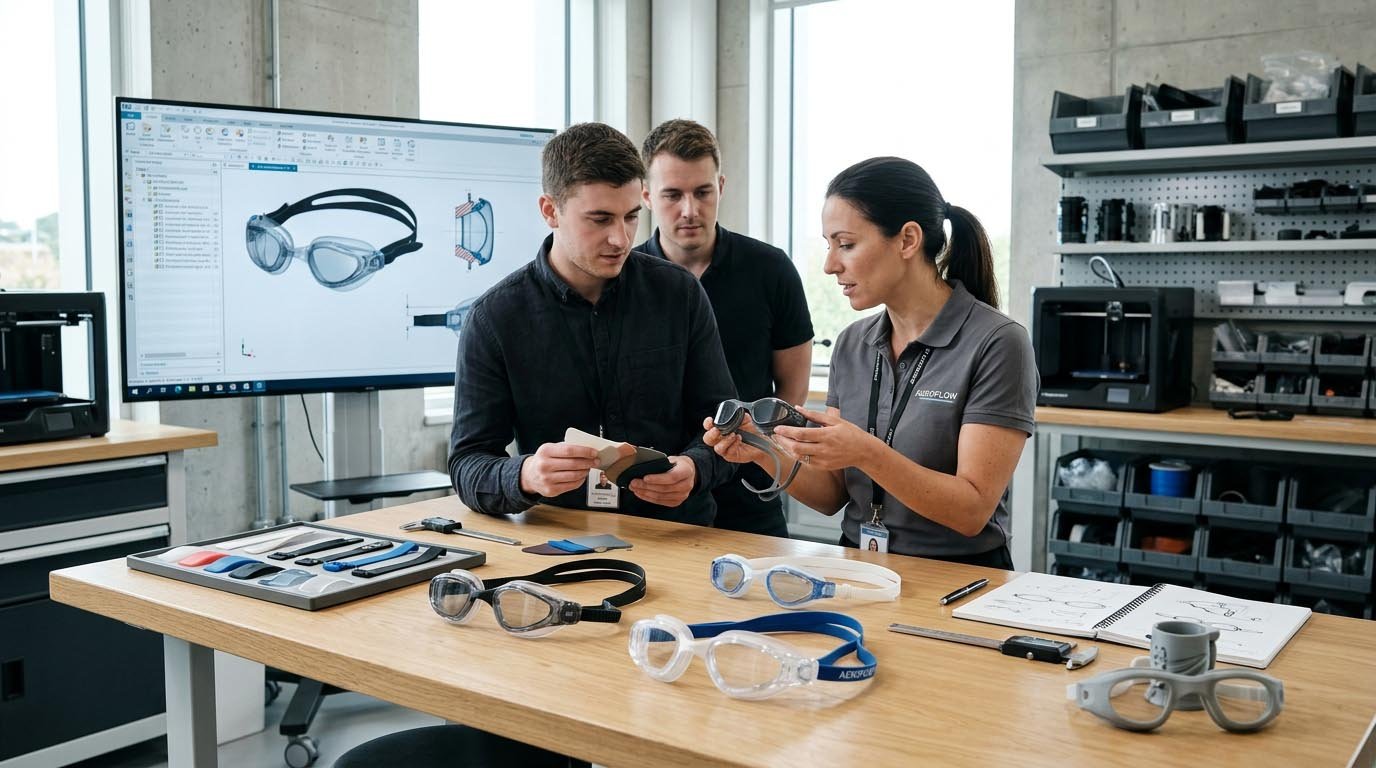
At Jerry, in-house development connects engineering with mold making, injection molding, silicone processing, anti-fog treatment, assembly, and quality control.
The objective is not simply to create an attractive sample. It is to develop swimming goggles that fit the intended users, meet agreed performance requirements, and can be manufactured consistently.
This guide explains the complete R&D process, the decisions brands should approve, and how engineering risks are managed before mass production.
Quick Answer: How Are New Swimming Goggles Developed?
A professional swimming goggle R&D project typically follows eight stages:
- Product Brief: Define the target swimmer, market, and product requirements.
- Engineering & CAD Design: Convert the concept into technical specifications and 3D models.
- Prototyping & Fit Evaluation: Build samples and evaluate comfort, sealing, and functionality.
- Material & Lens Development: Select materials and establish lens performance requirements.
- Design Validation: Test performance, resolve problems, and approve revisions.
- Tooling Preparation: Review manufacturing feasibility and authorize tooling.
- Mold Trials: Evaluate molded components and approve necessary corrections.
- Pilot Production: Verify assembly, process stability, and production-quality criteria.
Each stage should resolve important risks before the project advances to a more expensive commitment.
An approved CAD design is not an approved prototype. An approved prototype is not an approved mold. And an acceptable molded sample does not automatically demonstrate mass-production readiness.
What Is the Difference Between In-House R&D and Basic Customization?
Not every customized swimming goggle requires original product development.
Brands can launch distinctive products using existing models, while proprietary designs may require new engineering, tooling, and validation.
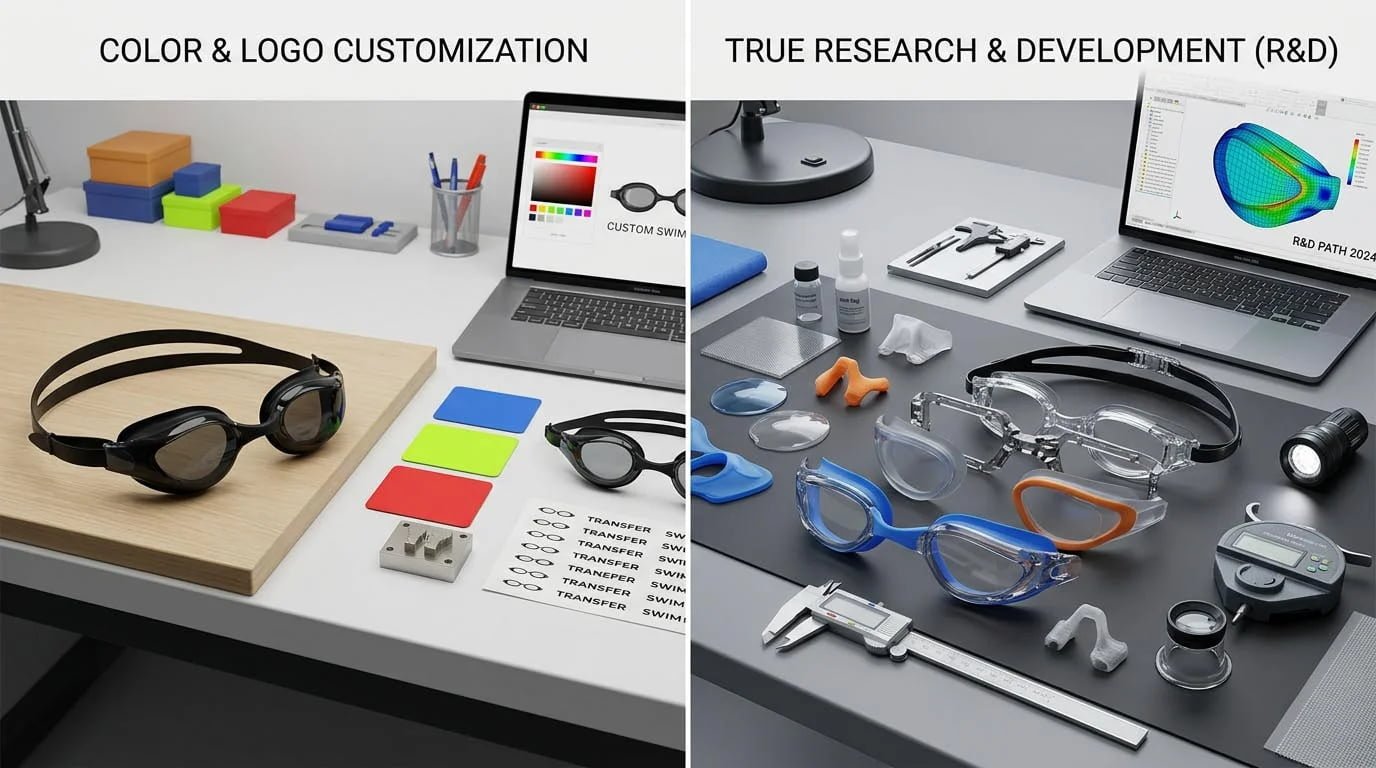
| Basic Customization | New Product R&D |
|---|---|
| Existing product structure | New product architecture |
| Existing production molds | New tooling may be required |
| Logo and color changes | New lens or frame geometry |
| Customized packaging | New gasket or bridge development |
| Limited engineering changes | Prototyping and validation |
| Simpler development process | Multiple engineering approval stages |
A brand launching its first collection may prefer private-label swimming goggles based on existing product platforms.
A company developing proprietary lens geometry, improved sealing systems, or distinctive structural features may require an OEM/ODM development project.
The distinction matters because development complexity affects engineering work, testing, tooling, cost, and approval responsibilities.
Development Stages and Buyer Approvals at a Glance
A well-managed R&D project should establish clear deliverables and decision points.
The following matrix provides a practical framework. Exact responsibilities and acceptance criteria should be agreed upon before development begins.
| Stage | Manufacturer Deliverable | Buyer Approval |
|---|---|---|
| 1. Product Definition | Product brief and requirements | Target user and positioning |
| 2. Engineering Design | CAD models and specifications | Design direction |
| 3. Prototyping | Samples and revision notes | Fit and functionality |
| 4. Material Development | Material and lens specifications | Materials and features |
| 5. Design Validation | Test findings and revision records | Design acceptance |
| 6. Tooling Preparation | Manufacturing review and tooling proposal | Release for tooling |
| 7. Mold Trials | Molded samples and trial findings | Molded-part acceptance |
| 8. Pilot Production | Production samples and QC criteria | Production release |
Design approval, tooling approval, and production approval are separate decisions.
For example, a brand may approve the prototype’s appearance while still requiring improvements to its sealing performance.
Clear approval points help prevent misunderstandings and keep engineering revisions traceable.
Step 1: Turn the Market Concept Into a Product Brief
New swimming goggle development begins with understanding the intended swimmer rather than designing a mold.
Racing, training, open-water, and children’s goggles have different performance and comfort priorities.
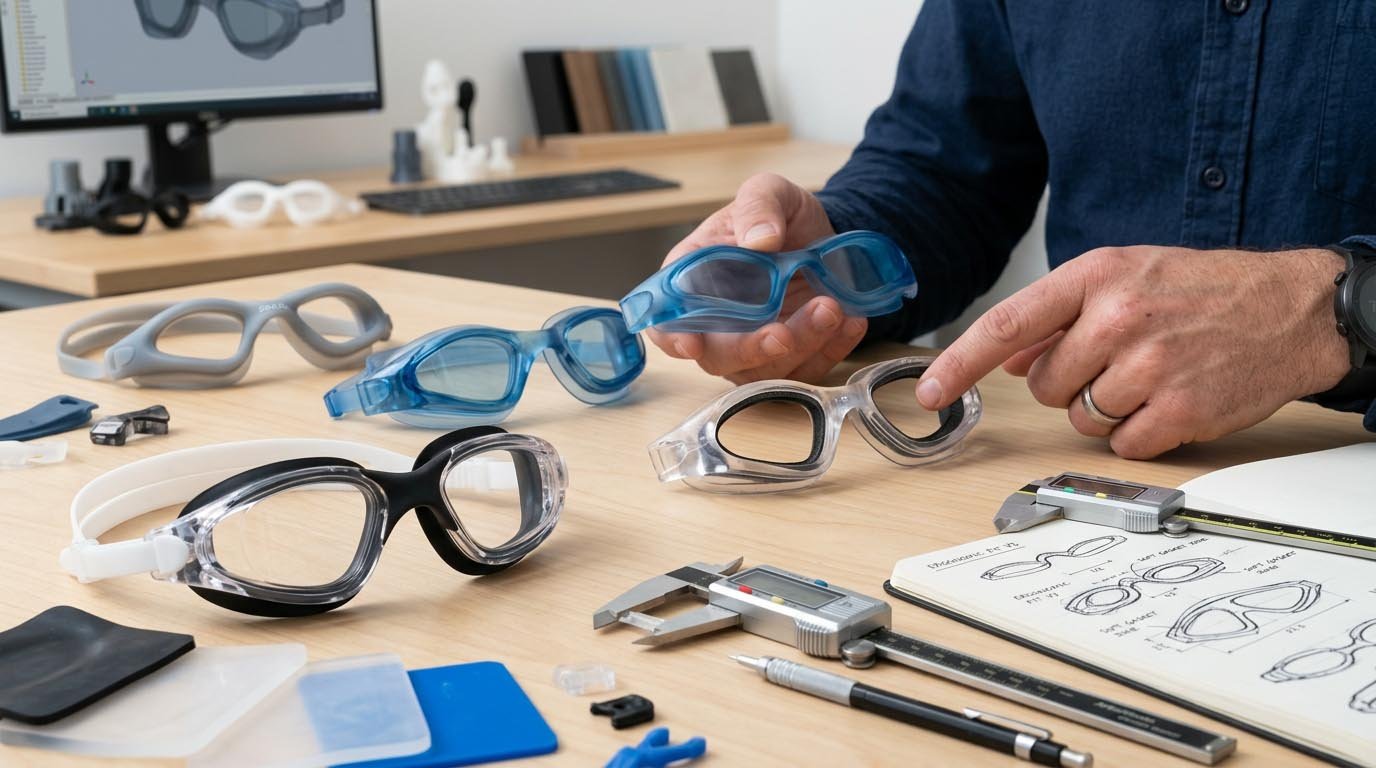
Define the Target User and Application
A product brief should answer:
- Who will use the goggles?
- Are they intended for racing, training, open water, or recreation?
- Which markets will the product enter?
- What comfort, visibility, and performance features are required?
- Does the brand need an original design or an adapted existing model?
- What retail positioning and expected production volume are planned?
These answers guide the engineering team when evaluating product structure, materials, and development priorities.
| Product Category | Main Development Priorities |
|---|---|
| Racing Goggles | Low-profile construction, secure fit |
| Training Goggles | Comfort, durability, easy adjustment |
| Open-Water Goggles | Wide visibility, outdoor lens features |
| Kids’ Goggles | Appropriate sizing, comfort, simple adjustment |
| Premium Goggles | Distinctive design, finish, lens features |
A clear product brief helps prevent changes to fundamental design requirements after engineering and tooling have begun.
Stage output: An agreed product concept, target-user definition, and preliminary performance requirements.
Step 2: Convert the Brief Into Engineering Specifications and CAD Design
Once the product direction is approved, engineers translate commercial goals into technical requirements.
A request for comfortable, wide-vision training goggles must become a defined product structure with measurable specifications.
Develop the Component Specifications
Important engineering areas include:
- Lens geometry and optical requirements
- Frame structure and support
- Gasket shape and facial contact
- Nose bridge construction
- Strap attachment and adjustment
- Material and lens treatment requirements
- Component assembly interfaces
These components must work together.
A wider lens may require changes to frame geometry. A softer gasket can alter sealing behavior. Increased strap tension may improve stability while creating additional pressure around the eyes.
Engineers must therefore evaluate the product as an integrated system rather than a collection of independent parts.
Create and Review 3D CAD Models
CAD models allow engineers to examine dimensions, component arrangements, wall structures, and assembly interfaces before physical sampling.
However, CAD geometry cannot prove facial comfort or actual swimming performance.
A digital model cannot fully demonstrate how a gasket compresses against different facial shapes or how the complete product behaves under water.
Physical evaluation remains necessary.
Stage output: Preliminary engineering specifications and CAD designs ready for prototype development.
Step 3: Build Prototypes and Evaluate Fit
Physical prototyping helps identify design problems that are difficult to detect in digital models.
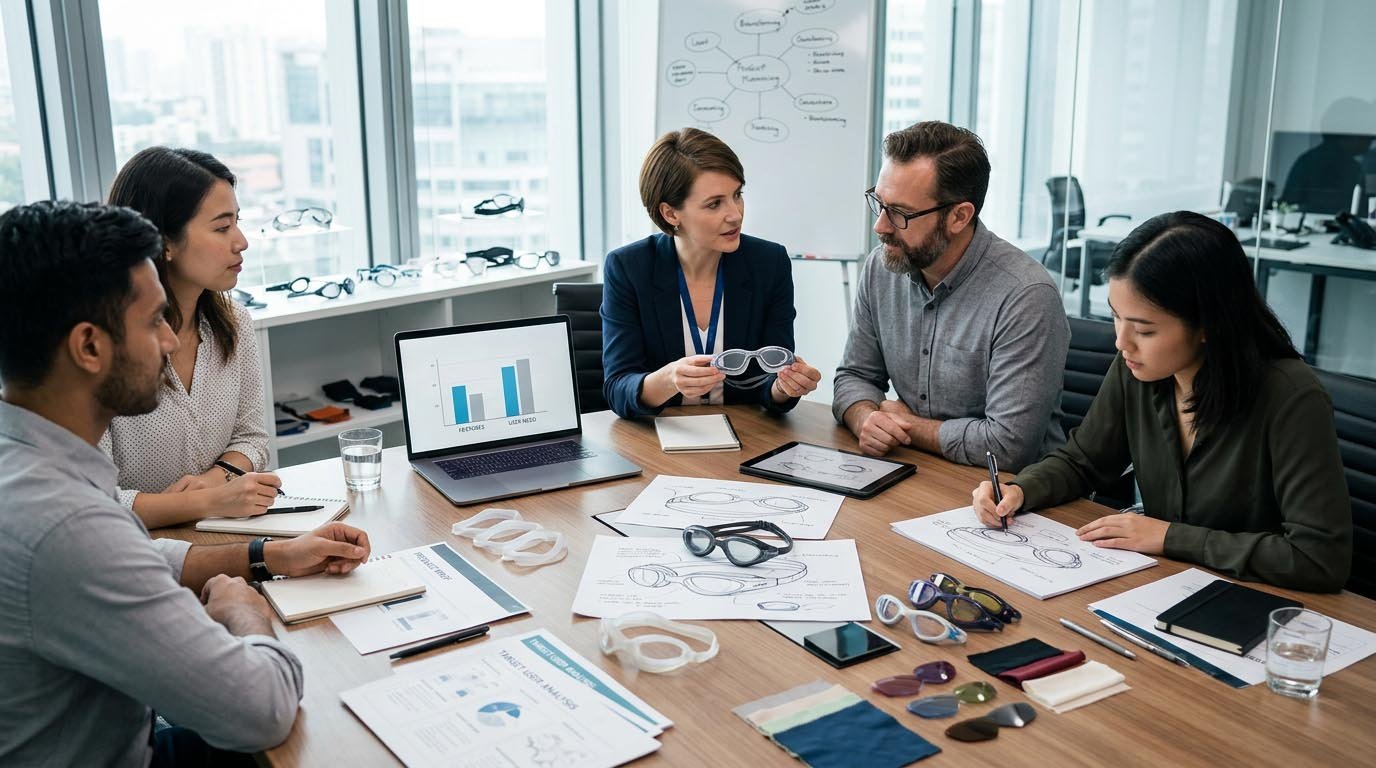
Prototype evaluation may include:
- Facial fit and eye socket clearance
- Gasket contact and pressure distribution
- Nose bridge comfort
- Frame position and balance
- Strap adjustment
- Lens positioning and visibility
- Overall appearance and assembly
Jerry supports sampling and prototyping so brands can review product details before committing to production tooling.
Why Prototype Revisions Matter
An initial sample may reveal an uncomfortable nose bridge, excessive gasket pressure, or uneven sealing.
Engineers then follow a controlled revision cycle:
Design → Prototype → Evaluate → Revise → Retest
Each modification should address a defined problem.
Instead of changing multiple features without documentation, the team records the suspected cause, design revision, and evaluation result.
This allows brands and manufacturers to understand why a design changed and whether the modification achieved its intended purpose.
What Should Buyers Approve?
Buyers should review appearance, intended fit, adjustment, and agreed functional characteristics.
Aesthetic approval alone should not be treated as complete engineering acceptance.
Prototype materials may also behave differently from final molded materials, so some performance characteristics require further validation after tooling.
Stage output: Reviewed prototypes, documented revisions, and approval to continue design development.
Step 4: Select Materials and Develop Lens Performance
Material selection influences comfort, durability, optical performance, and manufacturing consistency.
The lens, frame, gasket, and strap must function as an integrated product.
Lens Development
Lens evaluation may consider:
- Optical clarity and distortion
- Impact-resistance requirements
- Tint and light transmission
- UV protection requirements
- Anti-fog compatibility
- Mirror-coating appearance
- Material and molding consistency
The selected lens material must support the intended optical features and manufacturing process.
Gasket, Frame, and Strap Materials
Gaskets require an appropriate balance of softness, resilience, geometry, and sealing performance.
An excessively soft gasket does not automatically create a better seal. Its shape, the surrounding frame, and strap tension also influence how the product contacts the swimmer’s face.
Frame materials must support the intended construction, while straps require suitable elasticity, adjustment, and retention characteristics.
Anti-Fog Development
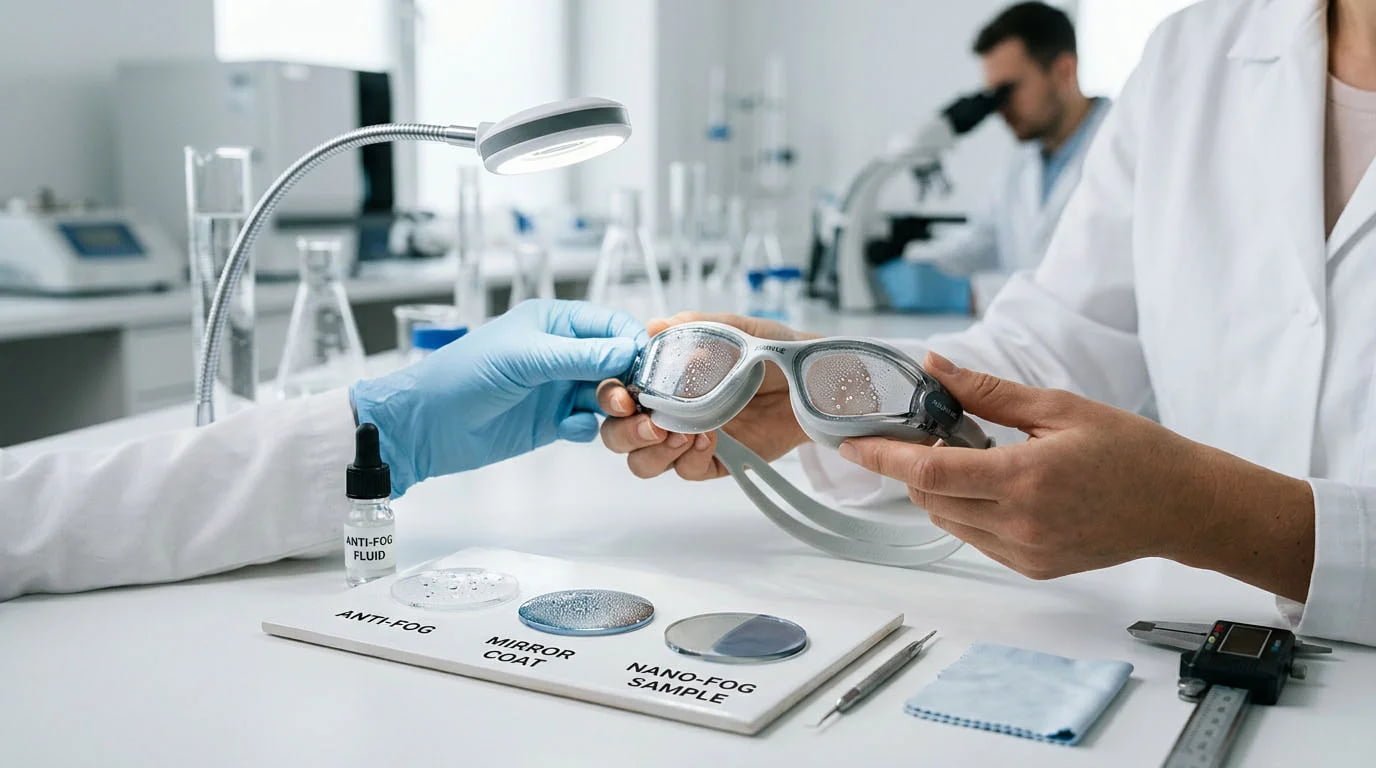
Anti-fog performance depends on more than coating chemistry.
Important development variables may include:
- Lens substrate and surface preparation
- Coating application and curing
- Compatibility between the lens and coating
- Packaging and storage conditions
- Expected end-user handling
Engineers should verify that the selected material and treatment process meet agreed performance requirements.
Detailed anti-fog durability testing methods belong in dedicated technical articles rather than this R&D overview.
Stage output: Agreed material specifications, lens features, and treatment requirements.
Step 5: Test the Design and Resolve Engineering Problems
Before production tooling, prototypes should be evaluated against the product brief and agreed performance requirements.
Testing should identify whether the design meets its intended purpose and which issues still require correction.
What Should Be Tested?
| Validation Area | Main Question |
|---|---|
| Fit & Comfort | Does the goggle fit intended users comfortably? |
| Seal & Leakage | Does the gasket maintain an effective seal? |
| Strap Stability | Does the adjustment system hold securely? |
| Lens Quality | Does the lens meet optical requirements? |
| Anti-Fog | Does the treatment meet specified test criteria? |
| Durability | Can components withstand expected use? |
| Assembly | Do the components fit together reliably? |
The exact testing methods and acceptance criteria depend on the product, intended market, applicable requirements, and agreed specifications.
Illustrative Example: A Prototype That Leaks
This is an illustrative engineering scenario, not a documented Jerry customer project.
Suppose a swimming goggle prototype looks correct and feels comfortable but leaks when the wearer moves their head.
The engineering team investigates several possible causes:
- Whether the gasket contacts the face evenly.
- Whether the nose bridge changes the frame position.
- Whether strap tension deforms the eyecups.
- Whether the gasket geometry accommodates the intended facial shapes.
If the investigation identifies a geometry problem, engineers can revise the relevant component and test another prototype.
The issue, corrective action, and subsequent results should be recorded.
The goal is not simply to produce another sample. It is to demonstrate that the identified problem has been resolved.
When Is the Design Ready for Tooling?
The design can proceed when agreed requirements have been satisfied, significant unresolved issues have been addressed, and the buyer approves the relevant revision for manufacturing review.
Stage output: Validation findings, revision records, and design acceptance before tooling preparation.
Step 6: Complete the Manufacturing Review and Prepare Tooling
A validated prototype must still pass a manufacturing feasibility review before tooling begins.
This transition is commonly called Design for Manufacturing (DFM).
Engineers review whether the design can be produced using the intended materials, processes, and component specifications.
Typical concerns include molding feasibility, dimensional consistency, assembly interfaces, and critical functional surfaces.
The key question changes from:
"Does this design work as a prototype?"
to:
"Can this design be manufactured consistently?"
Before authorizing tooling, the brand and manufacturer should confirm the approved CAD revision, tooling scope, engineering-change responsibilities, and sample acceptance requirements.
For the detailed engineering process—including DFM checks, mold design, T1 trials, and tooling approval—read our swimming goggle CAD-to-mold process.
This R&D overview focuses on the decision to release the design for tooling rather than repeating the complete mold-engineering workflow.
Stage output: Reviewed manufacturing design and authorization to begin tooling.
Step 7: Run Mold Trials and Validate Molded Components
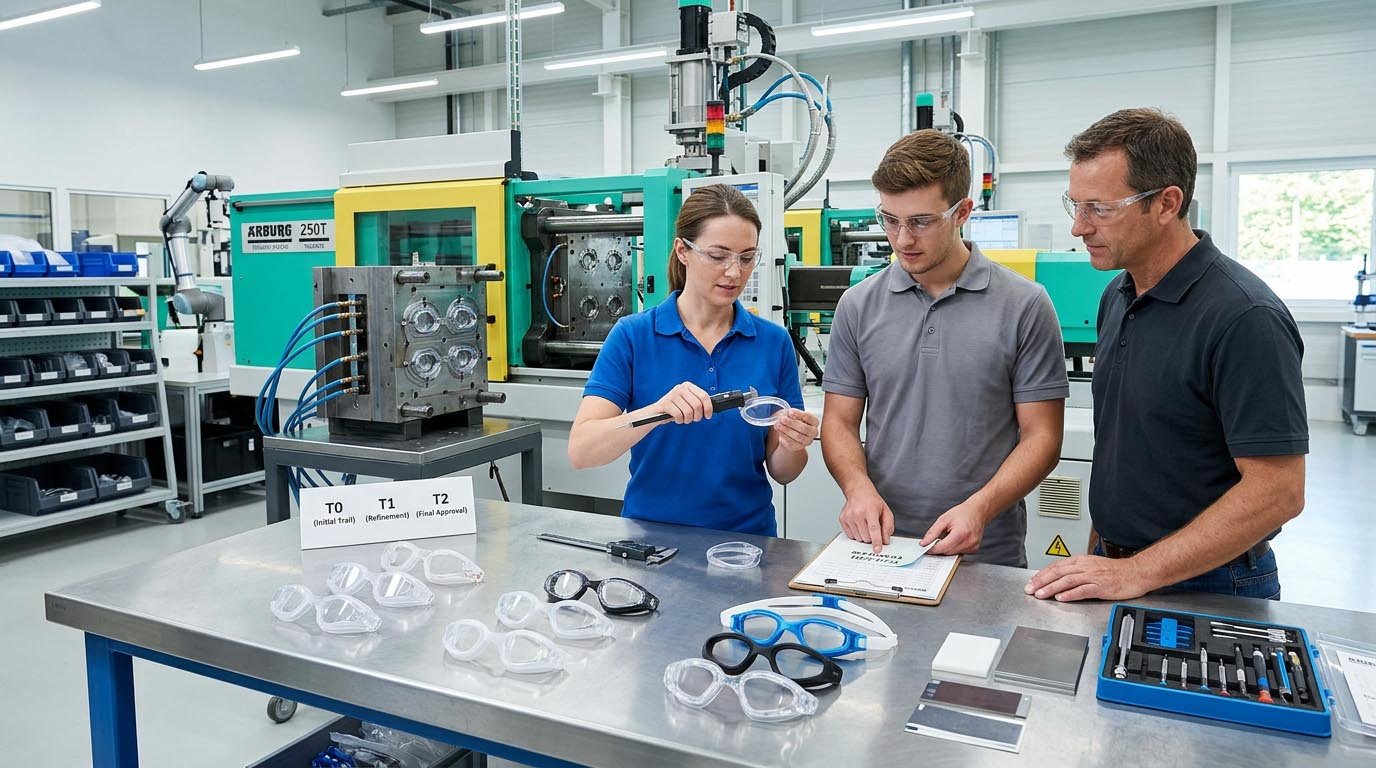
After mold fabrication, engineers evaluate components produced under actual molding conditions.
These parts may differ from earlier prototypes because of material shrinkage, molding conditions, and tooling geometry.
Review Initial Molded Samples
The first engineering trial may be called T0 or T1, depending on the manufacturer’s terminology.
Engineers inspect the components for dimensional differences, visual defects, assembly problems, and other deviations from approved specifications.
If issues are found, the team investigates their causes and determines the necessary corrections.
Verify Corrections and Component Performance
Subsequent trials, sometimes labeled T1, T2, or later revisions, help confirm whether the corrections are effective.
The manufacturer should review relevant dimensions, component interfaces, assembly, fit, sealing, and repeatability.
One acceptable molded sample is not sufficient evidence of tooling stability.
The acceptance decision should be supported by appropriate inspection records, approved samples, and agreed engineering criteria.
Stage output: Evaluated molded components, trial records, and a decision on tooling acceptance or further correction.
Step 8: Validate Pilot Production and Establish Quality Standards
An approved mold trial does not automatically demonstrate mass-production readiness.
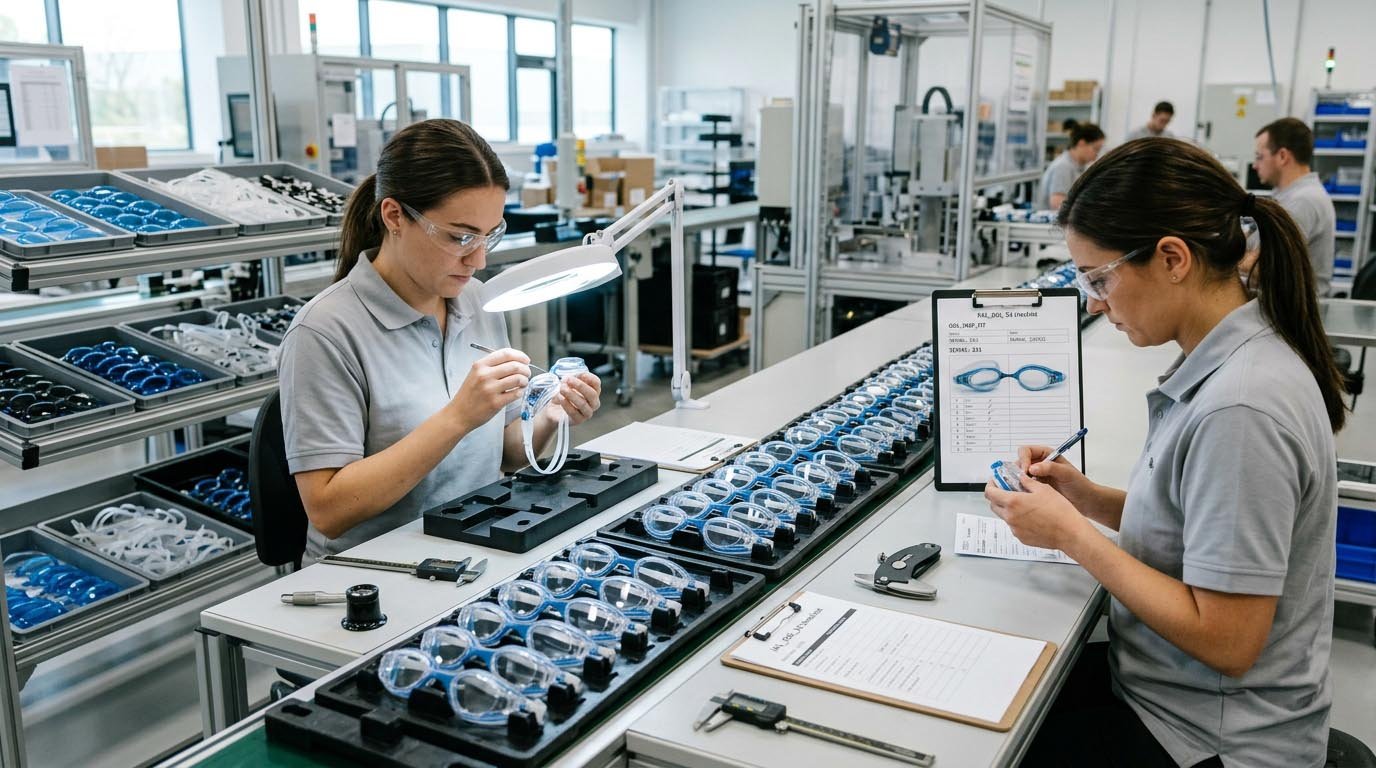
Pilot production evaluates whether complete swimming goggles can be manufactured and assembled consistently using the intended process.
What Does Pilot Production Evaluate?
Depending on the product, the team may review:
- Component consistency
- Assembly accuracy
- Lens and anti-fog treatment consistency
- Gasket fit and sealing
- Strap adjustment and retention
- Cosmetic quality
- Packaging requirements
- Inspection repeatability
Pilot production helps identify issues that may not appear during small engineering trials.
Establish the Production Reference
Before mass production, the approved design must become a controlled manufacturing reference.
This may include product specifications, inspection methods, acceptance criteria, reference samples, and approved processing requirements.
Jerry’s quality assurance capabilities support the transition from product development to controlled production.
For detailed injection molding, coating, and assembly operations, see How Swimming Goggles Are Made: Inside the Manufacturing Process.
The R&D team establishes validated product requirements. Production management focuses on meeting those requirements consistently.
Stage output: Reviewed pilot samples, production-quality criteria, and approval for mass production when agreed conditions are met.
Why Does In-House R&D Matter for Swimming Goggle Development?
In-house R&D can improve coordination when a product requires original engineering, multiple prototypes, or complex manufacturing processes.
At Jerry, engineering capabilities connect with mold making, injection molding, silicone processing, lens treatment, assembly, and quality control.
The benefit comes from how these teams work together.
Faster Engineering Feedback
Designers working closely with tooling and production teams can identify manufacturing concerns earlier.
For example, a proposed lens shape can be reviewed for optical requirements, assembly compatibility, and molding feasibility before tooling begins.
Early feedback can reduce avoidable redesigns and improve communication between development stages.
Clearer Design-Change Records
A structured R&D process documents why changes are made and whether they achieve the intended results.
| Record Item | Purpose |
|---|---|
| Issue Description | Identifies the problem |
| Suspected Cause | Guides engineering investigation |
| Design Revision | Records the modification |
| Verification Result | Confirms whether criteria were met |
| Approval Status | Documents the next authorized stage |
These records help protect design consistency when a project moves from prototyping to tooling and production.
Better Coordination With Manufacturing
A gasket redesign may affect silicone tooling. A lens modification may influence molding behavior or coating compatibility.
Reviewing these dependencies together helps teams make informed decisions before changes are finalized.
In-house R&D does not guarantee immediate success. Its value lies in coordinated engineering, controlled revisions, and effective validation.
Independent laboratory verification may still be required for applicable product or market requirements.
What Should Buyers Ask a Swim Goggle Manufacturer About R&D?
Before selecting a development partner, brands should understand how the manufacturer manages original product development.
| Buyer Question | What the Response Should Explain |
|---|---|
| Who handles product design? | Engineering responsibilities and capabilities |
| How are prototypes evaluated? | Fit, function, and revision procedures |
| How are design changes documented? | Revision records and approval processes |
| What happens before tooling? | Design validation and manufacturing review |
| How are mold problems resolved? | Trial findings and corrective actions |
| How is production readiness confirmed? | Pilot validation and QC criteria |
Buyers should establish project deliverables, communication responsibilities, and approval requirements before major development commitments.
The important question is not simply whether a factory can manufacture custom swimming goggles.
It is how the manufacturer turns an original concept into a validated, production-ready product.
Frequently Asked Questions
How Long Does It Take to Develop a New Swimming Goggle?
The timeline depends on product complexity, prototype revisions, materials, tooling, mold corrections, and testing requirements.
Modifying an existing platform generally requires less development than creating an original product with new structural components.
For new custom tooling, Jerry’s mold development planning reference is approximately 35–50 days, depending on project complexity. The complete R&D timeline also includes design, validation, and production preparation.
Can a Swimming Goggle Manufacturer Develop an Original Design From an Idea?
Yes. A manufacturer with suitable engineering, prototyping, and tooling capabilities can help convert a product concept into specifications, CAD designs, and physical samples.
The design must still be reviewed and validated before commercial production.
Why Is Prototyping Necessary Before Opening a Mold?
Prototypes help identify potential problems involving facial fit, comfort, gasket geometry, and component interaction.
Finding these problems before tooling can reduce unnecessary mold modifications and development delays.
Can an Approved Prototype Still Fail During Mold Trials?
Yes. Prototype materials and production-molded components may behave differently.
Shrinkage, dimensional variation, molding conditions, and material properties can create issues that require further engineering corrections.
What Is the Difference Between R&D Approval and Production Approval?
R&D approval confirms that the design has met the agreed development requirements.
Production approval requires further evidence that the finished product and manufacturing processes meet the applicable quality and performance criteria.
These should be treated as separate decisions.
Can Jerry Support Full Custom Swimming Goggle Development?
Jerry supports swimming goggle OEM/ODM projects through engineering, mold making, injection molding, silicone processing, anti-fog treatment, assembly, and quality assurance.
The appropriate development route depends on the product concept, degree of customization, and agreed project specifications.
Conclusion: From Product Concept to Production-Ready Swimming Goggles
Developing a new swimming goggle is a controlled engineering process, not simply a series of design and manufacturing activities.
A complete development project connects:
Product Brief → Engineering Design → Prototyping → Material Development → Design Validation → Tooling → Mold Trials → Pilot Production
Each stage should resolve important questions before the next commitment.
A CAD rendering cannot prove facial comfort. A prototype cannot fully demonstrate molded-part consistency. And one acceptable trial sample cannot guarantee stable production.
The purpose of in-house R&D is to connect product engineering, practical validation, manufacturing feasibility, and production-quality requirements.
Jerry combines engineering, mold making, injection molding, silicone processing, anti-fog treatment, assembly, and quality assurance to support custom swimming goggle development.
If your brand is planning an original swimming goggle design, start by defining the target users, desired features, product positioning, and expected production requirements.
Then contact Jerry’s team to discuss the appropriate development approach for your project.