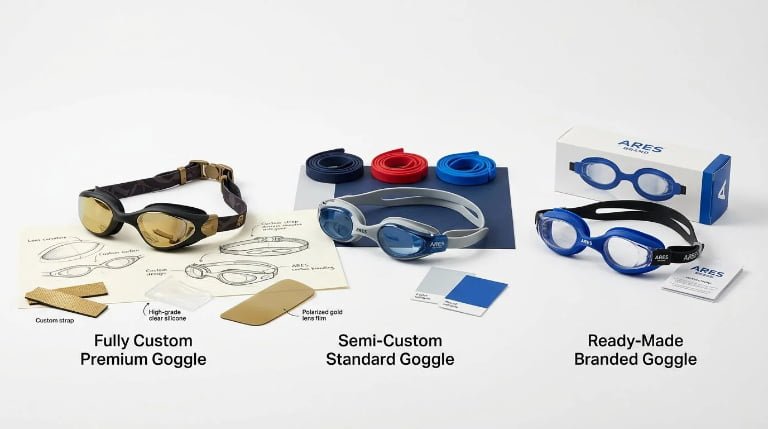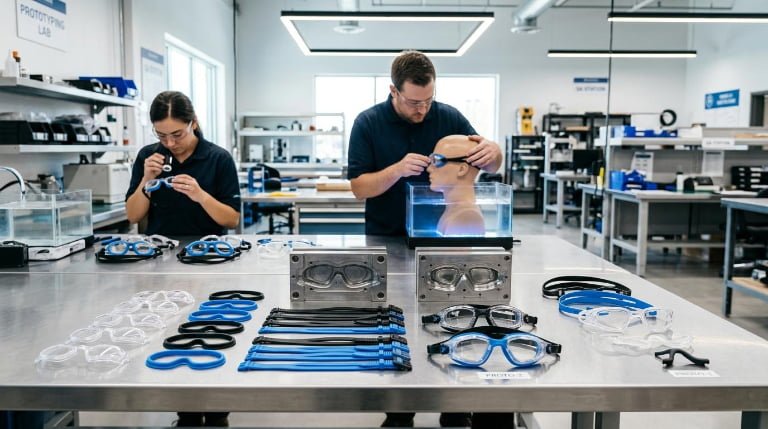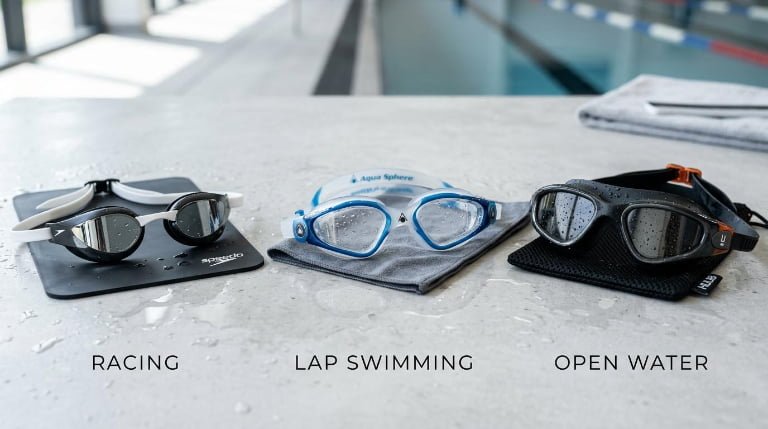
Sourcing swimming goggles successfully means checking 10 core factors before you place a bulk order: target user, lens material, gasket safety, fit and sealing, anti-fog durability, factory capability, quality control, compliance, commercial terms, and customization risk. The goal is not to find the cheapest supplier, but to match your product specs, order volume, and quality requirements with a factory that can deliver consistent bulk production.
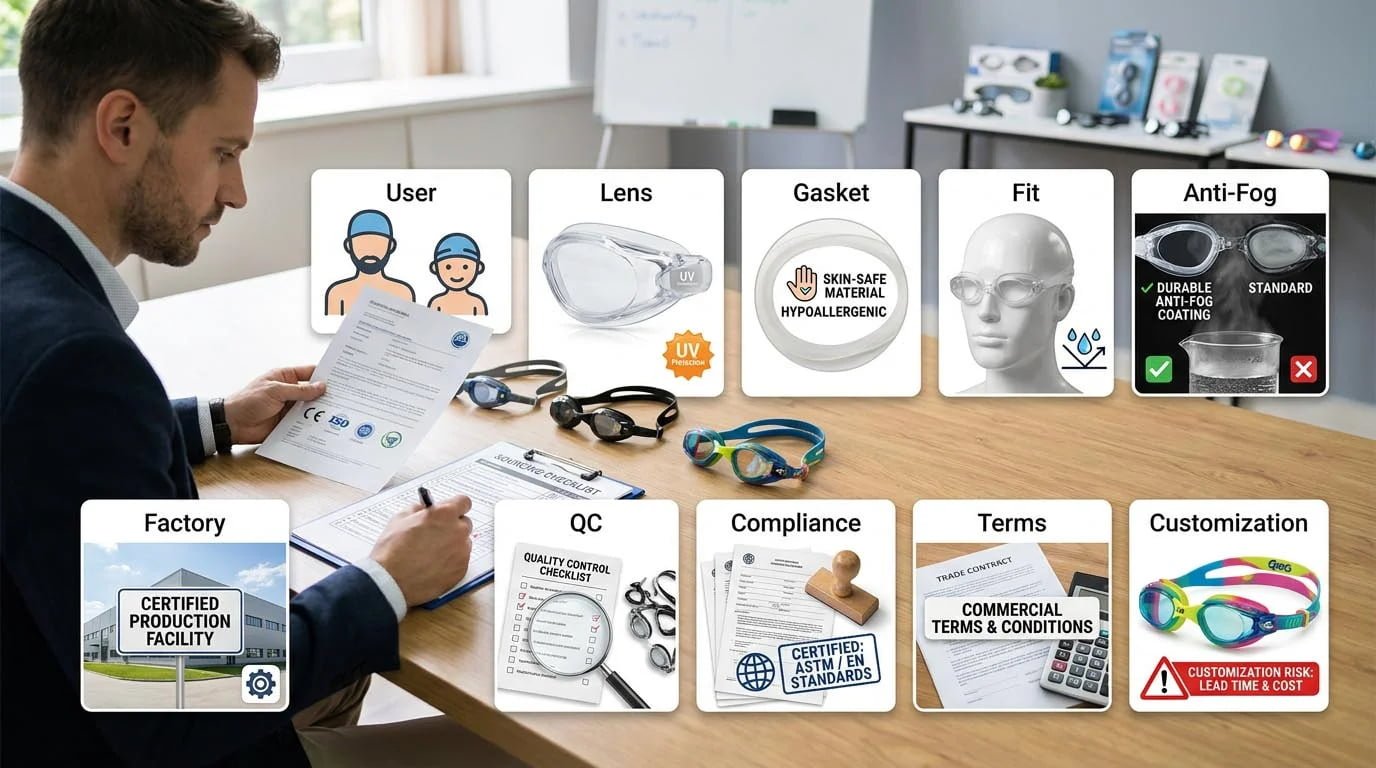
Many buyers compare samples, negotiate prices, and still end up with bulk orders that fog too fast, leak, trigger skin complaints, or get delayed at customs. In most cases, the problem is not one single defect. It is a sourcing decision made too early, with too little validation.
I have worked in swim goggle manufacturing for over 30 years. In that time, I have seen the same pattern repeat: buyers approve a good sample, skip process verification, underestimate tooling and compliance, and only discover the real risks after the shipment arrives. This guide will help you avoid that.
Quick Answers: One-Minute Swim Goggles Sourcing Checklist
Q: What’s the MOQ for custom swimming goggles?
A: Usually 1,000-3,000 pcs per colorway for semi-custom projects, and higher for full custom molds. New tooling often costs $3,000-$8,000 and takes 4-6 weeks.
Q: How long does anti-fog coating last on swimming goggles?
A: Standard chemical anti-fog coatings usually last 20-50 swims with proper care. Permanent treatments can last 200+ swims, but they increase unit cost.
Q: What certifications do swim goggles need for the US and EU?
A: Common requirements include CPSIA for the US, REACH for the EU, and relevant product testing such as ISO 18527-3 or retailer-specific standards depending on your market.
Q: Can I get logo samples before bulk production?
A: Yes. Branded samples are common, but logo setup or tooling usually costs $200-$500 and adds 1-2 weeks.
Q: What is the biggest sourcing mistake?
A: Approving a sample without checking whether the factory can maintain the same quality in bulk production through process control, inspection, and traceability.
1. Define Your Target User Before Contacting Any Swim Goggles Supplier
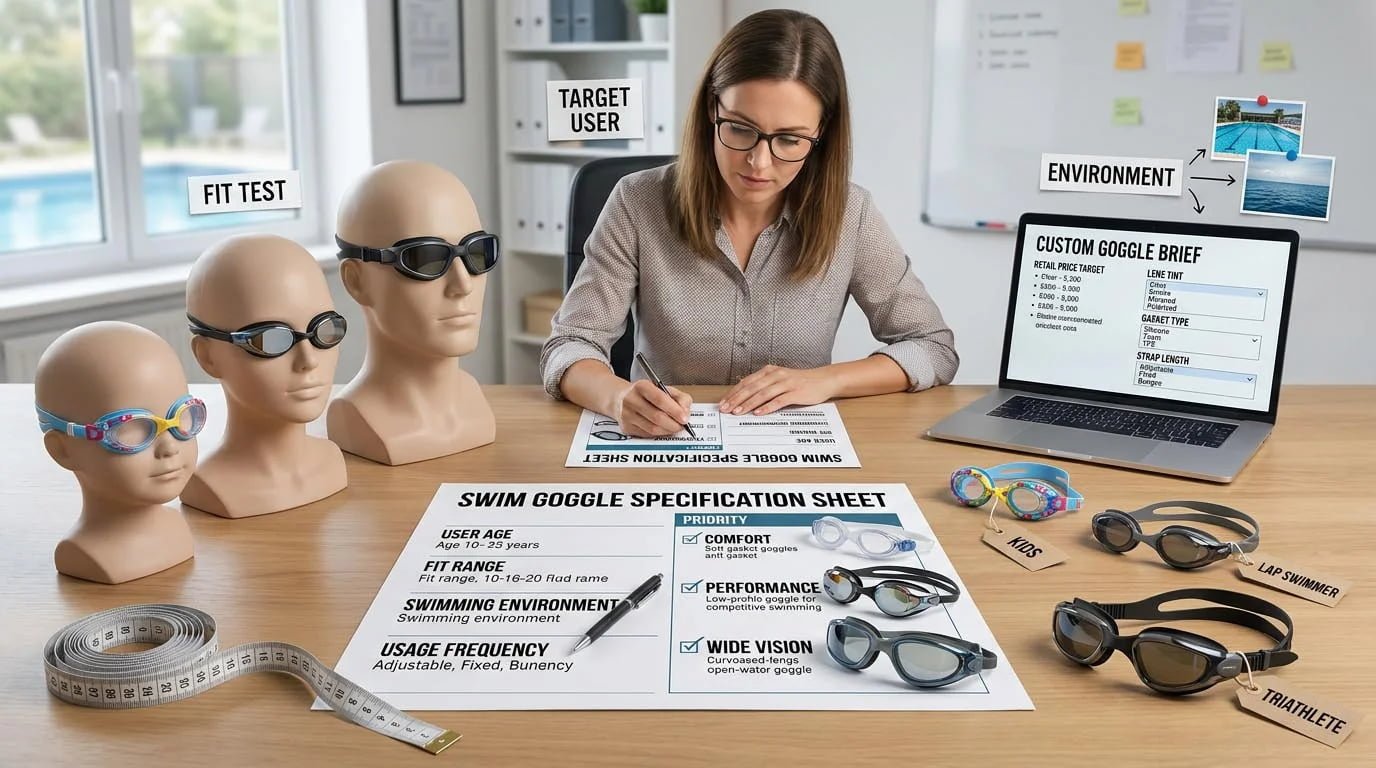
The first step in sourcing swimming goggles is defining exactly who will use them. A product for children learning to swim is not the same as a product for daily lap swimmers or open-water triathletes.
If your brief says only "high-quality swim goggles," most factories will fill in the gaps themselves. That is where sourcing problems start.
Before requesting quotes, define:
- User age group
- Face size and fit range
- Swimming environment: indoor pool, outdoor pool, saltwater, open water
- Usage frequency: occasional, weekly, daily
- Priority: comfort, racing performance, anti-fog life, wide vision, low drag
- Retail price target
A clear target user profile helps determine lens tint, gasket hardness, nose bridge design, strap length, and coating level. Without this, factories may sample a product that feels right in hand but fails in actual use.
Why This Matters
Recreational swimmers often prefer softer gaskets and easier adjustment. Competitive swimmers usually prefer lower-profile goggles with firmer sealing and less drag. If you try to serve both with one design, the product often satisfies neither group well.
2. Choose the Right Lens Material for Clarity, Durability, and Cost
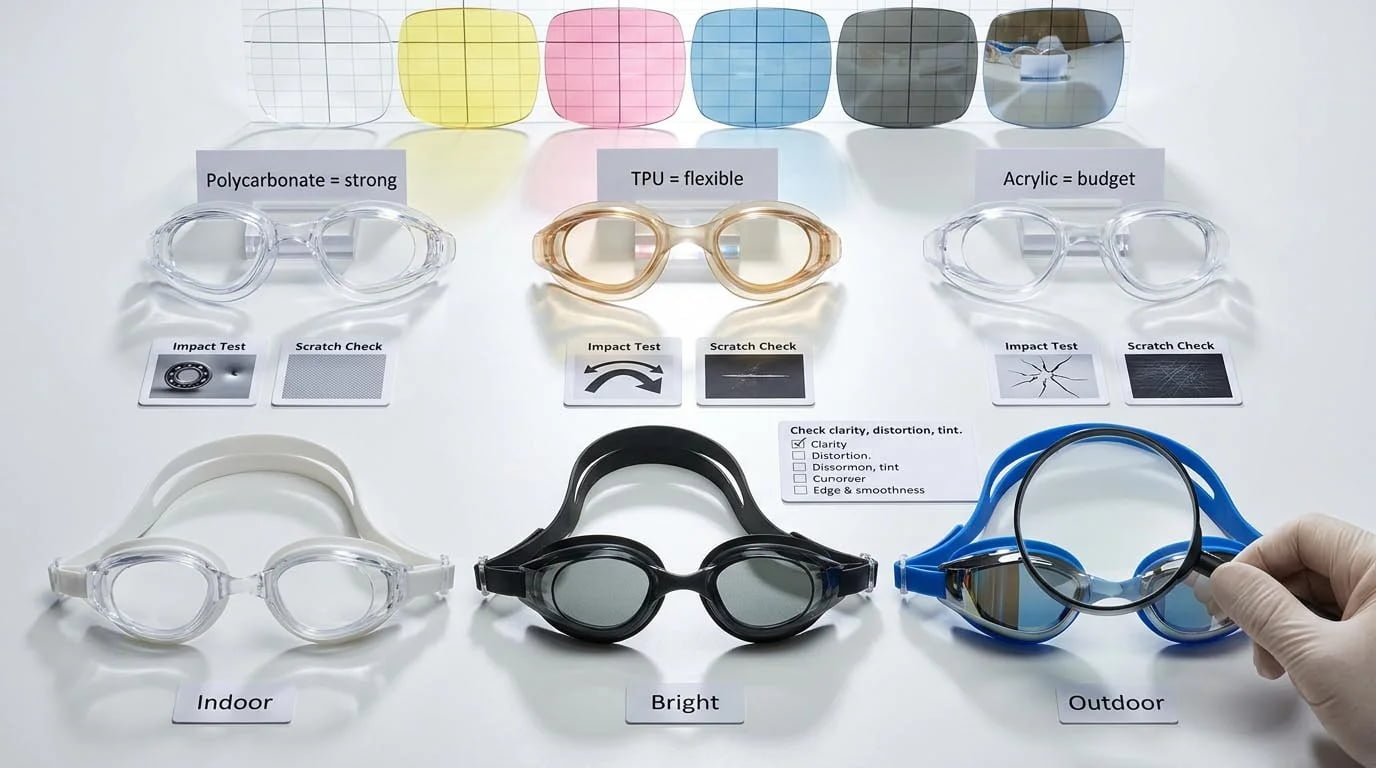
When sourcing swim goggles, lens material affects optical clarity, impact resistance, coating compatibility, and scratch performance.
The most common options are:
| Lens Material | Main Advantage | Main Weakness | Best Use |
|---|---|---|---|
| Polycarbonate (PC) | Strong impact resistance, good clarity, coating-friendly | Scratches without hard coat | Most adult swim goggles |
| TPU | Flexible and safer-feeling | Less ideal for mirror coatings | Junior or fitness goggles |
| Acrylic | Lower cost | Lower impact performance | Budget products only |
For most brands, polycarbonate is the safest choice. It works well with anti-fog, UV, and mirror coatings, and it offers a strong balance between performance and cost.
What to Check Beyond Transparency
Do not judge lenses by "clear appearance" alone. You should also verify:
- Optical distortion at the edges
- Wall thickness consistency
- Molding precision
- Peripheral vision
- Surface scratches before packing
A lens can look clear on the table and still perform poorly in water if curvature or molding consistency is weak.
Match Lens Tint to Use Case
- Clear lenses: indoor pools, low light
- Smoke lenses: bright pools, moderate sun
- Mirror lenses: outdoor glare reduction
- Amber/yellow lenses: low-light contrast enhancement
If your product page or packaging does not explain tint purpose, customers may buy the wrong version and blame the goggles.
3. Check Gasket and Strap Materials for Skin Safety and Long-Term Comfort
Gasket and strap materials directly affect comfort, skin safety, and return rates. This is one of the most overlooked factors in swim goggles sourcing.
For skin-contact parts, medical-grade or high-purity silicone is usually the better choice. Lower-grade silicone or rubber blends may reduce cost, but they increase the risk of odor, yellowing, irritation, and faster aging in chlorine.
What to Specify
Ask suppliers to confirm:
- Latex-free materials
- Silicone grade
- Shore hardness range
- Material test reports
- Colorant and additive compliance
Typical gasket hardness ranges:
| Gasket Type | Typical Shore A | Feel |
|---|---|---|
| Soft comfort gasket | 30-40 | Better for casual swimmers |
| Balanced training gasket | 40-50 | Good general-use range |
| Racing-style gasket | 50-70 | Firmer seal, less cushion |
For straps, check:
- Elastic recovery after repeated stretching
- Resistance to chlorine exposure
- No cracking at buckle connection points
- No strong chemical odor
Why This Affects Customer Retention
If the gasket feels harsh or causes redness, customers rarely give the product a second chance. A lower unit cost can easily become a higher return rate.
4. Verify Fit, Sealing, and Comfort Before Bulk Production
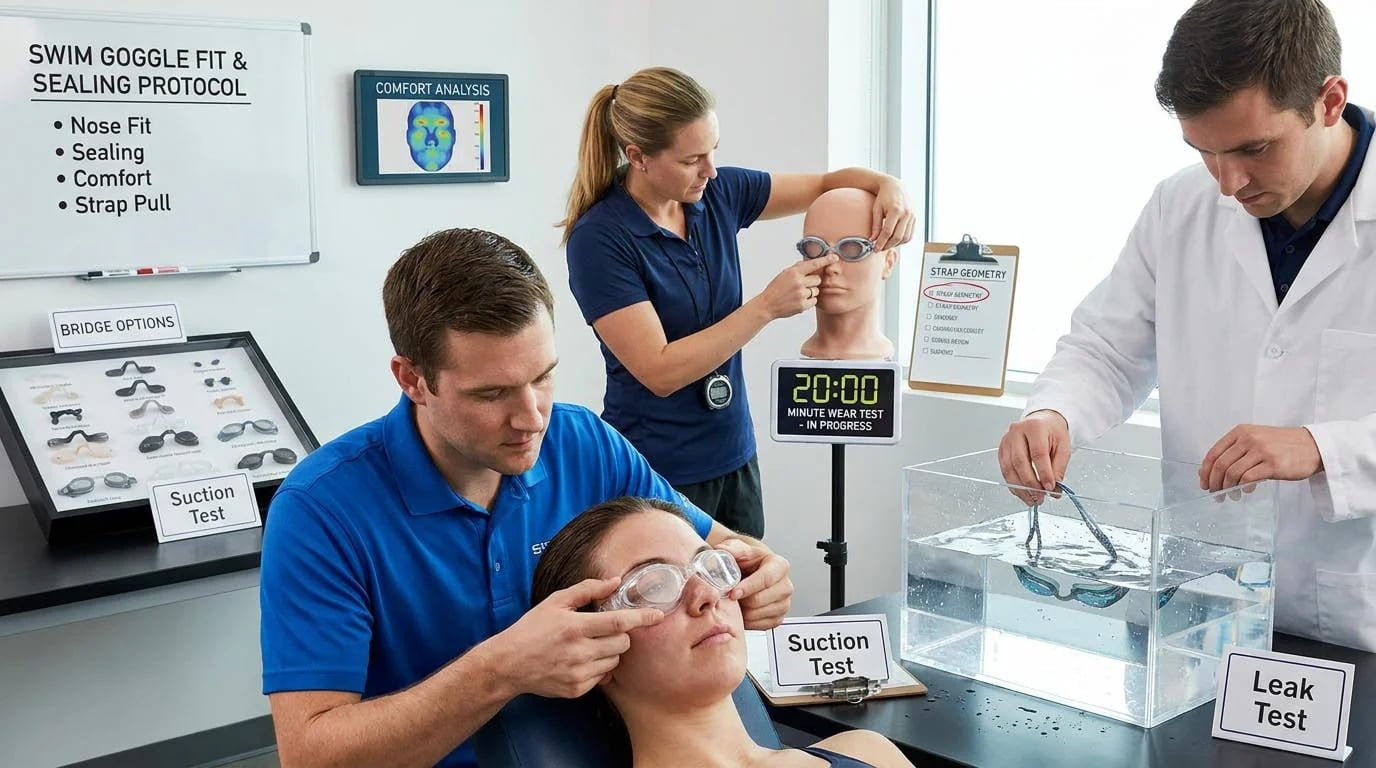
A swim goggle can have good materials and still fail if it does not seal properly. Fit is one of the biggest reasons customers leave negative reviews.
When sourcing swim goggles, verify three things early:
- Nose bridge fit
- Gasket-to-face sealing
- Strap pull angle
Key Fit Checks
A proper fit evaluation should include:
-
Suction test
Press goggles onto the face without using the strap. They should hold briefly by suction. -
Leakage test
Check sealing at the gasket and lens connection under water pressure. -
Comfort test
Wear for 20-30 minutes, ideally during actual swimming, not only during a quick try-on.
Global Markets Need Better Fit Planning
If you plan to sell in multiple regions, one bridge shape may not work for all users. Consider:
- Interchangeable nose bridges
- Adjustable bridge systems
- Different fits for adult and junior lines
This adds complexity, but it can reduce fit-related returns significantly.
Watch the Strap Anchor Geometry
Even if the strap material is strong, poor anchor placement can create uneven pressure and break the seal. The strap should pull evenly across the sealing line, not twist the goggles upward or downward.
5. Understand Anti-Fog, UV, Mirror, and Hard-Coat Trade-Offs
Surface treatments are one of the biggest complaint areas in swimming goggles. Buyers often expect every coating to be durable, low-cost, and maintenance-free. That is rarely realistic.
Anti-Fog Coating Reality
Most anti-fog coatings fall into two categories:
| Anti-Fog Type | Typical Life | Cost Impact | Notes |
|---|---|---|---|
| Standard chemical coating | 20-50 swims | Low | Common on mid-range products |
| Durable/permanent treatment | 200+ swims | Higher | Better for premium lines |
If your users swim often and expect long-term fog resistance, standard anti-fog may not be enough.
Other Surface Treatments to Check
- UV protection for outdoor and open-water use
- Mirror coating for glare reduction
- Hard coat for scratch resistance
- Layer sequencing to ensure compatibility
A basic rule: mirror coating is on the outside, anti-fog is on the inside. If a supplier makes broad claims about "full coating performance," ask exactly which treatment is applied to which surface.
Ask These Questions
- How many swims is the anti-fog designed for?
- Is the coating tested after rubbing or rinsing?
- Is there a hard coat under the mirror finish?
- Does the factory have test data or only sample claims?
6. Evaluate the Swim Goggles Factory’s Real Production Capability
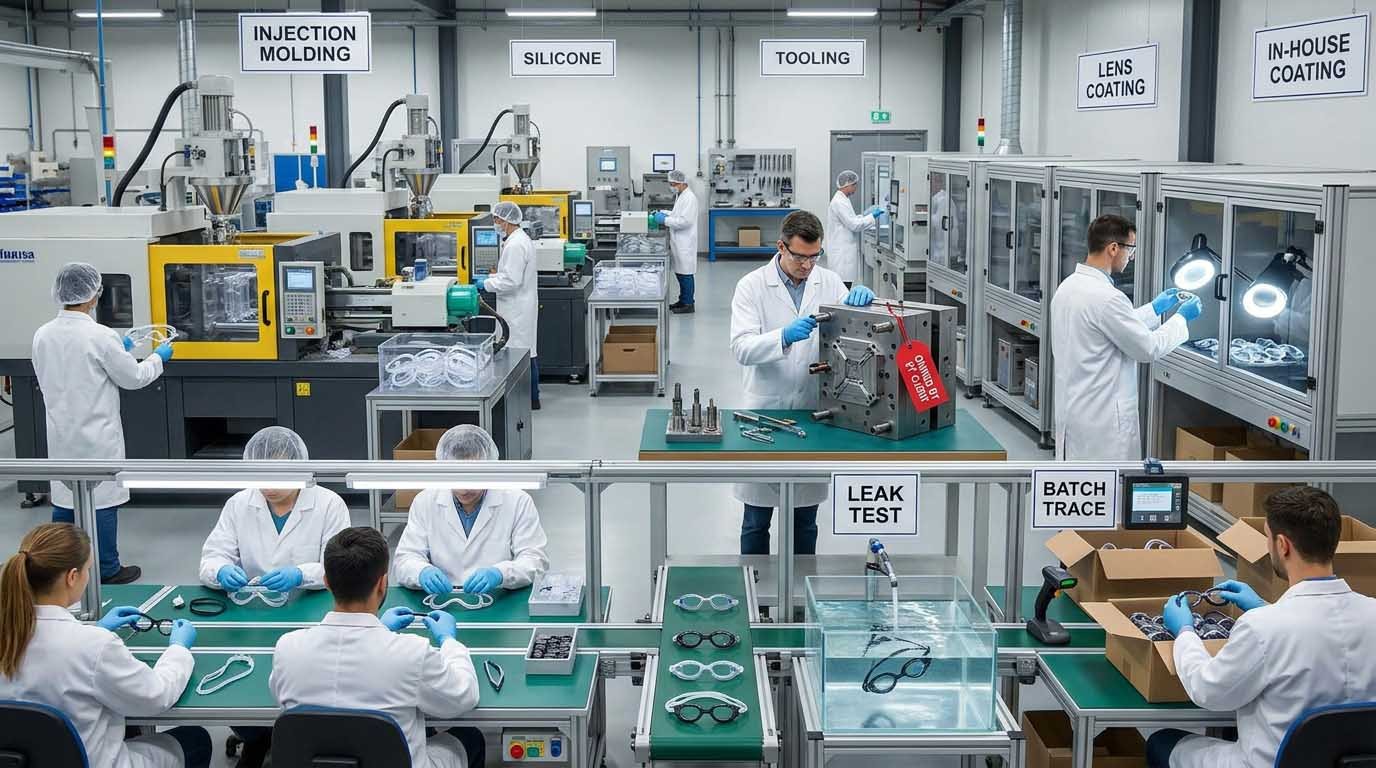
A strong sample does not prove strong bulk production. To source swimming goggles successfully, you need to understand how the factory actually produces them.
The most important factory capability areas are:
- Injection molding
- Lens and coating process
- Silicone molding
- Assembly
- Tooling maintenance
What to Ask a Swim Goggles Manufacturer
- How many molding machines do they operate?
- Do they maintain molds in-house?
- Is coating done in-house or outsourced?
- Do they perform leakage testing after assembly?
- How do they handle batch traceability?
In-House vs Outsourced Coating
If anti-fog or mirror coating is outsourced, you may face:
- Longer lead times
- Less control over defects
- More blame-shifting if issues appear
In-house coating usually improves consistency and traceability, though it may come at a higher price.
Tooling Ownership Must Be Clear
If you pay for custom molds, confirm in writing:
- Who owns the molds
- Where the molds are stored
- Whether you can transfer them later
- Whether storage or maintenance fees apply
This is one of the most important risk-control points in custom swim goggles sourcing.
7. Require Quality Control Systems, Not Just Good Samples
The biggest sourcing mistake in swim goggles is approving a sample and assuming mass production will match it automatically.
Bulk consistency depends on process control, not sample appearance.
What Quality Control Should Include
A reliable factory should have checks at multiple stages:
| QC Stage | What to Check |
|---|---|
| Incoming material inspection | Silicone hardness, lens clarity, strap elasticity |
| Post-molding inspection | Flash, sink marks, dimensions, warping |
| Post-coating inspection | Coverage, adhesion, haze, surface defects |
| Final assembly inspection | Strap direction, bridge installation, leakage, scratches |
AQL Recommendations for Swim Goggles
AQL standards help define acceptable defect levels during inspection.
Suggested starting point:
- Critical defects: AQL 1.0
- Major defects: AQL 2.5
- Minor defects: AQL 4.0
Critical defects for swim goggles include:
- leaking
- cracked lenses
- broken straps
- dangerous material issues
Ask for Batch Traceability
A factory should be able to trace:
- material lot
- coating batch
- production date
- inspection record
If they cannot trace defects back to a batch, solving quality problems becomes slow and expensive.
8. Confirm Compliance Requirements Before Production Starts
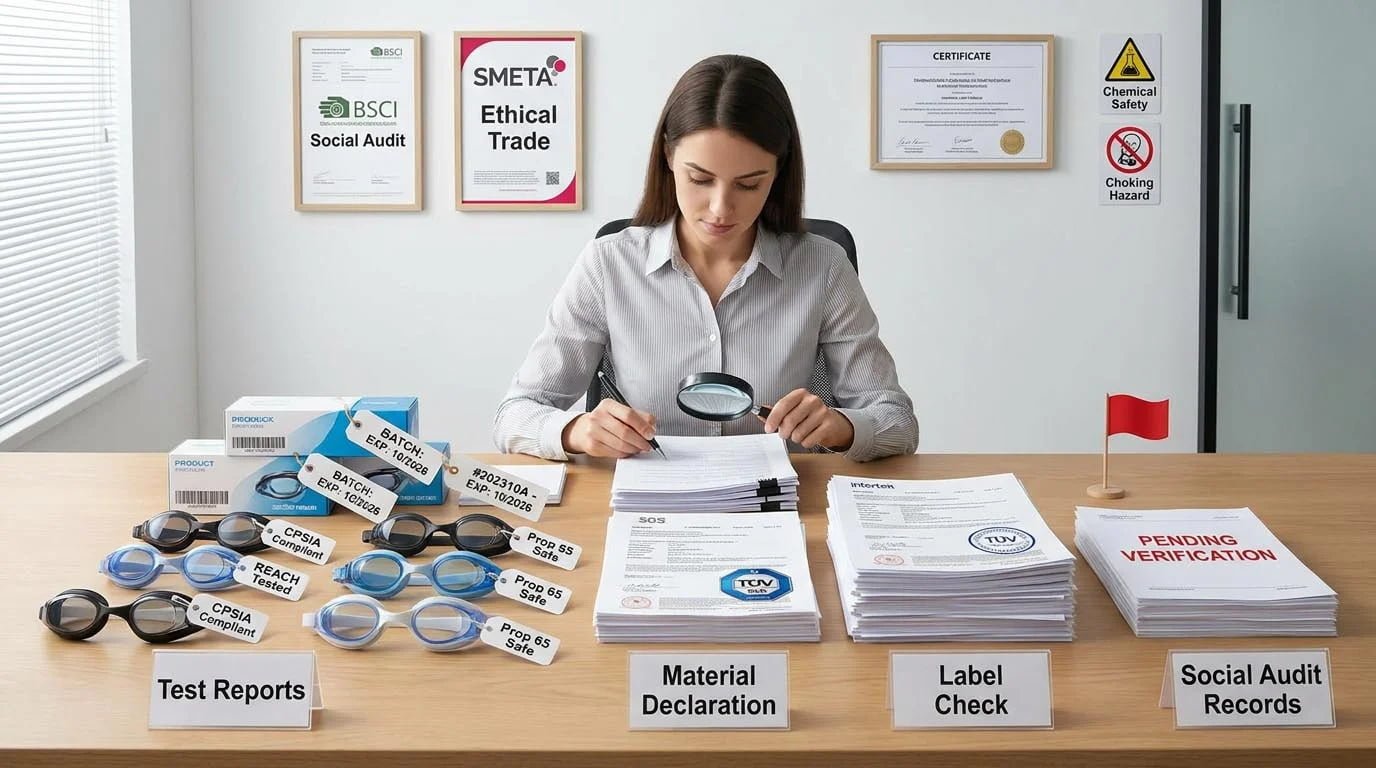
Compliance problems are one of the most expensive sourcing failures because they can block shipments entirely.
When sourcing swimming goggles, check which standards apply in your sales market before you confirm materials and packaging.
Common Compliance Requirements
| Market | Common Requirements |
|---|---|
| United States | CPSIA, lead/phthalates limits, retailer-specific testing |
| European Union | REACH, product safety requirements, retailer compliance |
| California | Prop 65 if applicable |
| Major retailers | Additional chemical, packaging, and labeling rules |
For swim goggles, buyers often request:
- REACH SVHC reports
- CPSIA testing
- material declarations
- batch-specific lab reports
- product labeling verification
Social Compliance Matters Too
If you sell to chains, distributors, or larger e-commerce partners, they may also require:
- BSCI
- SMETA
- other audit programs
These do not replace product testing, but they affect market access and brand reputation.
Red Flag
If a supplier says "we can do any certification" but cannot show recent reports from recognized labs, proceed carefully.
9. Structure MOQ, Lead Time, Pricing, and Payment Terms Carefully
Commercial terms are not secondary details. They determine whether your project is financially viable.
Typical MOQ Levels
| Customization Level | Typical MOQ |
|---|---|
| Stock model with logo/color changes | 500-1,000 pcs |
| Semi-custom changes | 1,000-3,000 pcs |
| Full custom molds | 3,000-10,000+ pcs |
MOQs depend on tooling, setup time, assembly efficiency, and packaging complexity.
Understand Total Cost, Not Just Unit Price
A low quote may exclude:
- logo setup
- tooling
- testing
- custom packaging
- freight
- duty
- rework reserve
Always request a full cost breakdown.
Typical Lead Time Structure
- Sample from existing mold: about 7-10 days
- New tooling/sample development: about 4-6 weeks
- Bulk production: about 20-35 days
- Shipping: depends on air or sea
Payment Terms and Risk
Common payment terms:
- 30% deposit, 70% before shipment
- sometimes staged terms for repeat buyers
For shipping terms, many first-time buyers prefer:
These often provide more visibility than fully outsourced DDP arrangements.
10. Protect Your Brand with Smart Customization, IP, and Packaging Decisions
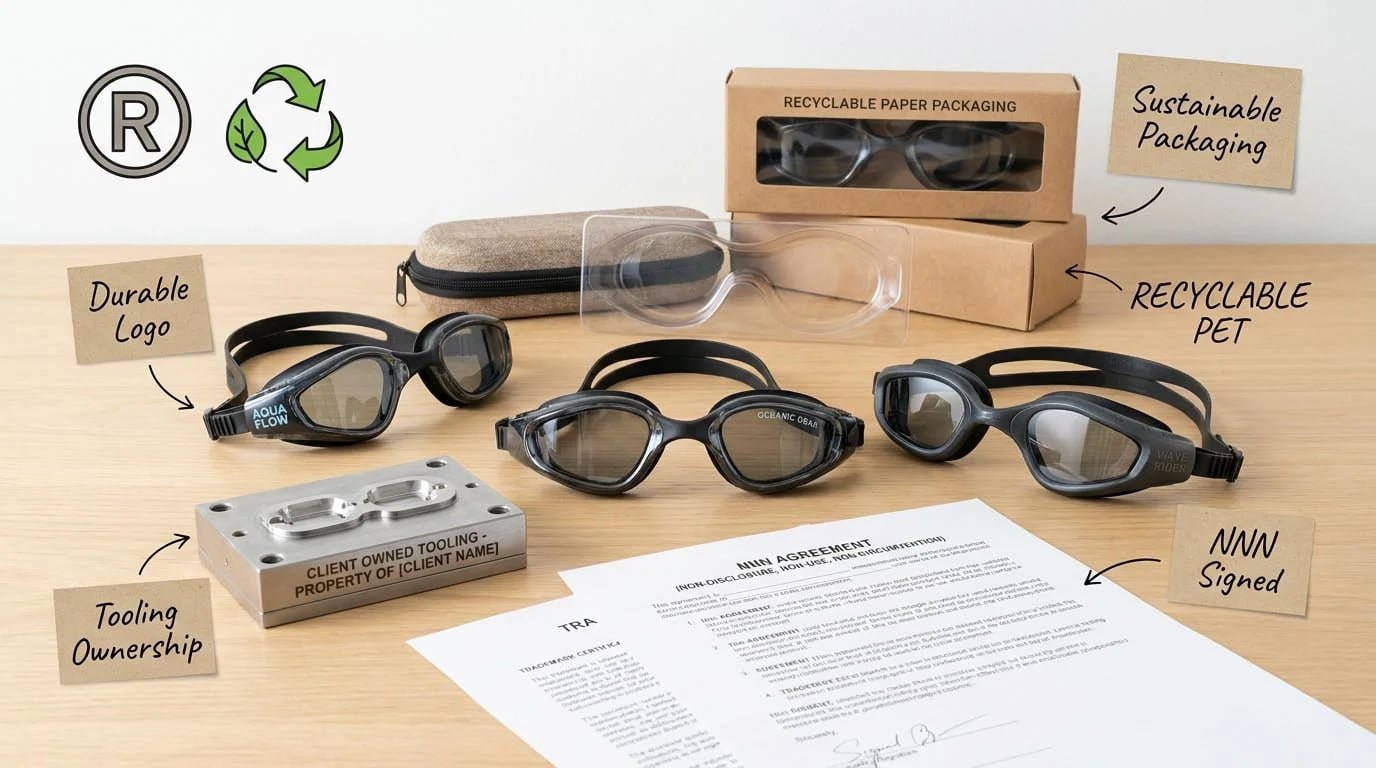
Customization is not only about making the product look unique. It also affects durability, cost, legal protection, and brand perception.
Common Customization Options
| Method | Benefit | Limitation |
|---|---|---|
| Pad printing | Low setup cost | Can wear off over time |
| Laser marking | Permanent | Less flexible visually |
| Embossing | Durable and premium | Higher tooling cost |
| Custom packaging | Brand differentiation | Adds cost and lead time |
Protect Your IP
If you are developing custom swim goggles, protect your design before sharing too much.
Basic protection steps:
- sign an NNN or confidentiality agreement
- register your trademark
- clarify tool ownership
- share detailed files only with shortlisted suppliers
- use unique internal codes or identifiers
Think About Packaging Sustainability
More buyers and retailers now care about packaging waste. Consider:
- recyclable paper boxes
- PET or PP instead of PVC
- reusable cases for premium products
- reduced plastic inserts
Sustainable packaging may raise cost slightly, but it can improve retail acceptance and brand positioning.
Swim Goggles Sourcing Checklist Before You Place an Order
Before placing a bulk order, make sure you can answer yes to these questions:
- Do you know your target user clearly?
- Have you selected the right lens material and tint?
- Are gasket and strap materials skin-safe and latex-free?
- Has fit and leakage been tested properly?
- Do you understand how long the anti-fog coating will last?
- Have you verified the factory’s real production capability?
- Does the factory use in-process QC, not only final inspection?
- Do you already know your US/EU compliance requirements?
- Have MOQ, tooling, and payment terms been confirmed in writing?
- Is tool ownership and customization scope documented clearly?
FAQ: Sourcing Swimming Goggles
What is the best lens material for swimming goggles?
For most projects, polycarbonate is the best balance of clarity, durability, impact resistance, and coating compatibility.
How can I test anti-fog performance before bulk production?
Ask for repeated-use testing, rubbing tests, rinse-cycle tests, and batch data from more than one production run.
What causes swim goggles to leak in bulk orders?
Common reasons include poor gasket molding, weak assembly consistency, bad strap geometry, and fit designs that were not properly tested on real users.
Should I choose a factory with in-house coating?
If anti-fog and mirror consistency are critical, in-house coating usually offers better traceability and faster problem-solving.
Do I need custom molds for a private label swim goggles project?
Not always. Many brands start with existing molds plus custom logos, colors, and packaging before investing in full tooling.
Conclusion
To source swimming goggles successfully, focus on the factors that actually affect bulk performance: user fit, material quality, coating durability, factory process control, compliance, and commercial structure. The best supplier is not the one with the cheapest sample or the fastest promise. It is the one that can consistently deliver the right product at the quality, cost, and volume your market requires.