A swimming goggle can look perfectly clear during a quick showroom demonstration and still fog during actual swimming.
That is why anti-fog performance should not be judged by one breath test or one fresh sample.
To test anti-fog performance on swimming goggles, start with a clean and standardized lens condition, control the testing environment, expose every sample to the same fog-producing conditions, and evaluate optical clarity using consistent observation criteria. Quick screening can identify obvious failures, while controlled vapor and real-wear tests provide more reliable evidence.
For buyers and product developers, the goal is not to ask:
Does this lens look clear right now?
The better question is:
Does this lens perform consistently when tested under the same controlled conditions as other samples?
This guide explains a practical way to evaluate swimming goggle anti-fog performance before moving into deeper durability or production validation.
Quick Answer: How Do You Test Anti-Fog Performance?
A practical anti-fog test can follow seven steps:
- Inspect and prepare the lens
- Run a quick screening test
- Control the test conditions
- Run a controlled vapor test
- Evaluate optical clarity
- Compare multiple samples
- Confirm performance with real-wear testing
The most important principle is:
Keep the test conditions consistent.
If temperature, humidity, lens cleanliness, exposure time, or sample handling change between tests, you may be measuring environmental differences rather than actual anti-fog performance.
Why Is a Simple Breath Test Not Enough?
A breath test is useful because it is fast.
You breathe onto the inner lens and immediately see whether condensation forms.
But the method has an important limitation:
Human breath is not controlled.
Different people produce different:
- breath temperatures,
- moisture levels,
- airflow,
- exposure distances,
- and exposure times.
That makes breath testing useful as a screening method, but weak as final proof of product performance.
Quick Screening vs Controlled Testing
| Method | Best Use | Main Limitation |
|---|---|---|
| Breath test | Fast screening | Highly variable |
| Warm vapor test | Controlled comparison | Requires consistent setup |
| Humidity-based test | Environmental evaluation | Requires stable conditions |
| Pool test | Real-use validation | Harder to standardize |
The right approach is therefore:
Use quick tests to identify obvious failures, then use controlled methods for meaningful comparison.
Step 1: Inspect and Prepare the Lens
Good anti-fog testing starts before the lens is exposed to moisture.
A dirty, scratched, or contaminated lens can produce misleading results.
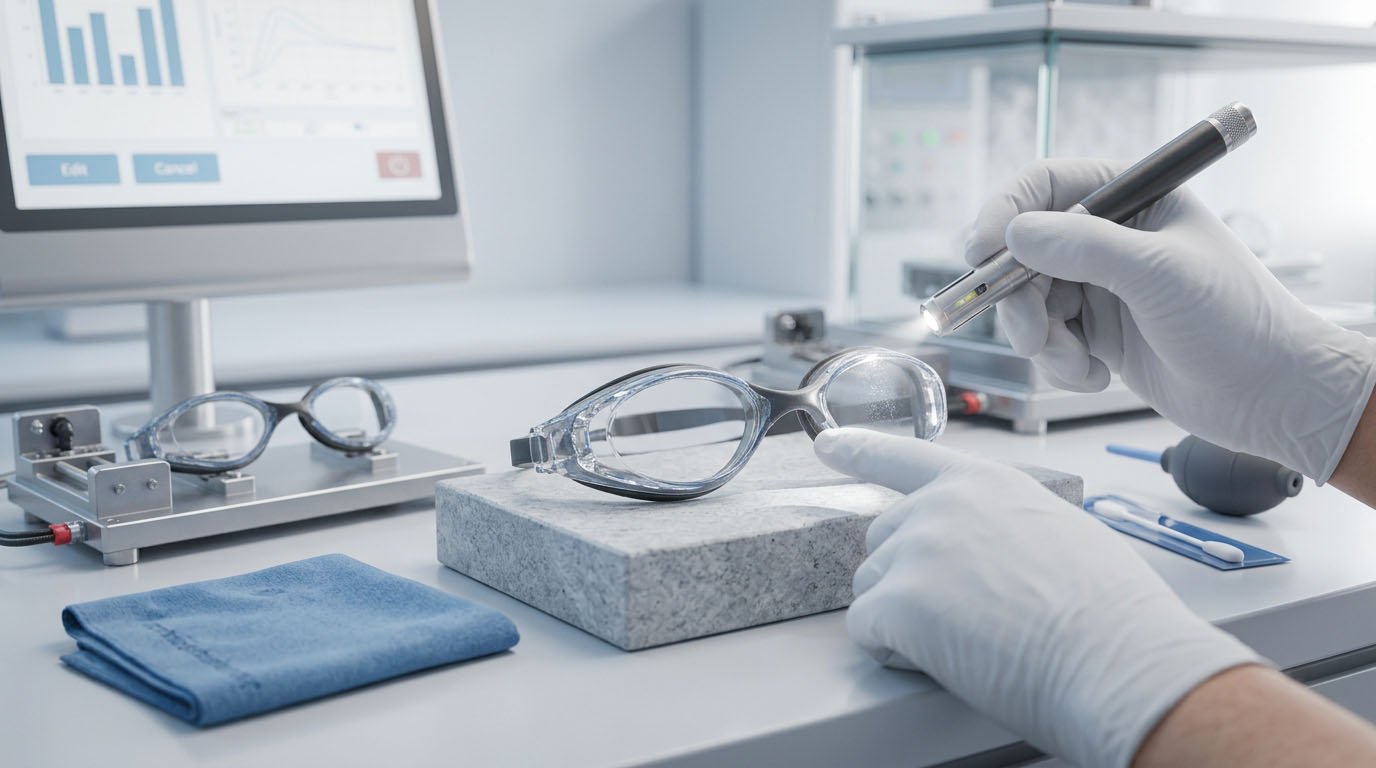
Before testing, inspect each sample for:
- scratches,
- fingerprints,
- visible residue,
- dust,
- packaging contamination,
- surface haze,
- and handling marks.
Standardize the Starting Condition
Every sample should begin the test in a comparable condition.
A simple preparation routine may include:
| Check | Action |
|---|---|
| Surface damage | Inspect for scratches or defects |
| Residue | Check for oils, dust, or film |
| Cleaning | Use one agreed preparation method |
| Handling | Avoid touching the inner lens |
| Drying | Allow samples to stabilize consistently |
Be careful with the inner anti-fog surface.
Aggressive wiping or unsuitable cleaners may change the coating before the actual test begins.
The goal is not to make the lens “perfect.”
The goal is to make sure:
Sample A and Sample B start from comparable conditions.
Step 2: Run a Quick Screening Test
A quick screening test can help eliminate obvious failures before more controlled testing begins.
Common options include:
- a breath test,
- brief warm-vapor exposure,
- or another simple condensation check.
What Should You Look For?
Observe whether the lens:
- fogs immediately,
- remains relatively clear,
- develops localized fogging,
- forms uneven condensation,
- or shows obvious coating inconsistency.
A fast test can answer:
Is functional anti-fog behavior present?
But it cannot reliably answer:
How durable is the coating?
or:
Will this performance remain stable in mass production?
Those questions require separate validation.
Step 3: Control the Test Conditions
Controlled conditions are what turn a visual demonstration into a useful comparison.
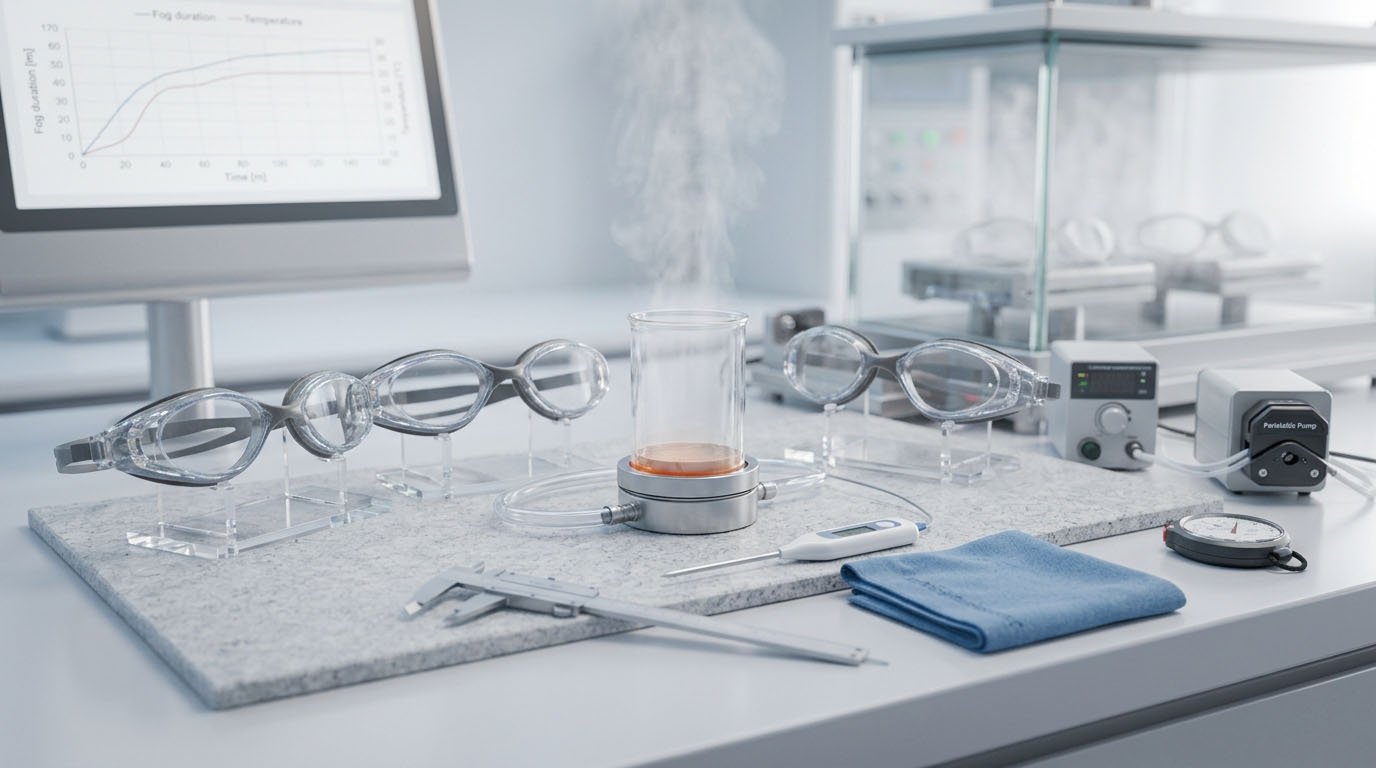
Several variables can affect anti-fog results:
- water or vapor temperature,
- room temperature,
- humidity,
- exposure duration,
- distance from the vapor source,
- lens starting temperature,
- lighting,
- sample preparation,
- and prior handling.
Why Consistency Matters More Than One Perfect Number
The goal is not necessarily to find one universal test temperature or distance.
The goal is to make sure:
Every sample is tested under the same defined conditions.
For example, if one goggle is held very close to warm vapor and another is tested farther away, the results are difficult to compare.
A useful test record should document:
| Test Variable | What to Control |
|---|---|
| Vapor source | Same setup |
| Lens position | Same orientation |
| Exposure time | Same duration |
| Environment | Stable conditions |
| Lighting | Consistent observation |
| Sample handling | Same procedure |
Repeatability gives the result meaning.
Step 4: Run a Controlled Vapor Test
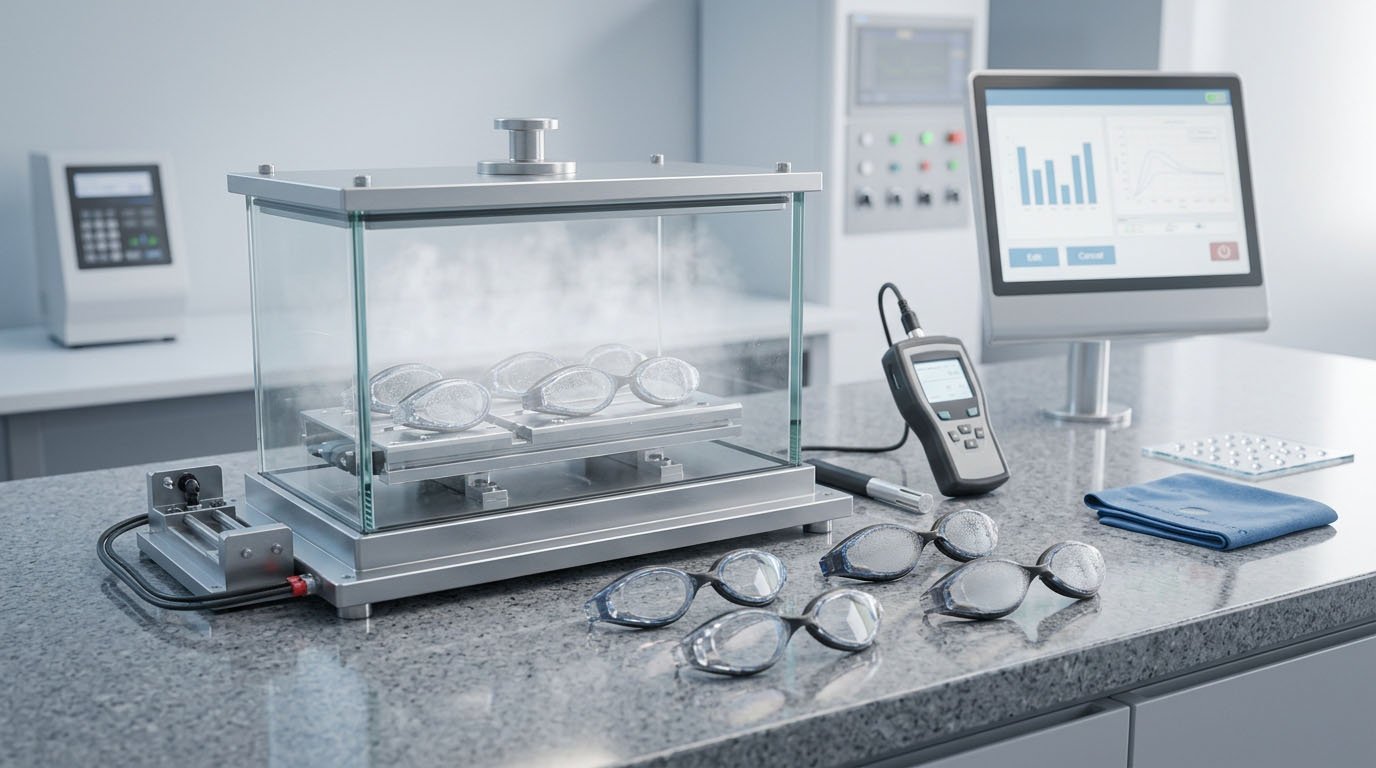
A controlled vapor test is more useful than a casual breath test because the moisture source and sample position can be standardized.
The basic concept is simple:
Expose the inner lens surface to the same controlled warm-vapor environment and compare how each sample maintains visibility.
A Practical Test Sequence
A simple workflow can look like this:
Prepared Lens → Controlled Vapor Exposure → Timed Observation → Optical Clarity Check → Record Result
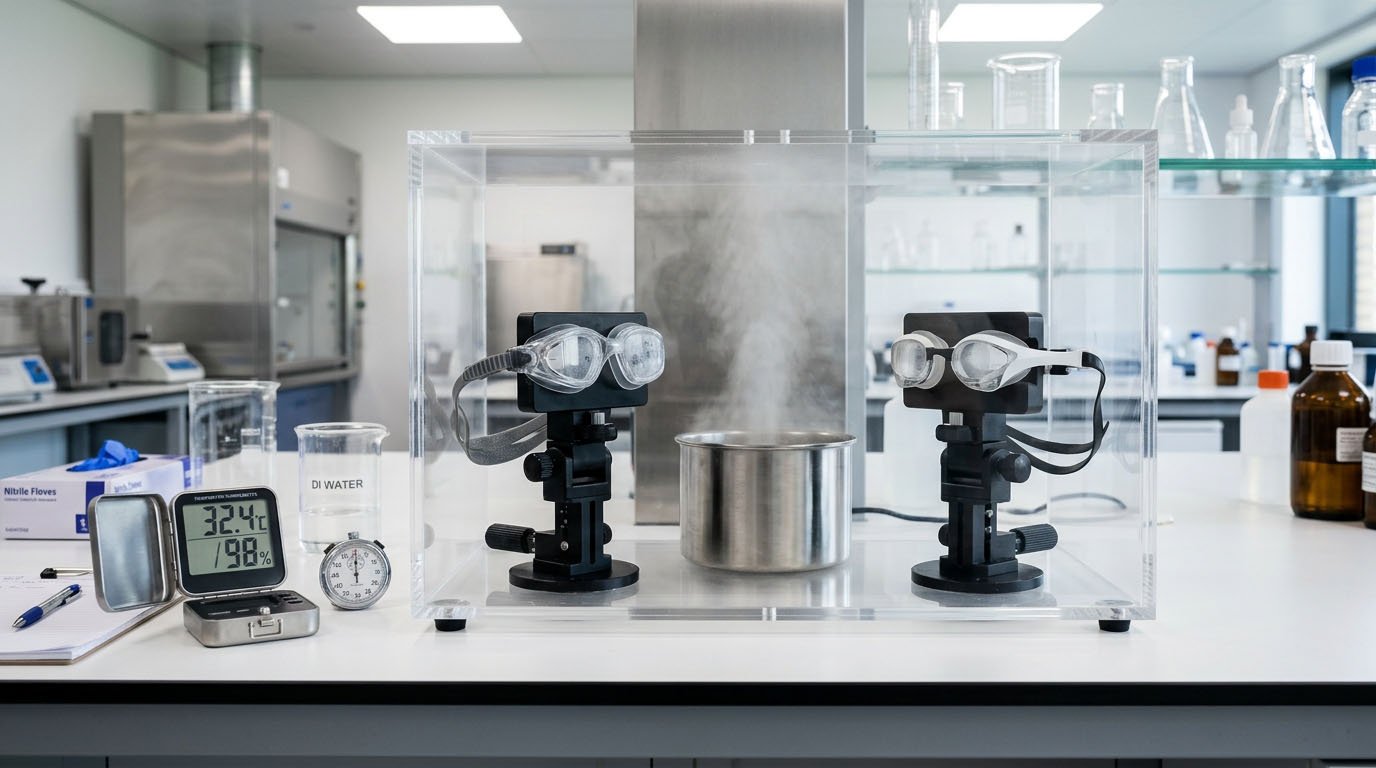
During testing, keep:
- the vapor source consistent,
- the lens position fixed,
- the exposure period consistent,
- and the observation method the same.
Avoid changing the test procedure from one sample to another.
What Does the Vapor Test Tell You?
It can help identify:
- immediate fogging,
- delayed fogging,
- uneven anti-fog performance,
- coating inconsistency,
- and differences between samples.
It is especially useful for comparing:
- different coating options,
- development samples,
- different suppliers,
- or multiple production samples.
Step 5: Evaluate Optical Clarity
Anti-fog testing should measure more than whether visible droplets appear.
The real question is:
Can the swimmer still see clearly through the lens?
That means optical clarity should be part of the evaluation.
Use a Consistent Visual Target
One practical approach is to place the same:
- text,
- contrast pattern,
- grid,
- or visual target
behind the lens for every test.
Then observe whether the target remains:
- readable,
- clear,
- undistorted,
- and visible through the condensation exposure.
You do not necessarily need a complex laboratory chart for basic product comparison.
The important point is:
Use the same visual target every time.
What Should Be Recorded?
| Observation | Possible Interpretation |
|---|---|
| Target remains clear | Strong initial anti-fog behavior |
| Light haze develops | Partial performance loss |
| Local fog patches appear | Possible coating inconsistency |
| Target becomes unreadable | Significant visibility loss |
| Uneven left/right result | Sample or process variation |
This gives buyers a more useful evaluation than simply writing:
PASS
without context.
Step 6: Compare Multiple Samples
One sample is not enough to evaluate manufacturing consistency.
A good sample can show that a coating can work.
Multiple samples help show whether that result is repeatable.
Why Sample Comparison Matters
Variation can appear due to:
- lens preparation,
- coating application,
- curing,
- handling,
- surface contamination,
- or manufacturing variation.
Test several samples using the same method and compare:
- initial clarity,
- fog formation,
- clarity retention,
- visual consistency,
- and left/right lens behavior.
The objective is not to find one perfect lens.
It is to determine whether:
The anti-fog performance is consistent enough across the samples being evaluated.
Even when development samples perform consistently, bulk production can introduce new variation. See why approved anti-fog samples can differ from bulk production.
Step 7: Run Pool or Real-Wear Validation
Laboratory testing gives you control.
Real-use testing gives you context.
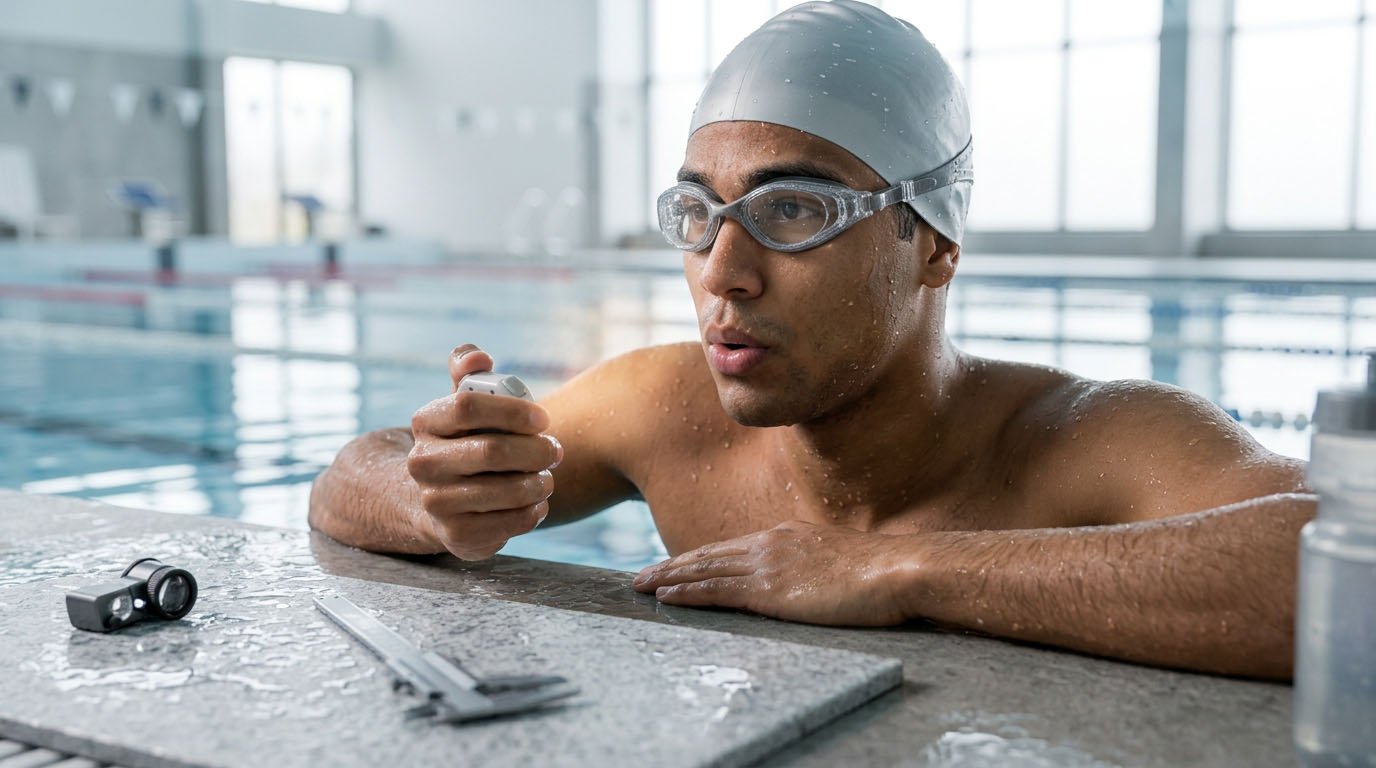
A swimming pool introduces factors that controlled bench tests cannot fully reproduce, including:
- body heat,
- face temperature,
- movement,
- sweat,
- pool conditions,
- fit,
- and repeated removal and re-wearing.
How Should a Real-Wear Test Be Used?
Use pool testing as a secondary validation step.
For example:
- Select samples that performed acceptably during controlled screening.
- Use them under normal swimming conditions.
- Observe clarity at consistent checkpoints.
- Record any fogging or visibility change.
- Compare the results between samples.
Real-wear testing should not replace controlled testing.
Instead:
Controlled testing helps compare products fairly. Pool testing helps confirm whether the result makes sense in real use.
How Is Anti-Fog Durability Different From Initial Performance Testing?
Initial anti-fog testing and durability testing answer different questions.
Initial Performance Testing
Asks:
Does the anti-fog system work now?
It focuses on:
- preparation,
- controlled conditions,
- vapor exposure,
- optical clarity,
- and sample comparison.
Durability Testing
Asks:
Does that anti-fog performance remain acceptable after repeated stress?
It may include:
- repeated water exposure,
- cleaning cycles,
- environmental stress,
- abrasion,
- multiple samples,
- and pilot-production verification.
So these topics should not be treated as the same test.
Initial Test = Does It Work?
Durability Test = Does It Keep Working?
For repeated stress cycles, pilot-run verification, and production-level validation, see our guide to anti-fog durability testing before mass production.
What Should Buyers Record During an Anti-Fog Test?
A simple test record can greatly improve traceability.
| Record Item | What to Note |
|---|---|
| Sample ID | Model and lens configuration |
| Preparation | How the sample was conditioned |
| Test method | Breath, vapor, humidity, or pool |
| Test conditions | Relevant environment and exposure |
| Observation time | When the result was checked |
| Optical result | Clear, haze, localized fog, or fail |
| Sample comparison | Better, similar, or worse |
| Test date | Links result to development stage |
This helps buyers avoid relying on vague descriptions such as:
“Anti-fog is good.”
A traceable test record makes product comparisons much easier.
Anti-Fog Testing Checklist for Buyers
Before accepting an anti-fog claim, confirm:
| Check | What to Verify |
|---|---|
| Lens preparation | Samples start in comparable condition |
| Quick screening | Used only as an initial check |
| Test environment | Main variables are controlled |
| Vapor exposure | Method is repeatable |
| Optical target | Same visibility reference used |
| Multiple samples | Results are compared |
| Real-use test | Pool validation where appropriate |
| Test record | Results are documented |
| Durability | Evaluated separately if required |
This checklist is useful when reviewing:
- factory samples,
- OEM or ODM developments,
- competing suppliers,
- or pre-production approvals.
Common Mistakes When Testing Anti-Fog Performance
Relying Only on a Breath Test
A breath test can identify obvious failures, but it is too variable to act as the only approval method.
Testing Dirty or Inconsistently Prepared Lenses
Fingerprints, residue, scratches, or different cleaning methods can distort the comparison.
Changing the Test Conditions Between Samples
If the vapor temperature, exposure time, lens position, or environment changes, the results become difficult to compare.
Confusing Initial Performance With Durability
A lens that performs well during the first test may still lose performance after repeated use.
Test initial performance and durability as separate questions.
FAQ About Testing Swimming Goggle Anti-Fog Performance
Is a Breath Test Enough to Test Swimming Goggles?
No.
It is useful as a fast screening method, but human breath varies too much to provide a reliable controlled comparison.
A more repeatable vapor-based setup is better for product evaluation.
Should Every Goggle Be Tested at Exactly the Same Temperature?
The important point is to use a defined method and keep conditions consistent across samples.
The appropriate parameters depend on the test protocol, product specification, and applicable requirements.
Avoid inventing universal thresholds without supporting evidence.
How Do You Know if the Anti-Fog Test Passed?
The pass/fail criteria should be defined before testing.
This may include:
- acceptable visibility,
- limited fog formation,
- target readability,
- consistency between samples,
- or other agreed product criteria.
Does a Successful Anti-Fog Test Prove Long-Term Durability?
No.
Initial testing confirms current performance.
Durability requires repeated stress, re-testing, and—where appropriate—production-level verification.
How Jerry Approaches Anti-Fog Evaluation
Anti-fog testing should be part of a broader product development and quality process.
That may include:
- lens selection,
- anti-fog treatment review,
- sample preparation,
- controlled testing,
- optical evaluation,
- real-wear validation,
- durability testing,
- and production quality control.
For custom developments, Jerry supports projects through OEM and ODM development, sampling and prototyping, and production-level quality assurance.
You can also review Jerry’s swimming goggles manufacturing capabilities when comparing lens, gasket, color, coating, and packaging options.
Conclusion
Testing anti-fog performance on swimming goggles requires more than breathing onto a lens and checking whether it stays clear for a few seconds.
A better process is:
Prepare the Lens → Screen → Control the Environment → Run a Vapor Test → Check Optical Clarity → Compare Samples → Validate in Real Use
For buyers, the most important principle is consistency.
Use:
- the same preparation,
- the same test setup,
- the same observation method,
- and the same evaluation criteria
for every sample.
That creates a much stronger basis for comparing anti-fog performance between products, suppliers, and development samples.
And remember:
Initial anti-fog performance and anti-fog durability are different questions.
If long-term performance matters, follow the initial test with separate durability and production validation before approving mass manufacturing.
If you are developing an OEM, ODM, or private label swimming goggle project and want to review anti-fog options, samples, or testing requirements, contact Jerry to discuss your project.