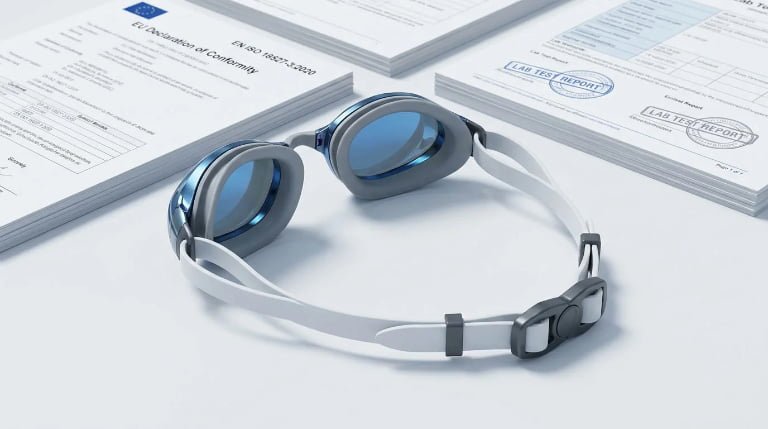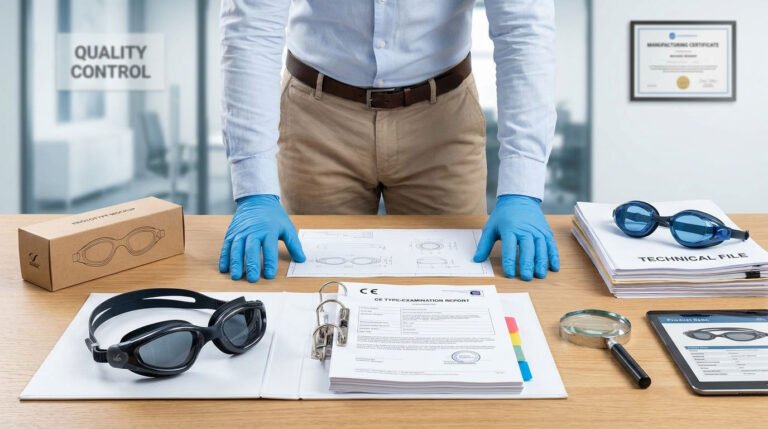
Selling swimming goggles in the European Union involves more than obtaining a test report or printing a CE mark. Brands and importers must identify the applicable regulations, confirm who holds legal responsibility, and make sure their packaging and online listings carry the right information.
Quick answer: Conventional surface-swimming goggles are generally Category I Personal Protective Equipment (PPE) under Regulation (EU) 2016/425. The EU General Product Safety Regulation (GPSR), Regulation (EU) 2023/988, does not replace that PPE framework. Certain GPSR provisions still apply, particularly requirements for online and distance sales.
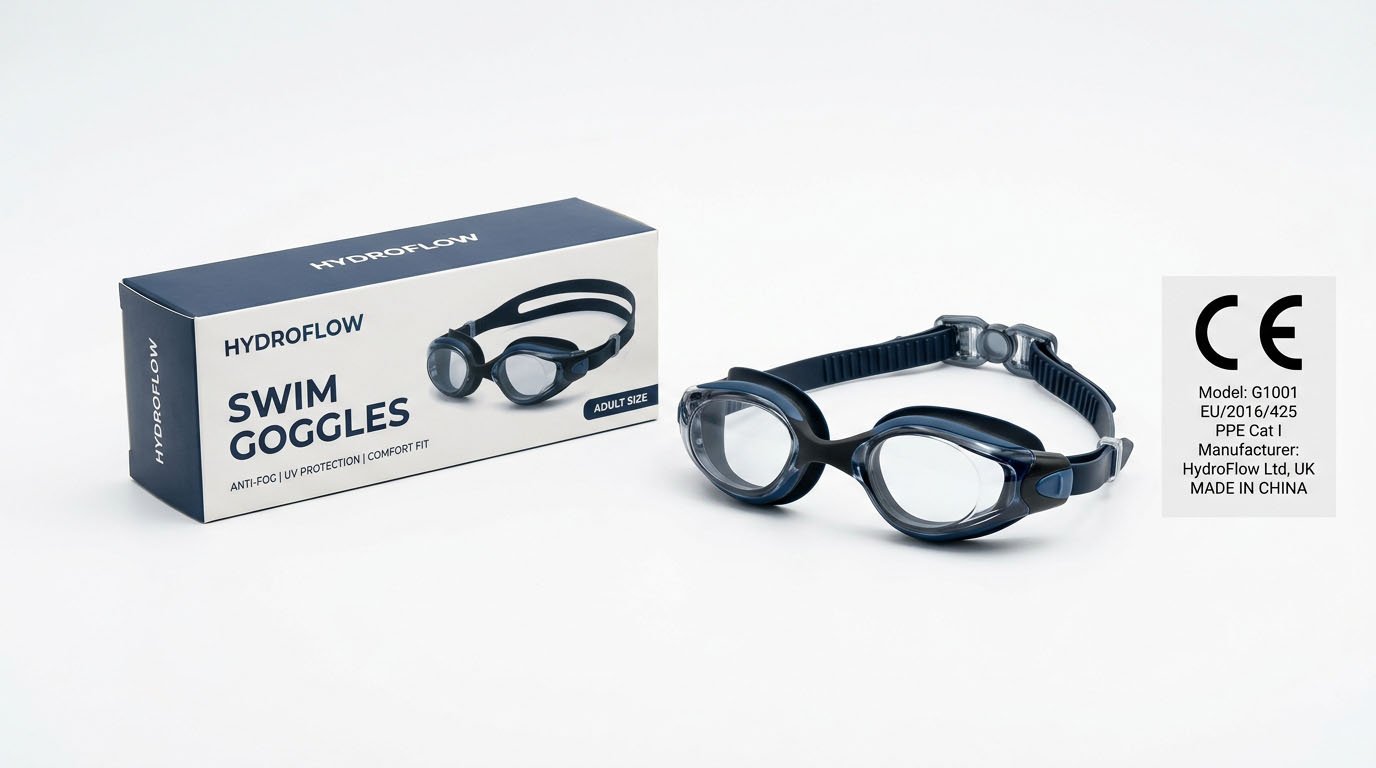
For OEM and private-label buyers, the goal is not to obtain a separate "GPSR certificate." It is to establish a reliable chain between the finished product, conformity documentation, legal economic operators, labeling, and sales information.
Quick Answer: EU Swimming Goggle Compliance at a Glance
| Area | What Buyers Need to Check |
|---|---|
| Product classification | Conventional surface-swimming goggles are generally Category I PPE |
| PPE conformity | Applicable technical assessment, EU Declaration of Conformity, and CE marking |
| GPSR | Relevant supplementary provisions, including Article 19 online offers |
| EU operator | An EU-established economic operator with applicable Article 4 responsibilities |
| Packaging | Product identification, manufacturer/importer details, instructions, and markings |
| Online sales | Manufacturer, responsible operator, product identification, and safety information |
| Traceability | Evidence connecting the approved configuration to production batches |
The GPSR has applied since December 13, 2024. However, the relevant legal route depends on the product’s intended use, design, and destination market.
Key 1. Does the GPSR Apply to Swimming Goggles?
Yes, but not every GPSR obligation applies to a PPE product in the same way. Article 2 of the GPSR limits its application where EU product-specific safety legislation already covers particular risks and obligations.
Swimming goggles intended for surface swimming generally fall under Category I PPE. This means the PPE Regulation provides the principal rules for assessing product conformity, preparing documents, and affixing CE marking.
For products governed by EU harmonisation legislation, GPSR Chapter III, Section 1 does not apply, and several other GPSR chapters are also excluded. Relevant rules outside those exclusions can still apply.
| Question | Main Framework |
|---|---|
| Must these goggles meet PPE safety requirements? | PPE Regulation 2016/425 |
| Do they need a CE mark and declaration? | PPE Regulation 2016/425 |
| Who performs the EU-established operator tasks? | Regulation 2019/1020, Article 4 |
| What must an online product offer display? | GPSR Article 19 |
The distinction matters because applying every GPSR manufacturer-labeling rule on top of PPE obligations can create an inaccurate compliance checklist.
For a broader market-by-market overview, see Jerry’s Swimming Goggles Compliance Guide.
Key 2. How Do GPSR, PPE and CE Requirements Work Together?
The three terms are related but not interchangeable:
- PPE Regulation: Establishes applicable product-safety, conformity-assessment, documentation, and operator duties.
- CE marking: Indicates that the manufacturer declares conformity with applicable EU harmonisation requirements; it is not a laboratory certificate.
- GPSR: Adds applicable consumer-product rules, including distance-selling requirements, without replacing the PPE framework.
For conventional Category I swimming goggles, the PPE conformity route generally uses Module A (internal production control). The manufacturer must prepare appropriate technical documentation, issue an EU Declaration of Conformity, and apply the CE mark.
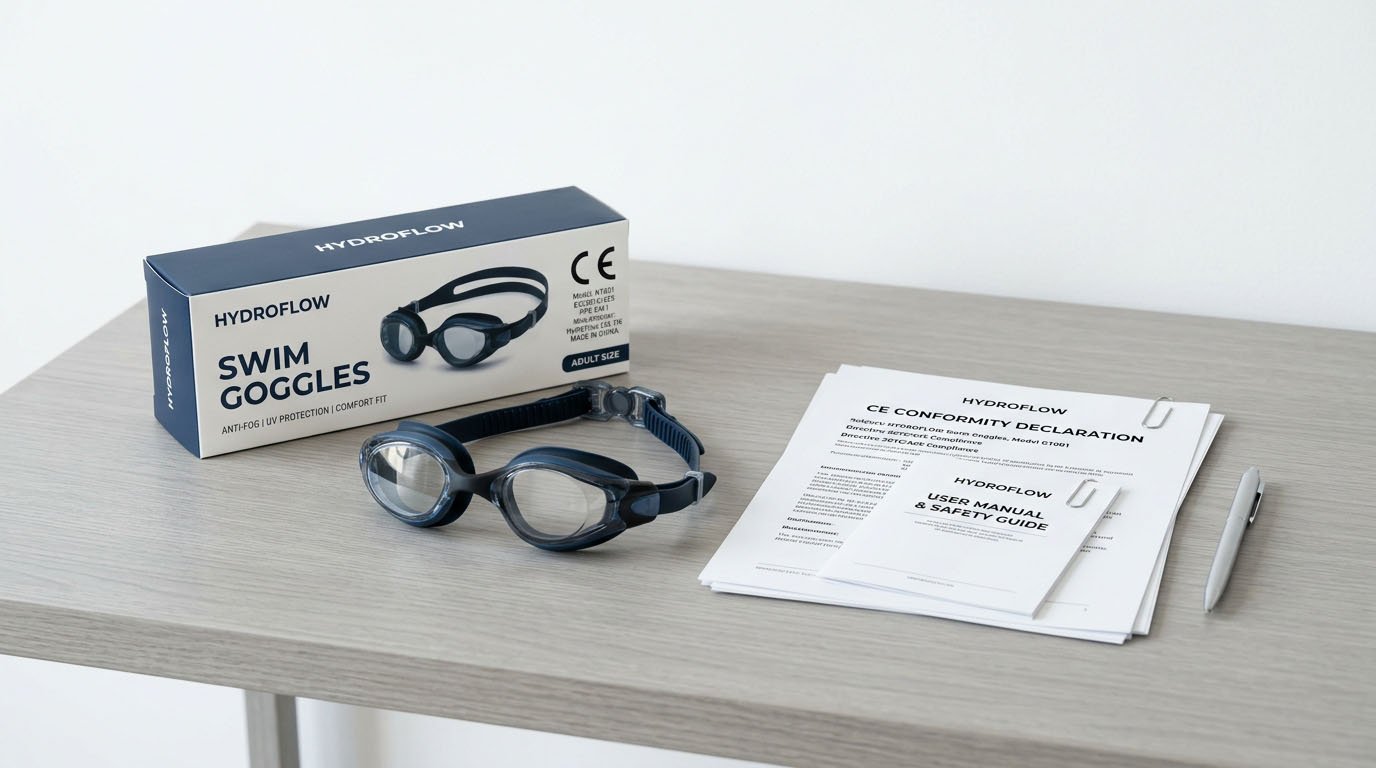
Testing against ISO 18527-3 may provide relevant technical evidence for surface-swimming eyewear. But the report must match the actual model, and its scope, edition, and relevance must be checked. A test result alone does not replace the manufacturer’s legal obligations.
For a deeper explanation of conformity procedures and the technical file, read Jerry’s EU PPE Regulation 2016/425 Guide.
Key 3. Who Is Responsible for EU Swimming Goggle Compliance?
An overseas factory, a private-label brand, and an EU importer may all participate in one supply chain, but their legal roles are not necessarily the same as their commercial job titles.
| Party | Main Duty |
|---|---|
| Legal manufacturer | Ensure PPE conformity, required documentation, declaration, and CE marking |
| EU importer | Verify required conformity steps and perform importer obligations |
| EU Article 4 operator | Handle specified documentation and authority-cooperation tasks |
| Distributor | Exercise required checks before making products available |
| OEM factory | Provide agreed manufacturing, testing, and traceability support |
An EU-established economic operator is required for products covered by Article 4 of Regulation (EU) 2019/1020, including PPE. This can be an EU manufacturer, importer, properly mandated authorized representative, or qualifying fulfillment service provider, depending on the arrangement.
What Changes for Private-Label Brands?
A brand that commissions goggles and markets them under its own name or trademark may be treated as the legal manufacturer under the PPE Regulation, even when another company runs the production line.
For example, an EU retailer ordering Jerry-made goggles with its own brand should establish who is the legal manufacturer before finalizing the declaration and packaging. A factory service agreement cannot simply remove responsibilities imposed by law.
Confirm these roles early in the OEM & ODM development process.
Key 4. What Must Appear on Swimming Goggle Packaging?
Small lens frames and silicone straps leave little room for printed information. Nevertheless, applicable PPE and market-surveillance rules still require product identification and contact information.
Before approving packaging artwork, verify:
- Product type, model, batch, serial number, or another suitable identifier.
- Legal manufacturer’s name and required contact information.
- Importer’s required identification and contact information, where applicable.
- EU Article 4 operator details, if the operator is not already adequately identified.
- CE marking in the location permitted by PPE Article 17.
- Required instructions and safety information in the appropriate destination-market languages.
Where the size or nature of the PPE prevents certain identifiers or addresses from being placed on the product, relevant PPE provisions allow alternative placement on the packaging or accompanying documentation. Do not assume every detail must appear both on the goggles and the box. Different information items follow different placement rules.
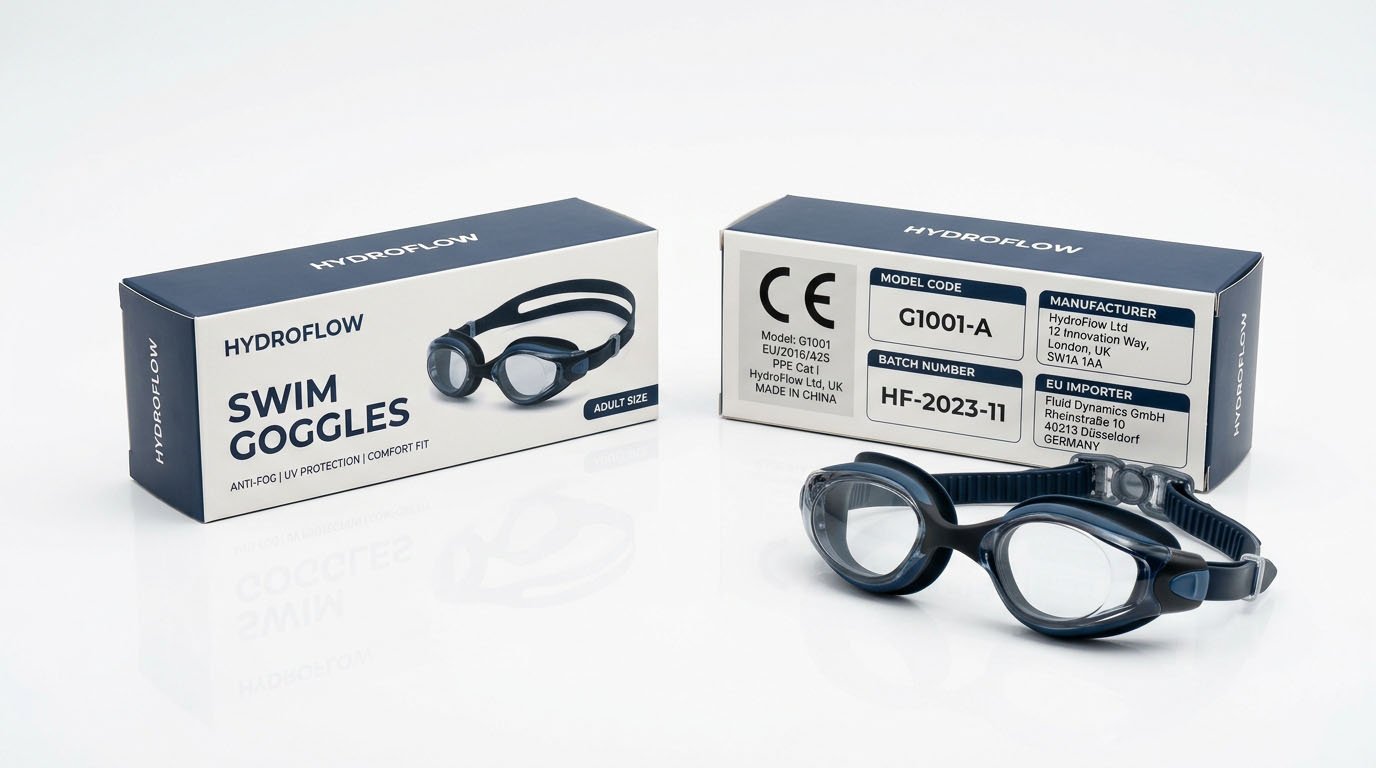
Example: Retail Packaging Artwork Review
| Artwork Field | Example to Confirm |
|---|---|
| Product | Swim goggle, model SG-210 |
| Batch | SG210-2609-A |
| Manufacturer | Correct legal entity and contact details |
| EU importer/operator | Applicable registered entity and contact information |
| CE and instructions | Correct position and target-market languages |
This is an artwork-planning example, not a universal label template. In practice, confirm the layout against the actual product and applicable rules before printing thousands of units.
A QR code may provide supplementary instructions, but it should not be assumed to replace legally required physical labels or accompanying safety information.
Key 5. What Must Amazon and Online Store Listings Display?
GPSR Article 19 is especially relevant to brands selling goggles through Amazon, marketplaces, and independent e-commerce stores. It requires certain information to appear clearly and visibly in online or other distance-selling offers.
| Online Listing Element | What to Display or Verify |
|---|---|
| Manufacturer | Name/trade name/trademark and postal and electronic contact addresses |
| EU responsible operator | Name, postal address, and electronic address when the manufacturer is outside the EU |
| Product identification | Photograph, product type, and relevant identifying information |
| Warnings | Required warnings or safety information in the appropriate language |
For PPE, the responsible operator referenced in Article 19 may be the economic operator established under Regulation (EU) 2019/1020, Article 4.
Example: A Private-Label Goggle Listing
A listing should let a buyer identify the actual product and the responsible businesses. A photograph and a claim such as "CE Certified Swimming Goggles" are not enough by themselves.
Common problems include publishing only a brand logo, using an unrelated model photo, omitting an electronic contact address, or keeping required warnings solely inside the delivered box.
Review the product page separately from the physical packaging. A correct box does not automatically mean the Amazon listing or independent store is compliant.
Key 6. What Technical Documents and Traceability Records Are Needed?
For Category I swimming goggles, technical documentation is primarily governed by PPE Regulation 2016/425, including Annex III. It should support the assessment of the specific product—not merely a similar model in the supplier’s catalog.
A practical buyer review includes:
| Evidence | Why It Matters |
|---|---|
| Intended use and product description | Establishes product identity and applicable risks |
| Design and material specifications | Identifies lens, gasket, strap, and frame configurations |
| Risk assessment and relevant standards | Explains how safety requirements were addressed |
| Testing and verification records | Supports the claims and conformity assessment |
| Declaration, marking, and instructions | Connects the product to its market obligations |
| Production and batch records | Enables changes and safety complaints to be investigated |
Under PPE Article 8, manufacturers retain technical documentation and the EU Declaration of Conformity for 10 years after the PPE has been placed on the market. This is a PPE duty, not a universal "GPSR certificate retention" rule.
Connect the Tested Sample to Bulk Production
A useful evidence chain is:
Approved sample → Final specification → Material/component records → Production batch → Finished product
If the lens coating, strap material, nose bridge, or other safety-relevant component changes, determine whether existing evidence remains representative. A passing report for one configuration should not automatically be applied to another.
Jerry’s Swimming Goggle Test Report Guide explains how buyers can compare a report with the actual product.
Key 7. Are Children’s Swimming Goggles Subject to Different Requirements?
Children’s goggles may raise additional design and foreseeable-use risks, but they do not automatically require a separate, universal "children’s GPSR certificate." Product classification and applicable legislation remain the starting points.
| Assessment | Adult Goggles | Children’s Goggles |
|---|---|---|
| Fit and retention | Secure fit during swimming | Fit, adjustment, and foreseeable misuse |
| Straps and buckles | Strength and durability | Entanglement, pinch, and accessible-part risks |
| Materials | Applicable chemical/contact requirements | Age-related exposure and applicable restrictions |
| User information | Intended use and limitations | Age-appropriate instructions and warnings where needed |
A decorative print or colorful frame does not automatically make goggles a toy. However, products intended for play may need a separate classification assessment under toy legislation.
Likewise, "food-grade silicone" is not a universal GPSR requirement. Select materials and tests based on the actual product risks and applicable restrictions, rather than using unverified marketing terms as legal standards.
For children’s ranges, resolve the intended age group, design risks, and classification questions before approving molds and artwork.
Key 8. Pre-Shipment Compliance Checklist for EU Importers
Use this checklist before authorizing a production run or approving the final shipment. It should complement, not replace, the legal manufacturer’s conformity process.
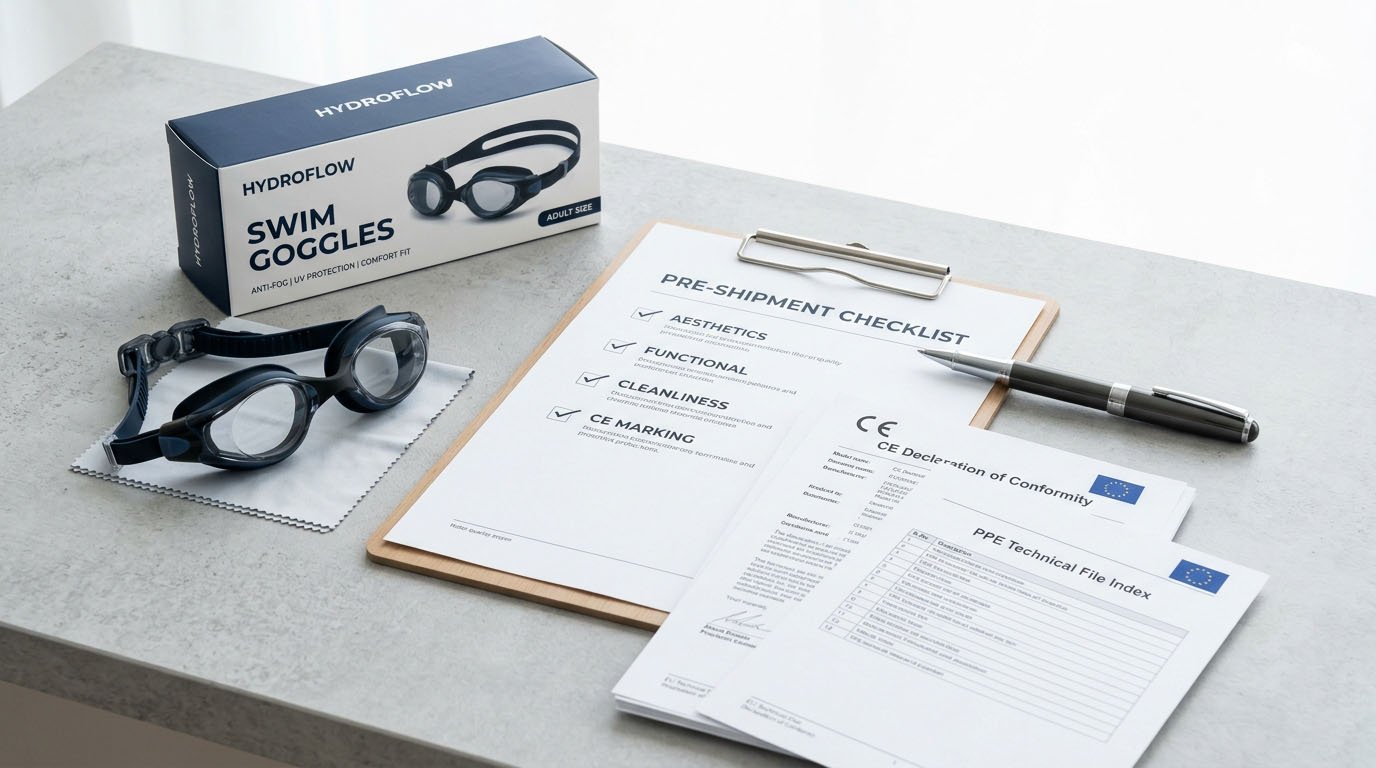
Step 1. Product and Conformity
- [ ] Intended use and PPE classification confirmed.
- [ ] Applicable assessment and technical evidence reviewed.
- [ ] CE marking and EU Declaration of Conformity confirmed.
Step 2. Operators and Labels
- [ ] Manufacturer, importer, and EU Article 4 operator roles established.
- [ ] Product identification and artwork checked.
- [ ] Required instructions and languages verified.
Step 3. Online Sales
- [ ] Article 19 manufacturer and EU operator information displayed.
- [ ] Product photo, identifiers, and required warnings checked.
Step 4. Production Traceability
- [ ] Approved sample matches the final specification.
- [ ] Changes to materials, coatings, or components assessed.
- [ ] Batch and quality records available for investigation.
Ask the factory for agreed specifications, packaging proofs, relevant test evidence, and production records. The legal manufacturer and importer must separately ensure their statutory obligations are fulfilled.
Frequently Asked Questions
Do Swimming Goggles Need a GPSR Certificate?
No standalone GPSR certificate universally establishes compliance. For conventional PPE swimming goggles, verify the applicable PPE conformity process, documentation, economic-operator responsibilities, and relevant GPSR provisions.
Does GPSR Replace CE Marking?
No. Conventional Category I PPE swimming goggles still require CE marking under Regulation (EU) 2016/425.
Can an EU Importer Be the Responsible Economic Operator?
Yes. An EU importer may fulfill the Article 4 role when applicable. It must perform the required tasks, not merely lend its address to a label.
Can a QR Code Replace Mandatory Product Labels?
Not automatically. Digital information can supplement documentation, but physical markings and accompanying information must meet their applicable legal requirements.
Are the Rules Identical Across Europe?
No. "Europe" is broader than the EU. Great Britain and other non-EU markets may use different conformity and product-safety rules; verify each destination separately.
Conclusion
For conventional swimming goggles sold in the EU, PPE Regulation 2016/425 is generally the principal product conformity framework. Applicable GPSR provisions, particularly Article 19 on distance sales, remain important.
Before launch, identify the legal manufacturer, confirm the EU economic operator, verify documents and labels, and connect test evidence to actual production. The objective is a traceable, correctly documented product—not simply another certificate.
Jerry supports OEM/ODM brands with product development, samples, material specifications, customized packaging, and production quality controls. To discuss an EU-bound swimming goggle project, contact Jerry.
Regulatory note: This guide is general manufacturing and sourcing information, not legal advice. Verify the current legislation and product-specific classification before placing goods on the market.