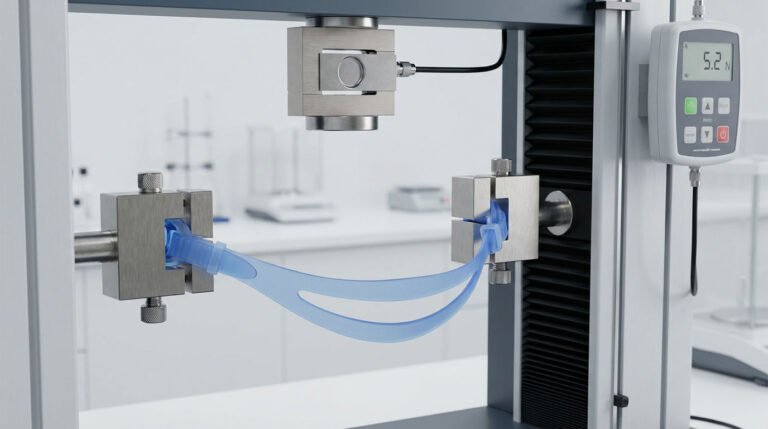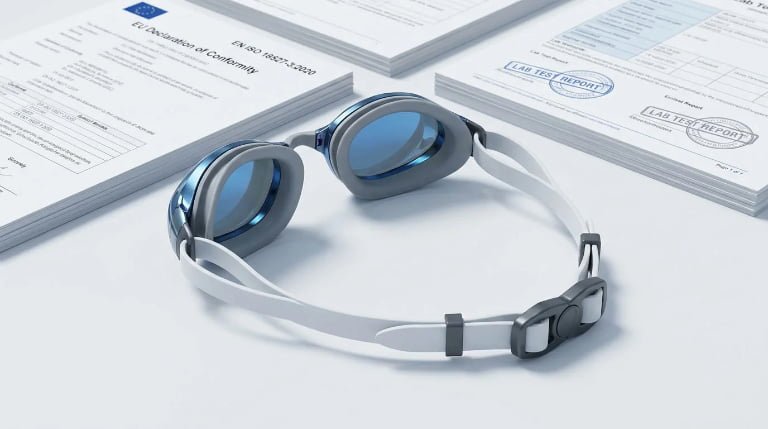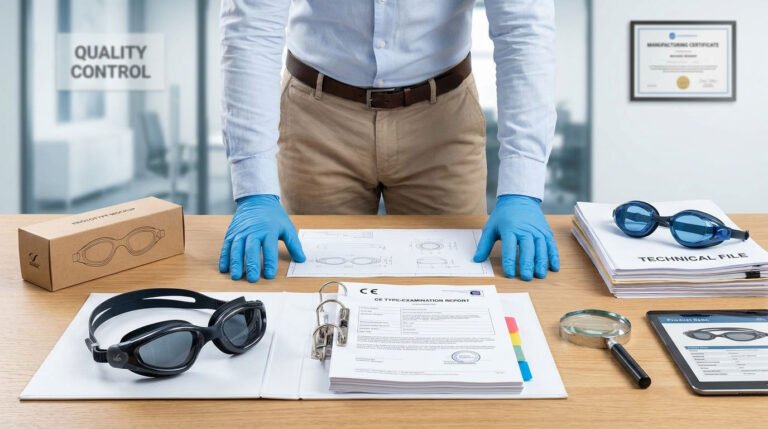
Swimming goggles sold in the European Union must comply with applicable product safety requirements. For importers and private-label brands, understanding EU PPE Regulation 2016/425 for swimming goggles is essential before placing products on the market.
Conventional surface swimming goggles are generally classified as Category I Personal Protective Equipment (PPE). However, compliance involves more than CE marking or a laboratory test report.
Manufacturers must prepare technical documentation, assess applicable safety requirements, issue an EU Declaration of Conformity, and maintain consistency between documented designs and mass production.
This guide focuses on three questions:
- What must an Annex III technical file contain?
- What responsibilities do manufacturers, importers, and private-label brands have?
- How can buyers verify PPE compliance before bulk shipment?
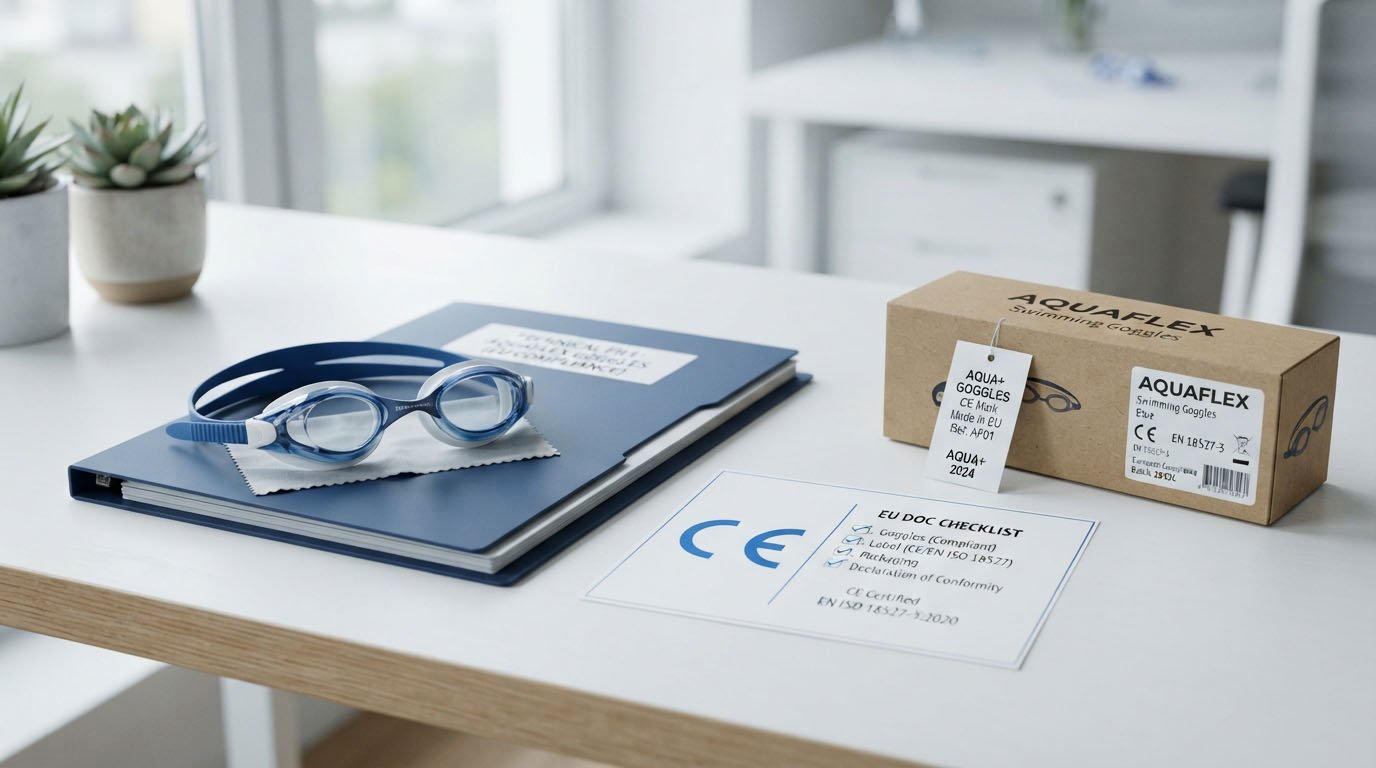
Quick Answer: What Does EU PPE Regulation 2016/425 Require?
Conventional swimming goggles intended for surface swimming are generally Category I PPE under Regulation (EU) 2016/425. They normally follow Module A internal production control without mandatory EU type-examination by a Notified Body.
However, manufacturers must demonstrate compliance with the applicable Essential Health and Safety Requirements (EHSRs) in Annex II.
| Requirement | Standard Surface Swimming Goggles |
|---|---|
| PPE classification | Generally Category I |
| Conformity assessment | Module A – Internal Production Control |
| Technical documentation | Annex III required |
| Product testing | Appropriate supporting evidence required |
| EU Declaration of Conformity | Required |
| CE marking | Required |
| Notified Body | Normally not required |
| Document retention | Generally 10 years after market placement |
The central requirement is consistency between the product, technical documentation, conformity declaration, labeling, and manufactured goods.
For a detailed explanation of the CE marking process, see our Do Swimming Goggles Need CE Certification? guide.
This article focuses specifically on the underlying PPE regulation and the evidence importers should verify.
How Are Swimming Goggles Classified Under EU PPE Regulation 2016/425?
Regulation (EU) 2016/425 establishes requirements for equipment designed to protect users against risks to their health or safety.
Annex I classifies PPE according to the risks it addresses.
Category I includes minimal risks such as prolonged contact with water and eye damage from ordinary sunlight exposure.
Conventional recreational and competitive surface swimming goggles generally fall within this category.
Do UV-Protective or Mirrored Swimming Goggles Become Category II?
Not automatically.
Tinted lenses, mirrored coatings, and ordinary UV protection claims do not independently establish Category II classification.
The applicable category depends on the actual protective purpose and risks addressed by the product.
For standard Category I goggles, Article 19 specifies Module A internal production control.
Products designed for substantially different hazards may require another classification assessment.
Importers should confirm the intended use and classification before finalizing their testing and documentation plans.
What Must an Annex III Technical File Contain?
The technical file is one of the most important compliance requirements under Regulation (EU) 2016/425.
Annex III requires manufacturers to document how their PPE meets the applicable Essential Health and Safety Requirements in Annex II.
For swimming goggles, the file must connect the intended use, design, materials, risk assessment, technical verification, and production controls.
A laboratory report alone does not replace this documentation.
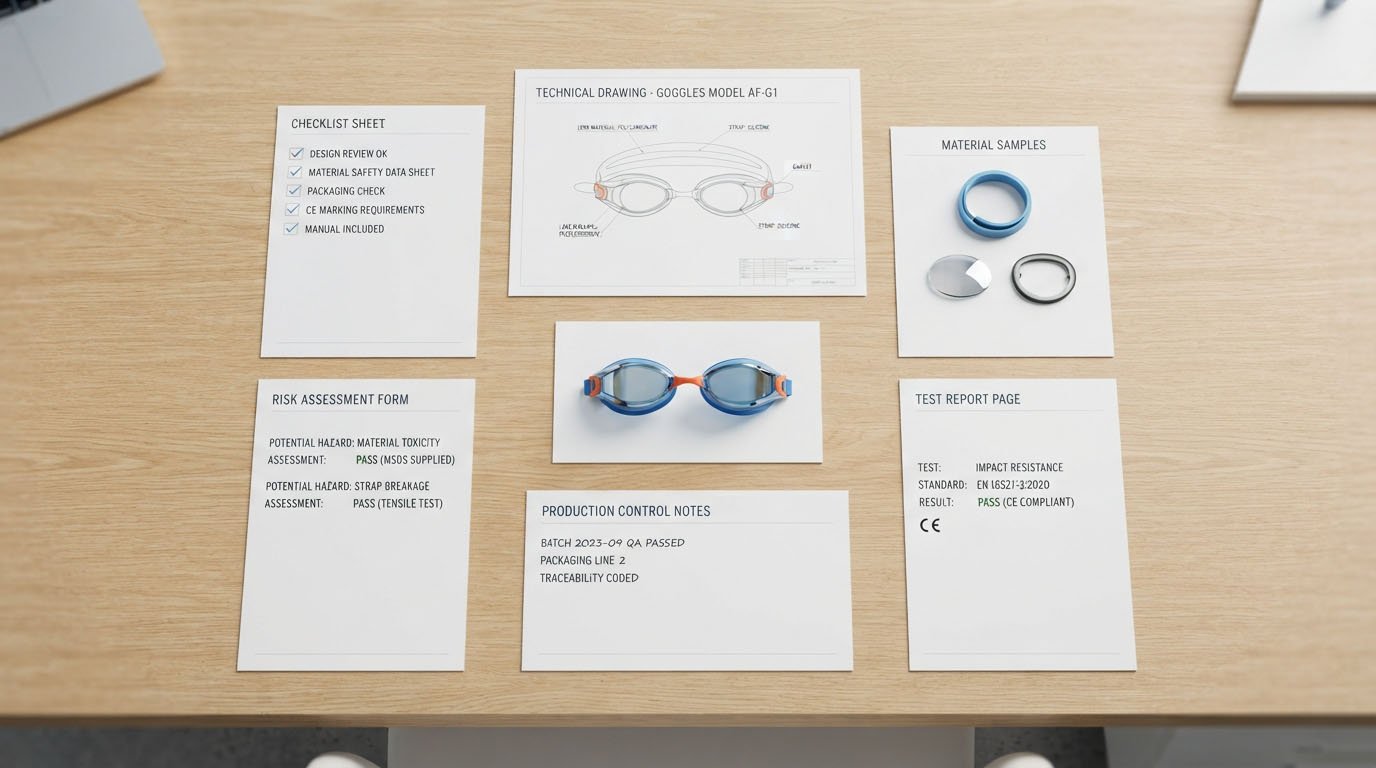
Key 1: Product Description and Intended Use
The technical file must identify the product being assessed.
Relevant information may include:
- Model identification and intended application.
- Product drawings and specifications.
- Lens, frame, gasket, strap, and nose bridge construction.
- Materials, coatings, and relevant design features.
The documented model must be identifiable against the commercial product.
Key 2: Risk Assessment and Applicable Safety Requirements
The manufacturer must identify relevant protective risks and applicable Annex II requirements.
For swimming goggles, the assessment may address optical characteristics, material safety, structural integrity, and risks associated with foreseeable use.
The documentation should explain how the selected design and verification methods address the applicable requirements.
Key 3: Standards and Technical Evidence
The file must identify relevant harmonised standards applied, including any partial application, or alternative technical specifications used where appropriate.
Supporting evidence may include:
- Laboratory test reports.
- Engineering calculations.
- Inspection and examination results.
- Product specifications and verification records.
The selected evidence must support the actual product and relevant safety requirements.
Key 4: Production Controls and User Information
Annex III also requires information describing how the manufacturer maintains conformity with the design specifications during production.
This may include approved material specifications, production controls, and change-management procedures.
The file must also contain the manufacturer’s required instructions and information.
Annex III Compliance Evidence Matrix
The following matrix connects the legal requirements to practical swimming goggle documentation.
| Annex III Requirement | Swimming Goggle Evidence | What Buyers Should Verify |
|---|---|---|
| Product description — (a) | Model, intended use, BOM | Correct commercial model |
| Risk assessment — (b) | Product risk evaluation | Relevant protective risks identified |
| Applicable EHSRs — (c) | Annex II requirements checklist | Applicable requirements addressed |
| Design information — (d–e) | Lens, gasket, strap, frame drawings | Design corresponds to the product |
| Standards — (f–g) | Applied standards and technical specifications | Correct scope and versions |
| Verification — (h–i) | Test reports, examinations, calculations | Evidence supports conformity |
| Production control — (j) | Approved specifications and control procedures | Production remains consistent |
| User information — (k) | Instructions, warnings, product information | Required information is available |
Annex III also contains additional provisions for individually fitted PPE where applicable.
For importers, this matrix is a verification framework—not a requirement that the factory disclose every proprietary engineering document directly to the buyer.
The legally responsible manufacturer must maintain the required technical file, while importers must ensure it can be made available to authorities as required.
Who Is Responsible Under Articles 8, 10, and 12?
Compliance responsibilities are particularly important when swimming goggles are produced by a Chinese OEM factory and sold by a European brand.
The PPE Regulation distinguishes between manufacturers, importers, and distributors.
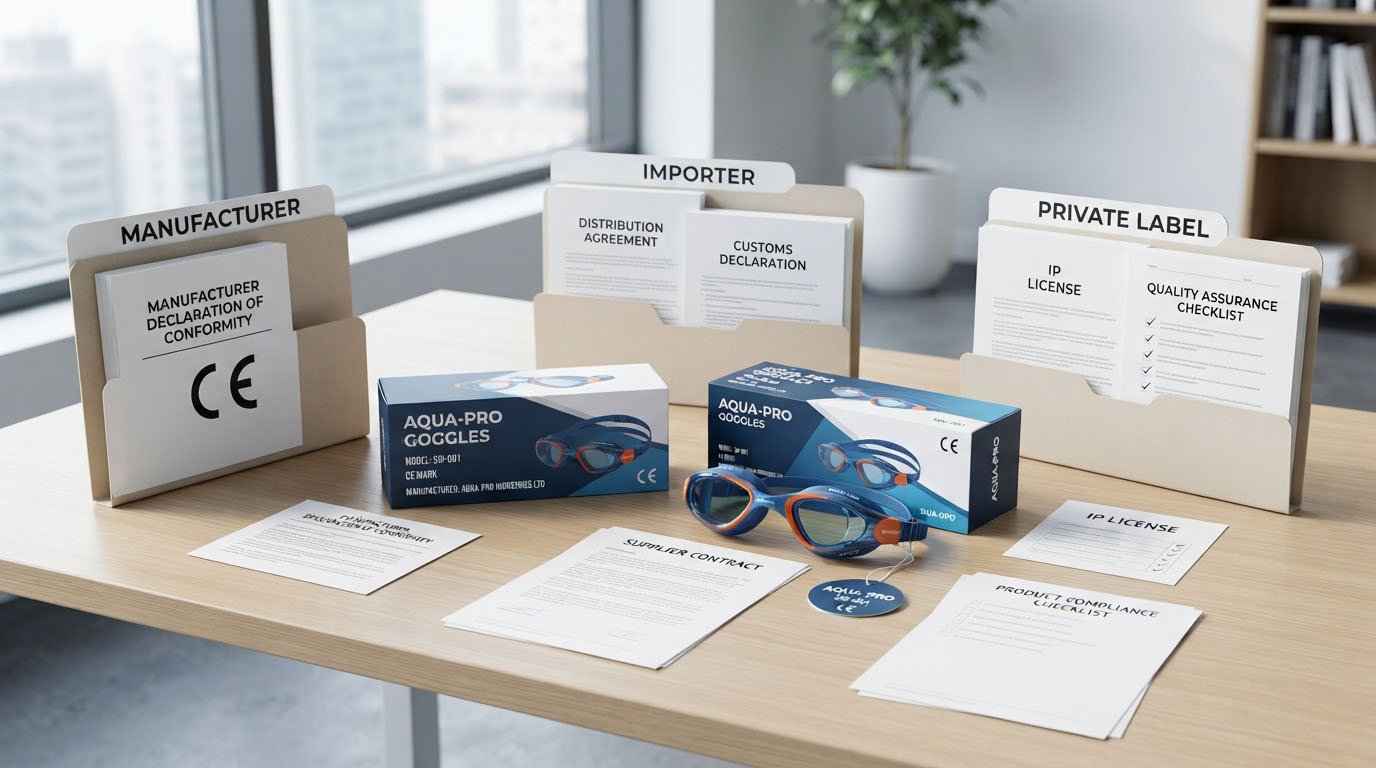
Article 8: Manufacturer Responsibilities
The legal manufacturer must:
- Ensure conformity with applicable Annex II requirements.
- Prepare Annex III technical documentation.
- Carry out the appropriate conformity assessment.
- Issue the EU Declaration of Conformity.
- Apply CE marking.
- Maintain conformity during series production.
- Provide required identification and instructions.
These responsibilities remain important even if physical production is outsourced.
Article 10: Importer Responsibilities
Before placing PPE on the EU market, importers must verify that the manufacturer has completed the appropriate conformity assessment.
They must also check that:
- Technical documentation has been prepared.
- CE marking is present.
- Required documents and instructions accompany the product.
- Manufacturer identification requirements have been met.
- Importer identification and contact information are provided as required.
Importers must retain a copy of the EU Declaration of Conformity for 10 years after market placement and ensure technical documentation can be supplied to authorities upon request.
Article 12: When Does a Private-Label Brand Become the Manufacturer?
Article 12 is especially important for OEM and private-label swimming goggles.
Under this provision, an importer or distributor assumes manufacturer obligations when it places PPE on the market under its own name or trademark, or modifies PPE already marketed in a way that may affect compliance.
A brand may also meet the regulation’s definition of a manufacturer when it has products manufactured and markets them under its own name or trademark.
Practical Example: Chinese OEM Factory + European Swimming Goggle Brand
Consider this arrangement:
A Chinese factory produces swimming goggles using an existing mold. A European company orders the goggles with its own logo, packaging, and retail instructions.
The European company sells the finished product under its own trademark.
Although the Chinese factory performs the manufacturing operations, the European brand may be the legal manufacturer under the PPE Regulation.
The parties should therefore establish who will:
| Compliance Task | Responsibility to Clarify |
|---|---|
| Product specifications | Who approves the final design? |
| Technical documentation | Who prepares and maintains the legal file? |
| Testing evidence | Who arranges and supplies supporting records? |
| EU Declaration of Conformity | Who is the responsible manufacturer and signatory? |
| CE marking and labeling | Who approves compliance information? |
| Production changes | Who authorizes changes affecting conformity? |
These arrangements should be documented before production.
A factory may support testing, technical records, and inspections, but commercial agreements do not automatically transfer statutory responsibilities away from the legally responsible economic operator.
For custom product development, these responsibilities should be clarified during the OEM & ODM development process.
What Are the EU Declaration of Conformity and CE Marking Requirements?
Article 15 and Annex IX establish the principal requirements for the EU Declaration of Conformity (DoC).
The DoC identifies the PPE and records the manufacturer’s responsibility for conformity with applicable legislation.
Buyers should verify that the declaration corresponds to the same model covered by the technical documentation.
What Should Be Checked?
| Item | Buyer Verification |
|---|---|
| EU DoC | Correct model, manufacturer, legislation, and signatory |
| CE marking | Correct placement and legibility |
| Product identification | Model, batch, or other required identification |
| Manufacturer details | Required name and postal address |
| Importer details | Required information where applicable |
| Instructions | Required destination-market language and content |
| Document access | DoC supplied or its internet address provided as required |
Under Article 17, CE marking must normally appear visibly, legibly, and indelibly on the PPE. Where direct marking is not possible or warranted because of the product’s nature, the regulation permits marking on the packaging and accompanying documents.
The EU DoC must accompany the PPE, or the required instructions and information must include the internet address where it can be accessed.
The CE mark, product identification, and conformity documentation must correspond to the actual product being sold.
How Does ISO 18527-3 Support PPE Compliance?
ISO 18527-3 provides technical requirements and test methods for eyewear intended for surface swimming.
The standard includes ISO 18527-3:2020 and its Amendment 1:2025.
However, an ISO test report does not automatically establish full compliance with Regulation (EU) 2016/425.
Under Article 14, presumption of conformity applies to requirements covered by harmonised standards whose references have been published in the Official Journal of the European Union.
The EU’s PPE harmonised-standards framework was updated in 2026 through Commission Implementing Decision (EU) 2026/1279 and subsequent amendments.
Manufacturers should therefore verify the applicable technical specifications, relevant harmonised-standard references, and corresponding Annex II requirements.
For practical report evaluation, see How to Read a Swimming Goggle Test Report.
The important distinction is that testing provides supporting evidence, while the PPE conformity process establishes the manufacturer’s legal declaration of compliance.
How Should Buyers Verify PPE Compliance During Mass Production?
A technical file is only useful if the manufactured swimming goggles remain consistent with the documented product.
Article 8 and Annex IV require manufacturers to maintain conformity during series production.
For importers, this means connecting compliance documentation to approved specifications and production records.
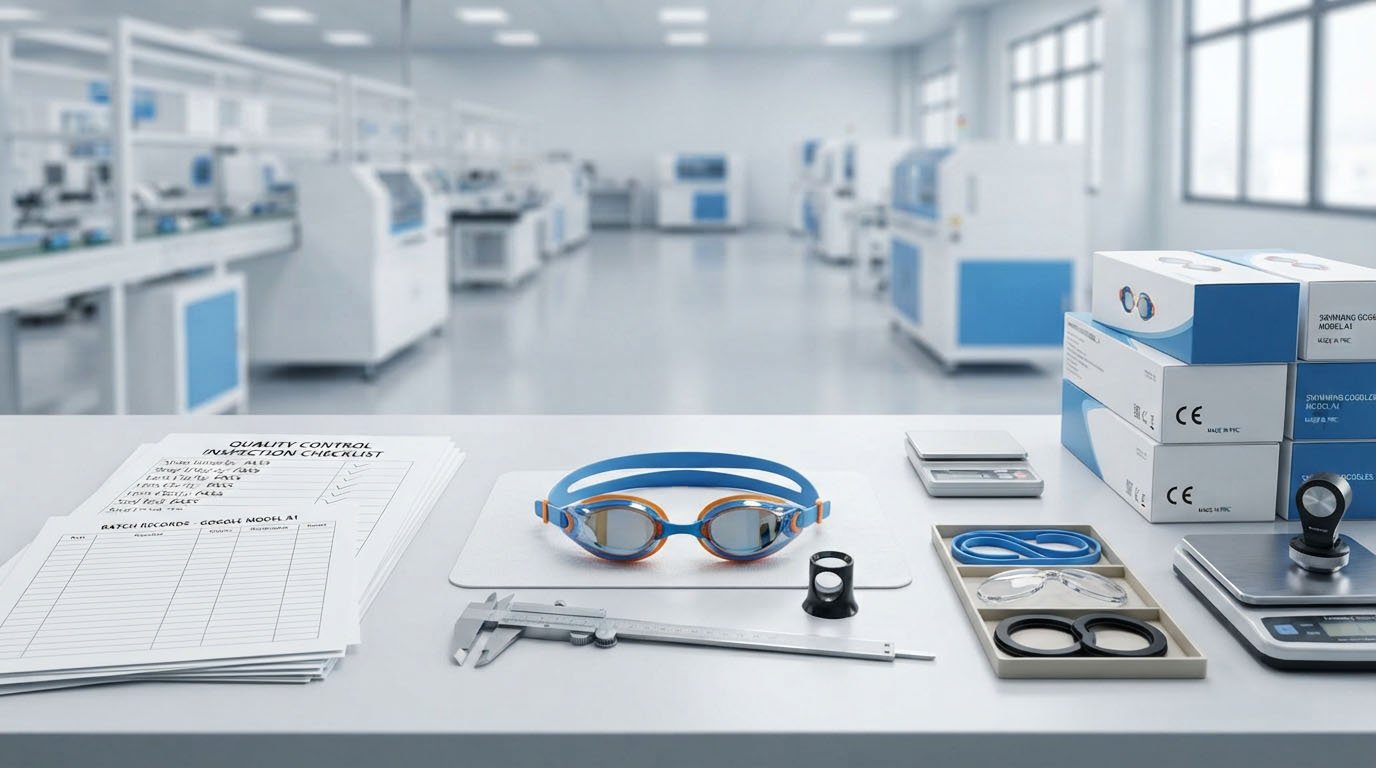
Step 1: Confirm the Approved Product Specification
Before bulk production, verify the final:
- Lens material and coating.
- Gasket and strap specifications.
- Frame and nose bridge construction.
- Relevant dimensions and functional requirements.
- Model identification and packaging.
Step 2: Verify Materials and Production Changes
Check that supplied materials and components match the approved specifications.
Changes in lens resin, silicone formulation, coating, or construction should trigger an assessment of their potential effect on conformity.
Additional testing or technical-document updates may be necessary depending on the change.
Step 3: Connect Production Inspections to the Technical File
| Production Stage | Main Verification Focus | Supporting Evidence |
|---|---|---|
| Incoming materials | Material and component conformity | Approved specifications and supplier records |
| Lens manufacturing | Optical and structural consistency | Inspection and verification records |
| Assembly | Gasket, strap, and fitting components | In-process inspection |
| Finished goods | Relevant functional performance | Approved inspection and test records |
| Packaging | CE marking, labeling, and instructions | Approved artwork and document checks |
Acceptance criteria should follow the applicable requirements and approved product specifications rather than arbitrary inspection limits.
Step 4: Review the Final Batch Before Shipment
Before shipment, confirm that the finished goods correspond to the approved commercial specification.
Check whether any production changes require further assessment or documentation updates.
Jerry’s Quality Assurance process includes incoming material checks, in-process monitoring, functional inspections, and final shipment verification.
Such controls help maintain manufacturing consistency, while legal conformity remains the responsibility of the relevant economic operators.
What Common EU PPE Compliance Mistakes Should Importers Avoid?
Several recurring mistakes can undermine an otherwise well-developed compliance process.
| Common Mistake | Recommended Action |
|---|---|
| Treating a test report as complete CE evidence | Verify the full conformity documentation |
| Using reports from another product model | Match reports to the commercial model |
| Missing Annex III documentation | Confirm the required technical file exists |
| Incorrect manufacturer or importer identification | Review Articles 8, 10, and 12 |
| Changing materials after testing without review | Assess effects on conformity and update evidence as needed |
| Assuming the factory carries all legal responsibility | Identify the legal manufacturer before production |
The purpose of compliance verification is not simply collecting more documents.
It is ensuring that every relevant document supports the same product being placed on the EU market.
FAQ: EU PPE Regulation 2016/425 for Swimming Goggles
Are Swimming Goggles Category I PPE Under EU Regulation 2016/425?
Conventional surface swimming goggles are generally Category I PPE.
Products designed to protect against different or substantially higher risks may require a separate classification assessment.
Do Category I Swimming Goggles Need a Notified Body?
Normally, no.
Category I PPE follows Module A internal production control. The manufacturer is responsible for demonstrating conformity, maintaining technical documentation, issuing the DoC, and applying CE marking.
Does Every Swimming Goggle Model Need Technical Documentation?
Each PPE model placed on the market must be covered by appropriate technical documentation and a corresponding EU Declaration of Conformity.
Related variants may be covered by shared documentation where their differences are properly assessed and the evidence adequately supports the products concerned.
A report for one model should not automatically be assumed to cover all other models.
How Long Must Manufacturers Keep PPE Technical Documentation?
Manufacturers must generally retain the technical documentation and EU Declaration of Conformity for 10 years after the PPE has been placed on the market.
Importers have related obligations to retain the DoC and ensure the technical documentation can be made available to authorities.
Can a Private-Label Brand Use the Factory’s Technical File?
A factory’s technical documentation and test reports may support the product’s conformity assessment.
However, a brand that is the legal manufacturer must ensure the required documentation is complete, applicable to its marketed product, and available when authorities request it.
The factory’s involvement does not automatically remove the brand’s statutory responsibilities.
Conclusion: EU PPE Compliance Depends on Documentation and Production Consistency
Regulation (EU) 2016/425 establishes the conformity framework for swimming goggles placed on the European market.
For conventional surface swimming goggles, Category I and Module A are normally the relevant route.
The most important requirements are:
- Correct product classification.
- Annex III technical documentation.
- Appropriate technical evidence.
- A valid EU Declaration of Conformity.
- Correct CE marking and traceability information.
- Clear legal responsibility between manufacturers and importers.
- Production consistency with documented specifications.
For importers and private-label brands, the critical question is whether the legal documentation, tested product, and manufactured goods all correspond to the same approved design.
For broader international requirements covering CE, REACH, CPSIA, and other markets, see our Swimming Goggles Compliance Guide.
If you are developing OEM or private-label swimming goggles for Europe, contact Jerry to discuss product specifications, development, documentation coordination, and production quality requirements.
This article provides general manufacturing and product compliance information and does not constitute legal advice. Requirements should be verified for the specific product, intended use, and target markets.